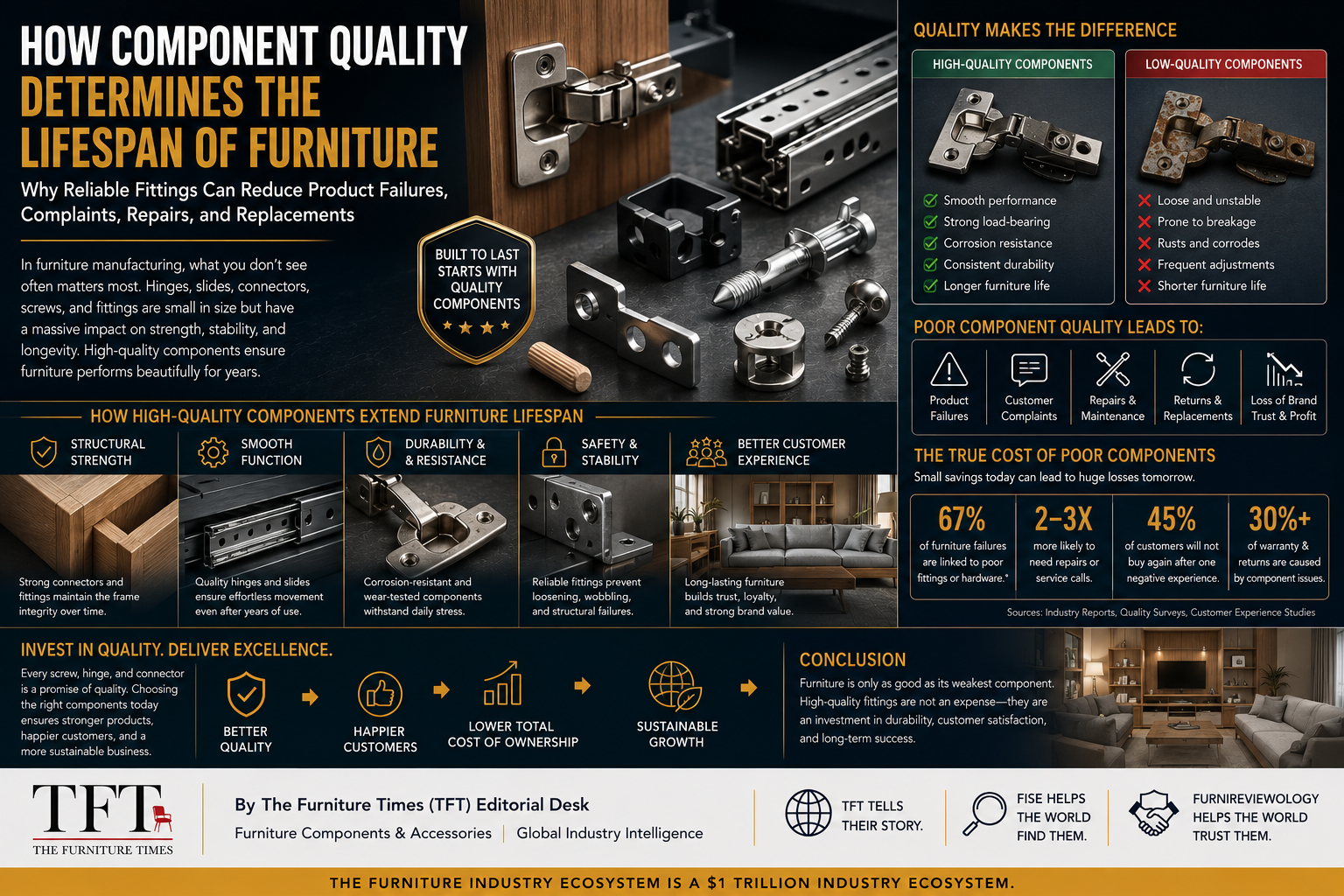
How Component Quality Determines the Lifespan of Furniture
Why Reliable Fittings Can Reduce Product Failures, Complaints, Repairs, and Replacements
By The Furniture Times (TFT) Editorial Desk | Furniture Components & Accessories | Global Industry Intelligence
Furniture does not usually fail because its design suddenly becomes unattractive. It fails when its structure weakens, its mechanisms stop operating, its connections become loose, its surfaces deteriorate, or an essential component can no longer perform its intended function.
A cabinet may still have beautiful doors, but it becomes frustrating when its hinges lose alignment. A wardrobe may remain structurally sound, but a damaged sliding-door roller can make it difficult to use. A sofa may still look presentable, yet weakened springs, low-quality foam, or a defective reclining mechanism can reduce its comfort. A table may be manufactured from valuable timber, but poor connectors can make it unstable. An office chair may have a strong seat and backrest, but unreliable castors, a weak base, or a failing adjustment mechanism can shorten its practical lifespan.
These examples reveal one of the most important and frequently overlooked realities of furniture manufacturing: the life of a product is often determined by its smallest components.
Hinges, drawer slides, screws, dowels, connectors, brackets, castors, legs, bases, gas lifts, springs, webbing, foam, locks, handles, electrical modules, and movement mechanisms may represent only a portion of the total production cost. However, their reliability can determine whether furniture performs for months, years, or decades.
Component quality is therefore not a minor technical matter. It is a strategic issue affecting customer satisfaction, brand reputation, warranty costs, repairability, sustainability, and the economic value of the entire furniture ecosystem.
Furniture Lifespan Is a System, Not a Single Material
Consumers often associate durable furniture with solid wood, metal, premium leather, quality fabric, or thick panels. These materials are important, but they do not function independently.
Furniture should be understood as an interconnected system containing:
- Primary structural materials
- Frames and support elements
- Joints and connectors
- Moving mechanisms
- Upholstery materials
- Surface finishes
- Decorative accessories
- Electrical and electronic systems
- Installation and adjustment points
The finished product can only perform as well as these elements work together.
A strong wooden panel cannot prevent failure if the fastener holding it is unsuitable. A heavy cabinet door cannot remain aligned if its hinges are not designed for the load. A premium tabletop cannot keep a table stable when the leg connections are weak. An expensive upholstery fabric cannot preserve comfort if the foam beneath it loses shape.
Furniture manufacturers must therefore evaluate durability across the complete product rather than relying on one premium material as proof of quality.
The strongest visible material cannot compensate for the weakest critical component.
What Does Component Quality Really Mean?
Component quality is sometimes misunderstood as appearance, weight, or price. A polished metal fitting may look premium, but appearance alone does not confirm its durability.
True component quality involves several factors.
Material Integrity
The raw material must be appropriate for the intended use. Steel, aluminium, zinc alloy, stainless steel, plastic, rubber, timber, foam, and composite materials each have different strengths and limitations.
The material must provide the necessary:
- Load capacity
- Fatigue resistance
- Dimensional stability
- Corrosion resistance
- Temperature performance
- Flexibility or rigidity
- Surface durability
- Chemical resistance
A component manufactured from unsuitable or inconsistent material may perform well initially but deteriorate under repeated use.
Dimensional Accuracy
Modern furniture manufacturing depends on precise dimensions.
A small variation in a hinge, runner, connector, or drilling point can create visible misalignment. In automated production, dimensional inconsistency can interrupt assembly, damage panels, increase rejection rates, and require manual correction.
High-quality components maintain reliable tolerances across production batches.
Performance Under Repeated Use
Furniture components rarely fail during the first use. Problems develop after hundreds or thousands of movements.
A hinge must repeatedly carry and control a door. A drawer slide must support changing loads while opening and closing. A castor must move under weight. A recliner mechanism must cycle through multiple positions. A gas lift must maintain height and stability.
Quality therefore depends on consistent performance over time, not simply successful operation when new.
Surface and Coating Performance
Coatings protect hardware from corrosion, abrasion, moisture, chemicals, and visual deterioration.
A weak finish may scratch, peel, fade, stain, or corrode. This can affect both appearance and structural performance.
Outdoor, hospitality, bathroom, kitchen, healthcare, and coastal applications require particularly careful selection of finishes.
Compatibility With the Furniture
Even a well-manufactured component can fail when it is incorrectly matched to the furniture.
The fitting must be suitable for:
- Product dimensions
- Material thickness
- Door or drawer weight
- Expected operating frequency
- Installation method
- Environmental conditions
- User requirements
- Maintenance practices
Quality is not only about the component itself. It is also about whether the component is correct for its application.
Hinges: Small Parts With Major Responsibility
A cabinet hinge controls movement, alignment, clearance, and load.
When hinges are correctly specified, doors open smoothly, remain level, close securely, and protect the furniture structure from repeated impact.
Low-quality or unsuitable hinges can create:
- Sagging doors
- Uneven gaps
- Loose mounting points
- Noise
- Incomplete closing
- Excessive movement
- Damage to cabinet panels
- Customer complaints
Heavy or wide doors place greater stress on hinges. The number, type, and position of hinges must be selected according to door dimensions, material, and weight.
Manufacturers should not assume that adding more low-quality hinges will produce the same result as using correctly engineered hardware. The mounting plate, screws, drilling accuracy, panel strength, and adjustment system must work together.
Soft-close hinges introduce additional mechanisms that must also remain consistent. A poor damper can become too weak, too slow, or unreliable over time.
For kitchen, wardrobe, hotel, office, and institutional furniture, hinge quality directly affects both lifespan and the customer’s daily experience.
Drawer Slides Determine More Than Movement
Drawer slides carry dynamic loads. Unlike a fixed shelf, a drawer changes position while supporting its contents.
The runner must remain aligned and stable as the drawer opens, closes, and reaches full extension.
Poor-quality slides may result in:
- Difficult or uneven movement
- Excessive side-to-side motion
- Noise
- Reduced extension
- Weak load support
- Drawer separation
- Premature wear
- Soft-close failure
The correct slide depends on drawer width, depth, construction, load, mounting position, and use frequency.
A residential bedside drawer has different requirements from a commercial filing unit, hotel storage drawer, laboratory cabinet, pharmacy drawer, or industrial tool-storage system.
Manufacturers should verify the rated capacity under realistic conditions. A drawer’s load can change throughout its life, and users may place more weight inside than originally expected.
Quality slides can protect the drawer box, cabinet structure, and stored contents while improving the perception of the entire product.
Connectors Protect Structural Stability
Connectors are among the most important hidden components in furniture.
They include:
- Screws
- Bolts
- Dowels
- Cam locks
- Confirmat fasteners
- Brackets
- Threaded inserts
- Knock-down connectors
- Bed fittings
- Table-leg connections
- Upholstery-frame connectors
Their purpose is to hold separate materials together while resisting movement, load, vibration, and repeated use.
Poor connection systems can cause furniture to loosen gradually. Once movement begins at a joint, surrounding materials may wear more quickly. Holes can enlarge, threads can strip, panels can crack, and the structure can become unstable.
High-quality connectors must be matched to the density, thickness, grain direction, and mechanical characteristics of the furniture material.
For example, a fastener suitable for solid wood may not perform identically in particleboard, medium-density fibreboard, plywood, plastic, aluminium, or a lightweight composite panel.
Furniture manufacturers must treat joints as engineered systems rather than simply selecting whatever fastener is available.
Castors, Glides, Legs, and Bases Carry the Product’s Weight
Furniture legs, bases, castors, and glides transfer load to the floor. Their quality influences stability, mobility, floor protection, and user safety.
A defective castor can make a chair difficult to control. A weak leg connection can cause a table to wobble. An unsuitable glide can damage flooring. A low-quality adjustable foot may lose its setting under load.
These components must be selected according to:
- Total furniture weight
- Expected user load
- Floor type
- Movement frequency
- Indoor or outdoor use
- Exposure to moisture
- Required braking or locking
- Noise expectations
- Cleaning procedures
Commercial furniture often experiences more movement than residential furniture. Restaurant chairs are pulled across floors repeatedly. Hotel tables are moved during room changes. Hospital furniture may be repositioned frequently. Office chairs travel continuously across workspaces.
Using residential-grade mobility hardware in intensive commercial environments can shorten product life significantly.
Upholstery Components Control Comfort Over Time
The lifespan of upholstered furniture is not determined by its external fabric alone.
A sofa or chair contains a layered comfort system that may include:
- Structural framing
- Springs
- Webbing
- Foam
- Fibre filling
- Adhesives
- Stitching
- Suspension components
- Recliner mechanisms
- Seat and back supports
If the internal materials lose resilience, the furniture may become uncomfortable even when the cover remains undamaged.
Foam Quality
Foam performance is influenced by density, firmness, resilience, cell structure, and intended application.
Low-quality foam may soften excessively, compress unevenly, or fail to recover its shape. This can create visible sagging and reduce support.
Manufacturers should not select foam solely by how it feels during a brief showroom test. Long-term performance matters more.
Springs and Webbing
Springs and webbing distribute weight and support the seating system. Poor materials or incorrect installation can create uneven support, noise, or premature loss of comfort.
Attachment points must also remain secure. A strong spring system can still fail when clips, fasteners, or frame connections are weak.
Recliner and Motion Hardware
Motion furniture introduces additional points of stress. Manual or powered mechanisms must support the furniture structure, user weight, repeated movement, and different operating positions.
The mechanism should be serviceable and accompanied by replacement cables, motors, controllers, switches, and power supplies where applicable.
A sofa frame may remain usable for many years, but one unavailable electronic part can make a powered feature unusable.
Outdoor Furniture Requires Environmental Durability
Outdoor furniture components face conditions that indoor products do not.
These may include:
- Rain and moisture
- High humidity
- Ultraviolet exposure
- Heat
- Temperature changes
- Salt air
- Sand and dust
- Pool chemicals
- Frequent cleaning
Materials and finishes must be selected for the specific environment.
Corrosion can weaken fasteners, stain surrounding surfaces, make mechanisms difficult to operate, and reduce the visual appeal of the furniture.
Stainless steel, protected aluminium, outdoor-grade plastics, appropriate coatings, and corrosion-resistant fasteners may offer better performance, but specifications must still match the environment.
Coastal and marine locations can be especially demanding. Hardware suitable for a covered residential balcony may not be appropriate for beachfront hospitality furniture.
Outdoor manufacturers should test complete assemblies, because contact between different metals can also influence corrosion behaviour.
Installation Quality Determines Component Performance
A premium component can still fail when installed incorrectly.
Common installation problems include:
- Incorrect drilling locations
- Misaligned mounting plates
- Over-tightened fasteners
- Under-tightened fasteners
- Damaged screw holes
- Wrong component orientation
- Insufficient component quantity
- Poor adjustment
- Incompatible tools
- Missing locking features
Manufacturers must control installation through clear work instructions, suitable jigs, machine settings, quality checks, and employee training.
Ready-to-assemble furniture presents an additional challenge because the final installation may be completed by the consumer.
Hardware for these products should be simple to recognise and difficult to install incorrectly. Instructions should include clear diagrams, product codes, part counts, and step-by-step sequences.
Digital guides, QR-linked videos, and colour-coded hardware packages can reduce assembly mistakes.
Repeated Small Failures Become Major Business Costs
Component failures create expenses throughout the furniture value chain.
The direct cost may include:
- Replacement components
- Return delivery
- Service labour
- Installer visits
- Product replacement
- Refunds
- Warranty administration
Indirect costs may be even more serious:
- Negative online reviews
- Reduced retailer confidence
- Project delays
- Loss of repeat customers
- Damage to brand reputation
- Removal from approved-supplier lists
- Increased customer-service workload
- Lower employee productivity
A manufacturer may save a small amount by purchasing cheaper fittings, only to spend many times that amount resolving complaints.
The correct financial calculation should compare the component’s initial cost with its total impact across manufacturing, installation, use, repair, and replacement.
The Warranty Department Is a Source of Product Intelligence
Many furniture companies treat warranty claims only as problems to resolve. They should also be treated as data.
Complaint records can reveal recurring weaknesses involving:
- Particular hinges
- Runner sizes
- Fastener types
- Mechanism suppliers
- Production batches
- Installation teams
- Product models
- Packaging methods
- Operating environments
A structured failure-analysis system should record:
- Which component failed
- Where the product was used
- When the failure occurred
- How frequently the furniture was used
- Whether installation was correct
- Whether the component specification was suitable
- Whether similar failures occurred elsewhere
- What corrective action was taken
This allows companies to separate isolated incidents from systemic problems.
A small rise in complaints can provide an early warning before a much larger failure pattern develops.
Online Reviews Reveal Hidden Component Problems
Consumers frequently describe hardware performance in product reviews, even if they do not use technical terminology.
Comments such as “the drawer sticks,” “the door does not close,” “the chair keeps sinking,” “the table wobbles,” or “the wheels stopped moving” point toward component or installation problems.
Furniture brands should analyse reviews by failure category rather than looking only at overall ratings.
Useful categories include:
- Assembly
- Stability
- Movement
- Comfort
- Noise
- Alignment
- Surface durability
- Missing parts
- Electrical functions
- After-sales service
This information can help manufacturers identify weaknesses that factory testing may not reveal.
FurniReviewology and other furniture-focused review systems can play an important role by turning customer experience into structured trust and product-intelligence signals.
Reliable Components Reduce Replacement Demand
When one component fails and cannot be replaced, consumers may discard the complete furniture product.
This creates unnecessary economic and environmental waste.
A wardrobe with a broken roller, a cabinet with damaged hinges, an office chair with worn castors, or a table with a missing connector may still contain valuable and usable materials.
Extending furniture lifespan requires:
- Replaceable components
- Standard or identifiable fittings
- Accessible fixing points
- Long-term spare-parts availability
- Clear repair instructions
- Compatibility information
- Trained service networks
Manufacturers should design the component replacement pathway at the same time as the original product.
If a vulnerable part is likely to wear before the furniture structure, it should be possible to remove and replace it without damaging the surrounding materials.
Repairability Is Becoming a Competitive Advantage
Consumers, commercial buyers, hospitality operators, institutions, and public authorities are paying greater attention to product lifespan and total ownership cost.
Repairable furniture can offer:
- Lower maintenance costs
- Longer service life
- Reduced waste
- Better resale value
- Easier refurbishment
- Improved customer loyalty
- Stronger sustainability claims
The component industry is essential to making repairability practical.
A claim that furniture is “sustainable” becomes much stronger when the manufacturer can demonstrate that hinges, slides, legs, castors, mechanisms, covers, controls, and electrical modules can be replaced.
Repairability should not remain an abstract environmental concept. It should be built into component selection, construction, documentation, and after-sales service.
Standardisation Can Extend Product Life
One obstacle to furniture repair is the large number of proprietary or discontinued components.
When every product uses a different hole pattern, connector, runner, or control module, maintaining spare parts becomes difficult.
Strategic standardisation can improve:
- Component availability
- Replacement speed
- Maintenance training
- Inventory management
- Compatibility
- Refurbishment
- Product upgrades
A furniture manufacturer does not need to use identical components across every product. However, it can create standard technical platforms across compatible collections.
For example, several cabinet ranges could use the same hinge system. Multiple office-chair models could share castors and gas lifts. Hospitality collections could use common glides, connectors, and handles.
Standardisation reduces complexity without eliminating design variety.
Component Traceability Will Become More Important
When a component fails, manufacturers need to know its identity, supplier, batch, specifications, and location within the finished product.
Without traceability, companies may struggle to determine whether a problem affects one item or an entire production run.
A component traceability system may include:
- Supplier identity
- Component code
- Manufacturing batch
- Material specification
- Test documentation
- Date of receipt
- Furniture production batch
- Installation records
- Replacement compatibility
Digital Product Passports and other product-information systems may eventually make component-level data more accessible to businesses, consumers, repairers, recyclers, and regulators.
Furniture companies should begin organising component data before complex regulatory or customer requirements make it urgent.
Quality Testing Must Reflect Real Furniture Use
Components should be tested according to their actual operating conditions.
Important tests can include:
- Static load testing
- Dynamic load testing
- Cycle testing
- Fatigue testing
- Impact testing
- Corrosion testing
- Abrasion testing
- Temperature and humidity exposure
- Surface adhesion testing
- Dimensional measurement
- Electrical safety testing
- Fastener withdrawal testing
Laboratory results must also be interpreted correctly.
A component that passes a specific number of cycles under one load may not perform identically under a heavier load, different installation angle, wider panel, harsher environment, or higher operating frequency.
Furniture manufacturers should communicate the complete application to component suppliers.
Testing a component separately is useful, but testing the complete furniture assembly is equally important because materials and connections interact.
Supplier Selection Must Look Beyond Price
A reliable component supplier should offer more than a competitive quotation.
Manufacturers should evaluate suppliers according to:
- Material consistency
- Dimensional accuracy
- Production capacity
- Quality-control systems
- Test evidence
- Delivery reliability
- Technical knowledge
- Product-development support
- Complaint response
- Spare-parts availability
- Traceability
- Compliance documentation
Supplier samples should be tested under realistic conditions before large-scale approval.
Manufacturers should also monitor performance after approval. Changes in materials, tooling, coatings, or production locations can affect quality.
A long supplier relationship does not remove the need for verification.
Product Design Must Consider Component Stress
Component problems often begin before purchasing or assembly. They can originate in the design stage.
Examples include:
- Doors that are too heavy for the hinge system
- Drawers that are too wide for the selected runners
- Insufficient material around fastener points
- Legs positioned in ways that create instability
- Mechanisms installed without adequate clearance
- Electronics placed where they cannot be serviced
- Components exposed to moisture without protection
Designers, engineers, production teams, purchasing teams, and suppliers should work together early.
Component selection should not be postponed until the furniture’s appearance has been finalised.
Early collaboration allows the product structure, drilling pattern, hardware, materials, and manufacturing process to be developed as one system.
Packaging Protects Component Quality
Furniture components can be damaged before the customer uses them.
During storage and transportation, hardware may scratch surfaces, bend, become separated, or go missing. Movement inside the package can damage both the components and the furniture panels.
Manufacturers should consider:
- Separate hardware bags
- Clear labelling
- Protective wrapping
- Moisture protection
- Compartmentalised packaging
- Part-count verification
- Scanning or weight checks
- Secure attachment of heavy mechanisms
- Replacement instructions
For e-commerce furniture, packaging quality is particularly important because products pass through multiple handling points.
A strong component delivered damaged is still a failed customer experience.
Training Is Part of Component Quality
Hardware quality depends partly on the knowledge of people who specify, install, adjust, maintain, and repair it.
Training should reach:
- Product designers
- Purchasing teams
- Machine operators
- Assembly workers
- Quality inspectors
- Installers
- Retail salespeople
- Customer-service teams
- Maintenance technicians
A sales team should understand the difference between standard and premium hardware. An installer should know how to adjust hinges and runners. Customer-service representatives should be able to identify replacement parts. Quality inspectors should recognise early signs of component inconsistency.
Without training, even good hardware may not deliver its full value.
Component Quality Supports Brand Trust
Furniture brands build trust through promises involving quality, comfort, craftsmanship, safety, durability, and service.
Components determine whether those promises survive daily use.
Customers may forgive a minor issue when the brand responds quickly and provides the correct replacement. They are less likely to trust a company that cannot identify its own parts, refuses responsibility, or requires replacement of the entire product for a small failure.
Strong component management supports trust through:
- Fewer failures
- Faster repairs
- Reliable warranties
- Clear information
- Available spare parts
- Consistent performance
- Transparent reviews
A furniture brand’s reputation is therefore connected to every fitting hidden inside its products.
Sustainability Claims Must Include Longevity
A product cannot be considered truly sustainable only because it contains a recycled or renewable material.
If the furniture fails prematurely, requires frequent replacement, or cannot be repaired, much of its environmental value may be lost.
Longevity should be treated as a central sustainability metric.
Reliable components can:
- Extend product life
- Reduce replacement demand
- Preserve materials and manufacturing energy
- Support second-hand use
- Enable refurbishment
- Make remanufacturing more practical
- Reduce waste
The most sustainable component may not always be the one with the lowest material footprint at production. It may be the one that performs reliably, can be replaced, and helps the complete furniture product remain in service for significantly longer.
A Practical Component-Quality Framework for Manufacturers
Furniture manufacturers can strengthen product lifespan through a structured approach.
Step 1: Identify Critical Components
Determine which fittings could cause the complete product to become unsafe, unstable, uncomfortable, or unusable.
Step 2: Define the Application
Record expected load, movement frequency, environment, user group, cleaning conditions, and target lifespan.
Step 3: Create Minimum Specifications
Define materials, dimensions, performance requirements, finishes, tolerances, and documentation.
Step 4: Test Before Approval
Evaluate components separately and within complete furniture assemblies.
Step 5: Control Installation
Use correct drilling data, tools, torque, jigs, work instructions, and inspections.
Step 6: Track Supplier Batches
Connect component deliveries with furniture production records.
Step 7: Monitor Customer Feedback
Analyse complaints, repairs, returns, reviews, and warranty claims by component type.
Step 8: Maintain Spare Parts
Keep strategically important replacement parts available for a defined period.
Step 9: Design for Replacement
Ensure vulnerable components can be accessed and removed without destroying the furniture.
Step 10: Review Performance Continuously
Use field data to improve specifications and future product development.
The Future Belongs to Furniture Built for Long-Term Use
The furniture industry is entering an era in which durability, repairability, transparency, and lifecycle value will become more important.
Consumers want products that justify their price. Commercial buyers want lower total ownership costs. Hospitality operators want furniture that can be maintained quickly. Institutions want reliable documentation and replacement support. Governments and sustainability programmes are increasing attention to product longevity and circularity.
Every one of these expectations leads back to component quality.
Reliable components reduce failures before they occur. They protect furniture structures, support smooth operation, preserve comfort, reduce service costs, and strengthen customer confidence.
They also create new business opportunities in spare parts, repairs, refurbishment, remanufacturing, product upgrades, testing, digital traceability, and circular services.
The global furniture industry must stop treating components as invisible commodities.
A hinge is not merely a hinge when it determines whether a wardrobe remains usable. A connector is not merely a connector when it protects structural stability. A castor is not merely a wheel when it carries a chair through years of daily use. A mechanism is not merely an accessory when its failure can remove the primary function of the furniture.
The lifespan of furniture is built one component at a time.
Manufacturers that understand this will produce better furniture, reduce complaints, protect margins, strengthen their brands, and contribute to a more responsible global furniture economy.
The Furniture Times (TFT) & Furniture Industry Search Engine (FISE)
“TFT tells their story. FISE helps the world find them.”
FurniReviewology helps the world trust them.
The furniture industry ecosystem is a $1 trillion industry ecosystem.