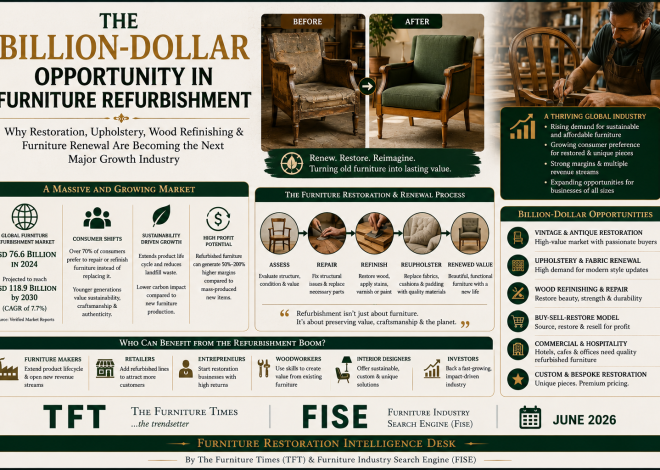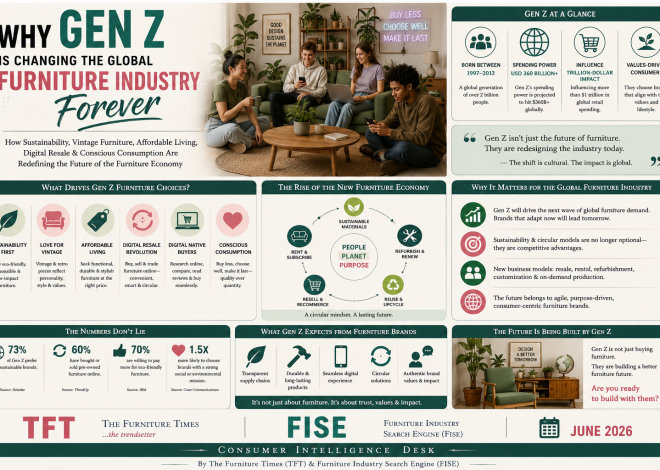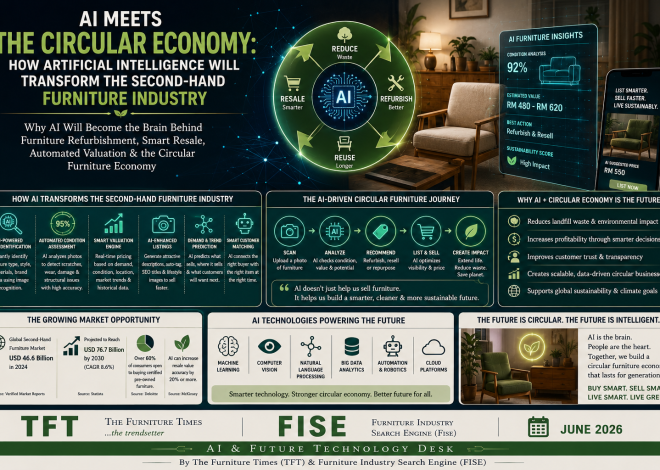
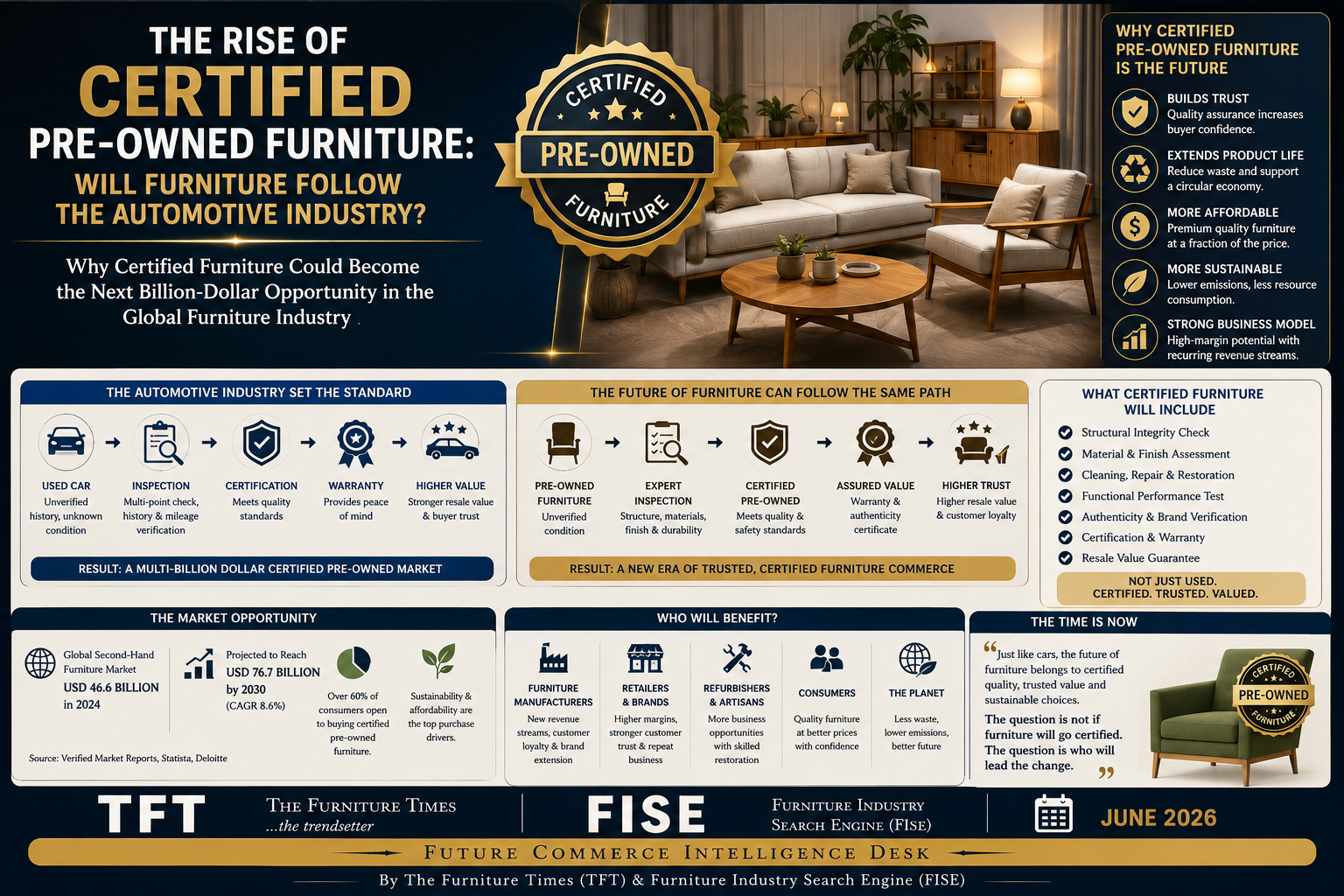
The Rise of Certified Pre-Owned Furniture: Will Furniture Follow the Automotive Industry?
Why Certified Furniture Could Become the Next Billion-Dollar Opportunity in the Global Furniture Industry
Future Commerce Intelligence Desk
By The Furniture Times (TFT) & Furniture Industry Search Engine (FISE)
June 2026
For decades, the furniture industry has followed a familiar business model.
Manufacture.
Sell.
Deliver.
Move on.
Once furniture left the showroom, the relationship between the manufacturer and customer often ended.
If the customer later sold the furniture, it entered an informal second-hand market.
The manufacturer rarely remained involved.
No certification.
No inspection.
No warranty.
No official resale programme.
No quality assurance.
Today, that model is beginning to change.
A new opportunity is emerging that has already transformed industries such as automotive, smartphones, luxury watches, and consumer electronics.
That opportunity is Certified Pre-Owned (CPO).
Imagine buying a five-year-old dining table with the same confidence as buying a certified used luxury vehicle.
Imagine purchasing a refurbished office workstation with a manufacturer-backed warranty.
Imagine hotels buying certified refurbished furniture directly from manufacturers.
Imagine homeowners knowing that every certified product has passed a rigorous inspection before resale.
This is no longer a distant possibility.
It could become one of the biggest transformations in the future furniture economy.
The Automotive Industry Already Proved the Model Works
Twenty years ago, many consumers were reluctant to purchase used vehicles.
There was uncertainty.
Unknown maintenance history.
Hidden defects.
No guarantees.
Today, the automotive industry has changed consumer confidence through Certified Pre-Owned programmes.
Leading car manufacturers now inspect used vehicles through comprehensive technical evaluations.
Vehicles receive:
- Professional inspections
- Component replacement
- Mechanical servicing
- Cosmetic improvements
- Manufacturer certification
- Extended warranties
Customers willingly pay higher prices because they trust the certification.
The value is not simply the vehicle.
The value is confidence.
The furniture industry can learn from this model.
Electronics Have Already Made the Transition
The electronics industry has also embraced certification.
Many consumers now purchase:
- Certified smartphones
- Certified laptops
- Certified tablets
- Certified gaming consoles
These products often include:
- Quality inspections
- Battery testing
- Repairs
- Data security verification
- Warranty coverage
The result is a stronger second-hand market with higher consumer trust.
Furniture may be the next industry to adopt this approach on a large scale.
Why Furniture Needs Certification
Today’s second-hand furniture market remains highly fragmented.
A customer purchasing used furniture often asks:
- Is it structurally safe?
- Has it been repaired?
- Are replacement parts original?
- Is the wood damaged?
- Has upholstery been professionally replaced?
- Are hidden defects present?
Unfortunately, buyers often receive uncertain answers.
Certification removes uncertainty.
It creates transparency.
It creates trust.
What Is Certified Pre-Owned Furniture?
Certified Pre-Owned Furniture is not simply used furniture.
It is professionally evaluated furniture that meets defined quality standards before entering the resale market.
Certification may include:
- Structural inspections
- Joint stability testing
- Hardware replacement
- Upholstery assessment
- Surface refinishing
- Safety verification
- Cleaning and sanitation
- Authenticity verification
Only products meeting established standards receive certification.
This distinguishes certified furniture from ordinary second-hand products.
Inspection Systems Will Become Critical
Inspection is the foundation of trust.
Future certified furniture programmes may include comprehensive evaluation systems covering:
Structural Integrity
Frames.
Legs.
Support systems.
Load-bearing components.
Material Condition
Wood quality.
Metal corrosion.
Glass integrity.
Fabric durability.
Leather condition.
Functional Performance
Drawer operation.
Cabinet hinges.
Adjustable mechanisms.
Reclining systems.
Moving parts.
Cosmetic Appearance
Surface scratches.
Colour consistency.
Finish quality.
Minor repairs.
Every product receives documented evaluation before certification.
Quality Grading Will Standardize the Industry
One of today’s biggest challenges is inconsistent product descriptions.
One seller describes furniture as:
“Excellent.”
Another says:
“Like New.”
Another writes:
“Very Good.”
These descriptions remain subjective.
Certified programmes can introduce standardized quality grading.
For example:
Grade A+
Nearly new condition.
Minimal signs of use.
Grade A
Excellent condition.
Minor cosmetic wear.
Grade B
Very good condition.
Visible but acceptable usage.
Grade C
Fully functional.
Cosmetic imperfections.
Such grading improves transparency while helping buyers make informed decisions.
Warranty Changes Everything
One of the biggest barriers to second-hand furniture purchases is fear.
Consumers worry about unexpected problems after purchase.
Warranty programmes eliminate much of this uncertainty.
Certified furniture may include:
- Six-month warranty
- One-year warranty
- Extended service plans
- Replacement part availability
- Repair support
Warranty transforms perception.
Customers begin viewing refurbished furniture as a professional product rather than a risky purchase.
Buyer Confidence Drives Market Growth
People rarely hesitate to buy because products are expensive.
They hesitate because they lack confidence.
Certified programmes increase confidence by answering important questions before customers ask them.
Consumers gain reassurance that:
- Products have been inspected.
- Repairs meet professional standards.
- Manufacturers stand behind quality.
- Hidden defects have been identified.
- Product information is transparent.
Confidence becomes the real product being sold.
Digital Trust Is Becoming the New Currency
Modern buyers increasingly depend on digital information.
They expect:
- Detailed product histories
- Inspection reports
- High-quality images
- Service records
- Digital certificates
- QR-code verification
- Customer reviews
Digital trust strengthens purchasing decisions.
Future certified furniture may include digital passports documenting:
- Manufacturing date
- Material composition
- Previous refurbishment
- Replacement parts
- Warranty status
- Ownership history
Every product becomes traceable.
Artificial Intelligence Will Support Certification
Artificial Intelligence will help standardize inspections.
Future AI systems may assist with:
- Damage detection
- Image analysis
- Quality scoring
- Material identification
- Repair recommendations
- Pricing estimation
AI will not replace skilled inspectors.
It will improve consistency.
This increases buyer confidence while reducing operational costs.
Hospitality Furniture Creates Massive Opportunities
Hotels replace furniture frequently.
Not because furniture is unusable.
But because brands renovate.
Certified hospitality furniture programmes could allow manufacturers to:
- Recover products
- Refurbish professionally
- Certify quality
- Resell globally
Budget hotels.
Student accommodation.
Serviced apartments.
Government housing.
All become potential buyers.
The hospitality industry could become one of the largest suppliers of certified furniture.
Office Furniture Can Follow the Same Path
Corporations regularly replace:
- Office chairs
- Desks
- Meeting tables
- Storage cabinets
Many remain structurally excellent.
Certified office furniture programmes could reduce waste while providing affordable solutions for:
- SMEs
- Startups
- Educational institutions
- Non-profit organisations
This creates both environmental and commercial value.
Manufacturers Should Lead the Transformation
Manufacturers possess advantages no reseller can match.
They know:
- Product engineering
- Original specifications
- Materials
- Safety standards
- Replacement components
They should establish:
- Certified refurbishment centres
- Factory inspection programmes
- Official resale channels
- Digital certification systems
- Warranty support
The original manufacturer becomes the most trusted authority.
Challenges Must Be Solved
To build a successful certified furniture industry, businesses must develop:
- Global inspection standards
- Professional training
- Digital verification systems
- Warranty frameworks
- Product grading standards
- Anti-counterfeit measures
- Reverse logistics
These challenges also create opportunities for innovation.
The Role of TFT & FISE
The Furniture Times believes Certified Pre-Owned Furniture could become one of the most important developments in the global furniture industry over the next decade.
Furniture Industry Search Engine (FISE) can support this transformation by helping buyers discover:
- Certified furniture dealers
- Manufacturer-backed programmes
- Refurbishment centres
- Inspection specialists
- Warranty providers
Certification without visibility creates limited value.
Certification combined with discoverability creates a trusted marketplace.
TFT & FISE Analysis
The furniture industry has reached an important turning point.
Consumers increasingly expect:
Transparency.
Verification.
Trust.
Warranty.
Digital information.
Professional service.
The industries that embraced certification—automotive and electronics—transformed consumer confidence and unlocked entirely new markets.
Furniture now stands at a similar crossroads.
The businesses that establish trusted certification systems today may become tomorrow’s market leaders.
Final Verdict
Certified Pre-Owned Furniture is more than a resale strategy.
It represents a completely new business model.
It creates:
Greater buyer confidence.
Higher resale values.
Longer product lifecycles.
New revenue streams.
Stronger customer loyalty.
Reduced environmental impact.
And a more professional second-hand furniture industry.
The future furniture economy will not simply separate new and used products.
It will distinguish between uncertified and trusted products.
Because in tomorrow’s marketplace, customers will not only ask:
“How much does this furniture cost?”
They will also ask:
“Can I trust it?”
The companies that answer that question with confidence will define the future of furniture commerce.
By The Furniture Times (TFT) & Furniture Industry Search Engine (FISE)
Future Commerce Intelligence Desk | June 2026
“TFT tells their story. FISE helps the world find them.”
The furniture industry ecosystem is a $1 Trillion Dollar Industry.