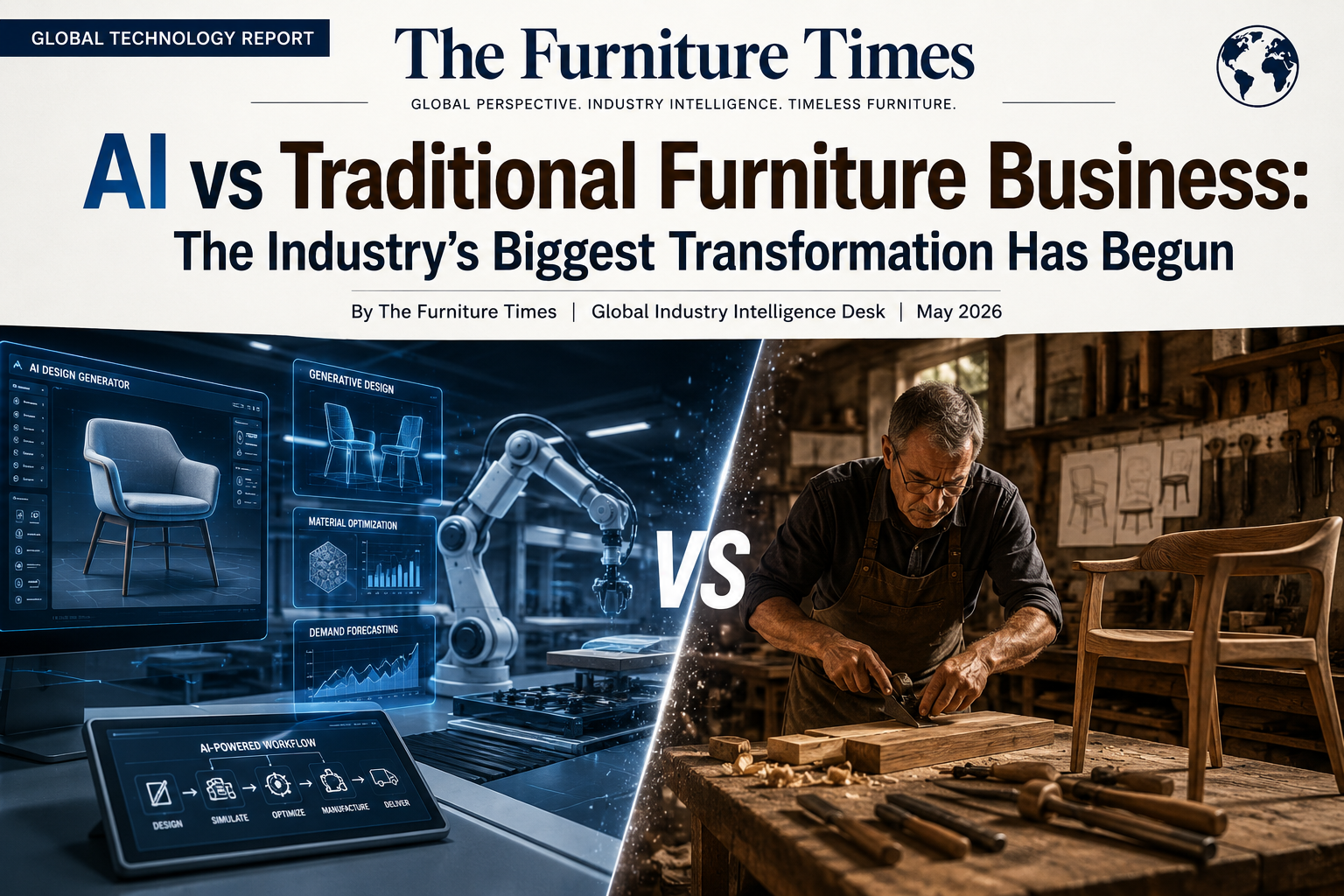
AI vs Traditional Furniture Business: The Industry’s Biggest Transformation Has Begun
Global Technology Report | The Furniture Times
By The Furniture Times | Global Industry Intelligence Desk | May 2026
The global furniture industry is entering the most important technological transformation in its history.
Artificial Intelligence is no longer a future concept discussed only by technology companies.
It is now entering:
- sourcing
- manufacturing
- logistics
- communication
- customer service
- search
- product discovery
- supply-chain intelligence
And the implications are enormous.
The furniture industry is moving from manual operations toward intelligent infrastructure.
The businesses that adapt early may gain massive advantages in:
- speed
- visibility
- efficiency
- lead generation
- operational control
Those that ignore the shift may struggle to compete in a rapidly evolving digital economy.
The Industry Is Moving Beyond Traditional Systems
For decades, furniture businesses relied on:
- exhibitions
- referrals
- sales representatives
- catalogs
- manual sourcing
- fragmented communication
That system is now under pressure.
Buyers today expect:
- instant information
- faster quotations
- digital visibility
- smart recommendations
- efficient communication
At the same time, manufacturers are facing:
- rising costs
- labor shortages
- supply-chain pressure
- margin compression
- growing competition
AI is emerging as a solution to many of these pressures.
1. AI Sourcing: The End of Manual Supplier Hunting
Traditional sourcing often involves:
- trade fairs
- referrals
- spreadsheets
- endless emails
- slow supplier comparison
AI is changing that process rapidly.
What AI Sourcing Can Do
AI systems can now:
- analyze supplier databases
- compare pricing patterns
- evaluate capabilities
- recommend suppliers
- predict sourcing risk
Example of the Future
A buyer may simply type:
“Need 2,000 hotel chairs for a UAE hospitality project within 45 days.”
AI systems could instantly:
- identify suppliers
- compare production capability
- suggest regions
- estimate lead times
- generate RFQs
The future of sourcing may become intelligent, predictive, and automated.
2. AI RFQs: Faster Quotations, Faster Decisions
One of the slowest areas in the furniture industry has traditionally been RFQ handling.
Buyers often wait:
- days
- weeks
- multiple follow-ups
just to receive quotations.
AI RFQ Systems Are Changing That
AI can help:
- generate RFQs automatically
- categorize inquiries
- route leads instantly
- suggest product alternatives
- predict pricing ranges
Why This Matters
Faster RFQs mean:
- faster decision making
- better conversion rates
- improved buyer experience
Speed is becoming one of the most important competitive advantages in global furniture trade.
3. AI Search: Visibility Is Becoming Algorithmic
Search behavior is changing dramatically.
Buyers increasingly rely on:
- AI search
- recommendation engines
- predictive discovery
- intelligent filtering
Traditional websites alone are no longer enough.
The New Reality
If a supplier is not:
- searchable
- categorized
- digitally structured
- algorithm-friendly
they risk becoming invisible.
AI Search Is Reshaping Discovery
AI-powered search systems can:
- understand buyer intent
- recommend suppliers
- compare categories
- personalize results
This Changes Everything
The industry is moving from:
- static listings
toward:
- intelligent discovery ecosystems
Visibility is no longer only about SEO.
It is becoming AI-driven discoverability.
4. Smart Factories: Manufacturing Is Becoming Intelligent
Manufacturing technology is advancing rapidly across the furniture ecosystem.
Smart factories are increasingly integrating:
- robotics
- CNC automation
- IoT systems
- predictive maintenance
- AI-driven production planning
What Smart Factories Improve
Efficiency
Faster and more consistent production.
Waste Reduction
Better material optimization.
Production Visibility
Real-time operational tracking.
Labor Optimization
Reduced repetitive manual tasks.
China Leads, But Others Are Catching Up
China remains highly advanced in:
- industrial automation
- smart manufacturing
- machinery integration
But countries like:
- Vietnam
- Malaysia
- India
are also increasing investment in automation and modern manufacturing systems.
5. Automation Is Reshaping Workforce Structures
Automation is changing the furniture workforce globally.
Machines are increasingly handling:
- cutting
- drilling
- nesting
- edge banding
- warehouse management
This creates both:
- opportunity
- disruption
The Big Debate
Will automation replace workers?
Or will it create higher-skilled jobs?
The answer may be both.
New Skills Are Becoming Critical
Workers increasingly need:
- digital literacy
- machine operation skills
- software understanding
- automation management capability
The future furniture workforce may become more technical and digitally driven.
6. AI Customer Service: Business Communication Is Changing
Furniture businesses traditionally rely on:
- calls
- emails
- manual follow-ups
AI is beginning to automate many of these interactions.
AI Can Now Help With:
- instant replies
- inquiry routing
- multilingual communication
- product recommendations
- lead qualification
Why This Matters
Buyers increasingly expect:
- fast replies
- 24/7 responsiveness
- structured communication
Businesses that respond slowly risk losing opportunities.
AI customer service is becoming a business survival tool.
7. The Rise of the Furniture Industry Operating System
The biggest shift may not be AI alone.
It may be the integration of:
- AI
- search
- communication
- live commerce
- data
- supplier intelligence
inside connected industry ecosystems.
The Future May Include:
AI-powered sourcing
AI RFQ systems
Intelligent supplier matching
Smart visibility systems
Live commerce integration
Automated communication infrastructure
The furniture industry is moving from fragmented systems toward connected intelligence infrastructure.
TFT Deep Industry Insight
AI will not destroy the furniture industry.
But it will transform how the industry operates.
The businesses that combine:
- manufacturing capability
- AI infrastructure
- digital visibility
- communication systems
- intelligent data
may become the dominant players of the next decade.
The Biggest Risk for Traditional Businesses
The biggest danger is not AI itself.
The danger is:
- slow adaptation
- resistance to change
- digital invisibility
- outdated systems
The Industry Shift Is Already Happening
The next generation of furniture business may no longer compete only on:
- factories
- price
- catalogs
It may compete on:
- intelligence
- speed
- visibility
- automation
- connected infrastructure
Strategic Recommendations
For Manufacturers
Begin gradual automation and digital integration.
For SMEs
Focus on visibility, communication systems, and AI-assisted efficiency.
For Exporters
Adopt smarter sourcing and RFQ systems.
For Industry Platforms
The future belongs to connected ecosystems combining:
- search
- communication
- intelligence
- AI
- live commerce
Final Thought
The furniture industry is entering a new era.
An era where:
- AI assists sourcing
- algorithms influence visibility
- automation drives factories
- communication becomes intelligent
- ecosystems become connected
The biggest transformation in furniture industry history has already begun.
The only question now is:
Who will adapt fast enough to lead it?

Related Posts
Global Furniture Industry Shows Signs of Strategic Transformation Amid Economic Uncertainty
Why Core Values Will Become the New Competitive Advantage in the Furniture Industry