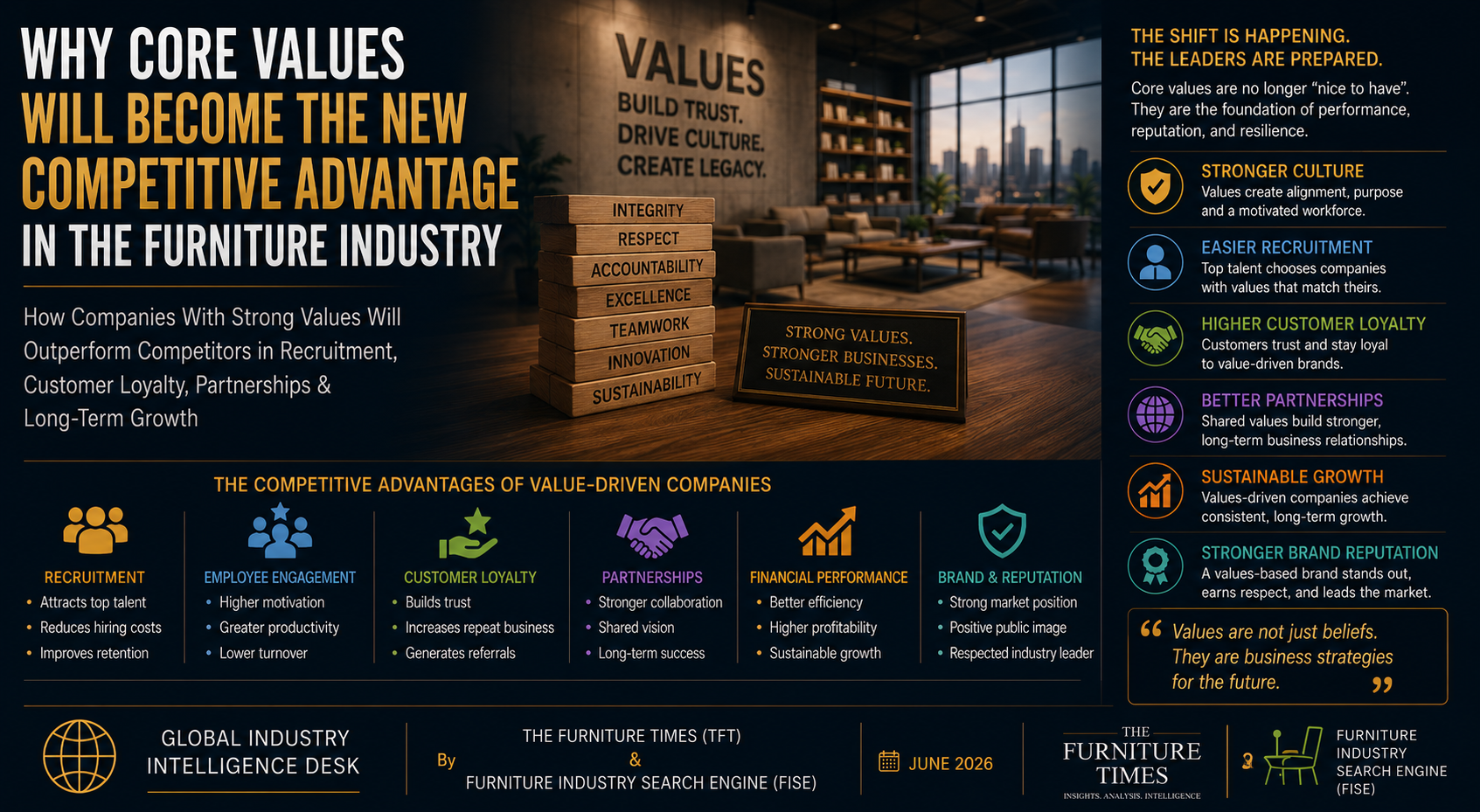
Why Core Values Will Become the New Competitive Advantage in the Furniture Industry
How Companies With Strong Values Will Outperform Competitors in Recruitment, Customer Loyalty, Partnerships & Long-Term Growth
Global Industry Intelligence Desk
By The Furniture Times (TFT) & Furniture Industry Search Engine (FISE)
June 2026
For decades, competitive advantage in the furniture industry was determined by a handful of factors:
- Manufacturing capacity
- Raw material access
- Production costs
- Distribution networks
- Product design
- Pricing strategies
Companies invested heavily in factories, machinery, logistics, and product development to gain market share.
These investments remain important.
However, a new reality is emerging across the global furniture ecosystem.
The companies that will dominate the next decade will not necessarily be those with the biggest factories or the lowest prices.
They will be the companies with the strongest values.
In 2026 and beyond, core values are becoming a measurable business advantage.
As competition intensifies, technology becomes more accessible, and products become easier to replicate, values are becoming one of the few assets that competitors cannot easily copy.
The future furniture economy will increasingly reward businesses that are trusted, respected, purpose-driven, and values-led.
The Competitive Landscape Is Changing
The furniture industry is undergoing one of the most significant transformations in its history.
Manufacturers face:
- Global competition
- AI disruption
- Workforce shortages
- Supply chain volatility
- Sustainability expectations
- Buyer transparency demands
- Digital discoverability challenges
In such an environment, operational excellence alone is no longer enough.
Customers, employees, suppliers, investors, and partners increasingly evaluate companies based on what they stand for—not simply what they sell.
This shift is redefining competition.
Products Can Be Copied. Values Cannot.
A new furniture design can be copied.
A manufacturing process can be replicated.
Technology can be purchased.
Machinery can be imported.
Even business models can be imitated.
But values are different.
Values become embedded within:
- Leadership behavior
- Organizational culture
- Decision-making processes
- Customer experiences
- Employee relationships
These elements cannot be duplicated overnight.
This is why values are becoming a sustainable competitive advantage.
Recruitment: The Talent War Has Changed
One of the biggest challenges facing the global furniture industry is attracting and retaining talent.
Many businesses continue asking:
“How do we recruit better people?”
The better question may be:
“Why would great people choose us?”
The next generation of professionals increasingly seeks:
- Purpose
- Meaning
- Respect
- Inclusion
- Growth opportunities
- Values alignment
Young professionals no longer evaluate employers solely based on salary.
They evaluate culture.
They evaluate leadership.
They evaluate values.
Furniture companies with strong values increasingly attract stronger talent.
And talent drives innovation.
Employee Retention Begins With Culture
Recruitment is only the beginning.
Retention is where long-term success is determined.
Organizations with weak values often experience:
- High turnover
- Employee disengagement
- Internal conflict
- Poor communication
- Low morale
Organizations with strong values create environments where people want to stay.
Employees who believe in the company’s mission become ambassadors rather than workers.
The result is:
- Greater productivity
- Better collaboration
- Higher loyalty
- Stronger performance
Culture is no longer an HR issue.
Culture is a business strategy.
Customer Loyalty Is Becoming Values-Driven
Today’s customers have more choices than ever before.
Whether buying:
- Sofas
- Dining tables
- Office furniture
- Outdoor furniture
- Hospitality furniture
Consumers increasingly ask:
Who am I buying from?
What does this company stand for?
Can I trust them?
Trust is becoming a decisive factor.
A customer who trusts a brand becomes:
- A repeat buyer
- A referral source
- A long-term advocate
Customer loyalty is increasingly built on values rather than promotions.
Partnerships Depend on Trust
The furniture ecosystem relies heavily on partnerships.
Manufacturers depend on suppliers.
Retailers depend on manufacturers.
Developers depend on contractors.
Designers depend on project partners.
Distributors depend on exporters.
Partnerships succeed when trust exists.
Trust is a direct result of values.
Companies known for:
- Integrity
- Accountability
- Transparency
- Reliability
attract stronger partnerships.
Strong partnerships create stronger ecosystems.
The Rise of the Trust Economy
The global economy is entering what many analysts describe as a trust-driven era.
Information is abundant.
Choices are abundant.
Trust is scarce.
As a result, trust has become one of the most valuable business assets.
In the furniture industry, trust influences:
- Purchasing decisions
- Supplier selection
- Project awards
- Investment opportunities
- Brand reputation
The companies that consistently demonstrate strong values become trusted market leaders.
Sustainability Starts With Values
Sustainability has become one of the most important conversations in the furniture industry.
Yet sustainability is often misunderstood.
Many companies view sustainability as:
- Certifications
- Reporting requirements
- Environmental programs
True sustainability begins much earlier.
It begins with values.
A company that values responsibility naturally makes better decisions regarding:
- Materials
- Waste reduction
- Energy use
- Community impact
- Supply chain ethics
Without values, sustainability becomes marketing.
With values, sustainability becomes culture.
Core Values Improve Decision-Making
One of the most overlooked benefits of values is decision-making clarity.
Businesses face difficult decisions every day.
Questions arise regarding:
- Pricing
- Quality
- Partnerships
- Investments
- Hiring
- Expansion
When organizations operate without clear values, decisions become inconsistent.
When values are clearly defined, decision-making becomes easier.
Values create alignment.
Alignment creates consistency.
Consistency creates trust.
Why Investors Increasingly Care About Values
Investors are paying greater attention to organizational culture and leadership quality.
Why?
Because values influence risk.
Businesses with strong values often demonstrate:
- Better governance
- Stronger leadership
- Lower turnover
- Greater resilience
- Long-term thinking
These characteristics reduce uncertainty.
And investors value stability.
The 28 Core Values and Furniture Industry Growth
The 28 Core Values framework highlights principles such as:
- Vision
- Integrity
- Accountability
- Excellence
- Leadership
- Respect
- Commitment
- Sustainability
- Service
- Trust
- Purpose
These are not motivational concepts.
They are business assets.
Each value contributes directly to organizational strength.
Together, they create competitive advantage.
Why Visibility Alone Is Not Enough
The furniture industry increasingly discusses:
- SEO
- Searchability
- AI discoverability
- Digital visibility
These are important.
But visibility without values creates short-term attention.
Values create long-term reputation.
The future belongs to companies that combine:
Visibility + Trust + Values + Leadership
This combination creates sustainable growth.
The Future Furniture Brand
The next generation of furniture brands will compete on:
Trust
Not just transactions.
Purpose
Not just products.
Culture
Not just capacity.
Leadership
Not just management.
Values
Not just visibility.
The strongest brands will stand for something meaningful.
TFT & FISE Analysis
The furniture industry is entering a period where competitive advantage is being redefined.
Historically, companies competed through scale.
Today they increasingly compete through credibility.
Values influence credibility.
Credibility influences trust.
Trust influences growth.
This creates a direct connection between values and business performance.
The organizations that embrace values today will become the industry leaders of tomorrow.
Final Verdict
The future of the furniture industry will not belong solely to the companies with the largest factories, the lowest costs, or the most advanced machinery.
It will belong to the companies that earn trust.
The companies that build cultures.
The companies that inspire employees.
The companies that create meaningful customer relationships.
The companies that stand for something greater than profit.
Because in the next decade:
Products will create sales.
Values will create loyalty.
Loyalty will create growth.
And growth built on values will always outlast growth built on transactions.
By The Furniture Times (TFT) & Furniture Industry Search Engine (FISE)
Global Industry Intelligence Desk | June 2026
“TFT tells their story. FISE helps the world find them.”
The furniture industry ecosystem is a $1 Trillion Dollar Industry.

Related Posts
Global Furniture Industry Shows Signs of Strategic Transformation Amid Economic Uncertainty
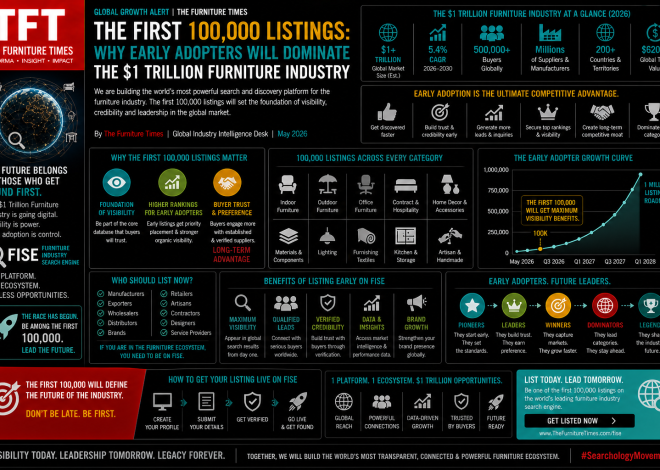
The First 100,000 Listings: Why Early Adopters Will Dominate the $1 Trillion Furniture Industry