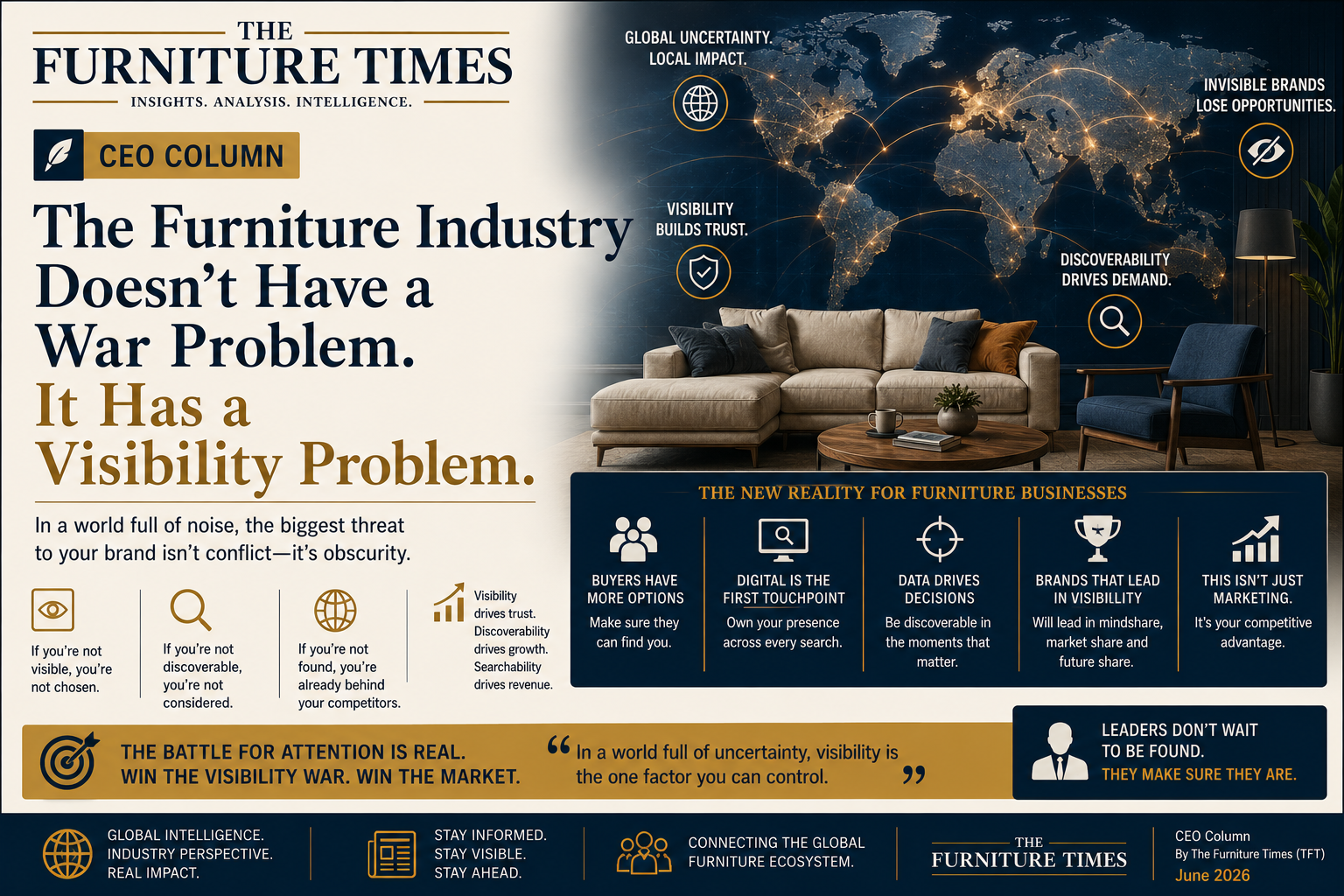
The Furniture Industry Doesn’t Have a War Problem. It Has a Visibility Problem.
CEO Column | By The Furniture Times (TFT) | June 2026
Every day, I read headlines about wars.
Russia and Ukraine.
Middle East tensions.
Red Sea disruptions.
Trade conflicts.
Tariffs.
Inflation.
Energy uncertainty.
And almost every week, someone in the furniture industry asks me the same question:
“How will these wars affect the furniture industry?”
My answer often surprises them.
The biggest threat to most furniture businesses today is not war.
It is invisibility.
That statement may sound controversial.
But let’s look deeper.
The Industry Has Survived Worse
The furniture industry has survived:
World War I
World War II
Oil crises
Financial crashes
Housing collapses
Pandemics
Global recessions
And yet, every time, the industry continued.
Why?
Because furniture is not a luxury industry.
It is a necessity industry.
People may delay purchases.
Projects may slow.
Margins may shrink.
But the world never stops needing:
Beds
Chairs
Sofas
Tables
Cabinets
Office furniture
Hospitality furniture
Furniture remains part of human life.
The demand does not disappear.
It simply changes direction.
What I See Across the Industry
During the last few years, I have spoken with manufacturers, retailers, suppliers, exporters, designers, architects, distributors, and factory owners across multiple countries.
A pattern continues to emerge.
Many businesses blame:
The economy
Competition
Freight rates
Government policies
Wars
Yet when we analyze deeper, another issue appears.
Customers simply cannot find them.
Their websites are outdated.
Their Google presence is weak.
Their business profiles are incomplete.
Their projects are invisible.
Their expertise is hidden.
Their products are not discoverable.
The problem is not always demand.
The problem is discoverability.
The Invisible Factory
Imagine a factory producing world-class furniture.
Excellent craftsmanship.
Competitive pricing.
Strong quality control.
Export capability.
Experienced workforce.
Now imagine nobody can find it online.
No visibility.
No search presence.
No reviews.
No digital footprint.
No industry profiles.
No authority signals.
In today’s world, that factory effectively does not exist.
The internet has become the first trade exhibition.
The first showroom.
The first sales representative.
The first introduction.
If customers cannot find you there, they may never find you at all.
Search Is Becoming More Important Than Location
Twenty years ago, location was power.
Today, search is power.
A manufacturer in Indonesia can win a project in Europe.
A supplier in Malaysia can serve a hotel group in the Middle East.
A designer in India can collaborate with a developer in North America.
The geography of opportunity has changed.
The question is no longer:
“Where is your showroom?”
The question is:
“Can buyers find you?”
AI Is Changing Everything
The next disruption is already here.
Artificial Intelligence.
Increasingly, buyers are not searching websites.
They are asking AI.
They ask:
Who are the best furniture manufacturers?
Which suppliers are trusted?
Who specializes in hospitality projects?
Which outdoor furniture brands serve resorts?
AI systems are becoming recommendation engines.
This changes the entire game.
The companies that prepare for AI discoverability today may dominate tomorrow.
The companies that ignore it may become invisible.
The New Competitive Advantage
For decades, the furniture industry competed on:
Price
Quality
Manufacturing capacity
These factors remain important.
But a new layer has emerged.
Visibility.
Trust.
Authority.
Searchability.
Data.
These factors increasingly influence who gets discovered first.
And in business, being discovered first often means being considered first.
What Smart Companies Are Doing
The smartest furniture businesses I see today are not waiting for markets to improve.
They are investing.
Not only in machinery.
Not only in factories.
Not only in inventory.
They are investing in:
Digital visibility
Search presence
Industry authority
Brand trust
Content
Data
Customer experience
They understand something important.
When uncertainty ends, visibility remains.
The Next Decade Belongs to the Discoverable
The furniture industry is entering a new era.
An era where discoverability matters as much as manufacturing.
An era where search influences sales.
An era where AI influences recommendations.
An era where trust becomes measurable.
An era where visibility creates opportunity.
The companies that understand this shift early will build extraordinary advantages.
The companies that ignore it may spend years wondering why opportunities are passing them by.
My Final Thought
Wars create uncertainty.
Economic cycles create pressure.
Supply chains create challenges.
These realities are part of business.
But many furniture companies are fighting the wrong battle.
They are preparing for problems they cannot control while ignoring problems they can.
You cannot control geopolitics.
You cannot control oil prices.
You cannot control global conflicts.
But you can control whether buyers can find you.
And in the next decade, that may become the single most important decision your business makes.
Because the future furniture industry will not only belong to those who manufacture the best products.
It will belong to those who are easiest to discover.
By The Furniture Times (TFT)
CEO Column | June 2026
“TFT tells their story. FISE helps the world find them.”

Related Posts
When Conflict Defines Leadership: Why the Global Furniture Industry Can No Longer Remain Fragmented
Global Furniture Trade, Exports & Market Shifts: How Geopolitics and Policy Are Reshaping the Industry