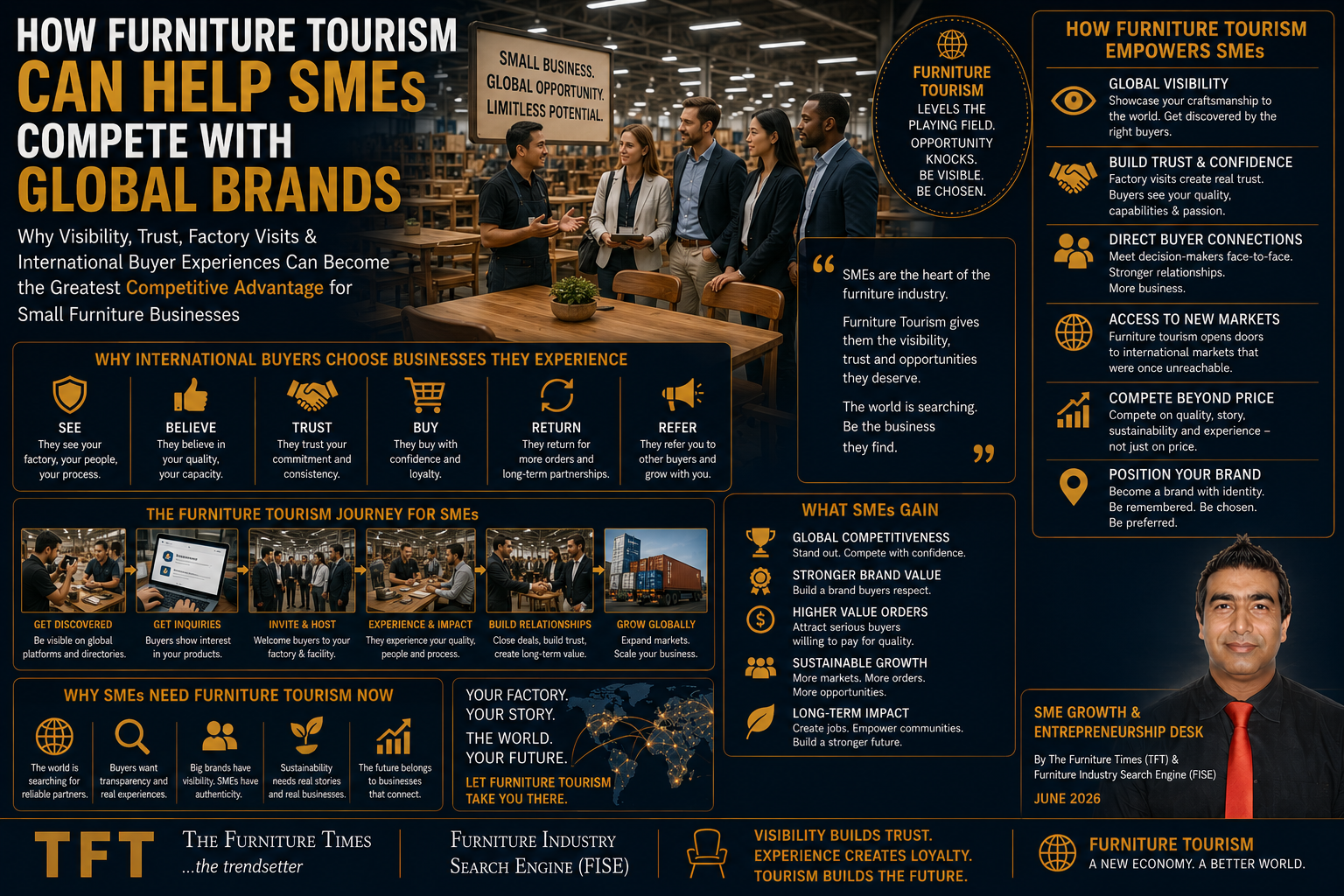
How Furniture Tourism Can Help SMEs Compete with Global Brands
Why Visibility, Trust, Factory Visits & International Buyer Experiences Can Become the Greatest Competitive Advantage for Small Furniture Businesses
SME Growth & Entrepreneurship Desk
By The Furniture Times (TFT) & Furniture Industry Search Engine (FISE)
June 2026
Around the world, the furniture industry is built by millions of businesses.
Some are global corporations with thousands of employees.
Others are family-owned workshops that have existed for generations.
Many are small and medium-sized enterprises (SMEs).
Some are startups trying to build their first customer base.
Some manufacture only a few products each month.
Others produce world-class furniture that competes with the best brands in the world.
Yet despite their craftsmanship, innovation and manufacturing capability, one harsh reality remains.
Most SMEs remain invisible.
Not because they lack quality.
Not because they lack passion.
Not because they lack innovation.
They remain invisible because the world simply does not know they exist.
For decades, global brands have dominated international markets through advertising, distribution networks, retail showrooms and marketing budgets.
SMEs rarely have those advantages.
But the future is changing.
According to The Furniture Times (TFT), Furniture Business Tourism may become one of the greatest equalisers ever introduced into the global furniture industry.
Instead of competing with multinational companies through expensive advertising campaigns, SMEs can compete through something far more powerful.
Experience.
When buyers visit factories…
Trust replaces uncertainty.
Relationships replace transactions.
Experience replaces advertising.
And small manufacturers become global opportunities.
SMEs Are the Backbone of the Global Furniture Industry
Across Asia.
Europe.
Africa.
Latin America.
North America.
The Middle East.
Millions of furniture businesses are SMEs.
They manufacture:
Solid wood furniture.
Outdoor furniture.
Office furniture.
Kitchen cabinets.
Hotel furniture.
Handcrafted furniture.
Custom-made furniture.
Luxury furniture.
Children’s furniture.
Many produce exceptional products.
Yet thousands never receive international enquiries.
Visibility—not capability—is their biggest challenge.
The Advertising Gap
Large brands invest millions every year in:
Television advertising.
Digital marketing.
Trade exhibitions.
Global sales offices.
Brand ambassadors.
Retail expansion.
International PR.
SMEs simply cannot compete at that level.
Trying to outspend global corporations is unrealistic.
Furniture Business Tourism offers another path.
Instead of spending millions on advertising…
Invite the world to your factory.
Factory Visits Build Trust Faster Than Advertisements
An advertisement can introduce a company.
A factory visit can convince a buyer.
When international visitors walk through a factory they see:
The people.
The machinery.
The craftsmanship.
The production process.
The quality control systems.
The attention to detail.
Transparency creates confidence.
Confidence creates business.
Trust built through experience is often stronger than trust built through advertising.
Visibility Becomes the New Competitive Advantage
The greatest challenge for SMEs is not production.
It is discoverability.
If buyers cannot find a manufacturer…
They cannot request quotations.
They cannot compare products.
They cannot build partnerships.
They cannot visit factories.
Visibility creates opportunity.
Furniture Tourism brings visibility directly to manufacturers.
Instead of waiting to be discovered, SMEs become destinations.
International Buyers Want Relationships, Not Only Products
Today’s buyers increasingly seek long-term suppliers.
They want to understand:
Who owns the company.
How production operates.
Whether quality remains consistent.
How problems are solved.
Whether innovation continues.
These questions cannot always be answered through catalogues.
Factory experiences provide those answers.
Relationships begin long before purchase orders.
Export Readiness Begins with Confidence
Many SMEs have excellent manufacturing capabilities.
But they hesitate to export.
Reasons include:
Limited international exposure.
Lack of buyer confidence.
Uncertainty about export procedures.
Fear of entering global markets.
Furniture Business Tourism helps overcome these barriers.
International visitors create practical export experience.
SMEs learn buyer expectations.
They improve documentation.
They strengthen quality systems.
Export readiness becomes a natural outcome.
Furniture Tourism Reduces Customer Acquisition Costs
Traditional customer acquisition often requires:
Advertising.
Trade fairs.
Sales representatives.
Travel.
Promotional campaigns.
Furniture Tourism changes the equation.
Buyers travel to manufacturers.
The factory becomes the showroom.
The production line becomes the presentation.
The visitor becomes the sales opportunity.
Customer acquisition becomes more efficient.
Every Factory Has a Story Worth Sharing
Many SMEs underestimate their greatest strength.
Their story.
Family businesses.
Generational craftsmanship.
Traditional woodworking.
Innovation.
Sustainability.
Community employment.
Every factory has something unique.
Furniture Tourism allows buyers to experience those stories firsthand.
Storytelling creates emotional connection.
Emotional connection builds stronger business relationships.
Furniture Cities Help SMEs Grow Together
Furniture Tourism does not benefit one manufacturer alone.
Entire furniture clusters benefit.
When buyers visit one city they often explore:
Multiple factories.
Material suppliers.
Hardware companies.
Design studios.
Training centres.
Local restaurants.
Hotels.
Every SME gains greater visibility.
Growth becomes collective.
Digital Visibility Supports Physical Visits
Factory visits begin online.
Buyers first search.
Then compare.
Then contact.
Then visit.
This means SMEs require:
Professional websites.
Search engine visibility.
Industry listings.
Digital catalogues.
Virtual factory tours.
Business profiles.
Furniture Industry Search Engine (FISE) provides an ecosystem where SMEs can become searchable to buyers worldwide.
Digital visibility creates physical business opportunities.
SMEs Need Visitors More Than Advertisements
Advertising tells people who you are.
Visitors discover who you really are.
An advertisement lasts seconds.
A factory experience may create a partnership lasting decades.
Advertising competes for attention.
Experience creates memory.
Furniture Tourism allows SMEs to invest in relationships rather than impressions.
This is often a far better long-term investment.
Governments Can Empower SMEs Through Furniture Tourism
Governments can support SMEs by:
Developing factory tour programmes.
Creating certified business visitor routes.
Providing export training.
Supporting translation services.
Improving digital discoverability.
Promoting furniture cities internationally.
Helping SMEs welcome global buyers.
Furniture Tourism becomes a national SME development strategy.
AI Will Help SMEs Reach Global Buyers
Artificial Intelligence will increasingly recommend manufacturers based on:
Business profiles.
Customer reviews.
Factory information.
Product data.
Digital credibility.
Search visibility.
The SMEs investing in discoverability today will be the companies AI recommends tomorrow.
Why The Furniture Times Created This Vision
According to Togbega Dortor Dr. Bilal Ahmad Bhat, Founder of The Furniture Times (TFT) and Furniture Industry Search Engine (FISE):
“The furniture industry is full of extraordinary SMEs that the world has never seen. They are not invisible because they lack quality. They are invisible because nobody has built a system to help the world discover them. Furniture Business Tourism changes that forever.”
He continues:
“Large companies buy advertising. SMEs need something more valuable. They need visitors. They need conversations. They need buyers walking through their factories, meeting their people and understanding their passion. That creates trust money cannot buy.”
And concludes:
“Furniture Tourism is not about competing with global brands by spending more. It is about competing by being more authentic, more transparent and more accessible. Every SME deserves that opportunity, and TFT is committed to making it possible.”
The Role of TFT & FISE
The Furniture Times believes SMEs are the future of the global furniture industry.
TFT gives them a voice.
FISE helps the world find them.
Furniture Business Tourism brings international buyers directly to them.
Together these three elements create a complete growth ecosystem:
Visibility.
Trust.
Opportunity.
TFT & FISE Analysis
For decades, global brands dominated because they controlled visibility.
Furniture Business Tourism changes the rules.
It allows SMEs to compete through:
Transparency.
Relationships.
Experience.
Craftsmanship.
Authenticity.
Factory visits.
Trust.
Instead of competing with marketing budgets, SMEs compete through genuine business experiences.
That is a much fairer marketplace.
Final Verdict
The future of the furniture industry should not belong only to the largest companies.
It should belong to the best companies.
The most innovative companies.
The most passionate companies.
The most trustworthy companies.
Furniture Business Tourism gives SMEs the opportunity to prove their value.
It transforms factories into business destinations.
Visitors into customers.
Customers into partners.
And partnerships into long-term growth.
The world’s next great furniture brands may not come from the largest factories.
They may come from small workshops hidden inside furniture cities that finally receive the visibility they deserve.
That is why Furniture Business Tourism matters.
That is why SMEs matter.
And that is why The Furniture Times (TFT) believes the future of the global furniture industry will be built not only by global brands—but by globally discoverable SMEs.
By The Furniture Times (TFT) & Furniture Industry Search Engine (FISE)
SME Growth & Entrepreneurship Desk | June 2026
“TFT tells their story. FISE helps the world find them.”
The furniture industry ecosystem is a $1 Trillion Dollar Industry.