Think, Act and Become Searchable
The Furniture Industry’s Next Great Opportunity Has Arrived
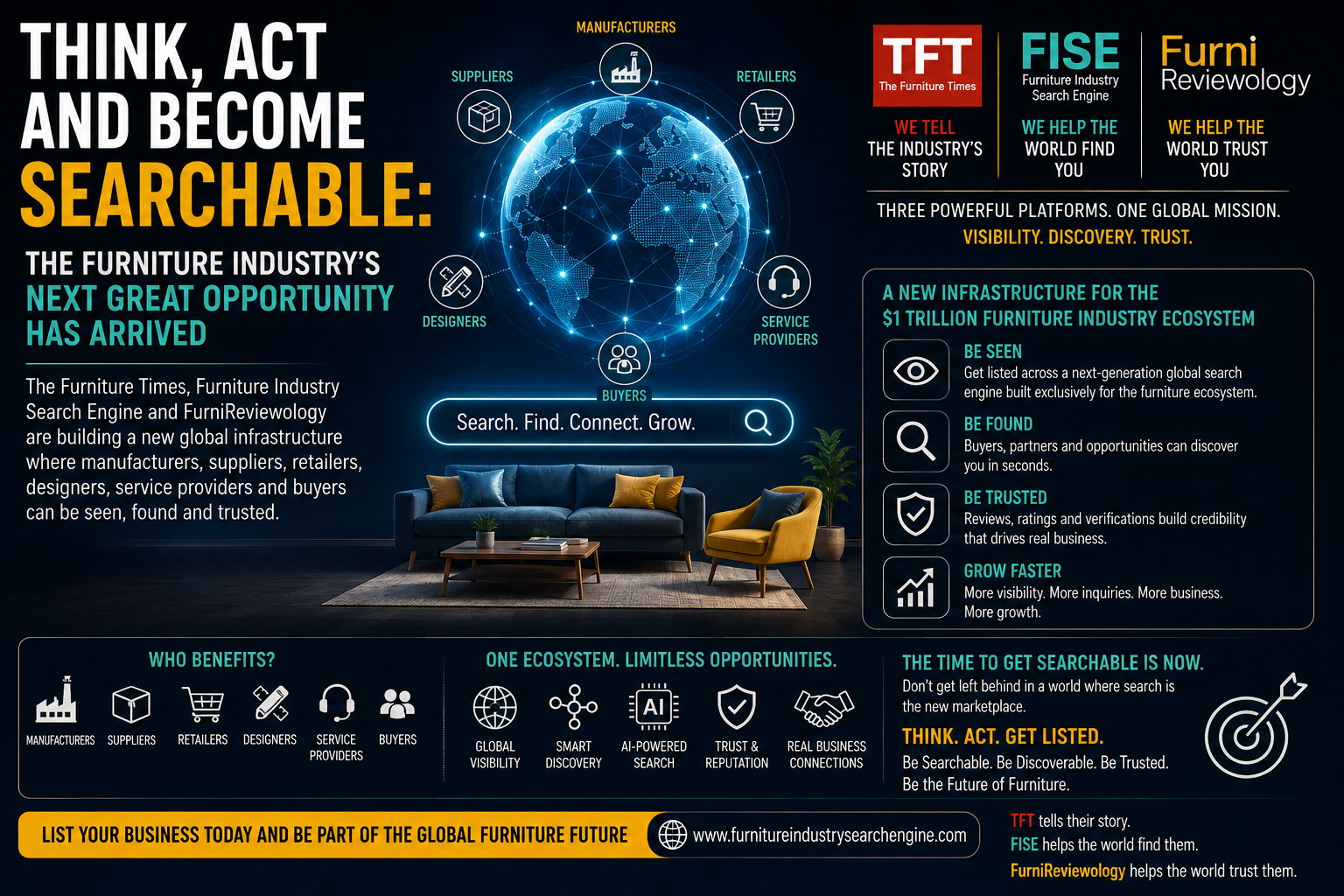
The Furniture Times, Furniture Industry Search Engine and FurniReviewology are building a new global infrastructure where manufacturers, suppliers, retailers, designers, service providers and buyers can be seen, found and trusted
By The Furniture Times (TFT) Editorial Desk | Furniture Search | Industry Visibility | Supplier Discovery | AI Search | Global Industry Intelligence
The furniture industry has spent generations perfecting how products are designed, manufactured, displayed and delivered. It has built factories, showrooms, warehouses, trade fairs, retail networks and global supply chains.
But one critical problem remains unresolved:
The furniture industry is still extremely difficult to search.
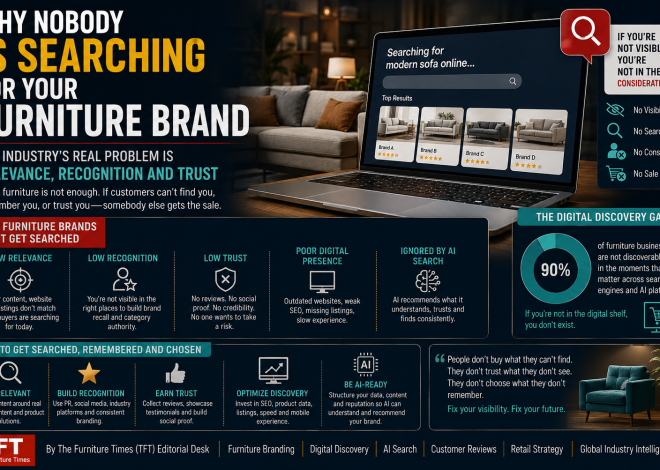
Millions of businesses participate in the global furniture ecosystem, yet only a relatively small number are easily discoverable online. Countless manufacturers, material suppliers, component producers, craftspeople, designers, distributors, installers, logistics companies and independent retailers remain almost invisible outside their immediate markets.
They may manufacture excellent products. They may have decades of experience. They may employ skilled people, serve loyal customers and deliver dependable quality. But when a buyer searches online, their names may not appear.
When an architect searches for a specialist supplier, they may not appear.
When a retailer searches for a new manufacturer, they may not appear.
When an artificial-intelligence assistant is asked to recommend a furniture business, it may not know that they exist.
This is not merely a marketing weakness. It is an economic disadvantage.
In the emerging digital economy, a business that cannot be found may be excluded before a commercial conversation even begins.
That is why the furniture industry must now think, act and become searchable.
The furniture industry is ready for a next-generation discovery system
The conventional furniture trade has relied heavily on exhibitions, printed catalogues, sales representatives, personal relationships and distributor networks.
These channels remain valuable. Furniture is a relationship-driven industry, and physical products often need to be touched, tested and inspected.
However, traditional discovery systems have limitations.
A trade fair lasts only a few days. A printed catalogue becomes outdated. A salesperson can meet only a limited number of buyers. A showroom serves a particular location. A small manufacturer may lack the resources to exhibit internationally.
Digital search can operate continuously.
A well-organized digital presence allows a company to be discovered:
- Twenty-four hours a day
- Across different countries
- In multiple product categories
- By buyers it has never previously met
- Without waiting for the next exhibition
- Without maintaining an international sales office
- Without paying continuously for every click
- By both people and AI-powered search systems
This is the opportunity behind the combined development of The Furniture Times (TFT), the Furniture Industry Search Engine (FISE) and FurniReviewology.
These initiatives address three separate but connected industry challenges:
TFT tells their story.
FISE helps the world find them.
FurniReviewology helps the world trust them.
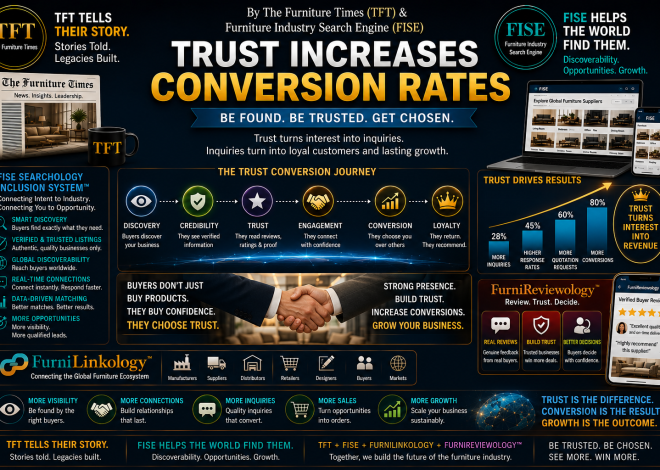
Together, they create a pathway from visibility to discovery and from discovery to trust.
The problem is not a lack of furniture businesses
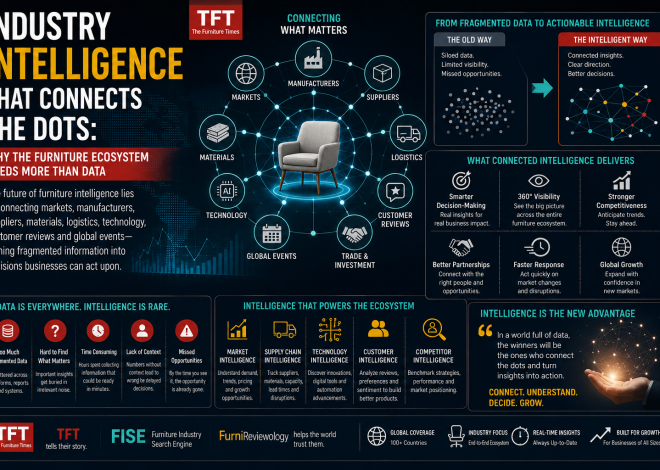
The global furniture industry does not suffer from a shortage of companies. It suffers from fragmented information.
A buyer searching for a particular supplier may encounter scattered websites, outdated directories, social-media pages, incomplete marketplace profiles and search results dominated by the largest companies.
The buyer may struggle to answer basic questions:
- Which manufacturers produce the required product?
- Where are they located?
- Which markets do they serve?
- Do they manufacture or merely resell?
- What materials and components do they use?
- Can they manage custom orders?
- What certifications do they possess?
- Can they supply commercial quantities?
- What is their manufacturing capacity?
- What do customers and trade partners say about them?
- How can they be contacted?
The information may exist, but it is rarely organized in one furniture-specific discovery environment.
This fragmentation wastes time and creates risk. It also favors companies with the largest advertising budgets rather than those with the strongest capabilities.
The furniture industry needs a dedicated infrastructure designed around how the ecosystem actually operates.
FISE is not another general business directory
A general directory may identify a business as a “furniture company.” That description is often too broad to be commercially useful.
A furniture manufacturer may specialize in upholstered seating, bedroom casegoods, outdoor products, hotel furniture, office systems, educational furniture or custom joinery.
A component company may supply:
- Hinges
- Drawer slides
- Connectors
- Fasteners
- Handles
- Furniture legs
- Castors
- Reclining mechanisms
- Gas lifts
- Table-extension systems
- Lighting accessories
- Upholstery components
A material supplier may provide:
- Solid wood
- Veneer
- Plywood
- Particleboard
- Medium-density fiberboard
- Laminates
- Decorative surfaces
- Fabric
- Leather
- Foam
- Adhesives
- Coatings
- Glass
- Metals
- Recycled materials
A next-generation furniture search engine must understand these differences.
The Furniture Industry Search Engine—FISE—is intended to organize the ecosystem by what businesses actually manufacture, supply, design, distribute, install or service.
It is about helping users move from a broad search to a relevant connection.
A hotel procurement manager should be able to search for hospitality furniture suppliers. A manufacturer should be able to locate component partners. A consumer should be able to find nearby retailers or service providers. A designer should be able to identify specialist craftspeople. A factory should be able to discover machinery, materials and logistics support.
That is the difference between a list of names and a functional industry search system.
Who should become searchable?
The answer is simple: everyone contributing legitimate value to the furniture ecosystem.
This includes:
- Furniture manufacturers
- Contract furniture producers
- Original equipment manufacturers
- Private-label manufacturers
- Furniture component suppliers
- Raw-material companies
- Hardware and accessory businesses
- Machinery and equipment providers
- Upholstery and textile suppliers
- Foam and filling manufacturers
- Designers and design studios
- Architects and interior designers
- Craftspeople and artisans
- Importers and exporters
- Wholesalers and distributors
- Furniture retailers
- Online furniture sellers
- Commercial project suppliers
- Hospitality furniture specialists
- Office furniture companies
- Healthcare furniture suppliers
- Educational furniture providers
- Outdoor furniture businesses
- Kitchen and wardrobe companies
- Mattress and sleep-product businesses
- Logistics and warehousing providers
- Delivery and installation teams
- Testing and certification organizations
- Repair and restoration services
- Furniture rental companies
- Resale and refurbishment businesses
- Recycling and circular-economy operators
- Software and furniture-technology providers
- Trade associations and industry institutions
- Exhibition and event organizers
- Training and workforce-development providers
The furniture industry is not one category. It is an ecosystem of interconnected industries.
A search engine built for this ecosystem must make those connections visible.
The opportunity is especially important for small businesses
Large furniture companies can purchase advertising, employ public-relations teams, exhibit internationally and invest in sophisticated websites.
Small manufacturers and independent artisans often cannot.
Many highly skilled businesses remain hidden because they lack marketing budgets—not because they lack ability.
A craftsperson may produce exceptional carved furniture but remain unknown outside a local community. A small factory may deliver dependable contract furniture but have no international sales team. A component supplier may solve an important production problem but be invisible to manufacturers in other regions.
The digital-discovery economy should not become a competition in which only the wealthiest businesses are visible.
FISE presents the possibility of a more inclusive system where businesses can be discovered based on:
- Location
- Product category
- Manufacturing capability
- Material specialization
- Project experience
- Service area
- Customization ability
- Certification
- Verified business information
- Customer and trade reputation
This can give smaller participants a fairer opportunity to compete.
It does not guarantee an order. It creates the possibility of being considered.
That first opportunity—to enter the buyer’s consideration set—can change the future of a business.
Are you listed—or are you invisible?
Every participant in the furniture ecosystem should now ask three direct questions:
Is my story visible in The Furniture Times?
Can buyers find my company through the Furniture Industry Search Engine?
Can customers and partners evaluate my credibility through FurniReviewology?
If the answer is no, the business may be missing an important opportunity.
Being listed is not merely about adding a company name and telephone number. A commercially useful profile should help users understand what the business actually does.
A strong furniture-industry listing may include:
- Official business name
- Brand name
- Country and city
- Verified website
- Contact information
- Business type
- Product categories
- Materials
- Manufacturing capabilities
- Minimum-order information
- Customization services
- Export markets
- Certifications
- Delivery areas
- Project experience
- Photographs and catalogues
- Company history
- Warranty information
- Repair or replacement support
- Customer and trade reviews
The more accurate and complete the information, the easier it becomes for buyers and AI systems to understand the company.
Incomplete information produces incomplete visibility.
Listings are the new storefronts
A traditional storefront tells passersby that a business exists. A digital listing performs the same function for a global audience.
But a next-generation listing can do much more.
It can explain what the company manufactures, identify the markets it serves, show its capabilities, connect buyers with its website and present evidence of reputation.
This makes the listing a permanent digital entry point.
A potential customer may discover a business through:
- A category search
- A product search
- A location search
- A supplier search
- An AI-generated recommendation
- A news article
- A review
- A comparison
- A project reference
- A related company profile
Every structured listing creates another pathway into the business.
This is why listings are the new storefronts.
The physical showroom may serve one city. A searchable industry listing can introduce the company to the world.
The next generation of search is conversational
The future of search will not be limited to short keyword queries.
Buyers will increasingly describe their needs in complete sentences:
- “Find a hotel furniture manufacturer in Southeast Asia that can produce 300 guest rooms.”
- “Show me certified office chair manufacturers serving the Middle East.”
- “Which suppliers produce heavy-duty drawer slides for commercial furniture?”
- “Find sustainable outdoor furniture manufacturers using recycled materials.”
- “Who can restore heritage furniture in my country?”
- “Which nearby furniture retailers have strong delivery reviews?”
- “Find a custom wardrobe company for an irregularly shaped room.”
This is conversational and intent-based search.
For next-generation systems to answer these questions, the industry needs structured, accurate and detailed information.
AI cannot reliably recommend a company simply because it has an attractive logo. It requires evidence about products, capabilities, locations, experience, reputation and relevance.
A furniture business must therefore become understandable to machines as well as people.
From keyword matching to industry understanding
Conventional search often matches words appearing on websites. Next-generation furniture search should understand relationships.
For example:
- A hotel furniture company may also be relevant to resorts, serviced apartments and student accommodation.
- A hinge supplier may serve kitchen, wardrobe, office and institutional manufacturers.
- An upholstery mill may be relevant to furniture producers, interior designers, marine applications and hospitality projects.
- A restoration specialist may work with antiques, heritage institutions, hotels and private collectors.
- A modular furniture manufacturer may serve small homes, coworking environments and temporary accommodation.
This relationship-based discovery is far more useful than a simple alphabetical directory.
It helps buyers find possibilities they may not have known how to search for.
That is why FISE has the potential to become a game-changing infrastructure for the industry: it can organize an ecosystem that is currently fragmented across thousands of websites, catalogues, marketplaces and offline relationships.
TFT gives the ecosystem a voice
Searchability begins with information, but information becomes more powerful when it is supported by professional storytelling.
A company profile explains what a business does. A news story explains why it matters.
The Furniture Times can help bring attention to:
- New products
- Factory expansions
- Sustainability initiatives
- Export achievements
- Design innovations
- Technology investments
- Business milestones
- Leadership developments
- Industry challenges
- Community impact
- Craft traditions
- Emerging markets
- Small-business success stories
This editorial layer is particularly valuable for businesses whose stories would otherwise remain untold.
Many manufacturers quietly create employment, preserve craft skills, train workers, support local suppliers and contribute to exports. Their influence may be significant even when their names are unknown.
TFT can place these stories within a wider industry context.
Media coverage creates visibility, and credible visibility can support search discovery, brand authority, partnerships and AI recognition.
FurniReviewology converts discovery into trust
Being found does not automatically result in a purchase.
Furniture is a high-consideration category. Buyers worry about quality, comfort, dimensions, delivery, installation, durability, warranty and after-sales support.
A customer may discover several companies through FISE but still ask:
- Which one is reliable?
- Does the delivered product match the description?
- Are the materials accurately stated?
- Does the company deliver on time?
- How does it handle damaged goods?
- Does it provide replacement parts?
- Does it honor its warranty?
- What happened to customers who raised complaints?
This is the purpose of FurniReviewology.
FurniReviewology can develop into a furniture-specific trust and review-intelligence layer that evaluates the complete ownership and business experience—not merely the initial sale.
It can help customers understand different dimensions of performance:
Product experience
- Quality
- Comfort
- Construction
- Material accuracy
- Finish
- Durability
- Functionality
Delivery experience
- Lead-time accuracy
- Communication
- Packaging
- Damage prevention
- Professional handling
Installation experience
- Assembly quality
- Installer conduct
- Missing components
- Completion time
- Site protection
Service experience
- Responsiveness
- Complaint management
- Returns
- Repairs
- Warranty support
- Replacement parts
Long-term experience
- Fabric wear
- Foam resilience
- Mechanism reliability
- Structural stability
- Maintenance
- Repairability
This makes FurniReviewology more than a star-rating platform. It becomes a source of practical evidence.
Reviews should protect good businesses
A credible review system should not exist only to punish companies. It should also protect honest and responsible businesses.
Many furniture companies face unfair, incomplete or fraudulent reviews. Sometimes customers blame a manufacturer for problems caused by a retailer, courier or installer. In other situations, a review may not come from a verified transaction.
A specialized review platform should seek context:
- Was the reviewer a verified buyer?
- Which product or service was involved?
- When did the transaction occur?
- Was the complaint reported to the company?
- Did the business respond?
- Was a remedy offered?
- Was the problem related to the product, delivery or installation?
- Has the issue appeared repeatedly?
This allows the review ecosystem to distinguish between an isolated disagreement and a systemic problem.
FurniReviewology can support fairness for consumers and businesses by focusing on evidence, transparency and resolution.
Reviews can improve the entire furniture ecosystem
Customer feedback is not only a trust signal. It is also operational intelligence.
Recurring complaints can expose weaknesses that may otherwise remain hidden.
For example:
- Loose chair joints may indicate a production or assembly problem.
- Damaged corners may reveal inadequate packaging.
- Color complaints may expose inaccurate photography.
- Difficult assembly may indicate poor instructions.
- Delayed orders may reveal supply-chain weaknesses.
- Mechanism failures may identify an unreliable component.
- Unanswered complaints may expose customer-service gaps.
When review information is organized properly, it can help manufacturers, suppliers and retailers improve.
FurniReviewology can therefore support:
- Product development
- Quality assurance
- Supplier evaluation
- Logistics management
- Packaging improvement
- Warranty planning
- Customer-service training
- Product selection
- Risk management
The furniture industry generates enormous amounts of customer feedback, but much of it remains fragmented and underused.
Review intelligence can turn that feedback into measurable improvement.
The three-layer model: visibility, discovery and trust
The combined TFT, FISE and FurniReviewology ecosystem can be understood through three connected layers.
Layer One: TFT—Visibility and authority
TFT communicates the industry’s stories, developments, innovations and challenges.
It answers:
Why should the market know about this business?
Layer Two: FISE—Search and connection
FISE helps users locate businesses by product, capability, service, country and industry role.
It answers:
Where can the right business be found?
Layer Three: FurniReviewology—Trust and validation
FurniReviewology helps customers and trade partners understand experience, reputation and accountability.
It answers:
Why should this business be trusted?
A company benefits most when all three layers support one another.
A news article can introduce the brand. A search profile can help the buyer locate it later. A credible review record can give the buyer confidence to make contact or purchase.
This is a more complete model than advertising alone.
The ecosystem serves both B2B and B2C users
The furniture industry serves different types of customers, and the search experience must recognize their needs.
Business-to-consumer users
Consumers may search for:
- Sofas
- Beds and mattresses
- Dining furniture
- Children’s furniture
- Outdoor furniture
- Home-office furniture
- Kitchen and wardrobe providers
- Repair and restoration services
- Local furniture stores
- Delivery and assembly services
Business-to-business users
Professional buyers may search for:
- Manufacturers
- Contract suppliers
- Private-label factories
- Material producers
- Hardware suppliers
- Machinery providers
- Designers
- Commercial installers
- Logistics partners
- Testing laboratories
- Certification consultants
Project and institutional users
Architects, developers and procurement teams may need:
- Hospitality furniture
- Office furniture
- Healthcare furniture
- Educational furniture
- Public-space furniture
- Custom joinery
- Project management
- Installation and maintenance
- Compliance documentation
A global furniture search ecosystem should connect all these users without treating the industry as one undifferentiated category.
Countries can build stronger furniture economies through searchability
Searchability can also support national and regional economic development.
Many countries have strong furniture capabilities that remain poorly represented internationally. They may have specialist timber, traditional crafts, competitive labor, modern factories or growing domestic markets.
A country-level furniture search ecosystem can showcase:
- Manufacturing clusters
- Regional craft traditions
- Export capabilities
- Material suppliers
- Furniture cities
- Training institutions
- Trade associations
- Design talent
- Logistics infrastructure
- Retail networks
- Investment opportunities
This can help international buyers discover markets beyond the most established sourcing destinations.
It can also help businesses find partners within their own countries, reducing unnecessary dependence on distant suppliers.
Searchability is therefore not only a company-level advantage. It can become national industry infrastructure.
Artisans deserve a place in the global market
Some of the world’s most valuable furniture skills exist inside small workshops.
Artisans preserve carving, weaving, joinery, inlay, metalwork, upholstery and finishing traditions that may have developed over generations. Yet many are not discoverable beyond their local communities.
They may not speak the language of international marketing. They may not understand search optimization. They may not have professional websites or advertising budgets.
An inclusive furniture search movement should ensure that these skills are not excluded.
A verified profile can help an artisan present:
- Craft specialization
- Materials
- Location
- Custom capabilities
- Production capacity
- Previous work
- Contact information
- Customer feedback
The objective is not to transform every craftsperson into a mass manufacturer. It is to give skilled people the opportunity to be seen by the customers who value their work.
Manufacturers must prepare their digital identity
A factory that wants to benefit from next-generation search should prepare more than a company introduction.
It should organize its information clearly.
Basic business identity
- Registered name
- Brand names
- Factory location
- Year established
- Ownership or management information
- Contact channels
Manufacturing capability
- Product categories
- Materials
- Machinery
- Production capacity
- Customization
- Minimum orders
- Lead times
- Packaging capabilities
Market information
- Export countries
- Domestic coverage
- Target customer groups
- Commercial project experience
- Private-label services
Quality and compliance
- Certifications
- Testing capabilities
- Quality-control systems
- Product standards
- Warranty support
Digital evidence
- Product photographs
- Factory photographs
- Catalogues
- Videos
- Project references
- News coverage
- Reviews
This information makes the business easier to evaluate and recommend.
Suppliers must become visible before the order is urgent
Component and material suppliers are often discovered only when a manufacturer faces an urgent problem.
A mechanism fails. A fabric becomes unavailable. A project requires a new certification. A customer demands a different finish. A factory needs alternative packaging.
Searching under pressure creates risk.
A furniture industry search engine can help manufacturers identify and compare potential partners before a crisis occurs.
Suppliers should make their capabilities searchable through:
- Technical specifications
- Application categories
- Material composition
- Load or performance ratings
- Certifications
- Sample policies
- Order quantities
- Delivery regions
- Compatibility information
- Installation guidance
The more technical the product, the more detailed the listing should be.
Retailers must prepare for AI-generated recommendations
Consumers increasingly ask AI tools for recommendations instead of manually opening many websites.
They may ask:
- “Which furniture store near me has strong delivery reviews?”
- “What is the best place to buy a durable sofa?”
- “Which retailer offers sustainable furniture?”
- “Where can I find furniture for a small apartment?”
If a retailer has inconsistent information, limited product data and no credible reviews, AI may overlook it.
Retailers should ensure that their digital profiles accurately describe:
- Locations
- Product categories
- Price ranges
- Delivery areas
- Services
- Financing
- Warranty policies
- Specializations
- Opening hours
- Customer experiences
AI visibility is becoming part of retail readiness.
What every furniture business should do now
The opportunity is available, but businesses must act.
1. Search for your own business
Look for your company using its name, product category, location and specialization. Examine what customers and AI systems can find.
2. Correct inconsistent information
Ensure that the name, address, telephone number, website and descriptions are consistent.
3. Define your category
Do not say only “furniture company.” Explain exactly what you manufacture, supply or service.
4. Organize product data
Prepare dimensions, materials, finishes, functions, certifications, warranties and delivery information.
5. Create a credible profile
Use authentic photographs, complete descriptions and verified contact details.
6. Publish your story
Share genuine developments, expertise, milestones and innovations through credible industry media such as TFT.
7. Join the furniture search ecosystem
Ensure that buyers can find your company through FISE.
8. Build a trustworthy review record
Encourage authentic customers and trade partners to provide detailed feedback through an accountable framework such as FurniReviewology.
9. Respond to feedback
Show that the company listens, resolves problems and improves.
10. Keep information current
A neglected listing can damage trust. Update products, contact details, certifications and service regions regularly.
Do not wait until competitors control the search results
The earliest participants in a new discovery system often gain an important advantage.
They have more time to complete their profiles, publish content, build review histories and establish authority.
Businesses that wait may find that competitors have already occupied the most important category and location searches.
The cost of delay is not always visible immediately. It appears later through missed enquiries, weak brand recognition and exclusion from AI recommendations.
A manufacturer may never know that an international buyer searched for its exact capabilities but selected another company because its own information could not be found.
A retailer may never know that a local customer asked an AI assistant for a recommendation and received the names of three competitors.
An artisan may never know that a designer wanted precisely the skill the artisan possesses.
Search invisibility hides the lost opportunity as effectively as it hides the business.
This is an invitation to the entire ecosystem
The TFT–FISE–FurniReviewology movement is an invitation to participate in a more connected and transparent furniture industry.
It is an invitation to manufacturers to present their capabilities.
It is an invitation to suppliers to make their products easier to source.
It is an invitation to retailers to improve local and global discovery.
It is an invitation to designers and artisans to showcase their expertise.
It is an invitation to customers to share responsible feedback.
It is an invitation to industry institutions to strengthen information and trust.
It is also an invitation to businesses that have never received international recognition—to step forward and become visible.
The furniture industry should not allow valuable companies to disappear merely because they lack large advertising budgets.
Talent should be searchable. Capability should be searchable. Quality should be searchable. Trust should be verifiable.
The furniture industry’s next competitive advantage is discoverability
For decades, the industry competed through product, price, location, production capacity and distribution.
All these factors remain important.
But a new competitive advantage has emerged:
Discoverability.
A discoverable business can enter new markets. It can attract buyers, employees, partners, investors and media attention. It can participate in conversations beyond its immediate geography.
A trusted and discoverable business becomes even more powerful.
The future will not belong only to the largest furniture companies. It will belong to businesses that can clearly demonstrate:
- Who they are
- What they do
- Where they operate
- Why they are different
- Whether they are reliable
- How customers can connect with them
This is the foundation of next-generation furniture search.
Think. Act. Become searchable.
The furniture industry is standing at an important transition.
The old model depended on who could afford the largest showroom, the biggest exhibition stand or the most advertising. The emerging model creates new opportunities for businesses whose information, capabilities and reputation can be organized and discovered digitally.
The opportunity is unprecedented because the ecosystem itself has never before been connected through a unified combination of industry media, vertical search and furniture-specific trust intelligence.
But opportunity requires participation.
Do not wait for someone else to tell your story.
Do not assume buyers already know you exist.
Do not allow outdated information to represent your business.
Do not remain invisible while competitors build searchable authority.
Ask yourself today:
Are you featured in The Furniture Times?
Are you listed in the Furniture Industry Search Engine?
Is your reputation represented through FurniReviewology?
If not, now is the time to think, act and become searchable.
The next buyer may already be searching.
The next supplier may already be searching.
The next project, partnership, retailer, designer or international opportunity may already be searching.
Make sure they can find you.
The TFT–FISE–FurniReviewology declaration
We believe every legitimate participant in the furniture industry ecosystem deserves a fair opportunity to be seen.
We believe discoverability should not be limited to companies with the largest advertising budgets.
We believe artisans, manufacturers, suppliers, retailers, designers and service providers should be searchable according to their capabilities.
We believe buyers deserve accurate information.
We believe customers deserve credible reviews.
We believe responsible businesses deserve recognition.
We believe technology should connect the ecosystem—not exclude it.
We believe the future of furniture belongs to those who are visible, searchable and trusted.
TFT tells their story.
FISE helps the world find them.
FurniReviewology helps the world trust them.
This is more than a listing.
It is more than a search engine.
It is more than a review platform.
It is a global furniture-industry movement.
The Furniture Times (TFT) & Furniture Industry Search Engine (FISE)
“TFT tells their story. FISE helps the world find them.”
FurniReviewology helps the world trust them.
The furniture industry ecosystem is a $1 trillion industry ecosystem.
Think. Act. Get listed. Become searchable. Build trust. Do not miss the opportunity to become part of the furniture industry’s next-generation global movement.