
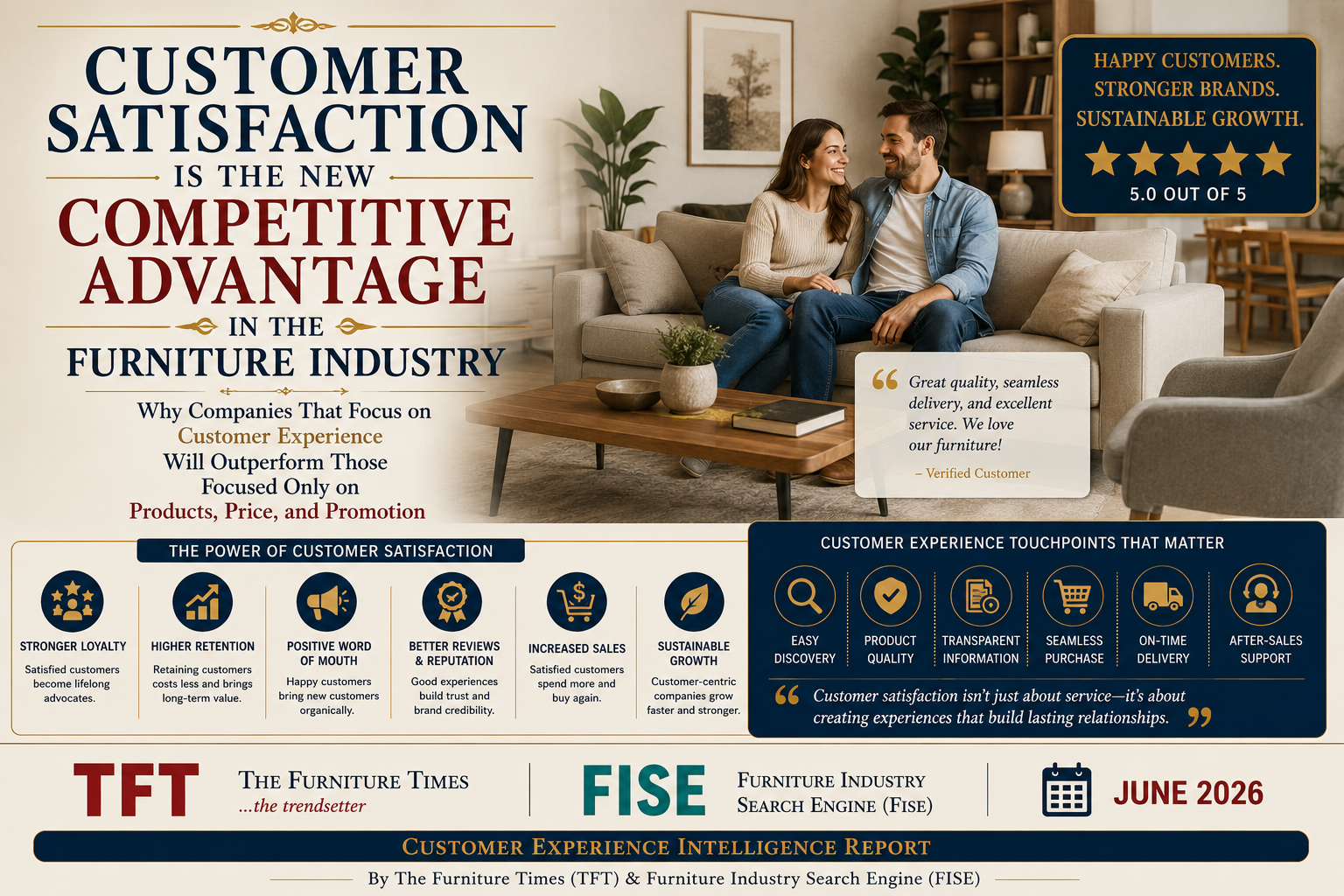
Customer Satisfaction Is the New Competitive Advantage in the Furniture Industry
Why Companies That Focus on Customer Experience Will Outperform Those Focused Only on Products, Price, and Promotion
Customer Experience Intelligence Report
By The Furniture Times (TFT) & Furniture Industry Search Engine (FISE)
June 2026
For decades, the furniture industry competed on three primary factors:
- Price
- Product Quality
- Distribution
Manufacturers focused on production.
Retailers focused on inventory.
Sales teams focused on closing deals.
The assumption was simple:
Build a good product.
Offer a competitive price.
Customers will buy.
While these fundamentals remain important, the global furniture industry is entering a new era.
An era where customer satisfaction is becoming one of the most important competitive differentiators.
In 2026, consumers have more choices than ever before.
They can compare products instantly.
Read reviews.
Watch videos.
Research competitors.
Check delivery experiences.
Evaluate customer service.
And share their experiences publicly.
The result is clear:
Companies are no longer judged solely by what they sell.
They are judged by how they make customers feel.
Customer satisfaction has become a business strategy rather than a customer service department responsibility. Research consistently shows that customer satisfaction is a leading indicator of customer loyalty, repeat purchases, and willingness to recommend a company to others.
The Furniture Industry’s Biggest Misunderstanding
Many furniture businesses still believe customer satisfaction begins after a purchase.
This is incorrect.
Customer satisfaction begins long before a customer buys.
It begins with:
- Search experience
- Website usability
- Product discovery
- Product information
- Communication quality
- Brand trust
The customer journey starts the moment a buyer begins looking for a solution.
Every interaction shapes perception.
Why Customer Satisfaction Matters More Than Ever
The cost of acquiring customers continues to rise globally.
Advertising costs are increasing.
Competition is intensifying.
Consumer expectations are evolving.
As a result, customer retention has become increasingly important.
Satisfied customers:
- Buy again
- Recommend businesses
- Leave positive reviews
- Create referrals
- Reduce acquisition costs
Customer satisfaction is often one of the strongest predictors of future purchase behavior and brand advocacy.
The Shift From Product-Centric to Customer-Centric Business
Historically, furniture businesses asked:
“What products should we manufacture?”
Modern businesses ask:
“What problems are customers trying to solve?”
This shift changes everything.
Customers do not buy sofas.
They buy comfort.
Customers do not buy wardrobes.
They buy organization.
Customers do not buy dining tables.
They buy experiences.
Customers do not buy office furniture.
They buy productivity.
Understanding this distinction is critical.
The most successful companies focus on customer outcomes rather than product specifications alone.
Customer Satisfaction Starts With Accurate Information
One of the biggest causes of customer frustration in furniture retail is inaccurate information.
Examples include:
- Incorrect dimensions
- Inaccurate delivery timelines
- Outdated pricing
- Misleading product descriptions
- Poor product images
Modern consumers expect transparency.
Accurate information builds trust.
Trust builds confidence.
Confidence drives purchasing decisions.
The Digital Experience Is Now Part of Customer Satisfaction
The furniture buying journey has become increasingly digital.
Customers expect:
- Easy navigation
- Smart search
- Mobile-friendly websites
- Product comparisons
- Real-time availability
- Fast responses
Companies that create friction in the buying process often lose customers before they reach the checkout stage.
Digital experience has become part of customer experience.
Why Visualization Improves Customer Confidence
Furniture is one of the most visual product categories in the world.
Customers frequently ask:
Will it fit?
Will it match?
Will it look good?
Will it work in my space?
This is why technologies such as:
- 3D visualization
- Product configurators
- Virtual showrooms
- Room planning tools
are becoming increasingly important.
These tools reduce uncertainty.
Reduced uncertainty improves customer confidence.
Improved confidence improves satisfaction.
Furniture technology providers increasingly focus on digital visualization, configuration, and product selection tools that help customers make better-informed purchasing decisions.
Fast Response Creates Better Experiences
One of the most overlooked drivers of customer satisfaction is responsiveness.
Customers expect answers quickly.
Questions about:
- Availability
- Pricing
- Materials
- Delivery
- Warranty
- Installation
require timely responses.
Research across service industries consistently shows that responsiveness and communication quality significantly influence customer satisfaction outcomes.
Furniture businesses that respond quickly gain a major advantage.
Personalization Is Becoming Expected
Consumers increasingly expect personalized experiences.
They want:
- Relevant recommendations
- Customization options
- Material choices
- Color selections
- Flexible configurations
Furniture companies that offer personalized buying experiences create stronger emotional connections with customers.
The future is moving toward customer-specific solutions rather than one-size-fits-all products.
Why Customer Satisfaction Impacts Revenue
Many businesses view customer satisfaction as a soft metric.
In reality, it directly affects financial performance.
Higher satisfaction often leads to:
Repeat Purchases
Satisfied customers return.
Referrals
Satisfied customers recommend.
Better Reviews
Satisfied customers share positive experiences.
Reduced Marketing Costs
Word-of-mouth reduces customer acquisition expenses.
Stronger Brand Reputation
Trust compounds over time.
Customer satisfaction influences loyalty, recommendation behavior, and future purchasing intentions.
The Furniture Industry’s Customer Experience Gap
Many furniture companies still focus heavily on:
- Manufacturing
- Inventory
- Pricing
while underinvesting in:
- Customer communication
- Digital experiences
- Service quality
- Customer education
This creates a significant opportunity.
The companies that prioritize customer experience can differentiate themselves even in highly competitive markets.
The Rise of Data-Driven Customer Experience
Modern businesses increasingly use data to understand customers.
They analyze:
- Search behavior
- Product preferences
- Purchase patterns
- Service interactions
- Customer feedback
Technology platforms now help manufacturers and retailers improve quoting accuracy, configuration experiences, product selection, and customer engagement across the buying journey.
The future of customer satisfaction will be increasingly data-driven.
What Furniture Companies Must Improve
To improve customer satisfaction, furniture businesses should focus on:
Product Information Quality
Website Experience
Search & Discovery
Faster Communication
Delivery Transparency
Customization Options
After-Sales Service
Customer Education
Trust Building
Consistent Follow-Up
Customer satisfaction is not created by one department.
It is created by the entire organization.
The Future Customer Will Be Different
The next generation of furniture buyers will expect:
- Instant information
- Digital convenience
- Personalization
- Sustainability
- Transparency
- Faster service
Businesses that fail to adapt may struggle.
Businesses that embrace customer-centric thinking will thrive.
Why Customer Satisfaction Is Becoming a Strategic Asset
In a crowded marketplace, products can be copied.
Prices can be matched.
Technologies can be replicated.
Customer relationships are harder to duplicate.
This is why customer satisfaction is becoming a strategic advantage.
The companies that consistently deliver exceptional experiences build stronger loyalty and stronger brands.
TFT & FISE Analysis
The global furniture industry is shifting from a product economy toward an experience economy.
The winners will not necessarily be the companies with the largest factories.
Nor the companies with the lowest prices.
The winners will increasingly be the companies that understand customers best.
Customer satisfaction is no longer a support function.
It is a growth strategy.
It is a branding strategy.
It is a retention strategy.
And ultimately, it is a profitability strategy.
Final Verdict
The future of furniture retail, manufacturing, and distribution will be shaped by customer experience.
Consumers now judge businesses by:
- Ease of discovery
- Quality of information
- Communication
- Service
- Trust
- Overall experience
The companies that consistently improve customer satisfaction will generate stronger loyalty, stronger reputations, and stronger financial performance.
Because in the modern furniture economy:
Products attract customers.
Experiences retain them.
And the businesses that master customer satisfaction will be the businesses that lead the next decade of growth.
By The Furniture Times (TFT) & Furniture Industry Search Engine (FISE)
Customer Experience Intelligence Report | June 2026
“TFT tells their story. FISE helps the world find them.”
The furniture industry ecosystem is a $1 Trillion Dollar Industry.
