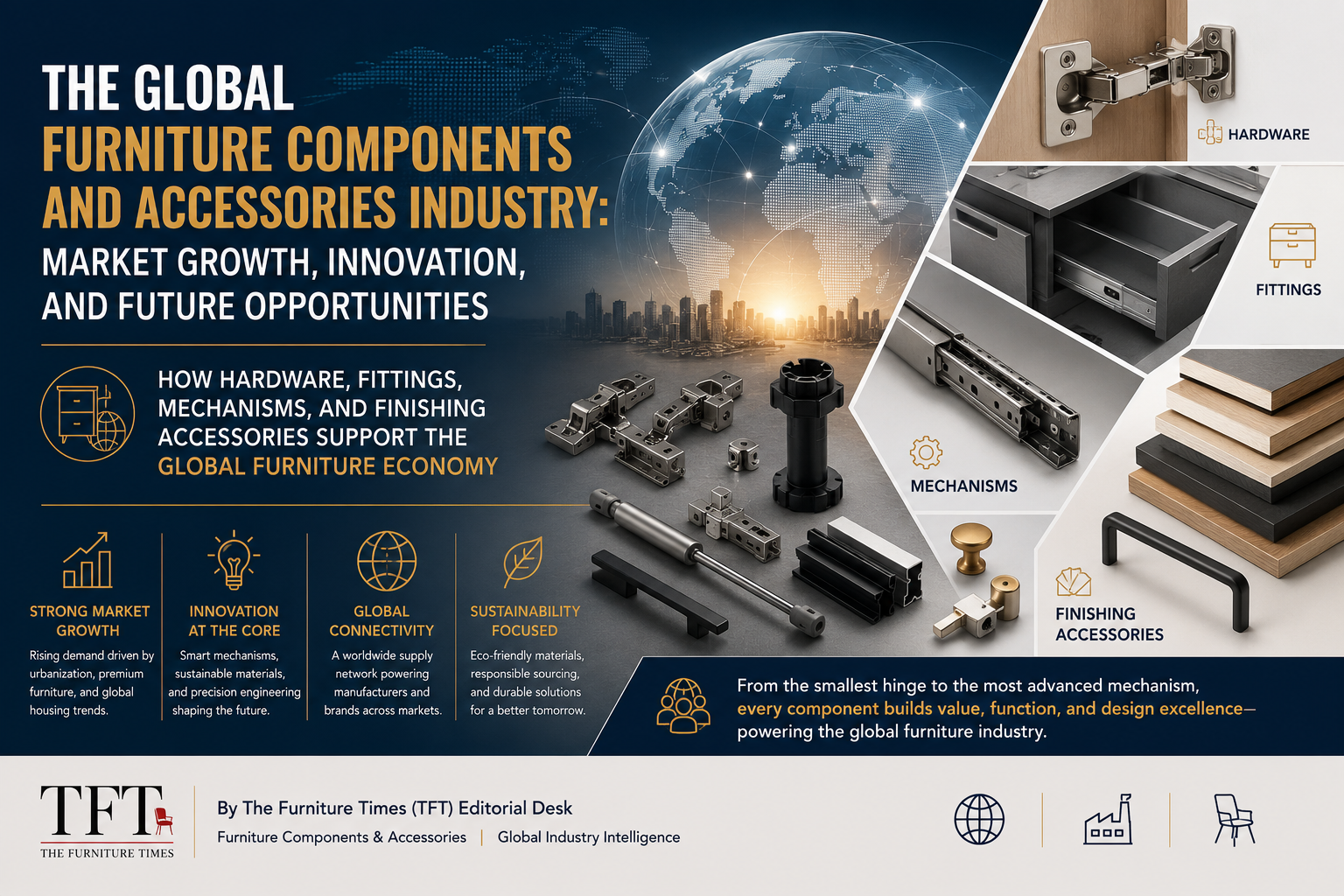
The Global Furniture Components and Accessories Industry
Market Growth, Innovation, and Future Opportunities
How Hardware, Fittings, Mechanisms, and Finishing Accessories Support the Global Furniture Economy
By The Furniture Times (TFT) Editorial Desk | Furniture Components & Accessories | Global Industry Intelligence
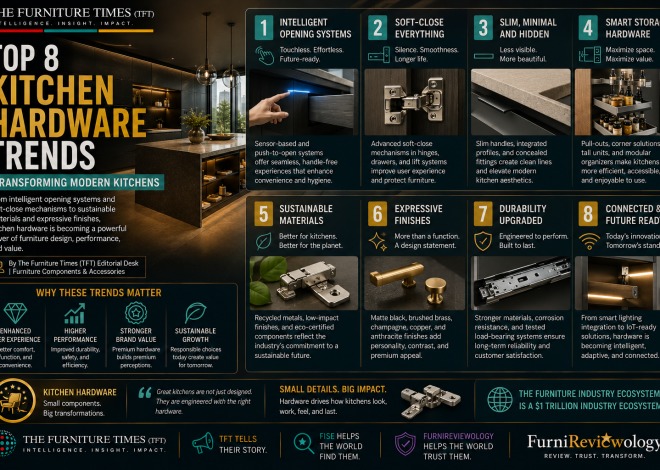
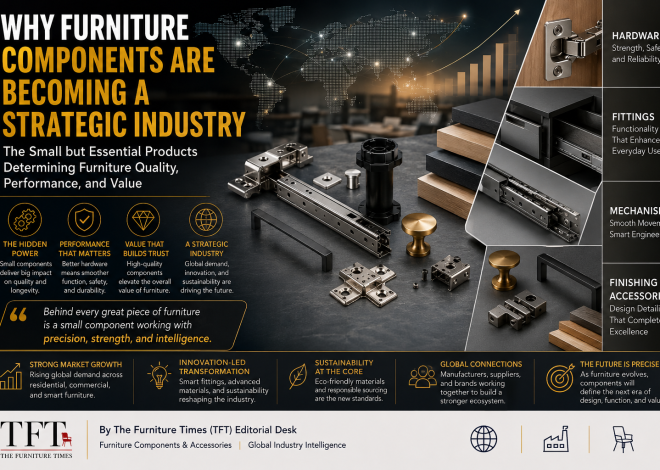
The global furniture industry is usually presented through finished products: sofas, beds, dining tables, wardrobes, kitchens, office desks, hotel furniture, outdoor collections, and decorative interiors. Yet beneath every successful furniture product lies another enormous and highly specialised industrial network—the furniture components and accessories industry.
A wardrobe cannot operate without hinges, tracks, connectors, handles, hanging systems, and internal organisers. A kitchen cabinet depends on drawer slides, lift-up mechanisms, corner-storage solutions, fasteners, levelling legs, profiles, and lighting accessories. An ergonomic office chair requires castors, bases, gas lifts, control mechanisms, armrests, lumbar-support systems, and upholstery components. A recliner relies on carefully engineered motion hardware, while an adjustable desk needs lifting columns, motors, control units, frames, and safety sensors.
These components may represent only a small part of the physical size of a finished product, but they can determine a large part of its performance, durability, safety, appearance, repairability, and customer satisfaction.
The furniture components and accessories sector is therefore not a secondary or supporting segment. It is one of the structural foundations of the global furniture economy.
As furniture production becomes more automated, customised, connected, sustainable, and internationally traded, demand is rising for components that are stronger, lighter, quieter, smarter, easier to install, easier to replace, and more environmentally responsible.
This transformation is creating opportunities for component manufacturers, technology companies, material suppliers, industrial designers, engineers, distributors, furniture producers, repair businesses, digital marketplaces, and small and medium-sized enterprises across the world.
The Invisible Industry Inside Every Furniture Product
Furniture is rarely made from a single material or produced entirely inside one factory. It is an assembly of materials, components, technologies, and services brought together through a complex supply chain.
A single modular kitchen, for example, may include:
- Cabinet boards and panels
- Hinges and mounting plates
- Drawer slides and runners
- Handles or integrated grip profiles
- Screws, dowels, cam locks, and connectors
- Adjustable legs and plinth systems
- Pull-out baskets and organisers
- Lift-up door mechanisms
- Corner-storage systems
- LED lighting profiles and sensors
- Worktop supports and joining hardware
- Waste-management accessories
- Electrical and charging modules
- Edge bands, adhesives, sealants, and finishing materials
Each component has a specific technical purpose. If even one important part performs poorly, the quality of the entire kitchen can be affected.
A weak hinge can cause cabinet doors to sag. An unreliable drawer slide can create noise, instability, or sudden failure. Poor fasteners may loosen after repeated use. Inferior castors can damage flooring or make office chairs unsafe. Low-quality upholstery foam can lose shape. A poorly designed recliner mechanism can reduce comfort and shorten the product’s life.
This is why furniture quality should not be judged only by what the customer can see. The engineering hidden inside the product is equally important.
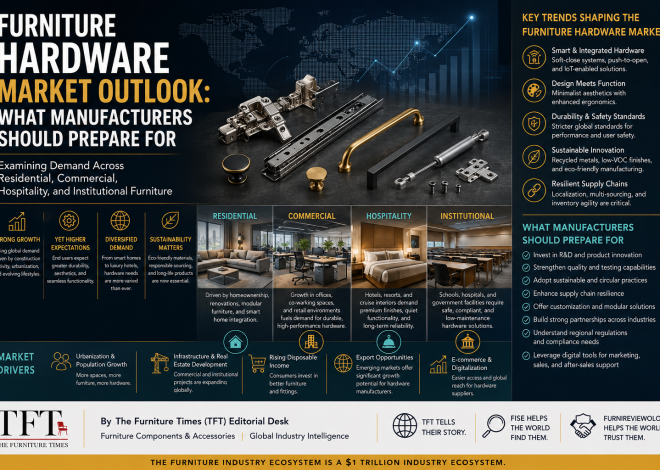
A Sector Serving Almost Every Furniture Category
The furniture components industry serves a broad range of markets, including:
- Residential furniture
- Kitchen and bathroom cabinetry
- Bedroom and wardrobe systems
- Office and workplace furniture
- Hospitality and hotel furniture
- Restaurant and café furniture
- Healthcare furniture
- Educational furniture
- Retail fixtures and display systems
- Outdoor and garden furniture
- Marine and recreational furniture
- Laboratory and technical furniture
- Public-space and institutional furniture
- Children’s furniture
- Smart and connected furniture
Every category has different performance requirements.
Components used in healthcare furniture may need to support hygiene, frequent cleaning, mobility, and intensive daily use. Outdoor furniture hardware must resist moisture, ultraviolet exposure, temperature fluctuations, and corrosion. Hotel furniture requires components capable of withstanding repeated use by different guests. Children’s furniture places greater emphasis on safety, controlled movement, rounded construction, and secure fastening.
The diversity of these requirements encourages specialisation. A supplier that understands a specific furniture category can create products that solve real technical problems rather than offering generic components alone.
What Is Driving Market Growth?
Several structural changes are increasing demand for furniture components and accessories.
1. Urbanisation and Residential Development
As cities expand, demand grows for apartments, houses, hotels, offices, schools, hospitals, restaurants, and retail environments. Each new building creates demand for furniture, storage, kitchens, wardrobes, workstations, seating, and interior systems.
Smaller urban homes are also increasing demand for multifunctional and space-saving furniture. Foldable tables, wall beds, sliding wardrobes, nesting furniture, extendable dining systems, hidden storage, and modular cabinets all depend on specialised mechanisms.
In this market, the component is not merely an attachment. It is what makes the furniture function.
2. The Expansion of Modular Furniture
Modular furniture allows consumers and businesses to configure products according to available space and changing requirements. Modular kitchens, wardrobes, office systems, shelving, sofas, and storage units have become important parts of modern furniture retail.
These systems require standardised connectors, interchangeable modules, adjustable fittings, compatible hardware, and precise manufacturing.
As modular furniture expands, component suppliers have an opportunity to provide complete systems rather than isolated products.
3. Growth of Ready-to-Assemble Furniture
Ready-to-assemble and flat-pack furniture has transformed global distribution. Products can be packed more efficiently, transported at lower volume, stored more easily, and delivered through e-commerce networks.
However, flat-pack furniture depends heavily on connector engineering. Cam locks, dowels, brackets, threaded inserts, screws, clips, and tool-free assembly systems must provide strength while remaining simple enough for consumers to use.
Better assembly hardware can reduce installation mistakes, missing-part complaints, product returns, and customer frustration.
4. Rising Expectations for Comfort and Convenience
Consumers increasingly expect drawers to close quietly, cabinet doors to remain aligned, wardrobes to offer organised storage, desks to adjust in height, chairs to support ergonomic movement, and furniture to integrate electrical connectivity.
Features once associated with premium furniture—such as soft-close hinges, full-extension drawer slides, concealed runners, lift-up cabinet systems, integrated lighting, and motorised adjustment—are entering wider market segments.
This is turning component innovation into a major source of product differentiation.
5. E-Commerce and Direct-to-Consumer Furniture
Online furniture sales have changed packaging, assembly, after-sales service, and replacement-parts requirements.
Furniture sold online must survive transportation through complicated delivery networks. It must also be easy to assemble without a professional installer. If a component is damaged or missing, the seller needs an efficient way to identify and replace it.
This creates opportunities for:
- Better protective packaging
- Numbered or colour-coded components
- QR-code assembly instructions
- Tool-free connections
- Standardised replacement parts
- Online spare-parts catalogues
- Video installation assistance
- Remote technical support
The future of furniture e-commerce will depend partly on how effectively brands manage the components after the sale.
Innovation Is Moving From the Surface to the Interior
For many years, furniture innovation focused heavily on shape, colour, material, and external styling. Today, some of the most significant innovation is taking place inside the product.
Soft-Close and Controlled-Movement Systems
Soft-close systems control the final movement of a drawer, door, or lid. They reduce impact, noise, and sudden movement while improving the perception of quality.
Their importance goes beyond convenience. Controlled movement can protect the furniture structure, reduce stress on joints, and improve user safety.
The next generation of movement systems is likely to become smaller, stronger, more adjustable, and easier to integrate into different product categories.
Push-to-Open and Handle-Free Systems
Minimalist interiors have increased demand for furniture without visible handles. Push-to-open mechanisms allow doors and drawers to open through light pressure.
This changes both furniture design and engineering. Manufacturers must achieve precise alignment because small inconsistencies become more visible on clean, handle-free surfaces.
Height-Adjustment Technologies
The growth of ergonomic workplaces has expanded demand for height-adjustable desks, monitor arms, mobile workstations, and adaptable seating.
Electric lifting columns, motors, controllers, memory settings, collision-detection systems, and cable-management accessories are now part of the furniture supply chain.
These technologies are also expanding into kitchens, healthcare products, laboratory furniture, hospitality spaces, and accessible home environments.
Smart and Connected Components
Furniture is gradually becoming part of the connected environment. Desks, tables, nightstands, wardrobes, seating, and storage systems can now incorporate:
- Wireless charging
- USB and power modules
- Motion sensors
- Occupancy monitoring
- Temperature controls
- Integrated speakers
- Lighting controls
- Electronic locks
- Position memory
- Safety alerts
- Usage and maintenance data
The opportunity is significant, but smart furniture must solve genuine user problems. Technology that adds complexity without providing lasting value can quickly become obsolete.
Successful smart components will need to be reliable, secure, repairable, energy-efficient, and compatible with widely used platforms.
Materials Innovation Is Changing Hardware Production
Furniture components are manufactured from steel, stainless steel, aluminium, zinc alloys, plastics, rubber, engineered wood, textiles, foams, composites, ceramics, and many other materials.
Material selection influences strength, weight, corrosion resistance, appearance, manufacturing cost, recyclability, and environmental performance.
Lightweight Materials
Lightweight components can reduce the total weight of furniture, making products easier to transport, install, and move. This can also reduce shipping-related costs and emissions.
However, reducing weight must not compromise safety or durability. Material optimisation requires careful engineering, testing, and quality control.
Recycled and Lower-Impact Materials
Manufacturers are exploring recycled metals, recycled plastics, bio-based polymers, certified wood materials, and lower-impact coatings.
The challenge is to deliver consistent performance at industrial scale. A recycled material must still meet requirements for load, wear, temperature, corrosion, colour, and dimensional stability.
Sustainability claims must also be supported by credible data. Buyers increasingly want information about recycled content, material origins, chemical composition, carbon impact, and end-of-life options.
Advanced Finishes and Coatings
The finish applied to a handle, leg, hinge, frame, or decorative fitting affects both appearance and performance.
Popular finishes include matte black, brushed brass, bronze, chrome, nickel, copper, titanium-inspired tones, powder-coated colours, and textured surfaces.
Future coating innovation will focus on:
- Improved scratch resistance
- Better corrosion protection
- Reduced use of hazardous substances
- Lower energy consumption during production
- Easier recycling
- Antimicrobial or easy-clean properties
- Longer-lasting colour consistency
Decorative hardware is increasingly becoming a fashion-driven category, but its environmental and technical performance will remain essential.
Sustainability Is Redesigning the Component Business
The circular economy is changing how furniture should be designed, manufactured, maintained, and recovered.
Under a traditional linear model, furniture is produced, sold, used, and eventually discarded. Under a circular model, products should remain useful for as long as possible through maintenance, repair, reuse, refurbishment, remanufacturing, and recycling.
Components are central to this transition.
A sofa with a damaged leg should not need to be discarded if the leg can be replaced. A wardrobe should remain usable when its hinges or tracks wear out. An office chair should be repairable through replacement castors, gas lifts, armrests, upholstery, or control mechanisms.
European circular-economy analysis has identified repair, refurbishment, and remanufacturing as important opportunities for recovering value, supporting economic activity, and creating jobs in the furniture sector. It has also highlighted the need for circular measures that are realistic for SMEs, which make up a large part of the furniture industry. European Circular Economy Stakeholder Platform
Design for Disassembly
Furniture designed for disassembly allows components to be removed without damaging the surrounding material.
This can make it easier to:
- Repair damaged products
- Replace worn components
- Separate materials for recycling
- Refurbish furniture
- Reconfigure modular systems
- Recover high-value parts
- Upgrade selected technologies
Permanent adhesives and inaccessible fasteners can make disassembly difficult. Reversible connectors, identifiable parts, accessible fixing points, and clear instructions can extend product life.
Replacement Parts as a Business Opportunity
The replacement-parts market could become one of the most important opportunities in the furniture components sector.
Many consumers discard furniture because they cannot identify or obtain one missing or damaged part. Manufacturers may have discontinued the model, the fitting may not be standardised, or no digital catalogue may exist.
Component suppliers and furniture brands can address this problem by developing:
- Searchable spare-parts catalogues
- Component identification tools
- QR-coded product records
- Compatibility databases
- Long-term parts availability
- Repair kits
- Authorised service networks
- Direct-to-consumer replacement sales
This is not only an environmental service. It can become a recurring revenue model and a powerful source of customer loyalty.
Regulation and Digital Product Passports
The policy environment is also changing.
The European Union’s Ecodesign for Sustainable Products Regulation entered into force in July 2024. Its framework is intended to support products that are more durable, repairable, recyclable, resource-efficient, and transparent. Furniture was subsequently included among the priority product groups in the EU’s 2025–2030 working plan. European Commission
The European Commission describes a Digital Product Passport as a digital identity card for a product, component, or material. It is intended to provide relevant lifecycle information to businesses, consumers, repairers, recyclers, and public authorities. The EU’s DPP Registry became operational in July 2026, creating infrastructure that could eventually support product groups including furniture. European Commission—Digital Product Passport
For the furniture components industry, this direction could increase the importance of documenting:
- Material composition
- Component origins
- Recycled content
- Chemical information
- Repair instructions
- Compatibility data
- Product identifiers
- Disassembly procedures
- Maintenance requirements
- Recycling and disposal guidance
Companies should not wait until every requirement becomes mandatory before organising their data. Suppliers that develop traceable component records early may be better prepared for international buyers, government procurement, sustainability reporting, and future regulations.
Quality Testing Must Become a Market Priority
Furniture hardware often fails gradually. A hinge may operate correctly when new but lose alignment after thousands of cycles. A drawer slide may carry a static load but perform poorly under repeated movement. A coating may look attractive initially but corrode in humid or coastal conditions.
Professional testing can examine:
- Load capacity
- Repeated operating cycles
- Impact resistance
- Fatigue performance
- Corrosion resistance
- Dimensional accuracy
- Fastener withdrawal strength
- Surface adhesion
- Abrasion resistance
- Temperature and humidity performance
- Electrical safety for powered systems
Testing must reflect the intended application. A component for a rarely opened residential cabinet should not be evaluated in the same way as a fitting used in a hotel, hospital, school, restaurant, or public facility.
Furniture manufacturers should request clear technical data rather than relying only on appearance, price, or supplier assurances.
The Cost of Low-Quality Components
Low-cost hardware may appear to reduce the factory’s bill of materials, but the apparent saving can create much larger expenses later.
Possible consequences include:
- Production-line interruptions
- Difficult installation
- Misaligned doors and drawers
- Increased warranty claims
- Customer complaints
- Product returns
- On-site repairs
- Damage to panels and surfaces
- Negative reviews
- Loss of retailer confidence
- Damage to brand reputation
The real cost of a component should therefore include its total lifecycle impact—not simply its purchase price.
A more expensive hinge that lasts longer, installs faster, and reduces service calls may offer better value than a cheaper alternative. The same principle applies to slides, connectors, castors, gas lifts, recliner mechanisms, electrical modules, and upholstery materials.
Supply-Chain Risks and the Need for Diversification
Furniture manufacturers often depend on components sourced from multiple countries. A delay involving one specialised fitting can stop the completion of an entire furniture collection.
Recent global disruptions have made manufacturers more aware of vulnerabilities involving shipping, energy, metals, currency movements, trade restrictions, port congestion, and supplier concentration.
Companies are responding through:
- Dual or multiple sourcing
- Regional supplier development
- Strategic inventory
- Greater component standardisation
- Supplier quality audits
- Long-term purchasing agreements
- Digital supply-chain monitoring
- Local manufacturing partnerships
This does not mean international sourcing will disappear. Instead, sourcing decisions are likely to balance cost with resilience, lead time, service, compliance, and technical capability.
Opportunities for SMEs and Emerging Manufacturing Regions
The furniture components industry offers meaningful opportunities for small and medium-sized enterprises.
Not every company needs to manufacture a complete range of hardware. SMEs can specialise in narrow but valuable categories, such as:
- Custom handles and knobs
- Replacement parts
- Furniture repair kits
- Outdoor corrosion-resistant fittings
- Wardrobe organisers
- Cable-management accessories
- Decorative metal legs
- Modular connectors
- Sustainable packaging
- Sensor-based lighting systems
- Upholstery accessories
- Components for accessible furniture
- Small-batch customised hardware
Emerging furniture-producing countries can also reduce their dependence on imports by developing domestic component clusters.
Local component production can shorten delivery times, improve communication between suppliers and furniture factories, support product customisation, create skilled employment, and strengthen industrial resilience.
However, local manufacturing must compete on quality and technical capability—not only on price.
Digital Visibility Is Becoming Essential
Many furniture component manufacturers possess strong engineering capabilities but remain difficult to find online.
Their websites may contain limited technical information, outdated catalogues, or product descriptions that search engines and artificial-intelligence systems cannot understand properly. Some suppliers rely almost entirely on trade exhibitions, distributors, or private sales networks.
That approach limits discovery.
Modern buyers increasingly research suppliers before making direct contact. They search for specifications, applications, certifications, materials, minimum order quantities, compatibility, production capacity, export experience, and delivery capabilities.
A component supplier’s digital presence should therefore include:
- Clear product categories
- Accurate technical descriptions
- Downloadable specifications
- High-quality product images
- Application examples
- Installation information
- Test reports and certifications
- Material and finish options
- Replacement-part references
- Export and distribution information
- Searchable product codes
- Structured digital data
Digital visibility does not replace relationships, exhibitions, samples, or factory audits. It helps qualified buyers discover the supplier and begin the evaluation process.
This is where specialised platforms such as the Furniture Industry Search Engine can help connect furniture manufacturers with component suppliers, technology providers, distributors, designers, and service companies.
What the Future Could Look Like
The next decade of furniture-component development will be shaped by several connected forces.
Greater Intelligence
More components will incorporate sensors, controls, motors, safety functions, connectivity, and usage data.
Greater Customisation
Digital manufacturing, CNC production, additive manufacturing, and flexible tooling will make smaller production runs and personalised components more commercially practical.
Greater Circularity
Replaceable, repairable, reversible, traceable, and recyclable components will become increasingly valuable.
Greater Standardisation
Manufacturers and consumers will demand easier compatibility, clearer identification, and longer-term spare-parts availability.
Greater Transparency
Material records, compliance information, lifecycle data, and Digital Product Passports will influence sourcing decisions.
Greater Collaboration
Furniture factories will work more closely with component engineers, material scientists, software developers, industrial designers, sustainability experts, and logistics companies.
Greater Focus on Total Value
Successful suppliers will compete through performance, service, data, availability, engineering support, sustainability, and reliability—not only through price.
A Strategic Message for the Global Furniture Industry
The future of furniture will not be decided solely by the design of finished products. It will also be decided by the intelligence, durability, precision, sustainability, and accessibility of the components inside them.
A hinge can improve the life of a cabinet. A connector can make a product reusable. A lifting mechanism can make furniture more accessible. A replacement component can prevent an entire product from becoming waste. A sensor can improve safety. A standardised fitting can simplify global production. A searchable digital record can help a repairer identify the right part years after the original purchase.
These are not minor contributions. They influence how furniture is manufactured, transported, installed, experienced, maintained, repaired, and eventually recovered.
For furniture brands, component selection should become a strategic management decision. For component suppliers, the opportunity is to move from selling individual parts to delivering complete solutions. For policymakers, investors, and industrial-development agencies, the sector represents an opportunity to create manufacturing capability, skilled jobs, export value, circular services, and technological innovation.
The global furniture components and accessories industry may often remain behind panels, underneath upholstery, or inside furniture structures. Nevertheless, it is one of the most important forces keeping the entire furniture economy in motion.
The Furniture Times (TFT) & Furniture Industry Search Engine (FISE)
“TFT tells their story. FISE helps the world find them.”
FurniReviewology helps the world trust them.
The furniture industry ecosystem is a $1 trillion industry ecosystem.