Top 8 Kitchen Hardware Trends Transforming Modern Kitchens
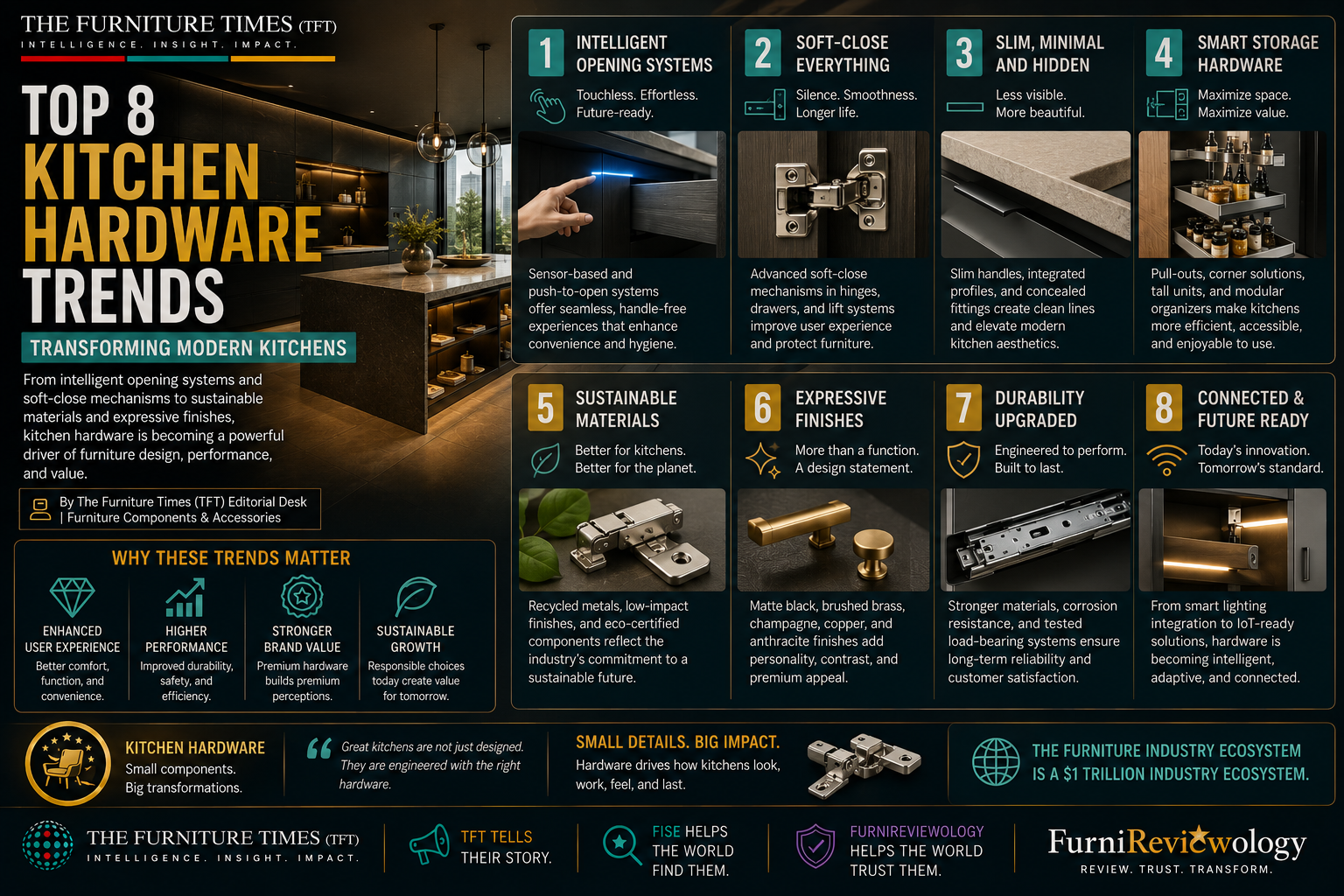
From intelligent opening systems and soft-close mechanisms to sustainable materials and expressive finishes, kitchen hardware is becoming a powerful driver of furniture design, performance, and value.
By The Furniture Times (TFT) Editorial Desk | Furniture Components & Accessories
Kitchen hardware may represent only a small portion of a completed kitchen’s visible surface, but its influence reaches almost every part of the user experience. Hinges determine how smoothly doors operate. Drawer slides affect load capacity and accessibility. Handles shape the visual character of cabinetry. Brackets support open shelves, while lift systems, lighting controls, locks, organizers and soft-close mechanisms determine how safely and conveniently the kitchen performs.
These components are therefore no longer being treated as secondary accessories selected near the end of a project. Hardware is increasingly considered during the earliest stages of product development, cabinet engineering and interior planning.
A source article published by Vocal identified eight leading kitchen-hardware directions: matte black and brushed-gold finishes, smart hardware, integrated pulls, sustainable options, soft-close mechanisms, textured hardware, mixed metals and open-shelving hardware. These trends demonstrate how the category is moving toward a combination of aesthetics, intelligence, environmental responsibility and everyday practicality. Vocal’s original “Top 8 Kitchen Hardware Trends” article
Although these ideas emerged as major themes for 2025, their influence continues to shape product development and purchasing decisions. The larger message for the furniture industry is clear: the future kitchen will not be defined by cabinetry alone. It will be defined by the components that make cabinetry work.
Hardware Moves from Supporting Role to Strategic Feature
Historically, kitchen-hardware purchasing was frequently driven by price, availability and basic compatibility. Manufacturers selected components that could open a cabinet, support a drawer or connect a panel. Consumers rarely asked which hinge, slide or connector was installed inside the furniture.
That situation is changing.
Consumers have become more familiar with soft-close drawers, touch-to-open doors, integrated lighting and handle-free cabinets. Once customers experience these features, they begin to expect them in future purchases. This raises the minimum performance standard across the market.
Kitchen manufacturers must consequently evaluate hardware according to several interconnected criteria:
- Functional reliability and tested durability
- Ease of installation and adjustment
- Load-bearing performance
- Noise reduction
- Visual compatibility
- Corrosion and moisture resistance
- Maintenance and replacement requirements
- Environmental impact
- Accessibility and ease of operation
- Integration with connected-home technology
The hardware category is moving beyond isolated products. Manufacturers are increasingly developing coordinated systems involving hinges, runners, opening mechanisms, organizers, lighting and digital controls.
1. Matte Black and Brushed Gold Become Modern Essentials
Matte black and brushed gold have emerged as two of the most influential finishes in contemporary kitchen design.
Matte black offers a strong visual contrast against pale wood, white cabinetry, stone surfaces and neutral interiors. It can also complement darker cabinet fronts by creating a quiet, architectural appearance. Unlike highly polished surfaces, matte finishes generally create a restrained look that works across modern, industrial and transitional kitchens.
Brushed gold delivers a different effect. Its warmer tone can soften minimal interiors and introduce a controlled sense of luxury. The brushed texture is usually more subtle than highly polished gold, helping it work with wood grains, marble-inspired surfaces and muted colors.
The importance of these finishes extends beyond appearance. Manufacturers must consider resistance to scratches, fingerprints, cleaning agents, humidity and daily handling. A fashionable finish that deteriorates rapidly can generate warranty claims and damage the reputation of an otherwise well-made kitchen.
Component producers are therefore investing in coating technologies and surface treatments that preserve color consistency across multiple batches. This matters when a kitchen uses matching handles, knobs, hinges, shelf brackets and other visible accessories.
The trend also creates opportunities for coordinated product families. A supplier that offers the same finish across cabinet handles, drawer pulls, legs, brackets and lighting profiles can help manufacturers create a more unified collection.
2. Smart Kitchen Hardware Introduces a New Level of Convenience
The movement toward connected homes is reaching kitchen furniture. Hardware is no longer limited to mechanical movement; it is increasingly interacting with sensors, lighting, electronic locks and automated opening systems.
Examples of smart kitchen hardware include:
- Drawers or doors activated by touch
- Sensor-controlled cabinet lighting
- Interior lights that switch on when a drawer opens
- Electrically assisted lift-up doors
- Programmable locks for selected cabinets
- Charging systems built into drawers or work surfaces
- App-controlled cabinet and display lighting
- Sensors capable of detecting whether a door is open
These features can improve convenience, accessibility and cleanliness. Touch-assisted systems may be particularly valuable when users have wet or occupied hands. Interior lighting can make deep drawers and corner cabinets easier to navigate, while electronic assistance can reduce the effort required to operate large fronts.
However, smart hardware creates additional responsibilities for manufacturers. A connected mechanism must be dependable as both a physical component and an electronic system. Product designers need to consider power supply, wiring routes, sensor placement, software compatibility and what happens during a power failure.
Repairability is equally important. If a small electronic module fails, the customer should not need to replace an entire cabinet. Modular construction, accessible spare parts and clear diagnostic procedures will be essential if smart furniture is to earn long-term consumer confidence.
Cybersecurity and privacy may also become more relevant as connected kitchen systems expand. A basic motion-activated light presents little concern, but hardware connected to broader smart-home networks requires careful data and security management.
The strongest smart-hardware products will be those that solve genuine problems without making the kitchen unnecessarily complicated.
3. Integrated Pulls Create Cleaner Cabinet Fronts
Minimalist kitchens continue to influence cabinet design, encouraging manufacturers to remove visual interruptions from furniture fronts. Integrated pulls and handle-free opening systems support this objective.
Instead of attaching a separate handle to the door, manufacturers can incorporate a recessed grip, finger channel or shaped edge into the cabinet front. This creates a continuous appearance across banks of drawers and doors.
Integrated pulls can deliver several benefits:
- Cleaner visual lines
- Reduced risk of clothing catching on protruding handles
- Easier movement through narrow kitchens
- Greater emphasis on cabinet materials and finishes
- Compatibility with modern architectural interiors
The design is deceptively simple. A successful integrated grip must be comfortable, accessible and easy to clean. If the recess is too shallow, users may struggle to open heavy drawers. Sharp or poorly finished edges can make operation uncomfortable. Dark finger channels may also reveal dust and grease if their shape makes cleaning difficult.
Cabinet producers must coordinate the front design with the hinge or runner system. Heavy, wide drawers require sufficient grip space and high-quality slides. Handle-free doors may need push-to-open mechanisms, concealed profiles or electrically assisted opening.
Manufacturing precision is vital because alignment errors become particularly visible in minimalist cabinetry. Even a small inconsistency between adjacent profiles can interrupt the intended appearance.
4. Sustainable Hardware Enters Mainstream Product Development
Sustainability discussions in furniture have often concentrated on timber, panels, fabrics and packaging. Hardware is now becoming part of the same conversation.
Kitchen components can contain metals, plastics, coatings, lubricants, electronic parts and packaging materials. Each element contributes to the product’s environmental footprint and affects whether the finished furniture can eventually be repaired, disassembled or recycled.
More sustainable hardware development may involve:
- Recycled or responsibly sourced metals
- Components designed for long service life
- Replaceable parts instead of sealed assemblies
- Lower-impact surface treatments
- Water-based or reduced-emission coatings
- Reduced packaging
- Elimination of unnecessary mixed-material construction
- Clear material identification
- Designs that facilitate furniture disassembly
Durability should remain central to this discussion. A component that uses less material but fails prematurely may generate more waste through repair and replacement. Genuine sustainability requires manufacturers to consider the complete service life of the hardware.
Standardization can support circularity as well. If a damaged hinge can be replaced without modifying the cabinet, the furniture may remain in use for many more years. Reliable spare-parts availability can therefore be as important as recycled content.
For furniture brands, credible environmental communication will require evidence. Broad terms such as “green” or “eco-friendly” should be supported by material data, certifications, lifecycle information or documented improvements.
5. Soft-Close Mechanisms Become an Expected Standard
Soft-close technology has moved rapidly from premium kitchens into the mainstream market. Many consumers now regard it as a basic indicator of quality.
The mechanism slows a door or drawer during the final part of its movement, allowing it to close quietly and under control. The immediate benefit is noise reduction, but the technology can also reduce repeated impact on cabinet fronts, joints and contents.
Soft-close systems are expanding into multiple applications:
- Standard cabinet hinges
- Deep and heavily loaded drawers
- Pantry pull-outs
- Corner-storage mechanisms
- Sliding doors
- Lift-up cabinet fronts
- Waste-bin systems
- Pocket-door mechanisms
Performance varies considerably between products. A well-engineered mechanism should operate consistently across the intended temperature range and load condition. It should not make a drawer difficult to open or cause a lightweight door to stop before closing completely.
Manufacturers must match the mechanism to the door dimensions, material weight and movement geometry. Oversized fronts may require different damping strength or additional hinges. Drawer systems need to maintain smooth movement even when loaded with cookware, appliances or food supplies.
Installation accuracy also matters. Poor alignment can prevent even high-quality hardware from working correctly. Furniture factories and installers therefore need clear drilling patterns, adjustment procedures and quality-control checks.
Soft-close technology illustrates a broader industry principle: customers may not see the mechanism, but they judge the entire kitchen by how it feels.
6. Textured Hardware Adds a Tactile Dimension
Knurled, ribbed, hammered and grooved surfaces are giving handles and knobs a more tactile character. Texture allows a relatively small component to become a carefully controlled design feature.
Textured hardware can create contrast against smooth cabinet fronts. It can also improve grip, making certain handles easier to operate. The effect works across several styles, from industrial kitchens using dark knurled metal to premium interiors using finely ribbed brass-toned pulls.
Texture introduces new manufacturing considerations. The pattern must remain consistent across components, and edges should feel comfortable during repeated use. Deep grooves can collect dust or cooking residue, so the profile should allow practical cleaning.
Suppliers must also ensure that the decorative finish reaches the recessed portions of the pattern. Inconsistent coating can become visible quickly on highly detailed surfaces.
The opportunity for furniture brands lies in differentiation. Standard cabinet shapes can gain a distinctive identity through carefully selected textured hardware. Manufacturers may even collaborate with component companies to develop exclusive patterns associated with a particular furniture collection.
7. Mixed Metals Replace Strict Finish Uniformity
The conventional approach to kitchen design often required every visible metal element to match. Cabinet handles, taps, appliances, lighting and accessories were expected to use a single finish.
Mixed-metal interiors offer greater flexibility. Black cabinet pulls may be combined with a stainless-steel sink and warm brass lighting. Chrome appliances can coexist with bronze-colored shelf brackets if the palette is deliberately balanced.
This approach reflects the broader shift toward personalized interiors. Consumers are less interested in purchasing a perfectly matched display-room package and more interested in spaces that feel collected, layered and individual.
Successful mixed-metal design still requires discipline. Using too many unrelated finishes can create visual confusion. Designers commonly select one dominant metal and one or two supporting finishes, repeating each deliberately across the room.
Hardware suppliers can respond by creating compatible finish groups rather than isolated colors. Digital visualization tools and physical sample boards can help manufacturers, designers and customers understand how finishes interact under different lighting conditions.
Color consistency remains a technical challenge. “Brushed brass” from one supplier may look very different from the same description offered by another. Furniture brands must compare physical samples instead of relying entirely on finish names or online images.
8. Open-Shelving Hardware Becomes a Visible Design Element
Open shelving remains influential in kitchens, particularly where designers want to break up continuous walls of cabinetry. As shelving becomes more visible, its supporting hardware becomes part of the interior composition.
Industrial metal brackets can provide a strong architectural character, while concealed supports create the appearance of floating shelves. Decorative brackets can introduce traditional or handcrafted details.
These systems must combine visual appeal with structural reliability. Manufacturers and installers need to consider:
- Shelf length, thickness and material
- Expected load
- Wall construction
- Fastener type
- Distance between supports
- Moisture and heat exposure
- Long-term deflection
- Installation tolerances
The increasing popularity of heavy stone, composite and solid-wood shelves makes proper engineering especially important. A bracket should not be selected solely because its appearance matches the room.
Open-shelving hardware also creates a new display opportunity for component brands. Unlike concealed hinges and runners, brackets remain permanently visible. This allows finish quality, form and craftsmanship to become part of the consumer’s purchasing decision.
What These Trends Mean for Hardware Manufacturers
The eight trends point to a category undergoing significant transformation. Component suppliers are being asked to deliver more than individual pieces of metal. They must provide coordinated finishes, intelligent functions, verified durability, installation support and replacement services.
Several strategic priorities are emerging.
First, testing will become increasingly important. Hardware must be evaluated under realistic loads and repeated operating cycles. Corrosion, coating adhesion, noise, alignment and temperature performance can all affect the user experience.
Second, documentation must improve. Furniture manufacturers need accurate dimensions, drilling patterns, load ratings, adjustment instructions and digital product data. This information also makes products easier for architects, designers and digital search platforms to discover and specify.
Third, component companies must support multiple market segments. Premium consumers may prioritize automation and exclusive finishes, while mass-market buyers may value durability, simple installation and replacement availability.
Finally, suppliers should view after-sales service as part of the product. Spare parts, installation videos, technical assistance and warranty clarity can influence whether a manufacturer continues using a hardware system.
What Furniture Brands and Kitchen Producers Should Prepare For
Kitchen manufacturers should avoid treating every trend as a short-term styling instruction. The objective is not to place all eight trends into one product. Instead, brands should determine which developments solve real problems for their customers.
A practical product-development strategy could include:
- Establishing soft-close operation as a baseline feature
- Offering premium smart-hardware upgrades
- Developing coordinated matte, metallic and textured finish packages
- Testing integrated pulls for comfort and accessibility
- Publishing component durability and material information
- Designing cabinets so important hardware can be replaced
- Using engineered shelf supports with declared load limits
- Maintaining spare parts for discontinued collections
- Gathering customer feedback about long-term operation
Hardware selection should also involve purchasing, design, engineering, production, installation and after-sales teams. A component may look excellent to a designer but create unnecessary complexity on the assembly line. Another may be inexpensive to purchase but costly to adjust or replace after installation.
The best decision considers total performance rather than unit price alone.
The Bigger Industry Opportunity
Kitchen hardware demonstrates why furniture components and accessories are becoming a strategic industry. A cabinet may be made from beautifully finished panels, but its perceived quality can be undermined immediately by a noisy hinge, unstable shelf or poorly moving drawer.
Conversely, thoughtfully engineered hardware can raise the value of relatively simple furniture. Smooth operation, intelligent storage, comfortable access and reliable closing give users a daily experience of quality.
This creates opportunities throughout the supply chain—for metals producers, coating specialists, mechanism designers, electronics developers, software providers, testing organizations, distributors and furniture manufacturers.
It also reinforces the importance of discoverability and trust. Buyers need accurate information to identify suitable component suppliers. They need independent reviews and documented performance to evaluate product claims. Component manufacturers, including smaller specialists, require platforms that can communicate their innovations to international markets.
Conclusion: Small Components, Major Influence
The top eight kitchen-hardware trends reveal an industry balancing design expression with practical engineering.
Matte black and brushed gold bring contrast and warmth. Smart hardware introduces automation and convenience. Integrated pulls support minimalist interiors. Sustainable options respond to environmental priorities. Soft-close systems improve comfort and component life. Textured surfaces add tactile identity. Mixed metals enable personalization, while open-shelving supports turn structural necessities into visible design features.
Together, these developments show that kitchen hardware is no longer an afterthought. It is becoming one of the clearest ways for manufacturers to improve furniture performance, distinguish their collections and create lasting customer value.
As kitchens become more intelligent, adaptable and environmentally responsible, the mechanisms behind their doors and drawers will become even more important. Consumers may not always know the name of every component, but they experience its quality every day.
Source: Vocal — Top 8 Kitchen Hardware Trends for 2025
The Furniture Times (TFT) & Furniture Industry Search Engine (FISE)
“TFT tells their story. FISE helps the world find them.”
FurniReviewology helps the world trust them.
The furniture industry ecosystem is a $1 trillion industry ecosystem.