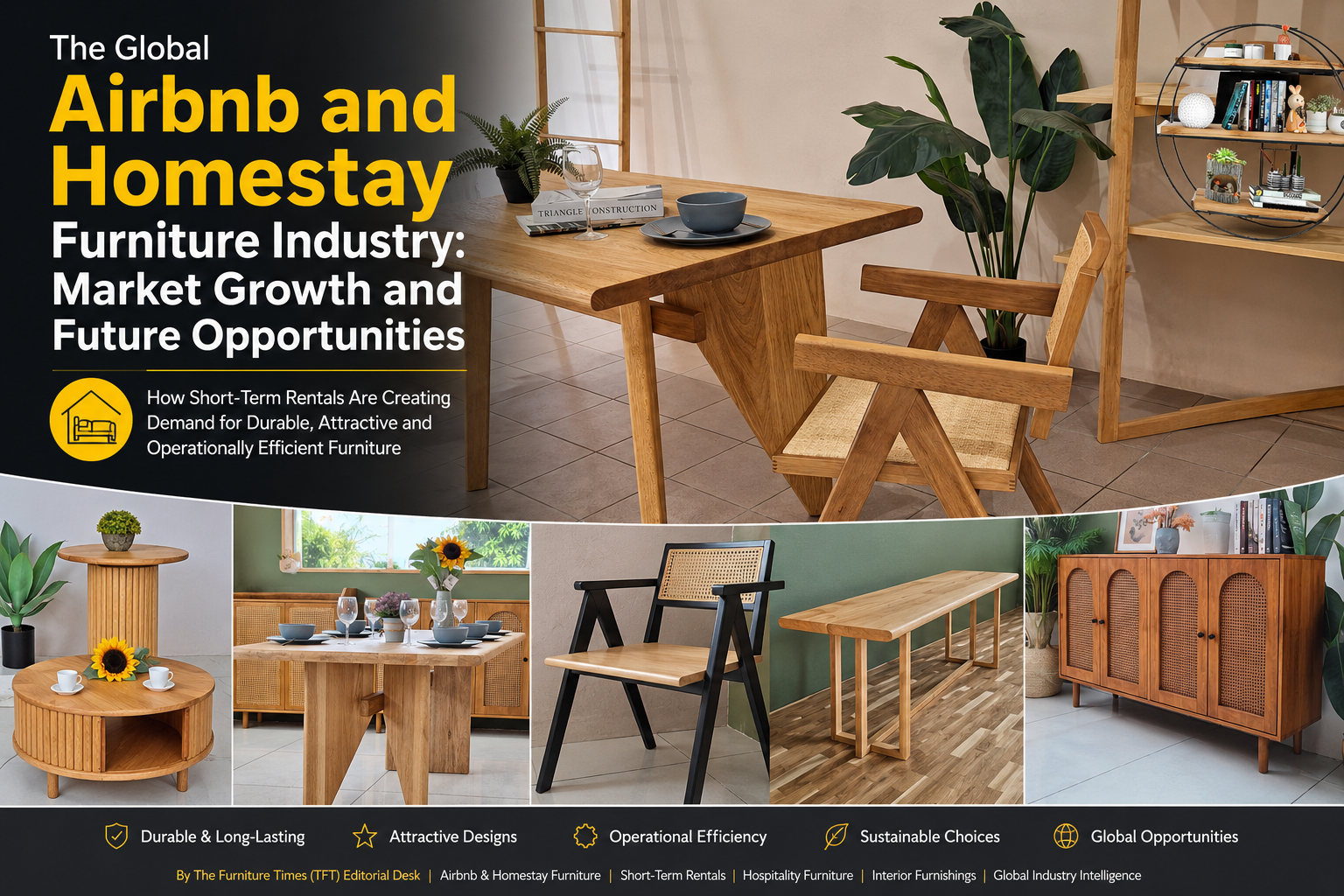
The Global Airbnb and Homestay Furniture Industry: Market Growth and Future Opportunities
The Global Airbnb and Homestay Furniture Industry: Market Growth and Future Opportunities
How Short-Term Rentals Are Creating Demand for Durable, Attractive and Operationally Efficient Furniture
By The Furniture Times (TFT) Editorial Desk | Airbnb & Homestay Furniture | Short-Term Rentals | Hospitality Furniture | Interior Furnishings | Global Industry Intelligence
The rapid expansion of Airbnb properties, vacation rentals, serviced apartments, villas, guesthouses and professionally managed homestays is creating an increasingly important market for furniture manufacturers, interior designers, furnishing companies, distributors and property-management specialists.
What was once largely an informal accommodation sector—where owners placed spare household furniture into an available room or holiday home—is becoming a professional hospitality economy. Hosts are competing for bookings, reviews, visibility and repeat guests. Property managers are operating dozens, hundreds or even thousands of units. Real-estate investors are designing apartments specifically for short-term accommodation. Developers are introducing rental-ready residences, while specialised furnishing companies are offering complete installation packages.
This transformation is producing a distinct furniture category: furniture designed for the operational and commercial realities of short-term rentals.
It must look attractive in photographs, withstand frequent guest turnover, accommodate different types of travellers, support efficient cleaning and remain affordable to replace. It must help a listing compete visually while reducing the owner’s maintenance, repair and operating costs.
The result is the emergence of a global Airbnb and homestay furniture industry positioned between residential furniture, hospitality furniture, contract furnishing and real-estate investment.
A Growing Accommodation Economy Creates a Growing Furniture Market
Short-term rentals have moved firmly into the mainstream of global travel.
Airbnb reported more than 9 million active listings across over 150,000 cities and towns in more than 220 countries and regions as of May 2026. The platform also reported more than 2.5 billion cumulative guest arrivals and approximately 5.5 million hosts worldwide. These figures illustrate the enormous physical accommodation infrastructure now operating through just one major platform. Airbnb Newsroom
The wider travel environment continues to support the sector. International tourist arrivals increased by 4% during 2025, while UN Tourism projected further growth of between 3% and 4% in 2026, subject to economic and geopolitical conditions. In the first quarter of 2026, international arrivals still increased by 2% despite major disruptions affecting parts of the global travel system. UN Tourism, UN Tourism Q1 2026 Update
Independent market estimates also suggest continued expansion. Grand View Research valued the global short-term vacation-rental market at approximately US$149.2 billion in 2025 and projected it to increase from US$165.7 billion in 2026 to US$362.4 billion by 2033. These figures are third-party forecasts rather than audited industry totals, but they indicate the scale of commercial expectations surrounding the category. Grand View Research
Every new property entering this market requires beds, mattresses, sofas, dining furniture, storage, lighting, outdoor furniture, workstations and decorative accessories. Existing properties also need frequent refurbishment, replacement and upgrading.
Furniture demand is therefore not generated only when a property is first launched. It continues throughout the operating life of the accommodation.
Airbnb Furniture Is Becoming a Category of Its Own
Airbnb and homestay furniture cannot be treated exactly like normal residential furniture.
A dining chair in a private home may be used by the same family for years. In a short-term rental, the chair may be used by hundreds of guests with different habits, weights and levels of care. A sofa may function as a living-room centrepiece, an informal dining seat, a workspace and occasionally an extra sleeping area. A bed frame may face continuous checking, cleaning, luggage impact and mattress movement.
This changes the purchasing criteria.
The owner is not simply buying an attractive object. The owner is acquiring a revenue-supporting business asset.
The furniture must contribute to:
- Stronger listing photographs
- Higher perceived accommodation value
- Positive first impressions
- Guest comfort
- Efficient housekeeping
- Reduced damage and maintenance
- Better use of limited space
- Faster property turnaround
- Consistency across multiple units
- Easier replacement and refurbishment
A beautiful product that is difficult to clean may become an operational problem. A cheap item that fails repeatedly can increase maintenance expenses and cause bad reviews. A fashionable design that cannot be replaced six months later may make portfolio standardisation difficult.
The best short-term-rental furniture combines visual appeal with commercial practicality.
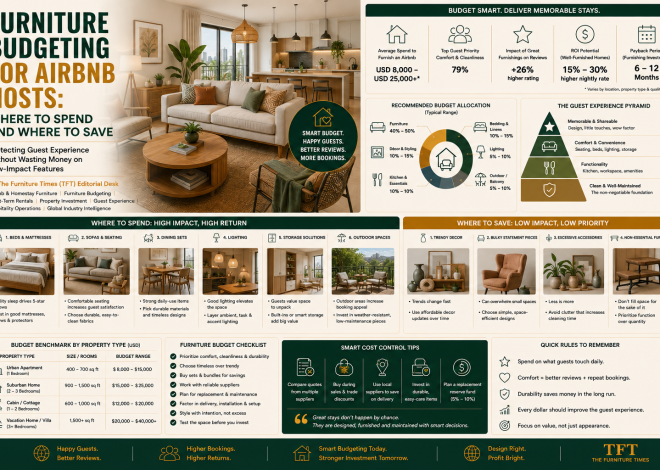
The Listing Photograph Has Become a Digital Showroom
Short-term accommodation is purchased primarily through images.
Before a guest touches the furniture, tests the mattress or sits on the sofa, the guest evaluates the property through a screen. Furniture therefore has two functions: it must perform well physically, and it must communicate value digitally.
The shape of a headboard, arrangement of a dining area, colour of an accent chair, texture of an outdoor lounge and visual openness of a living room can influence whether a traveller stops scrolling or continues to another listing.
This creates demand for furniture that is:
- Visually distinctive without being overly personal
- Proportionate to the room
- Easy to photograph in natural and artificial light
- Coordinated with the property’s interior identity
- Recognisable in small mobile-screen images
- Attractive across different camera angles
- Modern enough to remain relevant for several years
For many properties, furniture is part of the marketing budget.
A carefully designed interior can support stronger listing presentation, justify premium positioning and make an otherwise ordinary apartment more memorable. It can help owners distinguish their properties in markets where guests are comparing dozens of similar studios, condominiums or holiday homes.
However, “Instagrammable” design alone is insufficient. The property must deliver in person what its photographs promise. Poor comfort, unstable furniture, damaged surfaces or impractical layouts can quickly turn visual appeal into negative reviews.
Guest Reviews Are Changing Furniture Decisions
Ratings and reviews influence visibility, trust and booking behaviour across digital accommodation platforms.
Airbnb reported that more than 250 million nights had been booked at Guest Favourite listings following the introduction of that designation, with those listings maintaining an average overall rating of 4.92 at the time of its 2025 quality report. Although many factors determine guest satisfaction, these figures demonstrate the commercial importance of consistent property quality. Airbnb Global Quality Report
Furniture-related problems frequently appear in guest experiences:
- Uncomfortable mattresses
- No bedside tables or accessible charging points
- Insufficient dining seats
- Weak or unstable chairs
- Stained upholstery
- Inadequate clothes storage
- Poor-quality sofa beds
- Lack of luggage space
- Uncomfortable workstations
- Damaged outdoor furniture
- Sharp corners in family-oriented properties
- Furniture that makes rooms feel smaller than advertised
A single poorly selected mattress can affect hundreds of stays. One fragile chair can create maintenance expenses, safety concerns and emergency replacement requirements. In contrast, reliable furniture quietly supports positive reviews without drawing attention to itself.
This is why professional operators increasingly evaluate furniture through guest experience data rather than personal taste alone.
Durability Is Now a Commercial Requirement
Short-term-rental furniture experiences heavier and less predictable use than furniture in most private homes.
Guests arrive with luggage, children, food, cosmetics, wet clothing and outdoor equipment. Furniture may be moved without permission. Sofas and beds may be used beyond their intended capacity. Cleaning teams must reset the property quickly, often several times each week.
Manufacturers serving this market should therefore consider:
- Strong frame construction
- Reinforced joints
- High-quality hardware
- Replaceable components
- Commercial-grade upholstery
- Stain-resistant and easy-clean fabrics
- Scratch-resistant surfaces
- Moisture and humidity resistance
- Stable bed and seating structures
- Washable or removable covers
- Rounded edges where appropriate
- Floor-protecting glides
- Clearly stated weight capacities
- Availability of replacement parts
Durability should not mean making every interior look like an institutional hotel. The opportunity lies in producing furniture with residential warmth and contract-level performance.
This combination may become one of the most valuable product-development areas in the sector.
Operational Efficiency Is as Important as Appearance
Professional short-term-rental operators think in terms of turnover time, labour costs and property uptime.
A cleaner who must move a very heavy bed to retrieve objects, remove complicated cushion covers or clean beneath low-clearance furniture loses valuable time. A damaged custom item that requires six weeks to replace may force the operator to accept an imperfect room or temporarily stop bookings.
Operationally efficient furniture can include:
- Bed frames with accessible cleaning clearance
- Headboards mounted securely to the wall
- Tables with surfaces that tolerate common cleaning products
- Dining chairs without difficult dust-catching details
- Modular sofas with replaceable sections
- Removable upholstery covers
- Nightstands with integrated power access
- Open luggage racks
- Storage beds for compact urban apartments
- Stackable or foldable balcony furniture
- Lightweight pieces that housekeeping teams can safely move
- Standardised hardware and components
- Products available from repeatable stock programmes
For a single host, these details improve convenience. For a portfolio manager operating 100 apartments, they can significantly affect labour hours, maintenance expenditure and revenue availability.
The growth of professional property management will therefore encourage a more systematic approach to furniture procurement.
Major Product Categories Benefiting From Short-Term Rentals
1. Beds, Mattresses and Headboards
Sleep remains one of the most important components of the accommodation experience. Hosts may reduce spending on decorative items, but poor mattress quality can create immediate complaints.
Opportunities exist for durable bed frames, hospitality-grade mattresses, washable protectors, modular headboards, accessible under-bed storage and systems that make linen changes easier.
Manufacturers can also develop configurations that allow rooms to change between twin and king arrangements, helping operators accommodate couples, families and groups.
2. Sofa Beds and Convertible Furniture
Space is expensive in urban destinations. Owners want to increase sleeping capacity without making rooms feel overcrowded.
Well-engineered sofa beds, wall beds, extendable tables, nesting tables and convertible seating can help small properties serve more guests. The challenge is to provide genuine comfort and simple operation. Complicated mechanisms and thin mattresses frequently disappoint guests.
3. Dining Furniture
Dining areas are central to the value proposition of a home-style stay. Families and groups often choose rentals because they can prepare meals and eat together.
Furniture must be proportionate to the property’s advertised occupancy. A listing for six guests with only four dining seats creates a functional contradiction. Extendable tables, benches and easily cleaned dining chairs offer strong potential.
4. Storage and Luggage Furniture
Guests need places for suitcases, clothes, shoes and personal items even during short stays.
Open wardrobes, luggage benches, hooks, shelves and compact storage systems can sometimes be more useful than large traditional cabinets. The best solutions also make it easier for housekeeping teams to identify items left behind.
5. Work-From-Anywhere Furniture
The boundary between leisure, business and extended stays continues to blur. Travellers may work during part of a holiday, while digital professionals may select accommodation based on the availability of a proper desk and comfortable chair.
Small ergonomic desks, multifunctional consoles, task lighting and seating designed for several hours of use can differentiate a property without consuming excessive space.
6. Outdoor Furniture
Villas, beach houses, mountain homes, rural homestays and urban properties with balconies use outdoor areas to strengthen their listing appeal.
Demand includes loungers, dining sets, poolside seating, parasols, daybeds, swings, balcony sets and modular outdoor sofas. Products must be selected according to UV exposure, rainfall, humidity, wind, salt air and maintenance capability.
7. Children’s and Family Furniture
Family travel creates demand for bunk beds, baby cots, highchairs, child-friendly storage and seating with safer edges and easy-clean surfaces.
This category offers an opportunity for furniture suppliers to build complete family-accommodation packages rather than sell products individually.
8. Decorative and Statement Furniture
A visually distinctive chair, locally crafted table or memorable headboard can become an important part of a listing’s identity. Such products help properties communicate a destination, culture or design story.
The opportunity is particularly strong for local artisans and regional manufacturers capable of creating character without sacrificing consistency or serviceability.
The Rise of Complete Furniture Packages
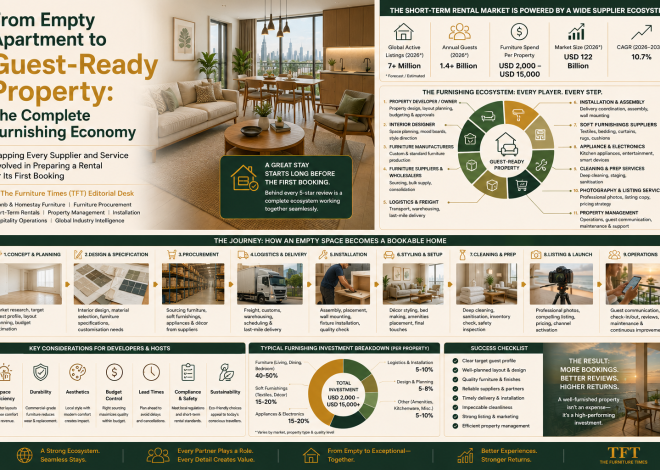
Many investors entering the short-term-rental market do not have the time or expertise to select dozens of products individually. They want a property prepared quickly so that bookings can begin.
This is creating demand for turnkey furnishing solutions that may include:
- Space planning
- Interior concept development
- Furniture selection
- Procurement
- Delivery and installation
- Window coverings
- Lighting
- Bedding and linen
- Kitchen equipment
- Artwork and accessories
- Photography preparation
- Inventory records
- Maintenance support
- Replacement programmes
Suppliers can develop packages for studio apartments, one-bedroom units, family homes, luxury villas, rural cottages and serviced residences. Clear pricing and installation timelines can make purchasing easier for investors.
The commercial advantage is significant: instead of selling one sofa or one dining table, the supplier becomes responsible for furnishing an entire revenue-generating property.
Standardisation Will Reshape Portfolio Procurement
As short-term-rental operators grow, they require greater consistency.
A host managing one property can purchase from several retailers and improvise when a product becomes unavailable. A professional manager furnishing 50 similar apartments needs repeatable specifications, controlled pricing, coordinated delivery and dependable replacement stock.
This creates opportunities for manufacturers to offer:
- Standard room packages
- Approved product catalogues
- Multi-unit pricing
- Regional warehousing
- Product codes and digital specifications
- Replacement guarantees
- Maintenance documentation
- Spare parts
- Furniture asset registers
- Rapid replenishment
- Customised finishes with minimum-order flexibility
Portfolio operators may also want to track installation dates, warranty status, repair history and expected replacement cycles. This could eventually connect short-term-rental furniture with digital product passports and furniture asset-management systems.
The furniture sale is therefore moving from a one-time transaction toward an ongoing service relationship.
Regional Opportunities
North America
North America remains a large and mature short-term-rental region, with demand spanning urban apartments, suburban homes, mountain cabins, coastal properties and large group accommodation.
Opportunities include durable furniture packages, family-oriented layouts, outdoor products, large dining tables and products suitable for high-capacity vacation homes. Operators also need faster replenishment and local after-sales support.
Europe
Europe combines established tourism destinations with apartments in historic buildings, countryside properties and premium villas.
Compact furniture, flexible storage, products for irregular room layouts and designs that respect local architectural character are important. Sustainability, repairability, material transparency and regulatory compliance are also likely to influence future purchasing.
Asia-Pacific
Asia-Pacific represents one of the most promising expansion regions because of its large population, recovering cross-border travel, growing middle class and increasing digital adoption.
Airbnb reported particularly strong first-time-booker growth in Brazil, Japan and India during the first quarter of 2026, while bookings originating in its expansion markets grew at roughly twice the rate of its core markets. This does not measure furniture demand directly, but it points toward accommodation growth in markets where new supply will require furnishing. Airbnb Q1 2026 Results
Manufacturers in Malaysia, Vietnam, Indonesia, China and India are well positioned to serve this demand, especially if they can combine competitive production with small-batch customisation and international delivery support.
Middle East
Luxury tourism, branded residences, large apartments and villa developments offer opportunities for premium short-term-rental furniture. Products must meet high expectations for visual impact, comfort and finish quality while tolerating heat, dust and intensive air-conditioned environments.
Latin America and Africa
Emerging destinations can create opportunities for locally manufactured furniture with strong cultural identity. Local production may reduce freight costs, shorten lead times and help properties deliver more authentic interior experiences.
However, suppliers must address inconsistent logistics, fragmented purchasing and varying levels of professional property management.
Sustainability and the Replacement Problem
Rapid furniture turnover can create a serious environmental challenge.
Cheap products may help a host open a property with a lower initial investment, but premature failure can lead to repeated purchasing, transportation and disposal. Damaged furniture may be difficult to repair if replacement parts are unavailable or if components are permanently bonded together.
A more sustainable short-term-rental model would prioritise:
- Durable construction
- Repairable joints and mechanisms
- Replaceable upholstery
- Modular components
- Refinishable surfaces
- Recycled or responsibly sourced materials
- Local manufacturing where practical
- Furniture take-back programmes
- Refurbishment and resale
- Accurate maintenance instructions
- Longer product warranties
Suppliers should communicate sustainability through measurable product characteristics rather than vague environmental claims.
For operators, the most sustainable furniture may often be the furniture that remains functional and attractive for the longest period.
Technology Will Enter the Furniture Procurement Process
Short-term rentals already use property-management systems, dynamic pricing, smart locks, automated guest communication and digital cleaning schedules. Furniture is likely to become part of this connected operational environment.
Future platforms could allow operators to monitor:
- Furniture purchase and installation dates
- Warranty expiration
- Reported damage
- Maintenance history
- Replacement cost
- Product location
- Supplier availability
- Guest complaints connected to specific items
- Expected service life
- Performance across different properties
Artificial intelligence may analyse guest reviews and identify recurring furniture problems, such as uncomfortable beds, insufficient seating or poor workspace design. Operators could then compare those findings with occupancy, rates and maintenance costs.
Visualisation tools may also help investors furnish virtual rooms, compare package costs and predict how furniture will appear in listing photographs before placing an order.
Important Risks Facing the Industry
Growth will not be uniform or risk-free.
Short-term-rental regulations are becoming stricter in many cities. Registration requirements, limits on rental nights, zoning rules, taxation and restrictions on non-owner-occupied properties can affect accommodation supply.
Economic weakness can reduce discretionary travel, while oversupply may pressure occupancy and nightly rates. In highly competitive markets, operators may delay refurbishment or choose cheaper furniture to protect cash flow.
Other risks include:
- Rising freight and material costs
- Seasonal demand
- Damage and misuse
- Product liability
- Fire and safety requirements
- Bedbug and hygiene concerns
- Inconsistent quality across suppliers
- Long replacement lead times
- Changing interior-design trends
- Difficulty recovering furniture when a property exits the market
Furniture companies should avoid treating every active listing as an equally stable long-term customer. The strongest opportunities may come from professional operators, developers, serviced-accommodation brands and experienced hosts with repeat purchasing potential.
Furniture Must Be Evaluated Through Lifecycle Cost
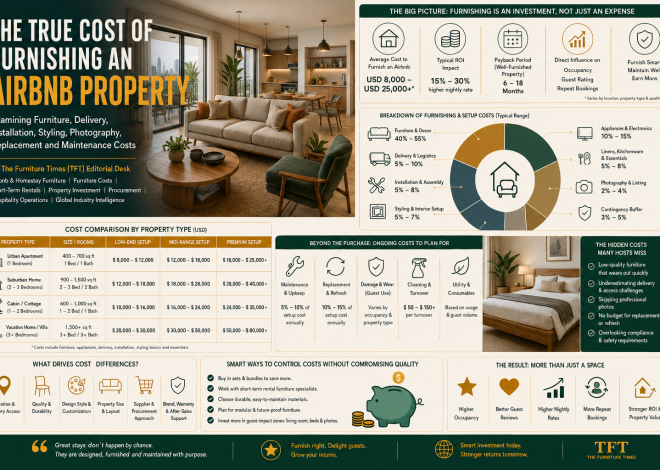
The lowest purchase price is not always the lowest operating cost.
Consider two dining chairs. One costs less but requires replacement after a year. The other costs more but survives several years and has replaceable glides and upholstery. Once delivery, installation, disposal, lost time and guest disruption are considered, the more expensive chair may be the better investment.
A proper lifecycle-cost assessment should consider:
- Initial purchase price
- Delivery and installation
- Cleaning requirements
- Maintenance frequency
- Repairability
- Replacement-part availability
- Expected service life
- Downtime caused by failure
- Disposal or resale value
- Effect on guest experience
Suppliers that help operators calculate these costs can move the conversation away from price alone and toward long-term value.
Future Opportunities for Furniture Companies
The global short-term-rental economy offers opportunities across manufacturing, distribution, design and technology.
Short-Term-Rental-Specific Collections
Brands can create dedicated collections tested for frequent turnover, easy cleaning, space efficiency and digital presentation.
Turnkey Furnishing Services
Complete packages can help investors move from an empty property to a booking-ready listing within a defined budget and schedule.
Rapid Replacement Networks
Local stock and fast delivery can be extremely valuable when broken furniture threatens future reservations.
Refurbishment and Circular Services
Companies can collect, repair, reupholster and redeploy furniture across an operator’s portfolio.
Furniture Leasing
Leasing or subscription models may appeal to operators who want to preserve cash flow or update properties regularly.
Local Design Partnerships
Manufacturers can collaborate with local artists and craftspeople to give accommodation a stronger destination identity.
Data-Driven Procurement
Suppliers can use damage reports, guest reviews and replacement records to continuously improve products.
Compliance Support
Clear documentation covering materials, flammability, structural testing, warranties and care instructions can strengthen confidence among professional buyers.
Flexible Small-Batch Production
Short-term-rental operators often need more customisation than retail customers but lower volumes than conventional hotel projects. Manufacturers capable of serving this middle ground can occupy a valuable market position.
What Manufacturers Should Do Now
Furniture manufacturers interested in this sector should begin by understanding how hosts and property managers operate.
They should study cleaning procedures, guest turnover, common damage, room photography, storage limitations and replacement urgency. Product development should involve property managers, housekeepers, maintenance teams, designers and guests—not only purchasing departments.
Manufacturers should also:
- Develop room-based furniture packages
- Provide transparent commercial specifications
- Test products for repetitive use
- Offer easy-clean material options
- Maintain spare parts
- Create digital catalogues with dimensions and care details
- Build partnerships with property managers and developers
- Provide realistic delivery schedules
- Establish repair and refurbishment support
- Show how products perform over their full lifecycle
The companies that solve operational problems will have an advantage over those that merely offer attractive products.
The Next Stage: From Informal Furnishing to Professional Infrastructure
The Airbnb and homestay sector is becoming more organised, competitive and performance-driven.
As the number of professionally operated properties increases, furniture purchasing will become more structured. Owners will expect greater durability, faster installation, clear warranties, replaceable components and reliable supply. Designers will be asked to create memorable interiors within commercial budgets. Manufacturers will need to balance residential warmth with hospitality performance.
The future opportunity is not limited to selling more beds, sofas or dining tables. It lies in building an integrated furnishing ecosystem around the short-term-rental property.
That ecosystem will include design, procurement, installation, maintenance, refurbishment, replacement, data management and eventually end-of-life recovery.
Short-term rentals have already changed how millions of people travel. Their next major impact may be on how furniture is designed, purchased, maintained and valued.
For the global furniture industry, Airbnb properties and homestays should no longer be viewed as a small extension of residential retail. They are becoming a significant commercial category with their own requirements, purchasing behaviour and long-term growth opportunities.
Conclusion
The rise of Airbnb, homestays and professionally managed vacation rentals is creating a new global furniture economy.
The winning products will not necessarily be the cheapest or the most decorative. They will be the products that photograph well, feel comfortable, survive repeated use, simplify cleaning, fit smaller spaces and remain easy to repair or replace.
For hosts, furniture is part of the guest experience and the property’s earning infrastructure. For manufacturers, it represents a route into a growing hospitality segment that includes millions of independently owned properties as well as expanding professional portfolios.
The opportunity belongs to companies that understand one essential principle: in short-term accommodation, furniture must perform as beautifully as it appears.