When Competitors Go Dark, Your Share of Voice Can Rise
Understanding the relationship between advertising visibility, market attention and competitive opportunity—and why disciplined brands can gain ground when others withdraw
By The Furniture Times (TFT) Editorial Desk | Advertising & Brand Visibility | Furniture Marketing | Business Strategy | SME Growth | Global Industry Intelligence
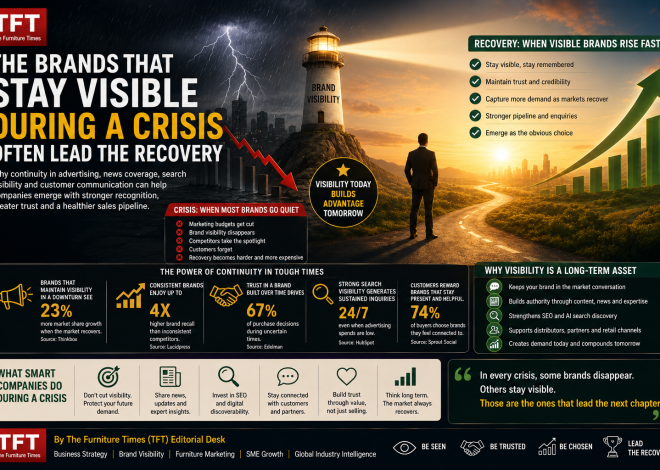
Economic uncertainty changes the way companies spend, communicate and compete.
When sales slow, costs rise or confidence falls, many businesses instinctively reduce advertising. Campaigns are suspended, content production stops, public relations disappears, search-engine optimisation is postponed and social-media activity becomes irregular. Management sees these measures as immediate savings because marketing expenses can often be reduced faster than payroll, rent, inventory or production capacity.
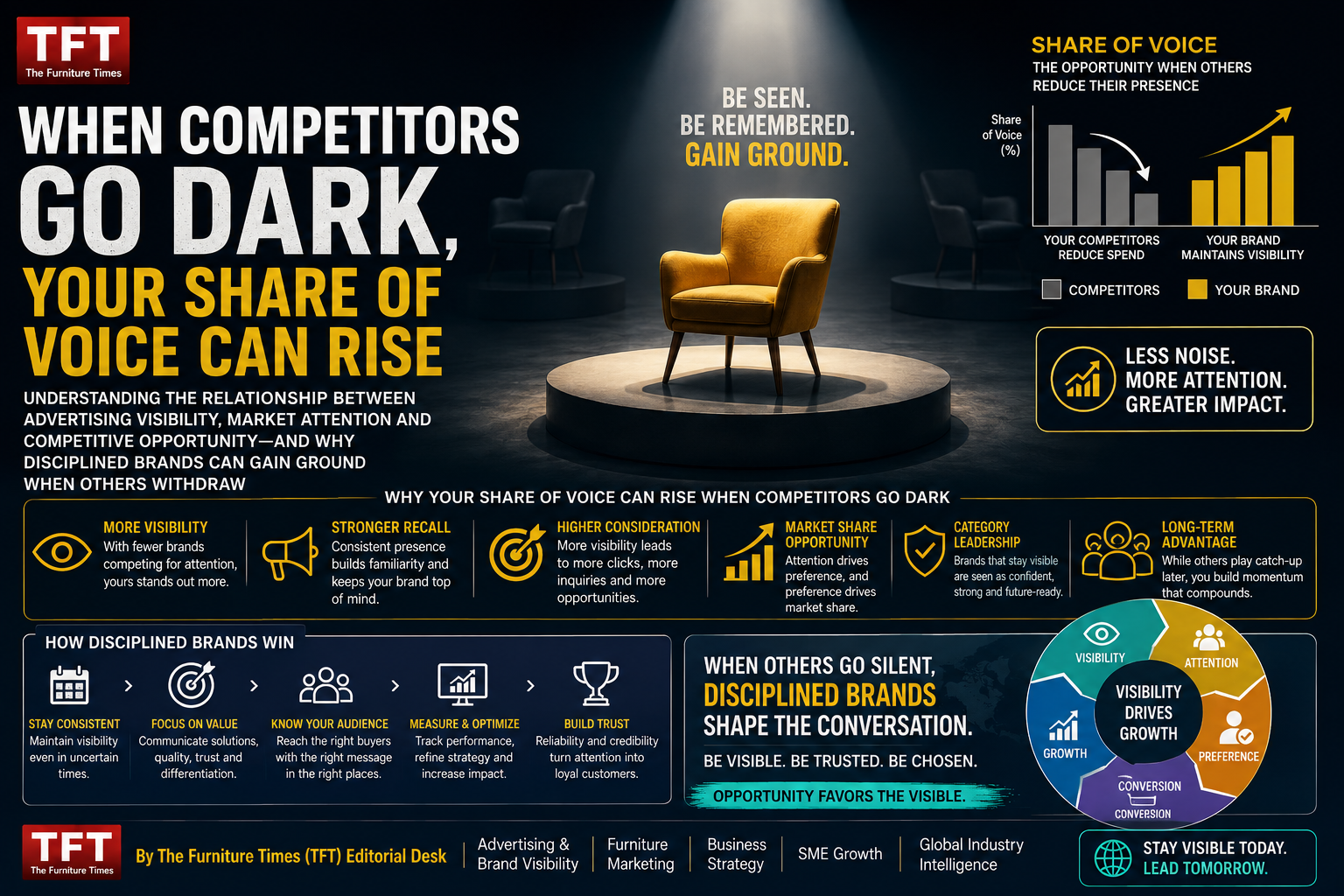
But when multiple competitors make the same decision, something important happens in the market: the competitive noise declines.
Fewer advertisements appear. Fewer companies publish useful industry content. Fewer brands communicate with customers. Fewer executives offer informed commentary. Fewer businesses release news, showcase projects or maintain their presence across search engines and industry platforms.
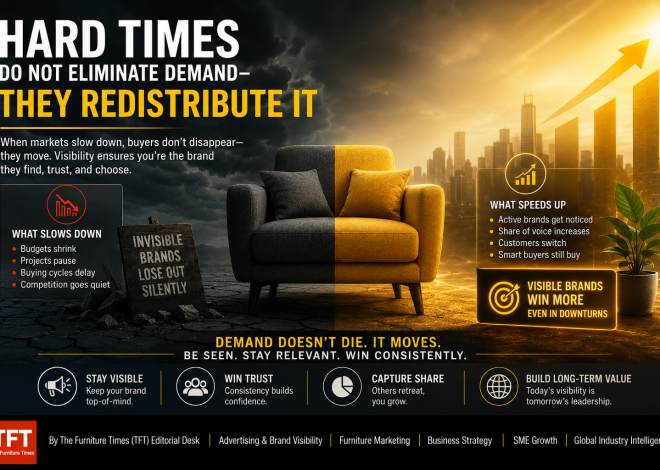
Demand may be weaker, but it has not necessarily disappeared. Customers still search, compare, plan, specify, repair, renovate and purchase. Projects continue, although decision cycles may become longer. Buyers become more cautious, research more thoroughly and place greater importance on reliability.
The brands that remain visible can therefore command a larger relative share of market attention—even without dramatically increasing their advertising budgets.
This is the strategic importance of share of voice.
What is share of voice?
Share of voice describes how visible a brand is compared with its competitors within a defined market, audience, channel or subject.
Traditionally, it was calculated by comparing a company’s advertising expenditure or media exposure with the total activity of its competitive category. If a brand accounted for 10% of advertising activity in a market, it could be described as holding approximately 10% of the category’s advertising share of voice.
Today, the concept is much broader. A company’s share of voice can include its visibility across:
- Paid search advertising
- Organic search results
- News publications
- Industry media
- Social-media conversations
- Online marketplaces
- Business directories
- Trade exhibitions
- Email communication
- Video and podcast platforms
- Customer reviews
- AI-generated recommendations
- Expert commentary
- Product comparisons
- Local search listings
- Digital catalogues and specification platforms
Share of voice is not simply a measure of how loudly a company speaks. It reflects how frequently and credibly the company appears when customers are paying attention.
A brand can have a strong share of voice without being the largest advertiser. It may earn visibility by publishing authoritative content, generating customer reviews, maintaining accurate business listings, participating in industry discussions and becoming a reliable source of information.
A simple example of how competitive withdrawal changes visibility
Consider a market containing five furniture suppliers. Each business contributes approximately the same amount of advertising, content and market communication.
| Brand | Initial visibility activity | Initial relative share |
|---|---|---|
| Brand A | 20 units | 20% |
| Brand B | 20 units | 20% |
| Brand C | 20 units | 20% |
| Brand D | 20 units | 20% |
| Brand E | 20 units | 20% |
| Total | 100 units | 100% |
Now imagine that three businesses sharply reduce their activity during an economic slowdown. Brand A maintains its visibility, while Brand B makes only a modest reduction.
| Brand | Visibility after reductions | New relative share |
|---|---|---|
| Brand A | 20 units | 36.4% |
| Brand B | 15 units | 27.3% |
| Brand C | 8 units | 14.5% |
| Brand D | 7 units | 12.7% |
| Brand E | 5 units | 9.1% |
| Total | 55 units | 100% |
Brand A did not increase its activity. Yet its relative share of visibility rose from 20% to more than 36%.
This simplified illustration is not a forecast of sales. Visibility does not automatically produce revenue, and real markets contain many additional factors. It demonstrates a strategic principle: when competitors retreat faster than you do, maintaining your presence can increase your relative position.
Market attention does not disappear—it becomes more selective
A slowdown rarely eliminates every form of furniture demand.
Consumers may postpone discretionary purchases while continuing to replace broken beds, damaged sofas or unsafe chairs. Hotels may delay complete renovations but proceed with essential refurbishment. Offices may reduce expansion while investing in space optimisation. Schools and healthcare facilities may continue procurement according to budgets and compliance requirements. Property developers may renegotiate specifications without cancelling every project.
Demand is redistributed across:
- Different price points
- Essential and non-essential categories
- New and refurbished products
- Immediate and delayed purchases
- Domestic and imported furniture
- Residential and contract markets
- Premium and value-focused suppliers
- Replacement and repair decisions
- Online and offline channels
This makes visibility particularly valuable. Buyers facing uncertainty often conduct more research because making the wrong decision becomes more expensive.
They want to know:
- Is the supplier financially stable?
- Can it deliver on time?
- Does it provide spare parts?
- Are its products certified?
- Can it support a large project?
- Does it have credible customer reviews?
- Is the warranty meaningful?
- Will the company still be operating after the sale?
- Can it provide installation, repair and after-sales support?
- Has it completed similar projects?
If a brand has stopped communicating, customers may not assume that it is carefully controlling costs. They may wonder whether it is still active, reliable or capable of serving them.
Silence creates an information gap—and competitors can fill that gap.
Visibility becomes a signal of stability
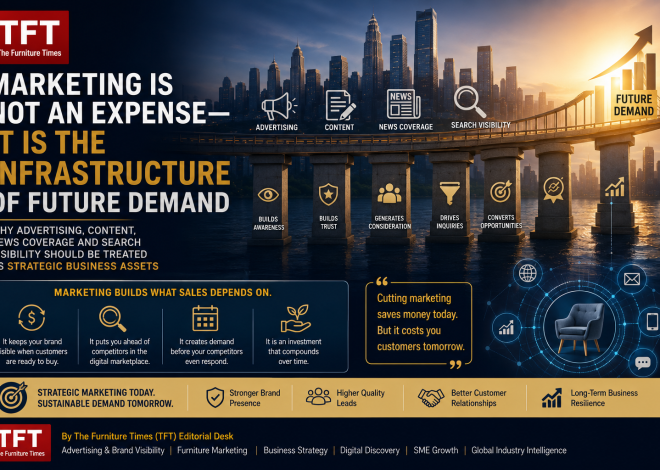
Advertising during difficult times does more than promote products. It can signal continuity.
A company that continues publishing, communicating and appearing in relevant searches tells the market that it remains operational and attentive. Customers see recent projects, updated products, new case studies, management perspectives and active service channels.
This does not mean a business should pretend that market conditions are easy. Credibility comes from communicating with realism.
A responsible company can acknowledge cost pressures, longer decision cycles and changing customer priorities while explaining how it is responding. It may introduce flexible ordering, refurbishment services, value-engineered solutions, local sourcing, shorter production runs or improved after-sales support.
Such communication demonstrates management competence.
A business that disappears from public view provides no evidence of adaptation. Customers and partners must make their own assumptions—and those assumptions may not be favourable.
Share of voice is not the same as wasteful spending
Maintaining visibility does not require a company to preserve every campaign, channel or agency contract.
A business can reduce marketing expenditure while protecting its market presence. The objective is not to continue spending blindly. It is to remove waste without destroying discoverability.
Management should evaluate:
- Which campaigns generate qualified enquiries?
- Which content continues attracting relevant search traffic?
- Which publications reach actual decision-makers?
- Which advertisements create awareness but no measurable engagement?
- Which business listings are incomplete or inaccurate?
- Which customer segments remain active?
- Which geographical markets still show demand?
- Which products have the strongest margins and shortest sales cycles?
- Which channels produce repeat customers?
- Which marketing activities create reusable long-term assets?
A company may stop an underperforming campaign while continuing technical articles, press coverage, local search, customer reviews and direct communication.
That is not withdrawal. It is reallocation.
The difference between temporary advertising and permanent visibility assets
Some marketing activity disappears as soon as payment stops. Other activity can continue creating value for months or years.
A paid advertisement usually produces exposure while the campaign remains active. It can be useful for launches, promotions, immediate demand capture and competitive targeting.
An authoritative news article, case study, product guide, verified directory profile or customer review may continue appearing in search results long after publication. These assets can educate buyers, provide evidence of experience and support AI-based discovery.
The most resilient visibility strategy combines short-term and long-term instruments.
Short-term demand capture
- Search advertising
- Retargeting
- Promotional campaigns
- Exhibition participation
- Direct-response email
- Limited-time offers
- Dealer incentives
Long-term authority building
- Industry news coverage
- Search-optimised educational content
- Detailed product information
- Customer reviews
- Project case studies
- Technical documentation
- Executive interviews
- Verified business listings
- Research and market commentary
- Video demonstrations
During a downturn, long-term visibility assets can be particularly valuable because they accumulate authority while competitors stop publishing.
Why search presence can improve when competitors become inactive
Search engines do not reward companies merely because they continue advertising. Organic visibility depends on relevance, technical quality, content usefulness, authority and many other signals.
However, competitors that stop updating their websites may gradually create opportunities.
Their product information becomes outdated. Broken pages remain unrepaired. News sections go silent. Customer questions are left unanswered. Local listings become inaccurate. New market terminology is not addressed. Emerging product categories receive no coverage.
An active company can publish better answers to current buyer questions.
For furniture businesses, this may include:
- Furniture compliance requirements
- Product-care and maintenance guides
- Material comparisons
- Delivery and installation information
- Office and hospitality procurement guides
- Repairability and spare-parts policies
- Sustainability documentation
- Customisation options
- Project-planning checklists
- Warranty explanations
- Furniture lifecycle-cost analysis
- Country-specific supply information
The objective should not be to produce large quantities of shallow content. It should be to build the most useful and trustworthy information in the category.
AI discovery is creating a new form of share of voice
Market visibility is no longer limited to conventional search-result rankings.
Customers increasingly ask AI systems questions such as:
- Which furniture manufacturers supply hotels in Malaysia?
- Who makes certified office chairs in India?
- Which outdoor furniture suppliers serve resorts in the Middle East?
- Where can I find sustainable furniture manufacturers in Europe?
- Which brands offer reliable spare parts and after-sales service?
- Who are the best-reviewed furniture retailers in my city?
AI systems attempt to answer by interpreting information available across websites, news publications, directories, reviews and other accessible sources.
A business that is poorly described, inconsistently listed or rarely mentioned may be difficult for these systems to understand. A competitor with structured information and credible third-party coverage may be easier to identify and recommend.
This creates a new competitive metric: share of answer.
Share of answer asks how often a business appears, directly or indirectly, when AI platforms respond to relevant buyer questions.
A company can advertise heavily yet remain invisible to AI if its online identity is incomplete. Conversely, a smaller manufacturer can improve its discoverability by creating clear, consistent and verifiable information about its products, capabilities, locations, markets and credentials.
In the AI-search era, share of voice must include whether machines can find, understand and confidently describe the business.
News coverage can fill the trust gap
Companies often treat news coverage as something reserved for major announcements. That is a narrow interpretation.
An industry publication can cover:
- Factory expansion
- New collections
- Export-market entry
- Leadership appointments
- Compliance achievements
- Technology investment
- Sustainability programmes
- Major projects
- Community initiatives
- Product innovations
- Partnerships
- Training programmes
- Repair and refurbishment services
- Responses to changing market conditions
News coverage creates an independent information layer around a business. It allows the company’s activities to be understood beyond its own advertisements.
During uncertain periods, this becomes valuable because customers are seeking evidence, not slogans.
A company saying it is reliable is advertising. A detailed case study showing how it completed a difficult project is evidence. A customer review is experience. An industry article adds context. Together, they create a stronger trust profile.
Smaller companies can gain disproportionately
Large businesses usually begin with greater awareness, larger databases and broader distribution. Yet downturns can provide an unusual opening for disciplined small and medium-sized enterprises.
SMEs can often move faster. They may respond to new customer concerns, publish specialised expertise, personalise communication and target market gaps more efficiently than larger organisations.
A regional upholstery manufacturer, for example, may not compete with a multinational brand across every category. It can become highly visible for a specific combination such as:
- Custom hotel upholstery
- Small-batch contract seating
- Rapid replacement cushions
- Fire-compliant furnishing solutions
- Locally manufactured sofa restoration
- Sustainable textile options
The goal is not to dominate every conversation. It is to become highly visible in the conversations that matter most.
When larger or comparable competitors reduce communication, a focused SME can occupy these specialised positions.
The danger of confusing awareness with immediate sales
One reason companies cut advertising is that marketing results are judged over an unrealistically short period.
A buyer may read an article today, visit the website next week, compare suppliers next month and request a quotation three months later. A hotel project may take a year to move from planning to procurement. An architect may remember a manufacturer from repeated exposure long before placing it on a specification list.
Not every marketing interaction produces an immediate enquiry.
Advertising and content influence:
- Recognition
- Familiarity
- Perceived credibility
- Shortlisting
- Dealer confidence
- Search behaviour
- Direct website visits
- Branded search volume
- Price acceptance
- Recommendation probability
- Future enquiries
This does not mean businesses should accept vague reporting. It means performance measurement must match the actual sales cycle.
A company selling inexpensive home accessories can expect faster feedback than a contract furniture manufacturer pursuing large institutional projects.
Excessive silence creates recovery debt
When a business stops communicating for an extended period, it accumulates what can be called recovery debt.
The company may later discover that:
- Customers no longer remember the brand
- Search visibility has weakened
- Competitors control important keywords
- Email databases have become inactive
- Social audiences have disengaged
- News coverage is outdated
- Dealers have shifted attention elsewhere
- AI systems have more information about competitors
- Reviews are old or insufficient
- Sales teams lack current marketing material
- Relaunch campaigns require greater spending
Restarting visibility is not as simple as switching advertising back on.
Brand memory must be rebuilt. Search authority may take time to recover. Content pipelines must be restarted. Media relationships need renewed attention. Customers must be reminded that the company remains relevant.
The money saved during silence can later be consumed by the cost of re-entering the market.
Visibility cannot rescue a weak offer
Share of voice is an opportunity, not a guarantee.
A business will not create sustainable growth by promoting products that are overpriced, unreliable or poorly supported. Advertising can generate attention, but the customer experience determines whether that attention becomes trust.
Visibility must be supported by:
- Competitive products
- Accurate specifications
- Consistent quality
- Reliable delivery
- Responsible pricing
- Genuine warranties
- Accessible after-sales service
- Trained sales teams
- Transparent communication
- Credible customer reviews
A loud brand with weak execution may increase complaints rather than market share.
The strongest strategy connects share of voice with share of experience. Customers must encounter the same quality promised by the company’s communication.
Measuring whether share of voice is increasing
Businesses should track visibility using a combination of indicators rather than depending on one number.
| Area | Useful indicators |
|---|---|
| Search | Organic rankings, impressions, branded searches and qualified traffic |
| Paid media | Impression share, click share, conversion cost and enquiry quality |
| News | Relevant coverage, publication authority and referral traffic |
| Social media | Meaningful mentions, engagement quality and audience growth |
| Reviews | Review volume, recency, rating patterns and response quality |
| AI discovery | Brand appearance in representative AI-generated answers |
| Direct demand | Website visits, calls, messages, RFQs and showroom appointments |
| Sales pipeline | Qualified leads, shortlist inclusion and quotation opportunities |
| Competitive presence | Competitor campaign activity, content frequency and category visibility |
| Customer memory | Surveys, aided awareness and unaided brand recall |
A rising share of voice is most meaningful when it is accompanied by stronger consideration, better enquiries and an improving sales pipeline.
Vanity metrics should not replace commercial judgement.
A practical strategy for difficult market conditions
1. Identify where demand still exists
Analyse products, locations and customer groups separately. A weak residential segment does not necessarily mean hospitality, healthcare, education, workplace or repair demand is equally weak.
2. Define the category you want to own
Avoid trying to be visible for everything. Select specific products, capabilities, markets or customer problems where the business can offer genuine authority.
3. Protect searchable business information
Maintain accurate websites, contact information, product categories, addresses, opening hours, certifications and service areas.
4. Publish evidence
Turn completed projects, customer outcomes, new capabilities and technical knowledge into articles, case studies, videos and press releases.
5. Strengthen review visibility
Encourage genuine customers to share detailed experiences. Respond professionally to positive and negative reviews.
6. Maintain consistent communication
Regular visibility is more credible than disappearing for months and returning with a sudden aggressive promotion.
7. Reallocate weak spending
Reduce channels that produce poor-quality traffic while protecting those that build demand, authority and trust.
8. Prepare for AI discovery
Use consistent business names, clear company descriptions, structured product data, detailed expertise pages and credible third-party references.
9. Connect marketing with sales
Record where customers first heard about the company and which information influenced their decisions.
10. Continue measuring competitors
Do not assume competitors have gone silent. Observe their advertising, content, media coverage, reviews, product launches and search presence.
The opportunity for the global furniture ecosystem
The furniture ecosystem is extraordinarily fragmented. Manufacturers, suppliers, designers, retailers, installers, repairers, logistics companies and artisans often operate beyond the visibility of international buyers.
During difficult conditions, disappearing from the market makes that fragmentation worse.
Companies that remain searchable can reach customers beyond their existing networks. Skilled artisans can be found outside their neighbourhoods. Component suppliers can connect with manufacturers. Repair businesses can reach hotels and offices. Emerging brands can demonstrate their capabilities through news and verified customer experiences.
This is where The Furniture Times, Furniture Industry Search Engine and FurniReviewology become part of a connected visibility infrastructure.
The Furniture Times tells their story.
Furniture Industry Search Engine helps the world find them.
FurniReviewology helps the world trust them.
TFT provides industry storytelling and intelligence. FISE creates structured discoverability across countries and furniture-industry categories. FurniReviewology provides the credibility layer customers need before taking action.
Together, they address three essential questions:
- Does the market know your story?
- Can customers and AI systems find your business?
- Is there enough evidence for people to trust you?
The furniture industry ecosystem is a $1 trillion industry ecosystem, but participation in that opportunity increasingly depends on visibility.
When competitors go dark, the market does not automatically become yours. You must remain relevant, credible and discoverable enough to earn its attention.
Do not spend blindly. Do not communicate without a strategy. But do not allow temporary uncertainty to make your business permanently invisible.
Be the next one. Be part of the movement.