Hard Times Do Not Eliminate Demand—They Redistribute It
How active furniture brands capture the customers, projects, enquiries and market attention competitors leave behind during economic uncertainty
By The Furniture Times (TFT) Editorial Desk | Advertising & Brand Visibility | Furniture Marketing | Business Strategy | SME Growth | Global Industry Intelligence
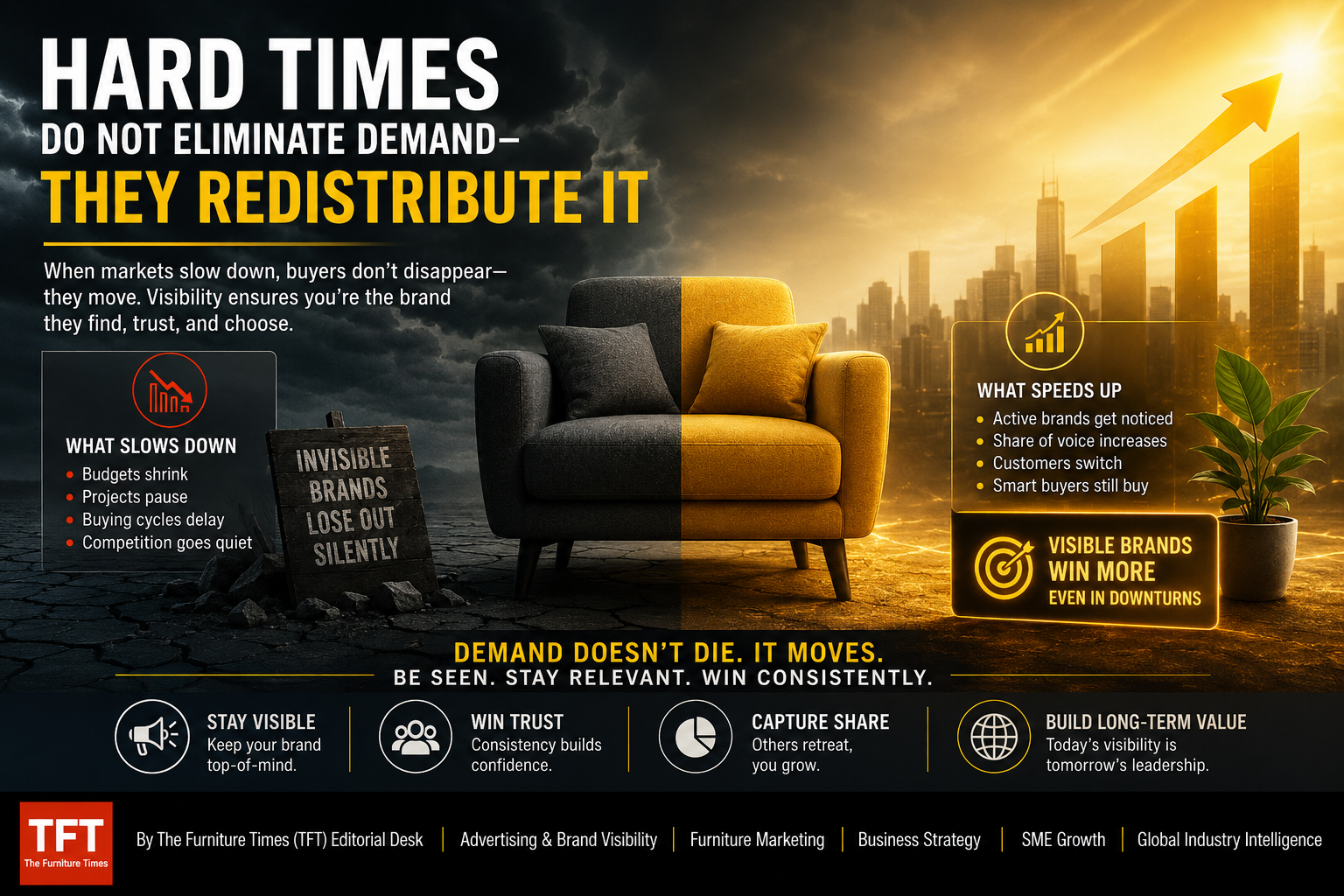
Economic slowdowns change markets, but they rarely switch demand off completely.
Consumers may postpone purchases, reduce budgets or search for less expensive alternatives. Property developers may revise project schedules. Hotels may renovate fewer rooms at a time. Offices may refurbish existing spaces instead of relocating. Retailers may reduce inventory commitments, while manufacturers become more cautious about machinery, materials and expansion.
Demand can weaken, but it also moves.
It moves between price points, product categories, geographic markets, sales channels, suppliers and purchasing periods. It moves from premium to value products, from new furniture to refurbishment, from ownership to rental, from imported products to local alternatives and from established suppliers to businesses that respond more quickly.
During hard times, the market does not reward every business equally.
It rewards companies that remain:
- Visible when buyers begin researching.
- Searchable when customers need alternatives.
- Responsive when enquiries arrive.
- Flexible when budgets change.
- Credible when purchasing risk increases.
- Helpful when customers become uncertain.
- Persistent when competitors withdraw.
- Prepared when delayed projects restart.
A manufacturer that stops communicating may conclude that demand has disappeared because its enquiries have fallen. But those enquiries may not have disappeared from the wider market. They may have shifted toward a competitor that continued advertising, answering questions, publishing information and reassuring buyers.
The important strategic principle is:
Hard times do not necessarily eliminate commercial opportunity. They redistribute opportunity toward businesses that remain visible, relevant and ready to respond.
Demand may shrink—but it rarely falls equally everywhere
It would be misleading to argue that demand always remains unchanged during a downturn. Recessions, conflicts, inflation, high interest rates and supply disruptions can produce genuine reductions in household spending and business investment.
However, aggregate decline does not mean every segment, region or company declines at the same rate.
A furniture market can contract overall while specific areas continue growing, including:
- Affordable furniture.
- Repair and refurbishment.
- Space-saving products.
- Multifunctional furniture.
- Rental furniture.
- Used and certified pre-owned furniture.
- Local manufacturing.
- Ready-to-assemble products.
- Healthcare furniture.
- Education furniture.
- Government procurement.
- Student accommodation.
- Flexible workplace products.
- Replacement components.
- Furniture maintenance.
- E-commerce.
- Export markets with different economic cycles.
Demand also moves between companies within the same category.
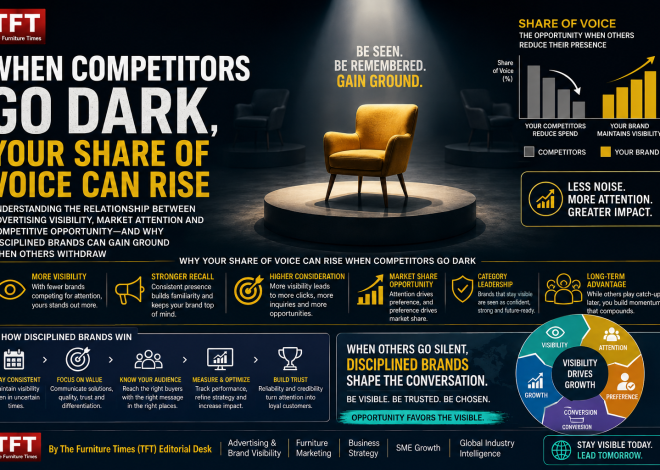
If ten furniture suppliers once competed for 1,000 enquiries and total demand falls to 800, there are still 800 opportunities in the market. If several competitors reduce advertising, fail to answer quickly or appear inactive, the remaining visible companies can capture a larger proportion of the reduced total.
A smaller market can therefore still produce growth for a company that gains market share.
The difference between market decline and company decline
Business owners frequently confuse three separate conditions:
- The entire market is declining.
- The company’s traditional customer segment is declining.
- The company is becoming less visible than its competitors.
These are not the same problem.
If the entire market declines by 10% but a company’s enquiries fall by 35%, the market alone may not explain the result. The additional loss could be related to weaker visibility, outdated products, slow responses, poor positioning, pricing problems or competitors gaining share.
Management should ask:
- Has demand disappeared, or moved to another price category?
- Have buyers stopped purchasing, or extended the decision period?
- Are projects cancelled, or merely delayed?
- Are customers choosing smaller orders?
- Are they repairing instead of replacing?
- Are they buying from local suppliers?
- Are they searching through different platforms?
- Are competitors appearing more often in search results?
- Are enquiries being answered quickly enough?
- Is the company still communicating value relevant to current conditions?
Without this analysis, a business can mistakenly respond to declining sales by reducing the very visibility needed to locate the remaining demand.
Demand redistribution across the furniture ecosystem
The furniture industry is not a single market. It is a network of connected markets involving residential, commercial, hospitality, institutional, industrial, architectural and service-based demand.
When conditions change, spending moves across this network.
From premium purchases to value-led purchases
A customer who planned to purchase a premium sofa may still buy a sofa but select:
- A smaller configuration.
- A lower-priced fabric.
- A simpler mechanism.
- A locally manufactured product.
- A deferred-payment option.
- A showroom display unit.
- A refurbished product.
The demand has not disappeared; its value proposition has changed.
Brands offering only aspirational messages may lose the customer, while businesses communicating durability, financing, modularity and long-term value may gain the sale.
From new furniture to repair and refurbishment
When capital budgets tighten, hotels, offices, schools and households may extend the life of existing furniture.
This redistributes demand toward:
- Upholsterers.
- Furniture repairers.
- Refinishers.
- Spare-part suppliers.
- Hardware distributors.
- Foam and fabric suppliers.
- Office-furniture refurbishers.
- Hotel furniture liquidators.
- Circular-economy platforms.
A manufacturer focused exclusively on new-unit sales may experience weakness, while a refurbishment provider receives increased enquiries.
From large projects to phased procurement
A hotel may postpone the complete renovation of 300 rooms but proceed with 50 urgent rooms. An office may replace only damaged workstations. A restaurant chain may renovate selected high-performing outlets.
The project has been reduced or divided—not necessarily abandoned.
Suppliers capable of handling smaller phases, faster deliveries and flexible specifications can capture the redistributed opportunity.
From imports to local sourcing
Currency volatility, tariffs, freight costs or geopolitical disruption can make imported furniture less predictable.
Buyers may shift toward domestic or regional manufacturers offering:
- Shorter lead times.
- Easier communication.
- Smaller minimum orders.
- Faster replacement parts.
- Local installation.
- Lower logistical risk.
This can create opportunities for SMEs that previously struggled to compete with large international suppliers.
From ownership to access
Companies facing uncertainty may hesitate to purchase large quantities of furniture outright. They may consider:
- Rental.
- Leasing.
- Furniture-as-a-service.
- Subscription models.
- Short-term event furniture.
- Temporary office furniture.
- Used furniture.
- Buy-back arrangements.
The underlying need remains, but the preferred commercial model changes.
From general products to problem-solving products
During difficult periods, buyers become less interested in vague luxury claims and more interested in practical outcomes.
Demand may shift toward products that:
- Save space.
- Reduce maintenance.
- Lower energy use.
- Support flexible working.
- Last longer.
- Can be repaired.
- Can be reconfigured.
- Reduce replacement frequency.
- Deliver faster.
- Carry reliable warranties.
Active brands that recognize these changes can adjust their communication without abandoning their identity.
When competitors go silent, attention becomes available
Market attention is finite.
Customers may see a limited number of advertisements, visit a limited number of websites and request quotations from only a few suppliers. If competitors reduce their activity, the remaining brands face less communication noise.
This does not guarantee success. A visible company still needs the right product, message, pricing, service and execution. But reduced competitive communication can improve its relative opportunity to be noticed.
Nielsen defines share of voice as a brand’s media spending relative to total category expenditure within a defined market, channel and period. It is not the same as awareness or campaign effectiveness, but it helps indicate whether a brand has enough media weight to compete. Nielsen’s explanation of share of voice reinforces that visibility must be evaluated relative to the competitive environment.
Consider a simplified example:
| Brand | Advertising before slowdown | Advertising during slowdown | Likely visibility effect |
|---|---|---|---|
| Brand A | High | Stops completely | Rapid relative decline |
| Brand B | Medium | Cuts by 80% | Weaker presence |
| Brand C | Medium | Maintains essential activity | Greater relative visibility |
| Brand D | Low | Focuses on search and content | Opportunity to gain consideration |
| Brand E | High | Maintains but changes message | Strong defensive position |
Brand C may not spend more money than before. Yet it may become more prominent because competitors have reduced their presence.
Brand D, previously a smaller participant, may gain access to customers who would not have noticed it in a crowded market.
This is why difficult conditions can create unusual openings for disciplined SMEs.
Visibility captures the first opportunity: discovery
A furniture business cannot win an enquiry it never receives.
When a customer searches for a product, supplier or solution, the initial shortlist may be influenced by:
- Search-engine rankings.
- Paid-search advertisements.
- AI-generated recommendations.
- Industry directories.
- Marketplace listings.
- News articles.
- Social-media activity.
- Customer reviews.
- Dealer recommendations.
- Project case studies.
- Local business profiles.
- Videos and product demonstrations.
If competitors have outdated websites, paused advertisements or stopped publishing, an active company has more opportunities to enter the shortlist.
This is especially important as discovery becomes distributed across traditional search engines, social platforms, marketplaces and conversational AI systems.
Modern visibility is no longer achieved through one advertisement. It is created by consistent public evidence that the company exists, understands its category and can satisfy a customer’s need.
That evidence includes:
- Clear company information.
- Accurate product data.
- Current projects.
- Technical expertise.
- Customer reviews.
- Media coverage.
- Relevant articles.
- Reliable contact details.
- Certifications.
- Delivery capabilities.
- Geographic coverage.
When this evidence is absent, the business may be invisible even if its manufacturing capability is excellent.
Searchable businesses inherit abandoned enquiries
Suppose a buyer searches for “hotel furniture supplier with short lead time.”
Several established suppliers may exist, but some have:
- Old websites.
- No recent projects.
- Unanswered enquiries.
- Incomplete product information.
- No clear service area.
- No published delivery commitments.
- Weak reviews.
- No visible contact person.
A smaller but active supplier may provide:
- A focused landing page.
- Recent hospitality projects.
- Clear manufacturing capabilities.
- Downloadable specifications.
- Rapid quotation procedures.
- Current contact information.
- Testimonials.
- News coverage.
- Delivery and installation details.
The buyer may select the smaller company for the shortlist—not because it is necessarily the largest supplier, but because it appears prepared, relevant and reachable.
In difficult markets, responsiveness becomes part of visibility.
Being found creates the opportunity. Responding effectively converts it.
Hard times make customers more cautious, not necessarily inactive
Economic uncertainty often increases the amount of research customers perform before purchasing.
Customers may:
- Compare more brands.
- Request additional quotations.
- Read more reviews.
- Examine warranties.
- Investigate the supplier’s history.
- Negotiate payment terms.
- Ask about replacement parts.
- Check delivery reliability.
- Search for lower-risk alternatives.
- Delay the final decision.
This expanded research process creates more discovery moments.
A company that provides useful information can become influential before the sales conversation begins.
For furniture businesses, valuable content might answer questions such as:
- Which materials provide the best long-term value?
- How can a hotel phase its renovation?
- Is refurbishment better than replacement?
- What furniture works in a smaller office?
- How can a restaurant reduce furniture maintenance?
- What warranty coverage is provided?
- Are replacement parts available?
- How long does production take?
- Can products be customized?
- What certifications apply?
- How can buyers compare quotations fairly?
Hard times do not eliminate the customer’s need for information. They often increase it.
Active brands capture competitor mistakes
During downturns, companies frequently make predictable mistakes.
They may:
- Stop advertising completely.
- Reduce sales staff.
- Delay quotations.
- Ignore small orders.
- Discontinue customer communication.
- Stop updating websites.
- Reduce dealer support.
- Remove customer service resources.
- Cut delivery capacity.
- Become inflexible on specifications.
- Avoid investing in digital visibility.
- Assume every enquiry is price-driven.
Each mistake creates an opening.
Slow quotations create openings
A commercial buyer requesting five quotations may award the project to one of the first credible suppliers to respond.
A company that takes seven days to acknowledge an enquiry may lose to a competitor that responds within hours.
Poor communication creates openings
If a supplier cannot provide clear information about lead time, materials, warranties or installation, the customer may choose a more transparent competitor.
Ignoring smaller projects creates openings
Large suppliers may reject reduced or phased orders. An SME capable of serving smaller volumes can establish a new relationship that grows when conditions improve.
Weak after-sales support creates openings
Buyers become highly risk-conscious in hard times. A supplier offering repair, spare parts and clear warranty procedures may outperform a cheaper competitor.
Silence creates credibility openings
A brand that continues publishing projects, educational content and operational updates demonstrates continuity. Inactive competitors may appear uncertain, even if they remain operational.
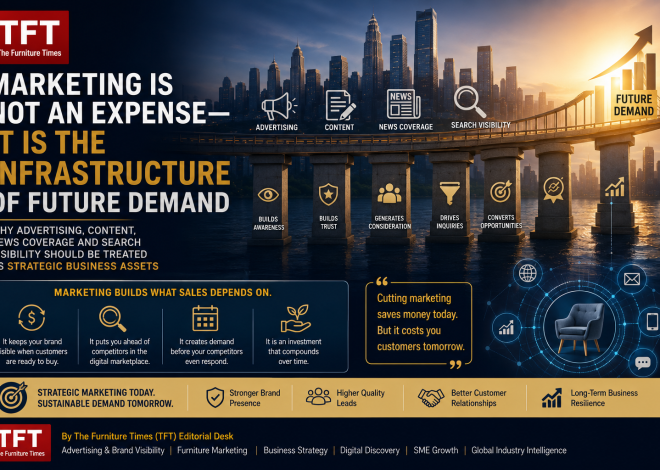
Advertising is not only about creating demand
Advertising is often judged as though its only job is to convince an unwilling customer to purchase.
In reality, advertising performs several roles:
- Helping existing demand find a supplier.
- Making a brand recognizable.
- Communicating relevance.
- Reassuring cautious buyers.
- Supporting dealers.
- Explaining value.
- Building a future sales pipeline.
- Protecting market share.
- Helping buyers remember the brand at the correct time.
Kantar has observed that much media investment works to maintain market share rather than immediately increase it. In one example cited in its recession-budget analysis, the market where investment stopped lost share, while the invested market remained stable—and renewed investment did not immediately recover the loss. Kantar’s analysis of marketing during recession illustrates why preservation should not be mistaken for failure merely because dramatic short-term growth is absent.
Protecting a company’s existing position can itself be a meaningful return during contraction.
Market share can grow even when the market contracts
Imagine a furniture category worth $100 million annually.
One company controls 5%, producing $5 million in sales.
During a downturn, the category contracts by 15% to $85 million. If the company maintains only its original 5% share, its sales decline to $4.25 million.
But suppose several competitors withdraw and the active company increases its share to 7%.
Its sales would become $5.95 million.
The overall market has declined, yet the company has grown because demand was redistributed toward it.
This simplified illustration does not account for pricing, margins or execution costs, but it demonstrates an essential point:
A company’s outcome depends on both market size and the portion of that market it captures.
Management cannot control the economic cycle, but it can influence its relative visibility, responsiveness, proposition and market share.
Recent evidence shows businesses are not uniformly retreating
Economic uncertainty does not produce one universal marketing response.
The IPA Bellwether Report for the second quarter of 2026 found that UK marketing budgets continued expanding despite difficult economic and inflationary conditions. According to the report, 23.8% of respondents increased marketing budgets while 16.9% reported cuts. The July 2026 IPA Bellwether findings demonstrate that some companies continue investing while others become more cautious.
That difference matters.
When one business cuts communication and another maintains it, customers do not see two internal budget decisions. They see one company repeatedly and the other less often.
Marketing restraint may protect cash, but it can also redistribute attention toward competitors.
The active-brand advantage across the furniture ecosystem
Furniture manufacturers
Active manufacturers can capture:
- Import-substitution opportunities.
- Private-label enquiries.
- Smaller production runs.
- Contract manufacturing.
- Urgent replacement orders.
- Regional export demand.
- Buyers seeking shorter lead times.
- Brands abandoned by failing suppliers.
Furniture retailers
Active retailers can attract customers searching for:
- Affordable alternatives.
- Financing.
- Immediate stock.
- Clearance products.
- Delivery certainty.
- Online consultation.
- Room packages.
- Replacement furniture.
Component and accessory suppliers
Hardware, foam, fabric, panels, mechanisms and fittings remain necessary for production, repair and refurbishment.
Suppliers can gain by communicating:
- Stock availability.
- Compatible alternatives.
- Technical specifications.
- Smaller minimum quantities.
- Faster delivery.
- Cost-saving substitutions.
- Product durability.
Interior designers and contractors
Clients may reduce full renovation budgets but still proceed with:
- Smaller redesigns.
- Essential upgrades.
- Workplace adaptation.
- Rental-property improvements.
- Restaurant refreshes.
- Home-office projects.
- Phased commercial renovations.
Design firms offering scalable options can capture this modified demand.
Repairers and refurbishers
These businesses may become more relevant as customers attempt to extend furniture life and preserve capital.
Logistics and installation companies
Customers may seek consolidation, storage, relocation, reconfiguration and more efficient delivery rather than entirely new furniture.
Every part of the ecosystem should ask where demand is moving—not simply whether it is falling.
The five characteristics of brands that gain during hard times
1. They remain visible
They maintain a minimum presence across search, content, news, directories, email and carefully selected advertising channels.
2. They listen for changes
They monitor enquiries, search terms, customer objections, quotation size, project delays, geographic shifts and product preferences.
3. They adapt the offer
They introduce phased delivery, alternative materials, smaller packages, repair options, financing or different service levels without abandoning quality.
4. They respond quickly
They treat every qualified enquiry as valuable and create clear internal response standards.
5. They communicate confidence honestly
They do not pretend conditions are easy. They demonstrate stability through accurate information, recent work, realistic lead times and reliable customer support.
What active visibility should look like during difficult periods
Staying active does not require wasteful spending.
A disciplined visibility strategy may include:
Protect high-intent search
Maintain visibility for customers actively searching for the products and services the company supplies.
Update product information
Remove unavailable models, correct specifications and clearly state lead times, service areas and contact routes.
Publish relevant news
Communicate product launches, completed projects, factory investments, certifications, partnerships, sustainability initiatives and market expertise.
Produce decision-support content
Help customers compare materials, budgets, life-cycle costs, repair options and procurement approaches.
Maintain review activity
Recent customer reviews help demonstrate that the business remains operational and trusted.
Strengthen industry listings
Make sure the company can be found by location, category, capability, material, product and service.
Support channel partners
Provide dealers, architects, designers and distributors with current images, specifications and sales tools.
Track changing demand
Review:
- Search queries.
- Enquiry categories.
- Conversion rates.
- Average order size.
- Lost-sale reasons.
- Customer locations.
- Product-page traffic.
- Quotation response time.
- Competitor activity.
Keep sales and marketing aligned
If advertising promises rapid quotation but the sales department takes five days to respond, visibility expenditure is being wasted.
Do not confuse activity with noise
An active brand is not one that publishes irrelevant messages every day.
It is one that consistently provides market evidence and customer value.
During hard times, communication should be:
- Clear.
- Useful.
- Current.
- Empathetic.
- Specific.
- Credible.
- Easy to act upon.
Empty slogans can appear insensitive. Excessive discounts can damage positioning. Fear-based advertising can reduce trust.
The objective is not to pretend that difficult conditions do not exist. It is to show customers how the company can help them make better decisions within those conditions.
Brand building and sales activation must work together
Companies under pressure often move their entire marketing budget toward immediate lead generation.
Short-term activation is important, but it becomes less efficient if awareness and consideration are allowed to decay.
Nielsen’s long-term marketing analysis warns that removing brand-building activity can weaken awareness and consideration, reduce the effectiveness of conversion campaigns and increase acquisition costs. Nielsen’s research on long-term marketing argues that future sales depend on maintaining the upper part of the marketing funnel as well as capturing immediate demand.
A balanced strategy should therefore address:
| Objective | Typical activity |
|---|---|
| Remain known | Brand advertising, news, expert content and media coverage |
| Remain findable | SEO, directories, product data and paid search |
| Create confidence | Reviews, case studies, warranties and certifications |
| Capture enquiries | Landing pages, forms, calls and quotation systems |
| Convert demand | Sales follow-up, offers, demonstrations and financing |
| Retain customers | Email, service, support and replacement programmes |
A business needs both visibility and conversion capability.
The redistribution audit: questions every furniture company should answer
Market questions
01 — Which customer segments are still buying?
02 — Which projects are delayed rather than cancelled?
03 — Which product categories are receiving more enquiries?
04 — Are customers moving toward lower prices, longer life or different payment models?
05 — Which geographic markets remain active?
Competitor questions
06 — Which competitors have reduced advertising?
07 — Which competitors have stopped updating their websites?
08 — Which suppliers are experiencing delivery or service problems?
09 — Which companies are ignoring smaller orders?
10 — What customer needs are competitors failing to address?
Visibility questions
11 — Can customers find the company through traditional and AI-assisted search?
12 — Are product specifications complete and current?
13 — Does the business have recent news, projects and reviews?
14 — Is the company listed under the correct categories and locations?
15 — Does the website clearly explain why the business is relevant now?
Sales questions
16 — How quickly are enquiries acknowledged?
17 — How quickly are quotations delivered?
18 — Why are quotations being lost?
19 — Can large projects be divided into phases?
20 — Can alternative specifications protect the customer’s budget?
Trust questions
21 — Are warranties, delivery terms and payment conditions clear?
22 — Can customers verify the company’s history and capabilities?
23 — Are genuine reviews available?
24 — Does marketing make realistic promises?
25 — Is after-sales support visible?
This audit helps management identify where demand has moved and what prevents the company from capturing it.
A practical scenario: the project did not disappear
Imagine a hotel originally planned to renovate 200 rooms.
Because of weaker occupancy and financing pressure, management reduces the immediate project to 60 rooms.
Supplier A views the reduced project as unattractive and responds slowly.
Supplier B stopped advertising months earlier and is not discovered during the hotel’s new supplier search.
Supplier C insists on its original minimum order and premium specification.
Supplier D remains visible, answers within one day and proposes:
- Phase one for 60 rooms.
- A standardized room package.
- Alternative materials at two price levels.
- A replacement-parts programme.
- Storage of approved specifications for future phases.
- Fixed production windows.
- Clear installation planning.
Supplier D does not capture the original 200-room order immediately. It captures the surviving 60-room demand and establishes itself for later phases.
The demand was reduced and redistributed.
The winning factor was not advertising alone. It was the combination of visibility, responsiveness, flexibility and credibility.
Why SMEs may have an unusual opportunity
Large brands possess greater budgets, established distribution and broad recognition. Yet SMEs can compete during periods of disruption through:
- Faster decisions.
- Direct founder involvement.
- Flexible order quantities.
- Local production.
- Specialization.
- Customization.
- Personal service.
- Rapid quotations.
- Narrow category expertise.
- Strong regional relationships.
The SME’s challenge is often not capability—it is discoverability.
An excellent artisan, furniture maker, upholsterer, component supplier or installer cannot capture redistributed demand if buyers cannot find or verify the business.
This is why affordable directories, industry media, search platforms and credible review systems matter. They can provide smaller companies with opportunities to be discovered outside their immediate networks.
Visibility without trust is incomplete
Customers do not automatically choose the most visible company.
They choose from the brands they can find and then evaluate which appears most trustworthy.
That evaluation may include:
- Customer reviews.
- Media references.
- Years in business.
- Completed projects.
- Factory images.
- Product details.
- Certifications.
- Professional communication.
- Warranty policies.
- Responsiveness.
- Transparent identity.
Visibility places the business in consideration. Trust helps it survive the comparison.
This is where the wider furniture-information ecosystem becomes important:
- The Furniture Times tells the stories of companies, markets and people.
- The Furniture Industry Search Engine helps buyers discover relevant businesses.
- FurniReviewology can help customers evaluate reputation and trust.
Together, storytelling, searchability and review credibility can create fairer discovery opportunities for businesses that cannot compete through large advertising budgets alone.
What businesses should avoid
Do not disappear completely
A minimal, focused presence is usually safer than prolonged silence.
Do not reduce service quality while advertising more
Visibility amplifies the customer experience—good or bad.
Do not chase every market
Identify the segments where the company has a credible advantage.
Do not compete only on price
Price attracts attention, but reliability, service and life-cycle value often determine the final decision.
Do not make unsupported claims
Hard times increase customer caution. Misleading promises can cause lasting reputational damage.
Do not judge marketing too quickly
Commercial furniture projects and higher-value consumer purchases may require extended consideration.
Do not ignore existing customers
Past customers may need repairs, additions, replacements, upgrades or referrals.
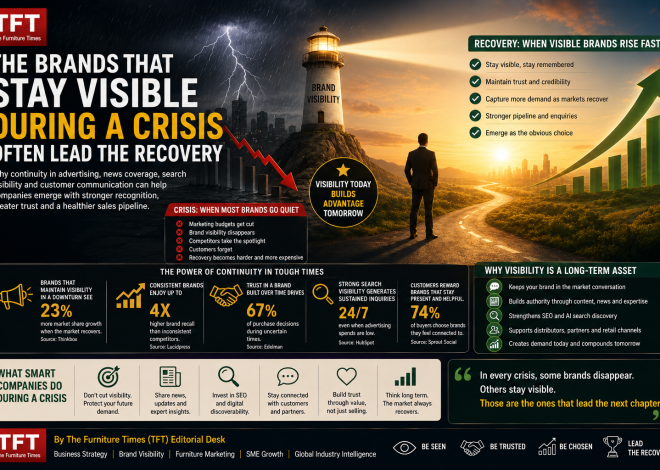
The companies that act early gain the strongest position
By the time an economic recovery becomes obvious, the easiest visibility opportunities may already be gone.
Media costs may rise. Competitors may restart. Search results may become more crowded. Customers may have established new supplier relationships. Dealers may have committed to other brands.
Companies that remained active during uncertainty enter recovery with:
- Greater familiarity.
- Current market data.
- Functioning campaigns.
- Recent customer relationships.
- Stronger search signals.
- More reviews.
- Updated content.
- Better understanding of changing demand.
- A healthier sales pipeline.
They do not begin preparing when the recovery is announced. They are already positioned within it.
Kantar’s BrandZ analysis has found that strong brands tend to demonstrate greater resilience and recover more quickly after crises. Kantar’s guidance for inflationary periods emphasizes the value of continuing to communicate brand differentiation during difficult conditions.
Conclusion: Demand flows toward visibility, relevance and readiness
Hard times can reduce purchasing power, delay projects and make buyers cautious. They can create genuine pain throughout the furniture industry ecosystem, particularly for SMEs operating with limited financial reserves.
But a difficult market is not an empty market.
People still move homes. Furniture still breaks. Hotels still renovate. Offices still adapt. Schools, hospitals and public institutions still require equipment. Retailers still search for differentiated products. Manufacturers still need components. Customers still seek value, comfort, function and reliability.
What changes is:
- What they buy.
- How much they buy.
- When they buy.
- Where they search.
- How they compare.
- Who they trust.
- Which payment model they prefer.
- Which supplier receives the opportunity.
Businesses that remain visible can observe these changes. Businesses that remain responsive can capture the enquiries. Businesses that remain flexible can reshape their offers. Businesses that remain trustworthy can convert uncertain buyers.
Competitors that disappear leave behind more than unused advertising space. They leave behind search impressions, customer attention, dealer conversations, quotation requests, projects and future relationships.
Those opportunities do not remain ownerless forever.
When competitors retreat, active brands do not merely advertise into a quieter market. They inherit opportunities others have stopped pursuing.
Demand may decline. Demand may delay. Demand may change direction.
But it continues to move—and it tends to move toward businesses ready to be found.
The Furniture Times (TFT) & Furniture Industry Search Engine (FISE)
“TFT tells their story. FISE helps the world find them.”
FurniReviewology helps the world trust them.
The furniture industry ecosystem is a $1 trillion industry ecosystem.
Stay active. Stay searchable. Capture the demand others leave behind.