The Furniture Industry’s Missing Digital Passport
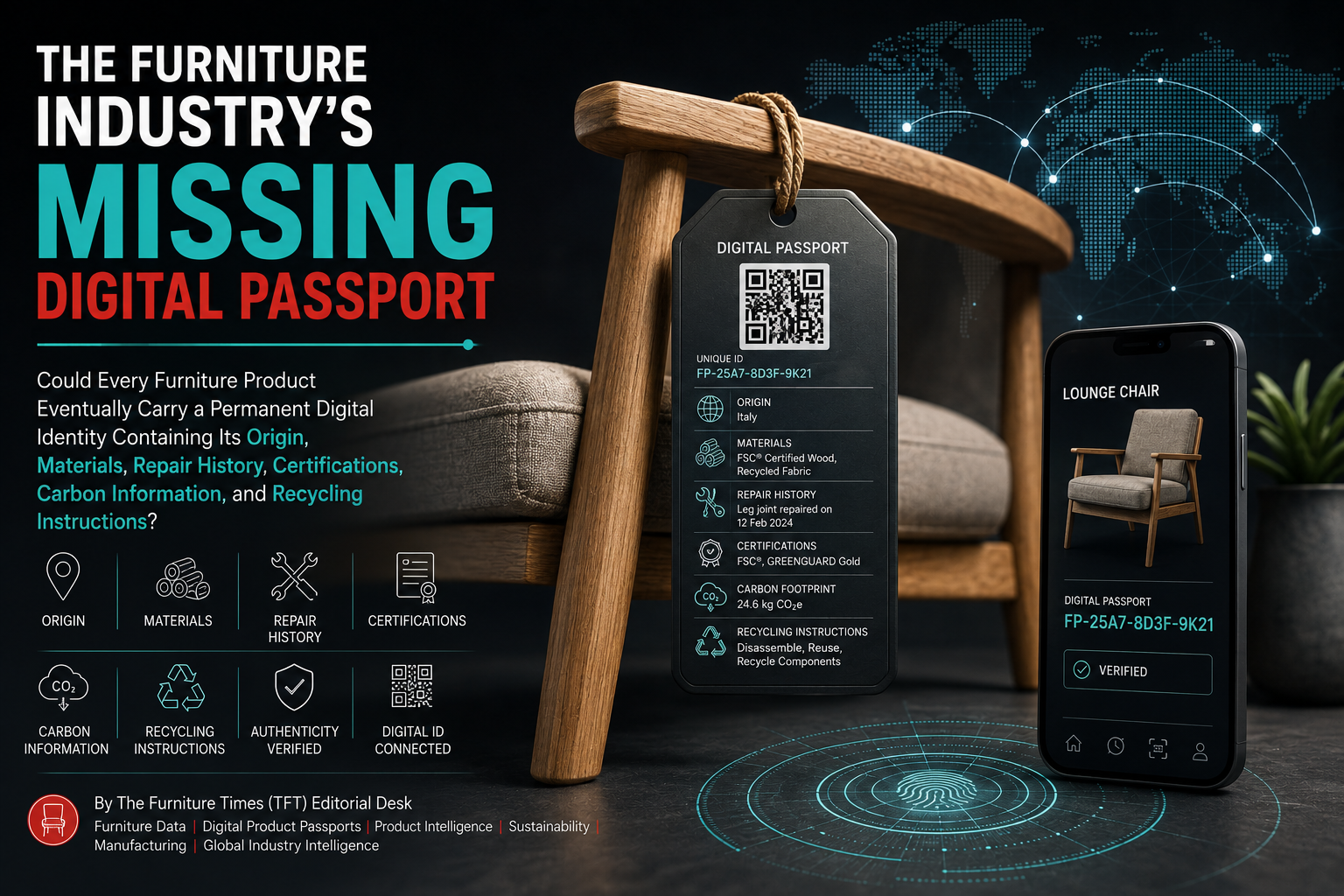
Could Every Furniture Product Eventually Carry a Permanent Digital Identity Containing Its Origin, Materials, Repair History, Certifications, Carbon Information, and Recycling Instructions?
By The Furniture Times (TFT) Editorial Desk | Furniture Data | Digital Product Passports | Product Intelligence | Sustainability | Manufacturing | Global Industry Intelligence
The furniture industry knows how to manufacture physical products.
It knows how to design them.
It knows how to package them.
It knows how to ship them.
It knows how to display them in showrooms and sell them online.
But once a piece of furniture leaves the factory and enters the market, something important is often lost:
its identity.
A sofa may remain in use for fifteen years.
A dining table may be resold multiple times.
An office chair may move through several companies.
A hotel room may be refurbished three or four times.
A cabinet may require replacement hinges.
A smart bed may need a new control unit.
A recliner may need a new motor.
An outdoor table may eventually be dismantled and recycled.
But during that entire lifecycle, where is the permanent record of the product?
Who made it?
When was it manufactured?
Which factory produced it?
What materials were used?
Which components are inside it?
What certifications apply?
What is the warranty?
Which spare parts are compatible?
How should it be repaired?
What has already been repaired?
What is its estimated carbon footprint?
Can it be disassembled?
Can it be recycled?
What should happen to it at the end of its life?
For most furniture products today, the answer is simple:
that information either does not exist in one place, or disappears over time.
That is why the global furniture industry may eventually need something far more powerful than a SKU, barcode, catalogue page or QR code.
It may need a permanent:
Digital Furniture Passport.
What Is a Digital Furniture Passport?
A digital furniture passport would be a persistent digital identity attached to a specific product or product model.
It could follow the product throughout its entire lifecycle.
From:
design,
to manufacturing,
to logistics,
to retail,
to installation,
to ownership,
to repair,
to resale,
to refurbishment,
to recycling.
The passport could potentially contain:
manufacturer information,
product model,
unique identifier,
manufacturing date,
factory location,
materials,
component specifications,
certifications,
test results,
care instructions,
repair guides,
warranty information,
spare-part references,
carbon-related data,
disassembly instructions,
recycling guidance,
and service history.
The physical furniture product could connect to this information through:
a QR code,
NFC tag,
RFID,
digital serial number,
embedded chip,
or another persistent identifier.
The purpose would not simply be to make furniture more “digital.”
The purpose would be to make it more:
traceable, understandable, repairable, verifiable, searchable and circular.
Furniture Has an Identity Problem
Today, a furniture product can effectively lose its identity soon after purchase.
The original invoice may disappear.
The retailer may close.
The catalogue may be removed from the website.
The manufacturer may discontinue the product.
The model number may be hidden underneath the product or may not exist at all.
The customer may not know the brand.
A second-hand buyer may have no idea who manufactured it.
A technician may be unable to identify the correct replacement component.
A recycler may not know what materials are inside.
This means a physical product can remain useful for decades while its digital information disappears after only a few years.
That is a major weakness in the furniture economy.
A durable product should have equally durable information.
A Sofa Should Not Become Anonymous
Consider a sofa purchased today.
It might contain:
wood or engineered-wood framing,
steel mechanisms,
foam,
springs,
adhesives,
fabric,
plastic components,
fasteners,
and finishing materials.
Ten years later, one seat mechanism fails.
The customer contacts a technician.
But the original retailer is gone.
The model is discontinued.
There is no accessible component list.
The technician cannot identify the mechanism.
A sofa worth thousands may become economically unrepairable because a relatively inexpensive component cannot be identified.
That is not simply a repair problem.
It is a data problem.
A digital passport could preserve the product’s technical identity even after the original commercial relationship ends.
Product Origin Could Become Verifiable
Furniture supply chains are global.
A product may be:
designed in one country,
manufactured in another,
assembled with components from several more,
shipped through international ports,
and sold under a brand located somewhere else.
Consumers often see only the final label.
A digital passport could provide greater transparency.
It might identify:
brand owner,
manufacturer,
country of manufacture,
production facility,
production date,
major suppliers,
and relevant sourcing information.
This would be particularly valuable for companies making claims around:
local manufacturing,
European production,
North American manufacturing,
responsible sourcing,
certified timber,
or regional craftsmanship.
Instead of relying only on marketing statements, information could become more easily verifiable.
Material Transparency Could Change Furniture Buying
Furniture material descriptions are often vague.
“Wood.”
“Premium fabric.”
“Metal frame.”
“Eco material.”
These descriptions tell customers very little.
A digital passport could provide deeper material information.
For example:
frame: FSC-certified rubberwood,
panel: 18 mm MDF with walnut veneer,
upholstery: 78% polyester, 22% recycled polyester,
foam density: specified by grade,
hardware: zinc-plated steel,
surface coating: water-based finish,
plastic content: listed by type.
This would improve transparency for:
consumers,
architects,
designers,
procurement teams,
repair specialists,
and recyclers.
Material information could become a permanent property of the product rather than temporary marketing copy.
Certifications Could Follow the Product
Furniture certifications frequently exist in separate documents.
Testing reports may sit in factory folders.
Certificates may be uploaded as PDFs.
Retailers may receive only partial information.
Customers may never see them.
A digital passport could connect specific certifications directly to the specific product or model.
Potential records could include:
structural testing,
flammability requirements,
material certifications,
wood sourcing certifications,
indoor-air-quality testing,
electrical safety certification,
commercial-use compliance,
sustainability certifications,
and region-specific requirements.
This could improve verification.
It could also reduce one of the industry’s persistent problems:
the gap between claims and evidence.
Carbon Information Could Become Product-Level Data
Sustainability reporting is becoming more detailed.
Instead of broad corporate claims, markets may increasingly expect product-level information.
A digital furniture passport could potentially include:
embodied carbon estimates,
material origin,
recycled content,
manufacturing energy information,
transport assumptions,
expected lifespan,
repairability,
and end-of-life options.
This would allow furniture buyers to compare products not simply on price and appearance but potentially on environmental performance.
For commercial projects, this could become especially relevant.
Architects, developers, hospitality groups and corporations increasingly want measurable sustainability information from suppliers.
Product passports could help make that information portable and persistent.
Repair History Could Become Part of the Product
One of the most interesting possibilities is a repair record.
Imagine a product that maintains a digital service history.
A hotel chair could show:
2027: front-right leg repaired.
2029: upholstery replaced.
2031: structural joint reinforced.
A motorized recliner could show:
2030: motor replaced.
2033: control unit replaced.
A cabinet could show:
2031: hinges upgraded.
This creates benefits for:
maintenance,
resale,
warranty analysis,
product quality,
and long-term ownership.
Furniture could begin developing something similar to a vehicle service record.
That would be a significant cultural shift.
Today, repairs are often invisible.
Tomorrow, they could become part of the product’s documented life.
Repairability Could Become a Competitive Feature
Furniture brands compete on:
design,
comfort,
price,
materials,
branding,
and delivery.
In the future, they may also compete on:
Repairability.
A digital passport could show:
which parts are replaceable,
which tools are required,
which components are standardized,
how long parts will remain available,
whether upholstery can be removed,
whether covers can be replaced,
whether mechanisms can be serviced,
and whether the product can be disassembled without damage.
A product that is easy to repair may become more attractive to:
consumers,
commercial buyers,
hotels,
offices,
schools,
and institutions.
The passport would make repairability visible.
Spare Parts Could Finally Become Searchable
A major furniture frustration is identifying spare parts.
A customer may know the product name but not the exact hinge.
A technician may know the mechanism type but not the manufacturer code.
A retailer may no longer carry the original model.
A digital passport could connect every repairable component to:
part number,
supplier code,
compatibility information,
replacement instructions,
availability,
and alternatives.
This could create an entirely new furniture after-sales economy.
Instead of replacing furniture, users could replace components.
That supports both:
customer value and circularity.
The Passport Could Change Furniture Resale
The second-hand furniture market suffers from uncertainty.
Buyers often do not know:
the original manufacturer,
product age,
materials,
original price,
repair history,
authenticity,
or compatibility of replacement parts.
A digital passport could transform resale.
A buyer could scan the product and access verified information.
That could increase trust.
It could also help premium furniture retain value.
Authentic designer furniture, high-quality contract furniture and durable residential products could carry a documented history throughout multiple ownership cycles.
Furniture could begin to develop stronger secondary-market value because its identity remains intact.
Authenticity Could Become Easier to Prove
Counterfeit and imitation furniture are significant concerns in many markets.
A permanent digital identity could make authenticity easier to verify.
A customer could scan a product and confirm:
manufacturer,
model,
production date,
authorized distribution,
and perhaps ownership history.
This would be particularly valuable for:
designer furniture,
luxury furniture,
limited editions,
collectible pieces,
and high-value commercial products.
A digital passport could become a form of anti-counterfeit infrastructure.
The Hospitality Industry Could Benefit Immediately
Hotels manage enormous quantities of furniture.
A large property may contain thousands of:
beds,
chairs,
tables,
wardrobes,
headboards,
desks,
sofas,
nightstands,
outdoor furniture pieces,
and custom fixtures.
Over time, maintenance becomes complex.
Which chair uses which glides?
Which room uses which hinge?
Which mattress model was installed in which year?
Which upholstery was specified?
Which replacement finish matches the original?
A digital passport could dramatically improve hotel asset management.
Each furniture item could carry:
product identity,
room location,
installation date,
service history,
warranty,
replacement parts,
and maintenance instructions.
Furniture could move from being an unmanaged physical asset to a digitally traceable facility asset.
Offices Could Use Furniture Passports for Asset Management
Corporate furniture is often moved, reconfigured and reused.
Desks may change departments.
Office chairs may change employees.
Workstations may be relocated between floors.
A digital identity could help organizations track:
product age,
location,
maintenance,
warranty,
repair history,
and reuse potential.
This could support more efficient workplace management.
It could also reduce unnecessary replacement.
Furniture Rental and Subscription Models Need Better Identity
Furniture-as-a-service, rental and subscription models depend heavily on lifecycle data.
If a company owns thousands of pieces of furniture and rotates them between customers, it needs to know:
where each product is,
how old it is,
how many rental cycles it has completed,
what repairs were performed,
what condition it is in,
and when it should be refurbished or retired.
A digital passport would fit naturally into this model.
The more furniture moves through multiple users, the more valuable persistent identity becomes.
Insurance Could Use Passport Data
Furniture insurance and risk management could also benefit.
A digital passport might provide verified records of:
product model,
manufacturing date,
certifications,
installation,
repair history,
and maintenance.
This could improve claims handling.
It could also help companies demonstrate:
quality controls,
maintenance discipline,
and product traceability.
In the future, better product data may influence how risk is understood.
Recalls Could Become Faster and More Precise
One of the strongest use cases for persistent product identity is recall management.
Today, recalls can be difficult because manufacturers may not know exactly where every affected product is.
A digital identity could connect specific serial ranges, batches or component versions with customers or commercial facilities, subject to appropriate privacy rules.
Instead of recalling an entire product family, companies may be able to identify only the affected units.
That could reduce cost and improve safety.
It could also allow owners to scan a product and instantly check whether it is affected by a safety notice.
Product Versioning Would Become Possible
Furniture products change over time.
A company may quietly change:
a hinge,
fabric,
motor,
frame design,
foam specification,
finish,
supplier,
or packaging.
But the product name may remain identical.
This creates problems when analyzing failures or warranties.
A digital passport could track exact versions.
For example:
Model X — Version 1.0
Model X — Version 1.1 with upgraded hinge
Model X — Version 2.0 with redesigned frame
This would allow companies to connect failures to specific product versions.
That would significantly improve quality analysis.
Failure Databases and Digital Passports Could Work Together
A digital passport becomes even more powerful when connected with failure intelligence.
Imagine a manufacturer discovers that a particular mechanism has an unusually high failure rate.
Because each product passport records the exact component installed, the company could identify all affected products.
It could then:
notify owners,
offer replacement parts,
update repair guidance,
and track whether the fix was completed.
This is how product identity and failure intelligence could become part of one integrated system.
A Passport Could Record Ownership Without Exposing Privacy
Ownership history could be useful, but privacy would need careful protection.
A product may have multiple owners.
A digital system could record ownership transfer without exposing personal information publicly.
For example:
Original purchase: 2028.
Ownership transferred: 2034.
Refurbished: 2034.
Ownership transferred: 2035.
This could support resale while maintaining privacy.
The system should be designed around data minimization and appropriate access controls.
Recycling Instructions Could Finally Become Specific
Furniture recycling is difficult because products combine many materials.
A sofa may contain:
wood,
foam,
textiles,
metal,
plastic,
adhesives,
and fasteners.
A recycler may not know how to separate them.
A digital passport could provide:
disassembly instructions,
material identification,
hazard information,
recyclable components,
non-recyclable components,
and recommended end-of-life pathways.
This could make furniture recycling more efficient.
Disassembly Should Become Part of Product Design
Digital passports could influence design itself.
If companies know they must document how products are disassembled, they may begin designing them differently.
This could encourage:
modular construction,
reversible fasteners,
replaceable upholstery,
standardized components,
and easier material separation.
Documentation can therefore influence engineering.
The passport would not simply describe the product.
It could help change how products are made.
Product Lifespan Could Become Measurable
Furniture companies often make vague claims such as:
“Built to last.”
But how long?
Five years?
Ten years?
Twenty years?
A digital identity linked to repair and ownership data could gradually create real-world lifespan information.
Manufacturers could learn:
average product lifespan,
typical time to first repair,
most common failure point,
repair frequency,
and resale duration.
That information could transform how durability is measured.
AI Agents Will Need Product Passports
AI shopping assistants are likely to become increasingly important in furniture discovery.
A user may ask:
“Find me a modular sofa under $3,000 made with certified timber, repairable covers, low-emission materials, spare parts available for ten years, and suitable for resale.”
AI cannot answer this well from marketing language alone.
It needs structured, verified product data.
A digital passport could provide exactly that.
The passport could become the machine-readable source of truth for the product.
In an AI-driven marketplace, products with richer and more trustworthy data could become easier to recommend.
Searchability Could Extend Beyond the First Sale
Today, most furniture search systems are focused on new products.
But a permanent digital identity could allow the same product to remain searchable throughout its life.
A user might search:
replacement motor for Model 2019 recliner,
compatible hinge for cabinet series X,
recycling instructions for sofa Y,
original specifications for discontinued chair Z.
This would extend furniture search beyond commerce into:
maintenance,
repair,
resale,
and end-of-life management.
The Digital Passport Could Become a Trust Layer
Furniture information is currently fragmented across:
manufacturer websites,
retailer listings,
catalogues,
certificates,
warranty documents,
repair records,
and customer receipts.
A passport could consolidate this into one trusted record.
That would create value for:
manufacturers,
retailers,
customers,
repairers,
insurers,
designers,
architects,
procurement teams,
and recyclers.
The passport would become a bridge between the physical and digital furniture economy.
Who Should Control the Passport?
This is a critical question.
Should the manufacturer own it?
Should the retailer?
Should an independent industry platform?
Should a government-mandated system manage it?
Should the customer control access?
The answer may vary.
But one principle is important:
the product’s identity should remain accessible even if:
the retailer closes,
the manufacturer restructures,
the product is discontinued,
or the customer changes.
A passport that disappears when a company disappears is not truly permanent.
This suggests that interoperability and long-term data governance will be essential.
Standardization Will Be the Hardest Part
The technology is not necessarily the biggest challenge.
The greater challenge is deciding:
which fields are mandatory,
how materials are described,
how product IDs are assigned,
how certification data is verified,
how repairs are recorded,
how ownership transfer works,
how privacy is protected,
and how different platforms communicate.
The furniture industry will need common data standards.
Without standardization, every company may create its own passport format.
That would recreate the same fragmentation the industry is trying to solve.
SMEs Must Be Included
Digital product passports must not become a system only large corporations can afford.
The global furniture ecosystem contains enormous numbers of SMEs.
Many operate with:
basic ERP systems,
spreadsheets,
PDF catalogues,
and manual processes.
A successful passport framework should therefore be simple enough for smaller manufacturers to adopt.
At minimum, an SME could begin with:
unique product ID,
manufacturer identity,
dimensions,
materials,
production date,
warranty,
care guidance,
spare parts,
and recycling information.
The system could grow over time.
QR Codes Could Be the Starting Point
The digital passport does not require futuristic hardware.
A simple QR code could provide the first practical step.
Placed underneath a chair, inside a cabinet, beneath a table or on a product label, it could connect the physical product to its digital record.
The challenge is not the QR code itself.
The challenge is what sits behind it.
If the link leads to a dead webpage five years later, the system has failed.
The real infrastructure is:
persistent, structured, maintained product data.
Furniture Could Gain a Lifetime Record
Imagine buying a table in 2030.
You scan it and see:
Manufacturer: identified.
Model: identified.
Production date: January 2030.
Materials: documented.
Certification: verified.
Warranty: active.
Care guide: available.
Replacement parts: available.
In 2035, you repair one leg.
The repair is added to the record.
In 2040, you sell it.
The next owner receives the passport.
In 2050, the product is finally dismantled.
The recycler accesses material and disassembly information.
That one record has supported:
manufacturing,
ownership,
maintenance,
resale,
and recycling.
This is what lifecycle intelligence looks like.
A Furniture Passport Could Create New Business Models
Persistent product identity could create new commercial opportunities.
Manufacturers could offer:
lifetime service packages,
verified refurbishment,
certified pre-owned furniture,
spare-part subscriptions,
maintenance plans,
resale support,
buy-back schemes,
upgrade programs,
and recycling services.
The relationship with the customer would no longer necessarily end at the first sale.
A brand could remain connected to the product for decades.
Furniture Brands Could Build Lifetime Customer Relationships
Today, the furniture transaction often ends after delivery.
A digital passport could change that.
A company might notify the owner:
when maintenance is due,
when a replacement cover becomes available,
when a component has been upgraded,
when a recall is issued,
when a refurbishment service is available,
or when the product has resale value.
This creates a new kind of customer relationship.
Not:
sell and disappear.
But:
sell, support, repair, upgrade, resell and recycle.
The Passport Could Make Furniture More Valuable
Information has economic value.
A used product with no history is uncertain.
A used product with verified origin, materials, maintenance and repair records is more trustworthy.
That could increase resale value.
The same principle already exists in other asset classes.
Furniture could move in the same direction.
Products with strong digital histories may retain more value over time.
The Future Furniture Label Could Be Dynamic
Traditional furniture labels are static.
They show:
brand,
model,
country of origin,
and perhaps a warning.
A digital passport would be dynamic.
It could update over time.
A recall could be added.
A repair could be recorded.
A replacement component could be recommended.
A certification could be renewed.
A refurbishment could be documented.
A new recycling pathway could be added.
The product’s identity would evolve with its life.
From Product Catalogue to Product Memory
The furniture industry has spent decades creating catalogues.
The next era may be about creating:
Product Memory.
A catalogue describes a product before sale.
A digital passport records what happens throughout the product’s life.
That is a much more powerful information model.
It transforms furniture from a static object into a traceable asset.
The Digital Passport Could Become the Foundation of Circular Furniture
Circularity requires information.
To reuse a product, we need to know what it is.
To repair it, we need to know how it is built.
To refurbish it, we need to know its materials.
To resell it, we need to verify its identity.
To recycle it, we need to know how it comes apart.
Without information, circularity becomes difficult.
That means the digital passport may eventually become one of the most important pieces of infrastructure supporting a circular furniture economy.
A New KPI: Product Identity Completeness
Furniture companies may eventually measure:
Product Identity Completeness.
What percentage of products have:
unique identifiers?
complete material data?
certifications?
repair instructions?
spare parts?
carbon information?
recycling guidance?
version histories?
A company with high identity completeness would be better positioned for:
AI discovery,
circularity,
compliance,
repair,
resale,
and digital commerce.
The Digital Passport Is Bigger Than Compliance
There is a danger that furniture companies may eventually treat digital passports simply as another regulatory requirement.
That would miss the opportunity.
A well-designed passport could improve:
customer experience,
search visibility,
AI discovery,
repairability,
after-sales service,
resale value,
quality management,
recall response,
and sustainability.
In other words, it could create commercial value.
The smartest companies will not ask:
“What is the minimum information we must provide?”
They will ask:
“How can permanent product identity improve our business?”
The Furniture Industry Needs to Think in Lifecycles
Furniture is still largely managed around transactions.
Manufacture.
Ship.
Sell.
Deliver.
But products continue to exist long after the transaction.
The future furniture economy should think in lifecycles:
Design → Manufacture → Sell → Use → Maintain → Repair → Resell → Refurbish → Recycle.
A digital passport connects these stages.
Without it, each stage begins with incomplete information.
With it, knowledge travels with the product.
TFT Industry Perspective
The furniture industry is entering an era in which physical products will increasingly need digital identities.
The reasons are converging:
AI needs structured data.
Consumers want transparency.
Repair requires component information.
Circularity requires material information.
Resale requires authenticity.
Insurance benefits from traceability.
Recalls require precise identification.
Sustainability requires measurable product data.
And long-life products need long-life information.
The global furniture industry should therefore begin asking a simple but important question:
Why should a piece of furniture lose its identity after it leaves the factory?
It should not.
A chair should know what it is.
A sofa should know what it is made from.
A cabinet should know which hinge it needs.
A smart bed should know which controller is compatible.
A table should know where its wood came from.
A hotel chair should carry its repair history.
A used piece of furniture should retain its authenticity.
And a recycler should know what happens at the end of its life.
The furniture industry already creates physical products designed to last years or decades.
Now it needs digital information designed to last just as long.
The future furniture product may therefore consist of two equally important assets:
the physical object
and
its permanent digital identity.
That digital identity could become one of the most important foundations of the next-generation furniture economy.
The Furniture Times (TFT) — Global Furniture Industry Media & Intelligence
TFT tells their story. FISE helps the world find them. FurniReviewology helps the world trust them.