Wireless Lighting Controls Explained
By The Furniture Times (TFT) | Indoor & Outdoor Lighting | Smart Lighting & AI
Cutting the Wires, Not the Possibilities: How Wireless Lighting Controls Are Powering the Next Generation of Smart Living
Walk into a newly built home, a modern office, a luxury hotel, or a premium retail showroom today, and you may notice something remarkable—not because you can see it, but because you can’t.
Behind beautifully illuminated spaces, there are often no complex control panels, no extensive rewiring, and no visible infrastructure controlling every light fixture. Instead, invisible wireless communication is quietly connecting lighting systems, sensors, switches, smartphones, and intelligent devices into one seamless network.
Wireless lighting controls are rapidly changing how the world designs, installs, manages, and experiences lighting. What was once considered an advanced feature for luxury developments has become an increasingly practical solution for homes, commercial buildings, healthcare facilities, educational institutions, hotels, factories, and public spaces.
As Artificial Intelligence (AI), the Internet of Things (IoT), cloud computing, and smart building technologies continue to evolve, wireless lighting controls are becoming one of the foundations of intelligent environments.
For the global furniture industry ecosystem, this transformation reaches far beyond lighting. It opens new opportunities for furniture manufacturers, architects, interior designers, lighting companies, smart home developers, property owners, hospitality operators, retailers, and technology innovators to create spaces that are more flexible, energy-efficient, sustainable, and user-friendly.
The future of lighting is no longer defined by cables hidden behind walls.
It is defined by intelligent connections that people never have to think about.
What Are Wireless Lighting Controls?
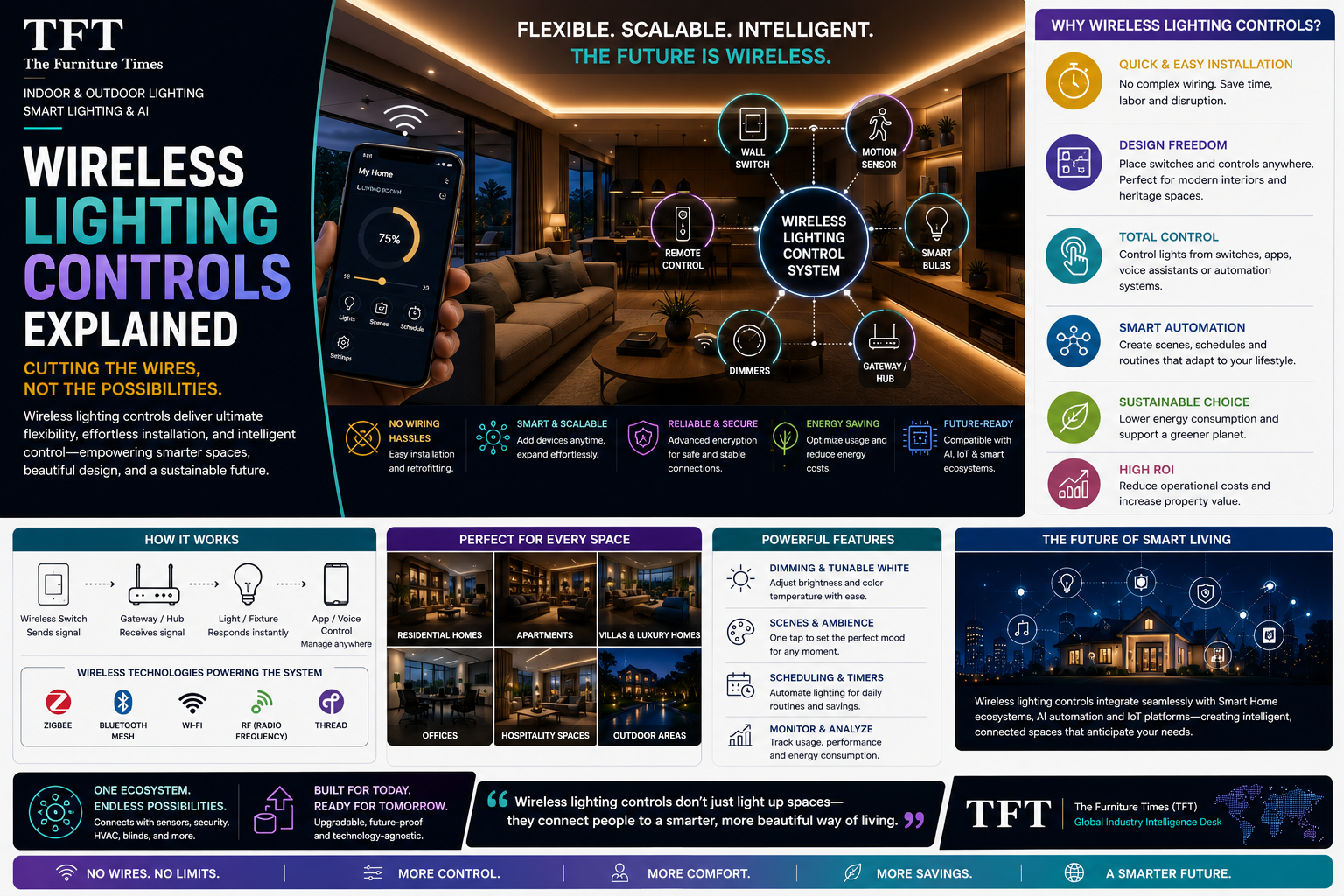
Simply put, wireless lighting controls allow lighting devices to communicate without traditional electrical control wiring.
Instead of relying on physical cables between switches, sensors, dimmers, and light fixtures, these systems exchange information using secure wireless communication technologies.
Depending on the application, wireless lighting systems may operate through:
- Wi-Fi
- Bluetooth
- Zigbee
- Z-Wave
- Thread
- Matter-compatible platforms
- Proprietary wireless protocols
- Cloud-based networks
- Mobile applications
- Smart home hubs
The result is a lighting system that is easier to install, simpler to expand, and far more adaptable to changing user needs.
Why Wireless Is Becoming the New Standard
Traditional lighting installations often require significant planning, rewiring, and labour whenever layouts change.
Wireless controls eliminate much of this complexity.
Whether adding new furniture, redesigning an office, renovating a hotel, or upgrading an existing home, lighting systems can often be reconfigured with minimal disruption.
This flexibility has made wireless controls especially attractive for:
- Residential renovations
- Rental properties
- Commercial offices
- Hotels
- Retail stores
- Healthcare facilities
- Educational campuses
- Warehouses
- Museums
- Smart city projects
The ability to adapt without rebuilding infrastructure saves both time and money.
Smarter Homes Without Major Renovations
For homeowners, wireless lighting offers a practical path into smart living.
Instead of opening walls to install new wiring, families can upgrade existing spaces using connected switches, sensors, dimmers, and smart bulbs.
Daily life becomes easier through features such as:
- Voice control
- Mobile app management
- Scheduled lighting
- Occupancy automation
- Remote access
- Scene creation
- Vacation mode
- Energy monitoring
- Child safety settings
- Personalised lighting routines
Technology becomes accessible without requiring expensive structural changes.
Furniture and Lighting Are Becoming More Connected
The furniture industry is entering an era where lighting is integrated directly into products.
Wireless controls make this integration significantly easier.
Manufacturers are introducing:
- Smart wardrobes with wireless sensors
- Illuminated kitchen cabinets
- Wireless bedside lighting
- Connected office desks
- LED shelving systems
- Smart mirrors
- Display cabinets
- Entertainment furniture
- Luxury walk-in wardrobes
- Modular storage systems
Without extensive wiring, furniture becomes cleaner, more flexible, and easier to install.
Consumers increasingly expect furniture to connect effortlessly with the rest of their smart home ecosystem.
Better Experiences for Hospitality
Hotels have become early adopters of wireless lighting controls because flexibility directly improves guest satisfaction.
Staff can easily customise lighting throughout guestrooms, restaurants, conference halls, spas, and public spaces.
Guests benefit from:
- One-touch lighting scenes
- Voice-controlled rooms
- Personalised ambience
- Night lighting
- Wake-up routines
- Smart energy management
- Comfortable room environments
- Automated occupancy control
- Seamless digital experiences
- Improved convenience
For hotel operators, wireless systems simplify maintenance while reducing operational costs.
Offices Are Becoming More Agile
The modern workplace changes constantly.
Departments expand.
Meeting rooms evolve.
Collaborative spaces replace fixed workstations.
Wireless lighting makes these transitions significantly easier.
Instead of rewiring entire floors, organisations can simply reprogram lighting zones to match new layouts.
This creates workplaces that remain flexible as businesses continue to evolve.
Sustainability Starts with Smarter Control
Lighting accounts for a significant portion of electricity consumption in many buildings.
Wireless controls help reduce unnecessary energy use by ensuring lights operate only when and where needed.
Intelligent systems automatically respond to:
- Occupancy
- Daylight availability
- Working hours
- Building schedules
- Weather conditions
- Seasonal changes
- User behaviour
- Facility management requirements
- Maintenance needs
- Energy-saving strategies
The result is lower energy bills, reduced carbon emissions, and more sustainable buildings.
Artificial Intelligence Takes Wireless Lighting Further
Wireless connectivity becomes even more powerful when combined with Artificial Intelligence.
AI can analyse building usage patterns and continuously improve lighting performance.
Future systems may automatically:
- Predict occupancy.
- Learn personal preferences.
- Detect unusual behaviour.
- Optimise electricity consumption.
- Schedule maintenance.
- Coordinate with HVAC systems.
- Integrate with security platforms.
- Support emergency responses.
- Improve workplace comfort.
- Personalise lighting experiences.
Lighting evolves from simple automation into intelligent decision-making.
Opportunities Across the Furniture Industry Ecosystem
Wireless lighting controls are creating exciting opportunities for:
- Furniture manufacturers
- Lighting manufacturers
- Architects
- Interior designers
- Property developers
- Hospitality groups
- Healthcare providers
- Educational institutions
- Retailers
- Smart home technology companies
Businesses that embrace wireless technologies can offer customers greater flexibility, lower installation costs, and more future-ready solutions.
Challenges That Still Need Attention
Like any emerging technology, wireless lighting continues to face challenges.
These include:
- Cybersecurity
- Device compatibility
- Network reliability
- Consumer awareness
- Installation standards
- Software updates
- Privacy concerns
- Skilled workforce development
- Long-term interoperability
- Technology lifecycle management
Industry collaboration will be essential to build trust and accelerate adoption.
The Next Generation of Buildings Will Be Wireless by Design
As connected buildings become increasingly intelligent, wireless lighting controls will play a central role in building management.
Future systems will not simply control lighting.
They will communicate with furniture, appliances, elevators, security systems, renewable energy sources, digital twins, and AI assistants to create environments that automatically respond to people’s needs.
This is the direction of smart living.
Not more technology.
Better-connected technology.
Lighting Without Limits
Wireless lighting controls represent much more than a convenient upgrade.
They symbolise a new philosophy of design—one where flexibility replaces fixed infrastructure, intelligence replaces manual control, and seamless experiences replace unnecessary complexity.
For the global furniture industry ecosystem, wireless lighting creates exciting opportunities to design smarter products, build more adaptable spaces, improve sustainability, and deliver better experiences for consumers around the world.
As homes become smarter, offices become more agile, hotels become more personalised, and furniture becomes increasingly connected, wireless lighting controls will quietly become one of the invisible technologies shaping everyday life.
The future of lighting is not about eliminating wires.
It is about removing barriers between people and the environments they live in.
The Furniture Times (TFT) & Furniture Industry Search Engine (FISE)
“TFT tells their story. FISE helps the world find them.”
“FurniReviewology helps the world trust them.”
The furniture industry ecosystem is a $1 trillion industry ecosystem.