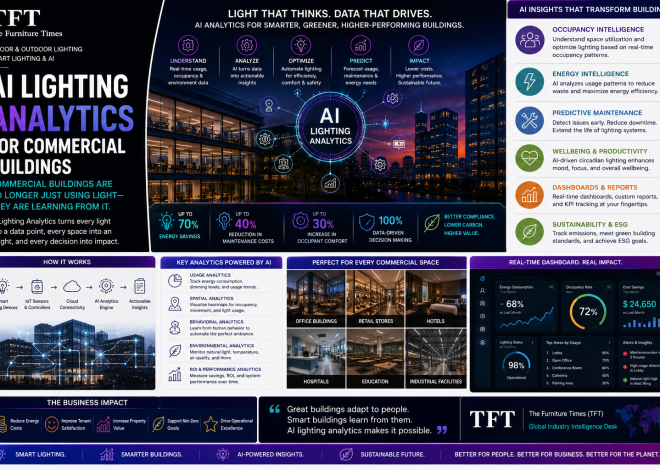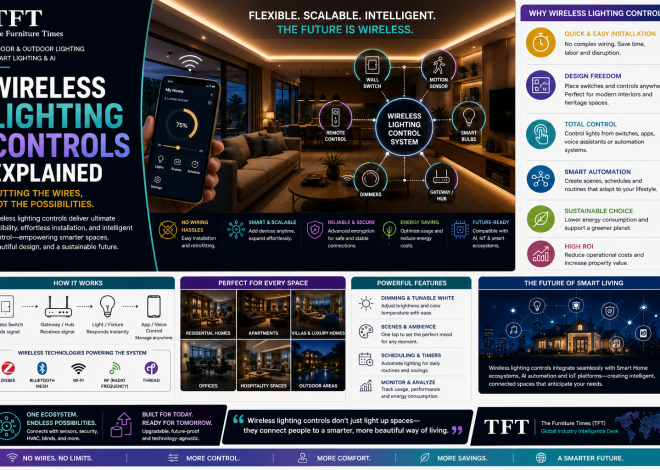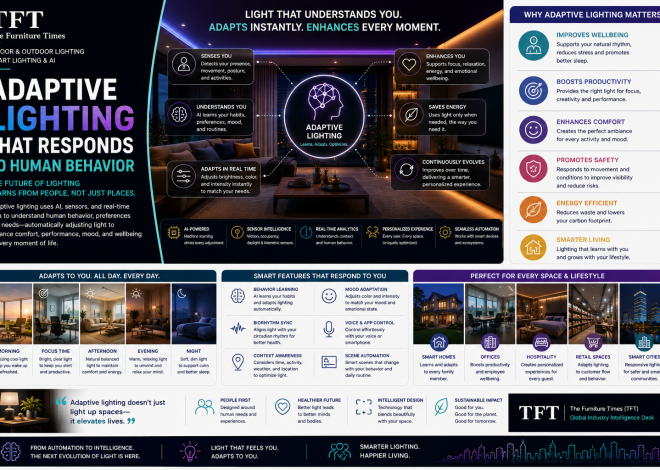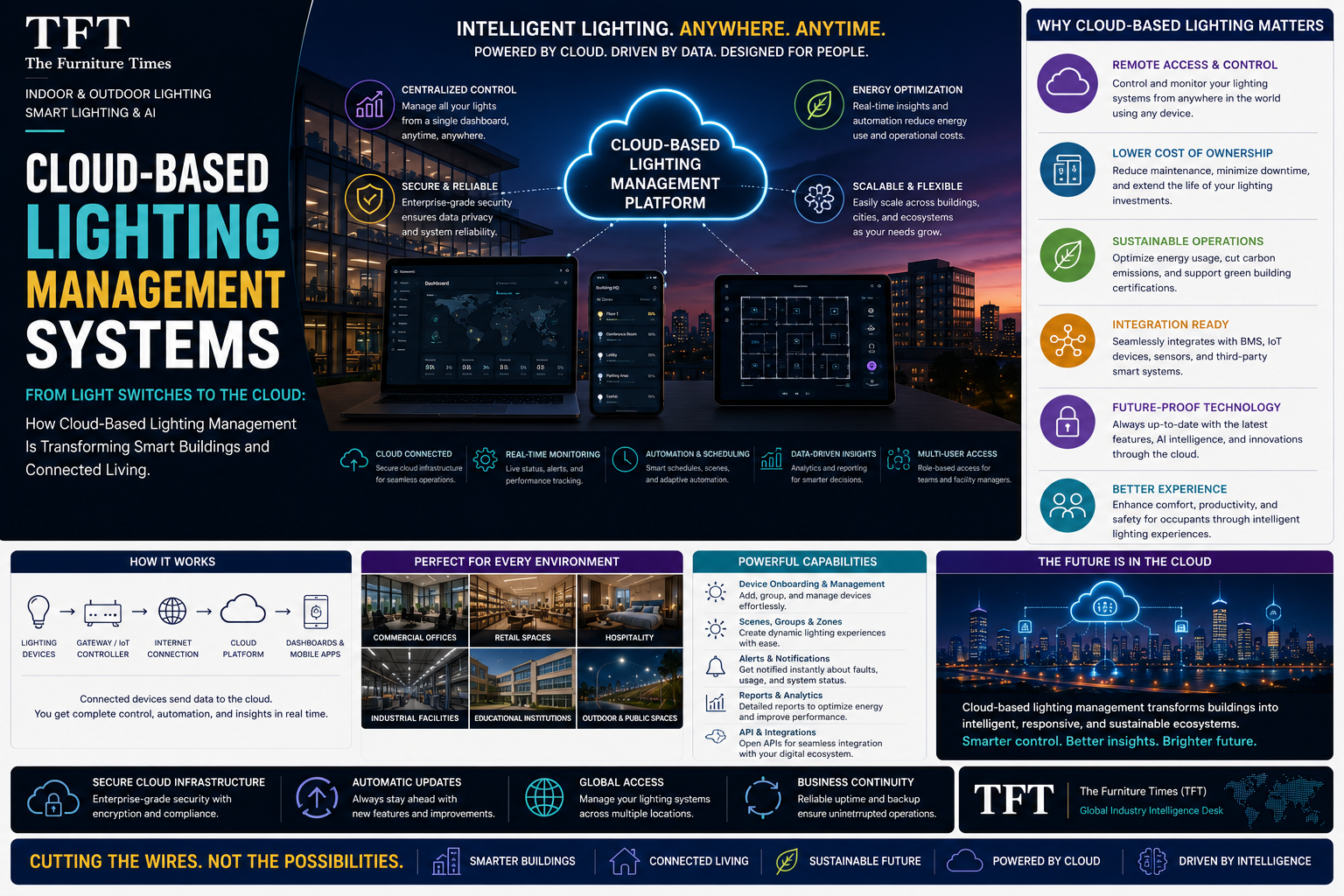
Cloud-Based Lighting Management Systems
By The Furniture Times (TFT) | Indoor & Outdoor Lighting | Smart Lighting & AI
From Light Switches to the Cloud: How Cloud-Based Lighting Management Is Transforming Smart Buildings and Connected Living
Imagine managing the lighting of a luxury hotel in Dubai while sitting in an office in Kuala Lumpur. Picture a retail chain adjusting the lighting in hundreds of stores from a single dashboard. Consider a furniture manufacturer monitoring the energy consumption of every showroom, warehouse, and office across multiple countries without stepping inside any of those buildings.
This is not a glimpse of the future—it is happening today.
Cloud-based lighting management systems are redefining how lighting is monitored, controlled, analysed, and optimised. By connecting lighting infrastructure to secure cloud platforms, businesses and homeowners can access real-time information, automate operations, improve energy efficiency, and make smarter decisions from virtually anywhere in the world.
For years, lighting management depended on local control panels, manual inspections, and isolated building systems. Today, cloud technology has removed those limitations. Lighting is no longer confined to a single room or building—it has become part of a connected digital ecosystem that can be managed across cities, countries, and continents.
For the global furniture industry ecosystem, this evolution presents exciting possibilities. Furniture manufacturers, lighting companies, architects, property developers, hospitality operators, retailers, facility managers, and technology providers now have opportunities to create environments that are not only beautifully designed but also intelligent, measurable, and continuously improving.
Cloud technology is quietly changing the way buildings think.
What Is a Cloud-Based Lighting Management System?
A cloud-based lighting management system connects lighting devices, sensors, gateways, and controllers to an internet-based platform where they can be monitored and managed remotely.
Instead of relying solely on local hardware, users access lighting controls through secure web portals or mobile applications.
From one central interface, they can:
- Monitor lighting performance.
- Adjust brightness levels.
- Schedule operating hours.
- Analyse energy consumption.
- Receive maintenance alerts.
- Manage multiple locations.
- Generate performance reports.
- Control lighting scenes.
- Update system settings.
- Optimise operational efficiency.
The result is greater visibility, flexibility, and control than traditional lighting systems could ever provide.
Lighting Data Is Becoming a Valuable Business Asset
Every connected light generates information.
How long was it switched on?
Which areas consume the most electricity?
When are meeting rooms occupied?
Which showroom attracts the most visitors?
Cloud platforms transform this information into practical business intelligence.
Instead of making decisions based on assumptions, organisations can rely on real-time data to improve efficiency, reduce costs, and enhance customer experiences.
In today’s digital economy, lighting is becoming a source of operational insight.
Managing Multiple Buildings from One Dashboard
One of the greatest advantages of cloud-based lighting management is centralisation.
Large organisations often manage dozens—or even hundreds—of buildings.
These may include:
- Corporate offices
- Furniture showrooms
- Manufacturing plants
- Warehouses
- Hotels
- Shopping centres
- Educational campuses
- Hospitals
- Residential developments
- Public facilities
Instead of managing each building separately, facility managers can oversee every location through a single cloud-based platform.
This saves time, improves consistency, and simplifies operations.
Smart Homes Are Joining the Cloud
Cloud technology is no longer reserved for commercial buildings.
Modern homeowners increasingly expect remote access to their lighting systems.
Whether travelling for business or on holiday, users can:
- Turn lights on or off remotely.
- Create lighting schedules.
- Receive security notifications.
- Simulate occupancy.
- Monitor energy use.
- Adjust outdoor lighting.
- Control multiple properties.
- Integrate voice assistants.
- Share household access.
- Personalise lighting scenes.
The home becomes accessible from virtually anywhere with an internet connection.
Furniture Is Becoming Part of the Connected Ecosystem
As furniture becomes smarter, cloud connectivity is creating entirely new possibilities.
Manufacturers are introducing products such as:
- Smart wardrobes with cloud-controlled lighting.
- Connected kitchen cabinetry.
- Intelligent bedside furniture.
- Display cabinets with remote lighting management.
- Smart office desks.
- LED-integrated shelving.
- Hospitality furniture.
- Luxury walk-in wardrobes.
- Retail display systems.
- Modular storage solutions.
Furniture is no longer simply manufactured—it is becoming digitally connected.
Hospitality Is Delivering Consistent Guest Experiences
Large hotel groups often operate hundreds of properties across different regions.
Cloud-based lighting management allows operators to maintain consistent brand standards while reducing operating costs.
Managers can remotely adjust:
- Guest room lighting.
- Lobby ambience.
- Restaurant illumination.
- Conference facilities.
- Spa environments.
- Outdoor landscapes.
- Emergency lighting.
- Seasonal decorations.
- Energy-saving schedules.
- Maintenance planning.
Every property benefits from central oversight while retaining local flexibility.
Retailers Are Using Lighting to Improve Business Performance
Retail lighting has always influenced customer behaviour.
Cloud technology now allows retailers to measure and optimise that influence.
Store managers can compare:
- Energy usage.
- Customer traffic.
- Promotional lighting.
- Display effectiveness.
- Seasonal campaigns.
- Product highlighting.
- Maintenance requirements.
- Operating costs.
- Branch performance.
- Sustainability targets.
Lighting becomes a measurable business strategy rather than simply an operating expense.
Artificial Intelligence Makes the Cloud Even Smarter
Cloud platforms become significantly more powerful when combined with Artificial Intelligence.
AI analyses enormous volumes of operational data and identifies opportunities that humans may overlook.
Future cloud-based lighting systems may automatically:
- Predict equipment failures.
- Recommend energy-saving adjustments.
- Detect unusual activity.
- Learn occupancy trends.
- Optimise lighting schedules.
- Coordinate with HVAC systems.
- Support predictive maintenance.
- Improve workplace comfort.
- Enhance building security.
- Personalise user experiences.
The cloud becomes more than storage—it becomes an intelligent decision-making platform.
Sustainability Through Real-Time Intelligence
One of the strongest advantages of cloud-based lighting management is its contribution to sustainability.
Real-time monitoring enables organisations to identify inefficiencies immediately rather than months later.
Benefits include:
- Lower electricity consumption.
- Reduced carbon emissions.
- Improved LED lifespan.
- Better maintenance planning.
- Reduced operating costs.
- Smarter resource allocation.
- Higher building efficiency.
- Renewable energy integration.
- Environmental reporting.
- ESG performance improvement.
Sustainability becomes measurable instead of aspirational.
Opportunities Across the Furniture Industry Ecosystem
Cloud-based lighting management creates opportunities for:
- Furniture manufacturers.
- Lighting manufacturers.
- Smart home companies.
- Property developers.
- Architects.
- Interior designers.
- Hospitality operators.
- Retail businesses.
- Facility management companies.
- Technology startups.
Companies that combine connected furniture with cloud-managed lighting will be better positioned to meet the growing demand for intelligent living and working environments.
Challenges the Industry Must Address
As adoption accelerates, several important issues require continued attention.
These include:
- Cybersecurity.
- Data privacy.
- Reliable internet connectivity.
- Cross-platform compatibility.
- Cloud infrastructure costs.
- Software maintenance.
- Industry standards.
- User education.
- Skilled workforce development.
- Long-term digital resilience.
Building trust will be just as important as building technology.
The Future Will Be Managed from Anywhere
The next generation of cloud-based lighting systems will extend beyond lighting itself.
Buildings will become fully connected digital ecosystems where lighting communicates with furniture, security systems, elevators, renewable energy sources, environmental sensors, occupancy analytics, digital twins, and AI assistants.
Facility managers may oversee thousands of buildings from a single intelligent platform.
Homeowners may personalise every room before arriving home.
Retailers may optimise customer experiences in real time.
Hotels may adjust every guest room automatically based on occupancy and preferences.
Lighting will no longer simply illuminate spaces.
It will generate intelligence that improves how those spaces operate.
The Cloud Is Changing the Way We Experience Light
Cloud-based lighting management systems represent far more than a technological upgrade.
They signal a fundamental shift in how lighting is designed, managed, and valued.
For the global furniture industry ecosystem, cloud connectivity opens new opportunities to create products and environments that are smarter, more sustainable, more efficient, and more responsive to the people who use them.
The buildings of tomorrow will not only consume electricity.
They will generate knowledge.
And in an increasingly connected world, that knowledge will become one of the most valuable resources of all.
The Furniture Times (TFT) & Furniture Industry Search Engine (FISE)
“TFT tells their story. FISE helps the world find them.”
“FurniReviewology helps the world trust them.”
The furniture industry ecosystem is a $1 trillion industry ecosystem.