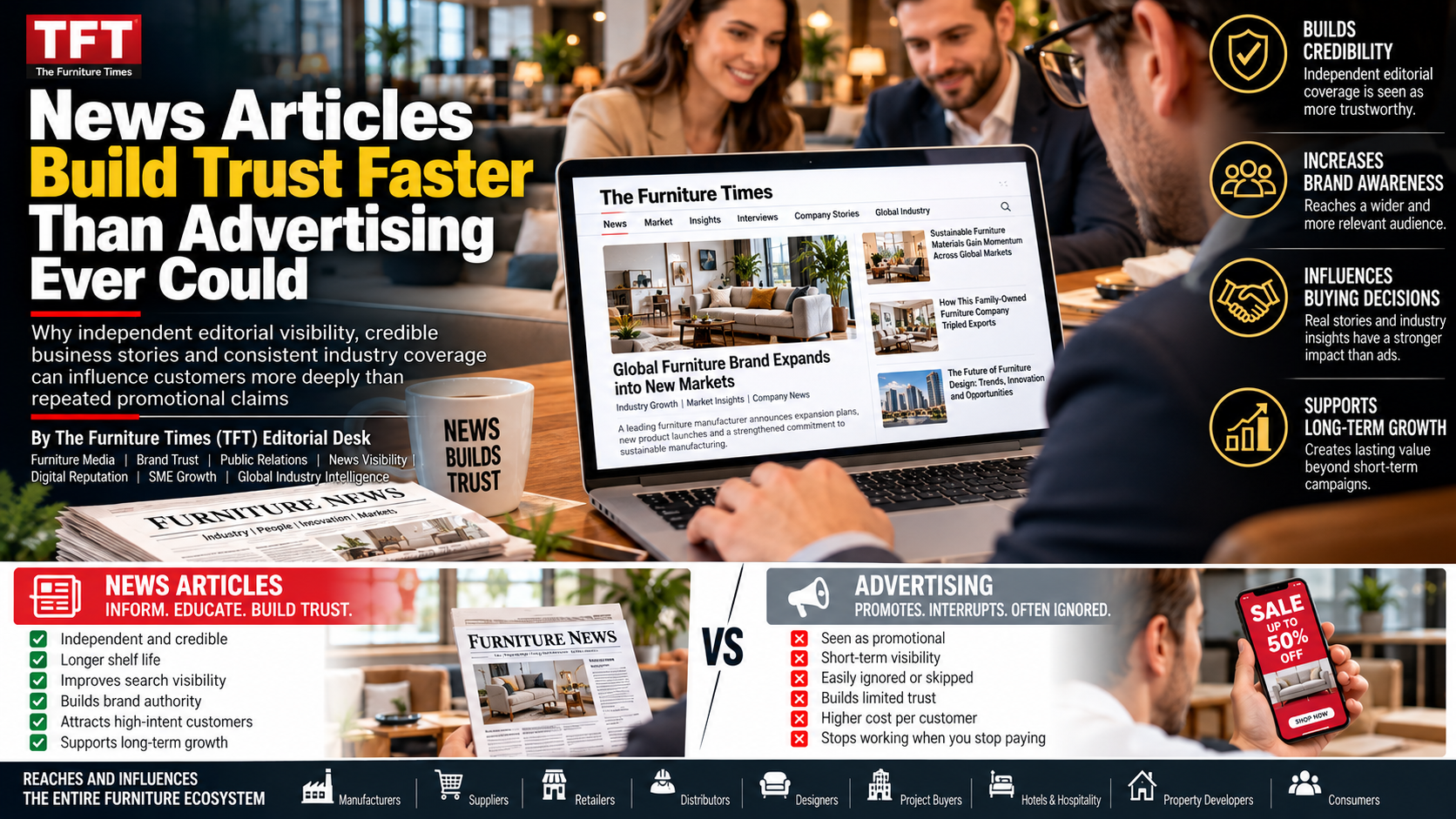
News Articles Build Trust Faster Than Advertising Ever Could
Why independent editorial visibility, credible business stories and consistent industry coverage can influence customers more deeply than repeated promotional claims
By The Furniture Times (TFT) Editorial Desk | Furniture Media | Brand Trust | Public Relations | News Visibility | Digital Reputation | SME Growth | Global Industry Intelligence
Advertising tells people what a company wants them to hear.
A news article helps them understand why the company may deserve their attention.
That distinction has become increasingly important in a crowded digital market where customers encounter promotional claims everywhere. Furniture manufacturers, retailers, suppliers, designers and service providers regularly describe themselves as:
- The best
- The most trusted
- The highest quality
- The most affordable
- The industry leader
- The preferred supplier
- The premium choice
These claims may be sincere, but customers recognise that businesses pay to promote them. Advertising can create awareness and capture demand, but it does not automatically create credibility.
A well-researched news article works differently.
It can explain:
- What the company has achieved
- Why its work matters
- Which problem it solves
- How it manufactures or delivers
- What distinguishes its products
- Who is behind the business
- Which markets it serves
- What customers or partners have experienced
- How it contributes to the wider industry
- What evidence supports its claims
That depth gives the reader something advertising rarely provides: context.
Advertising can buy attention. Credible news coverage can earn belief.
Businesses need both. The mistake is expecting paid promotion to carry the entire responsibility for trust.
Advertising creates visibility—but visibility is not trust
Advertising remains an essential commercial tool.
It can help a furniture business:
- Reach targeted audiences
- Announce a new collection
- Promote showroom traffic
- Generate enquiries
- Support a seasonal campaign
- Retarget interested visitors
- Capture high-intent searches
- Introduce the brand to a new market
- Increase product awareness
However, customers know that advertising is controlled by the advertiser.
The company decides:
- What to say
- Which photograph to show
- Which features to highlight
- Which limitations to omit
- Which customer segment to target
- How long the campaign should run
This does not make advertising dishonest. It makes it promotional.
Customers therefore interpret an advertisement differently from:
- A news report
- An industry profile
- A founder interview
- An independent review
- A project case study
- A research article
- A third-party business feature
Advertising says:
“This is what we claim.”
Credible editorial coverage says:
“This is why the claim may be worth examining.”
Why news coverage feels more credible
Third-party coverage creates a degree of separation between the company and the message.
A business can publish its own announcement, but when an independent media platform researches, structures and presents the story, readers may perceive the information as more credible—provided the article is transparent, accurate and not disguised advertising.
News coverage can add:
- Editorial context
- Industry comparison
- Independent framing
- Verifiable facts
- Public accountability
- Searchable documentation
- Quotable information
- A permanent reference point
A company may tell a potential client:
“We are an experienced hospitality-furniture supplier.”
The client may reasonably ask for proof.
A detailed news feature can document:
- Years in business
- Projects completed
- Markets served
- Products supplied
- Manufacturing capabilities
- Materials used
- Installation experience
- Leadership background
- Customer feedback
- Future plans
The claim becomes more concrete.
Advertising is rented attention; news becomes an enduring asset
Most advertisements stop producing exposure when the campaign ends.
A news article can remain accessible through:
- Search engines
- Media archives
- Company websites
- Industry platforms
- Social sharing
- Email distribution
- Sales presentations
- Investor discussions
- Dealer proposals
- AI-assisted search
A paid campaign may run for seven days. A well-indexed news article can remain discoverable for years.
This makes news coverage a cumulative business asset.
Each credible article can add another layer to the company’s public identity:
- Launch story
- Founder profile
- Factory feature
- Product innovation
- Project announcement
- Export milestone
- Sustainability initiative
- Award recognition
- Market commentary
- Customer-experience improvement
- Community contribution
Over time, these stories create an independently visible history.
A company with no public history can appear smaller, newer or less active than it actually is.
News helps buyers conduct due diligence
Before approaching a company, buyers increasingly investigate it online.
They search for:
- Company name
- Founder or leadership
- Product reviews
- Project history
- News coverage
- Factory location
- Certifications
- Customer complaints
- Delivery experience
- Industry reputation
- Years in business
- Markets served
This research is especially important for high-value furniture purchases and business-to-business procurement.
A hotel, property developer, architect, retailer or importer may need confidence that the supplier can:
- Manufacture consistently
- Meet specifications
- Deliver on time
- Handle project quantities
- Resolve problems
- Provide replacements
- Maintain documentation
- Remain operational after the sale
Advertising alone rarely answers these questions.
News and long-form editorial content can help create the evidence trail buyers need.
Trust develops through repeated credible signals
One article does not automatically make a business trustworthy.
Trust develops when several signals support one another.
News does not replace these elements. It connects and strengthens them.
The trust difference: advertising versus news
| Advertising | Credible news coverage |
|---|---|
| Paid placement | Editorial or clearly disclosed sponsored coverage |
| Controlled by advertiser | Structured through an editorial process |
| Focuses on promotion | Adds context and explanation |
| Usually campaign-based | Can remain discoverable for years |
| Creates immediate reach | Builds searchable authority |
| Highlights benefits | Can examine significance and evidence |
| Often uses short messages | Allows detailed storytelling |
| Stops when spending stops | Can continue attracting attention |
| Supports transactions | Supports reputation and due diligence |
| Says the brand is valuable | Helps demonstrate why it may be valuable |
Both are useful, but they perform different jobs.
Advertising is effective for reach and conversion.
News is effective for credibility, context and long-term authority.
Why furniture businesses particularly need news
Furniture is a high-consideration category.
Customers may worry about:
- Product quality
- Comfort
- Durability
- Materials
- Dimensions
- Delivery
- Installation
- Warranty
- Repairs
- After-sales support
- Value for money
Commercial buyers may also evaluate:
- Production capacity
- Factory controls
- Lead times
- Compliance
- Customisation
- Project-management capability
- Replacement availability
- Financial and operational reliability
A simple advertisement showing a beautiful sofa cannot address all these concerns.
A news article can explore the company behind the product.
For example:
“New outdoor collection now available—buy today.”
is an advertisement.
A news story could explain:
- Why the collection was developed
- Which market need it addresses
- What materials are used
- How it performs in tropical conditions
- Whether cushions are removable
- What warranty support is available
- Which hospitality projects it suits
- How the manufacturer tested the products
- Whether replacement components are available
The same product becomes more understandable—and therefore more trustworthy.
News can make invisible expertise visible
Many SMEs possess genuine experience but communicate very little about it.
A furniture manufacturer may have:
- Twenty years of production knowledge
- Skilled craftspeople
- Custom-engineering capability
- Export experience
- Strong quality-control systems
- Successful hospitality projects
- Material expertise
- Reliable after-sales support
Yet its digital footprint may consist of:
- A basic website
- An inactive social page
- An outdated catalogue
- A few product photographs
- No media coverage
- No leadership profile
- No published case studies
To a new buyer, this company may appear less credible than a newer competitor with stronger communication.
The market cannot value expertise it cannot see.
News turns hidden experience into public evidence.
What makes a business story newsworthy?
Not every company announcement deserves to be called news.
A credible article should answer:
- What happened?
- Why does it matter?
- Who is affected?
- What evidence supports the story?
- How does it connect to the wider industry?
- What can readers learn from it?
Strong subjects include:
Business expansion
- New factory
- Production-line upgrade
- Showroom opening
- Entry into a new country
- Warehouse expansion
- Dealer appointment
Product development
- New furniture collection
- Material innovation
- Modular system
- Smart-furniture feature
- Outdoor-performance improvement
- Accessibility-focused design
Projects
- Hotel or resort installation
- Office fit-out
- Residential development
- Restaurant furnishing
- Public-space project
- Institutional contract
Certifications and standards
- Product certification
- Quality-management achievement
- Environmental accreditation
- Safety-testing milestone
- Export compliance
Leadership
- Founder story
- New appointment
- Skilled artisan profile
- Designer collaboration
- Succession planning
- Workforce development
Sustainability
- Responsible timber sourcing
- Repair and refurbishment programme
- Waste reduction
- Recycled-material initiative
- Take-back system
- Circular design
Industry insight
- Market analysis
- Consumer behaviour
- Supply-chain trends
- Material-price changes
- Export challenges
- Technology adoption
The strongest business news combines the company’s development with broader relevance.
A product launch becomes stronger when it explains the “why”
Many product-launch announcements list:
- Product name
- Colour
- Size
- Price
- Availability
A stronger article explores:
- Which customer problem inspired the product
- Why the company selected particular materials
- How the design was developed
- What testing was conducted
- How the product differs from alternatives
- Which environments it suits
- What feedback influenced development
- How it supports the company’s strategy
News turns a product from an item into a story.
Stories help customers remember.
Founder stories humanise the business
Customers often want to know who stands behind a company.
A founder profile can communicate:
- Origin
- Motivation
- Experience
- Challenges
- Values
- Industry knowledge
- Leadership philosophy
- Future vision
This is particularly valuable for SMEs, where leadership and brand identity are often closely connected.
A founder’s journey can help buyers understand:
- Why the company exists
- Why it chose its market
- What it has learned
- How it responds to adversity
- What it intends to build
But founder coverage must remain substantive. It should not become an unsupported celebration of titles and claims.
Credibility depends on evidence, humility and relevance.
News strengthens search visibility
Search engines require information to understand a business.
A company with only a homepage may provide limited evidence about:
- Products
- Leadership
- Projects
- Markets
- Expertise
- Locations
- Achievements
News articles create additional searchable pages connected to the company’s identity.
They can help search systems associate the business with:
- Furniture categories
- Materials
- Geographic markets
- Industry sectors
- Project types
- Leadership
- Special capabilities
For example, a furniture supplier seeking hospitality clients could publish credible coverage about:
- Resort projects
- Hotel-pool furniture
- Commercial outdoor materials
- Maintenance planning
- Replacement systems
- Hospitality procurement
- Delivery and installation
This does not guarantee search rankings, but it gives search engines and potential buyers more useful information.
News also supports AI discovery
Customers increasingly ask AI systems questions such as:
- Who manufactures hotel furniture in Malaysia?
- Which companies supply outdoor furniture to resorts?
- Where can I find custom furniture manufacturers?
- Which furniture brands focus on sustainable materials?
- Who are the leading furniture-industry founders?
- Which companies have completed similar projects?
AI systems rely on accessible, structured and corroborated information.
If a company has little public information, the system may:
- Ignore it
- Misunderstand it
- Confuse it with another company
- Lack confidence in recommending it
- Refer customers to more visible competitors
News articles contribute to the company’s public knowledge footprint.
They should clearly state:
- Company name
- Location
- Leadership
- Products
- Capabilities
- Markets
- Contact information
- Evidence supporting the story
In the age of AI discovery, public documentation is becoming a strategic asset.
One article can support multiple business functions
A credible news article can be reused responsibly across:
- Website news section
- Email newsletter
- Sales proposal
- Dealer presentation
- Investor deck
- Recruitment page
- Social media
- WhatsApp follow-up
- Trade-show material
- Export introduction
- Search campaigns
The business should not simply copy the headline everywhere. It can adapt the story for each audience while linking back to the complete article.
For example:
- Sales team: project credibility
- Recruitment: company growth
- Investors: market progress
- Dealers: brand momentum
- Customers: product confidence
- Media: future story background
- Search engines: company context
This makes editorial visibility commercially useful beyond public relations.
News coverage can reduce sales friction
Salespeople often spend time proving that the business is credible.
Potential customers ask:
- Who are you?
- How long have you operated?
- Have you completed similar projects?
- Can I see your work?
- Why should I trust your company?
- Do you have industry recognition?
- What happens after purchase?
A well-prepared media profile, case study or project article can answer several questions before the sales conversation begins.
This does not remove the need for direct evidence. Buyers may still require references, samples, contracts, certificates and site visits.
But news coverage can help the company enter the conversation with greater credibility.
Advertising performs better when supported by news
The relationship between advertising and news should not be treated as competition.
They can reinforce one another.
A customer may:
- See an advertisement.
- Search for the company.
- Find a news article.
- Read customer reviews.
- Visit the website.
- Contact the business.
Without supporting evidence, the advertisement may generate curiosity but fail to create confidence.
News therefore improves the environment around advertising.
The strongest marketing system combines:
- Paid reach
- Editorial credibility
- Search visibility
- Customer reviews
- Product information
- Consistent service
Advertising starts the journey. Trust signals help complete it.
The danger of disguised advertising
Not every article builds trust.
Content can weaken credibility when it:
- Makes unsupported claims
- Hides sponsorship
- Copies a press release without scrutiny
- Uses invented statistics
- Exaggerates achievements
- Presents promotional language as independent reporting
- Omits important limitations
- Gives no source
- Repeats keyword-stuffed text
- Pretends to be editorial coverage
Businesses and publishers should clearly distinguish between:
- Independent editorial coverage
- Submitted press releases
- Sponsored content
- Partner content
- Advertorials
- Company-authored opinion
Transparency does not reduce value. It protects trust.
A clearly labelled sponsored article can still be useful when it contains accurate, substantial and relevant information.
The problem is not commercial participation. The problem is deception.
Press releases must contain evidence
A weak press release says:
“Company X is the world’s leading furniture company offering the best products at unbeatable prices.”
A stronger release says:
“Company X has opened a 40,000-square-foot manufacturing facility, adding a new finishing line and increasing stated production capacity. The expansion is intended to support hospitality projects across three identified markets.”
The stronger version contains:
- A specific event
- Measurable information
- Commercial context
- A clear reason the story matters
Evidence makes a story publishable.
What evidence should support a news article?
Depending on the story, useful evidence may include:
- Official company documents
- Project photographs
- Customer confirmation
- Contracts where disclosure is permitted
- Product specifications
- Certifications
- Laboratory reports
- Award records
- Shipping records
- Factory information
- Executive interviews
- Government filings
- Market-research sources
- Published financial results
- Event documentation
- Before-and-after data
Not every article requires all these materials. But important claims should be verifiable.
Reviews and news perform different trust functions
Customer reviews and news coverage are complementary.
| Reviews | News articles |
|---|---|
| Describe customer experience | Explain company activity and significance |
| Reveal service performance | Document capabilities and developments |
| Often short and personal | Usually structured and contextual |
| Help assess satisfaction | Help understand the organisation |
| Highlight recurring issues | Explain strategy, products and projects |
| Support purchase confidence | Support authority and due diligence |
A company may have excellent media coverage but poor reviews. That signals a gap between its public story and customer experience.
It may have strong reviews but no news presence. That suggests customer satisfaction without broader industry visibility.
The strongest digital reputation combines both.
News is not a substitute for performance
No article can permanently protect a company that delivers poor products or service.
If a furniture business repeatedly experiences:
- Late delivery
- Damaged products
- Inaccurate specifications
- Weak construction
- Ignored complaints
- Unfulfilled warranties
- Misleading prices
positive coverage will eventually lose credibility.
News can amplify reputation, but the underlying reputation must be earned operationally.
The most effective editorial stories begin inside the business:
- Better products
- Better projects
- Better service
- Better systems
- Better leadership
- Better customer outcomes
Public relations cannot sustainably replace product quality.
A practical news programme for SMEs
An SME does not need daily press coverage. It needs consistency and substance.
Monthly
- Publish one meaningful company or industry story.
- Record new projects and milestones.
- Update leadership and company information.
- Collect approved photographs and quotations.
Quarterly
- Publish one case study.
- Provide expert commentary on an industry issue.
- Review search visibility and media mentions.
- Identify upcoming announcements.
Annually
- Publish a business progress report.
- Review major achievements and lessons.
- Update the company profile.
- Prepare a founder or leadership perspective.
- Build an editorial calendar for the next year.
A regular programme creates continuity without manufacturing artificial news.
The SME newsworthiness checklist
Before distributing a story, ask:
- Is there a real development?
- Why should anyone outside the company care?
- Can the main claim be verified?
- Does the article provide useful context?
- Are dates, names and figures accurate?
- Are promotional claims supported?
- Is sponsored involvement disclosed?
- Does the story contain original information?
- Are photographs authentic and properly authorised?
- Is there a clear company description?
- Can readers find accurate contact information?
- Is the article useful even if the reader does not immediately buy?
If the answer to most questions is yes, the story has a stronger chance of building trust.
News subjects furniture companies should publish
Furniture businesses often believe they have nothing newsworthy to announce. In reality, the industry contains many strong stories.
Potential subjects include:
- Factory modernisation
- Skilled-craftsmanship preservation
- New export destination
- Furniture testing and certification
- Sustainable material adoption
- Waste-reduction programme
- Hotel installation
- Furniture-repair initiative
- New showroom
- Dealer expansion
- Digital catalogue
- Custom-manufacturing capability
- Product-design process
- Circular furniture programme
- Apprenticeship and workforce development
- Technology investment
- Customer-experience improvement
- Collaboration with architects or designers
- Local sourcing
- Company anniversary
- Founder journey
- Industry forecast
- Material-performance education
- Responsible discounting
- Market expansion
The story should focus on why the development matters—not merely that it happened.
How TFT, FISE and FurniReviewology create a connected trust pathway
The global furniture industry contains thousands of manufacturers, suppliers, retailers, designers, artisans, installers, repairers and service providers.
Many remain difficult to discover and evaluate.
A connected visibility system can address three essential needs:
The Furniture Times—story and authority
The Furniture Times helps furniture businesses communicate developments, expertise, leadership, innovation and industry relevance.
Furniture Industry Search Engine—discovery
FISE helps buyers search for furniture companies, products, locations, capabilities and categories.
FurniReviewology—trust and experience
FurniReviewology helps organise customer and industry experience around furniture products, companies and services.
The Furniture Times tells their story.
Furniture Industry Search Engine helps the world find them.
FurniReviewology helps the world trust them.
News creates understanding. Search creates discovery. Reviews create confidence.
Together, they provide more value than isolated promotion.
The Global Furniture Ecosystem
The Furniture Industry is a $1 Trillion USD Ecosystem in the world.
Furniture Industry Search Engine – FISE helps the world find them.
The Furniture Times – TFT tells their story.
FurniReviewology helps the world trust them.
The TFT conclusion
Advertising remains necessary.
It can create immediate reach, support product launches, capture active buyers and generate measurable enquiries.
But advertising should not carry a responsibility it cannot fulfil alone.
A company cannot repeatedly call itself trustworthy and expect the market to accept the claim without evidence.
Trust grows when customers can find:
- Credible news coverage
- Complete company information
- Detailed product content
- Genuine reviews
- Real projects
- Transparent leadership
- Consistent service
- Verifiable achievements
Advertising asks for attention.
News gives people a reason to keep paying attention.
The strongest furniture brands will not choose between advertising and editorial visibility. They will use each for the purpose it serves best:
- Advertising for reach
- News for authority
- Search for discovery
- Reviews for reassurance
- Service for loyalty
People may notice an advertisement today. They may remember a credible story for years.
That is why news articles can build trust faster—and often more deeply—than advertising ever could on its own.