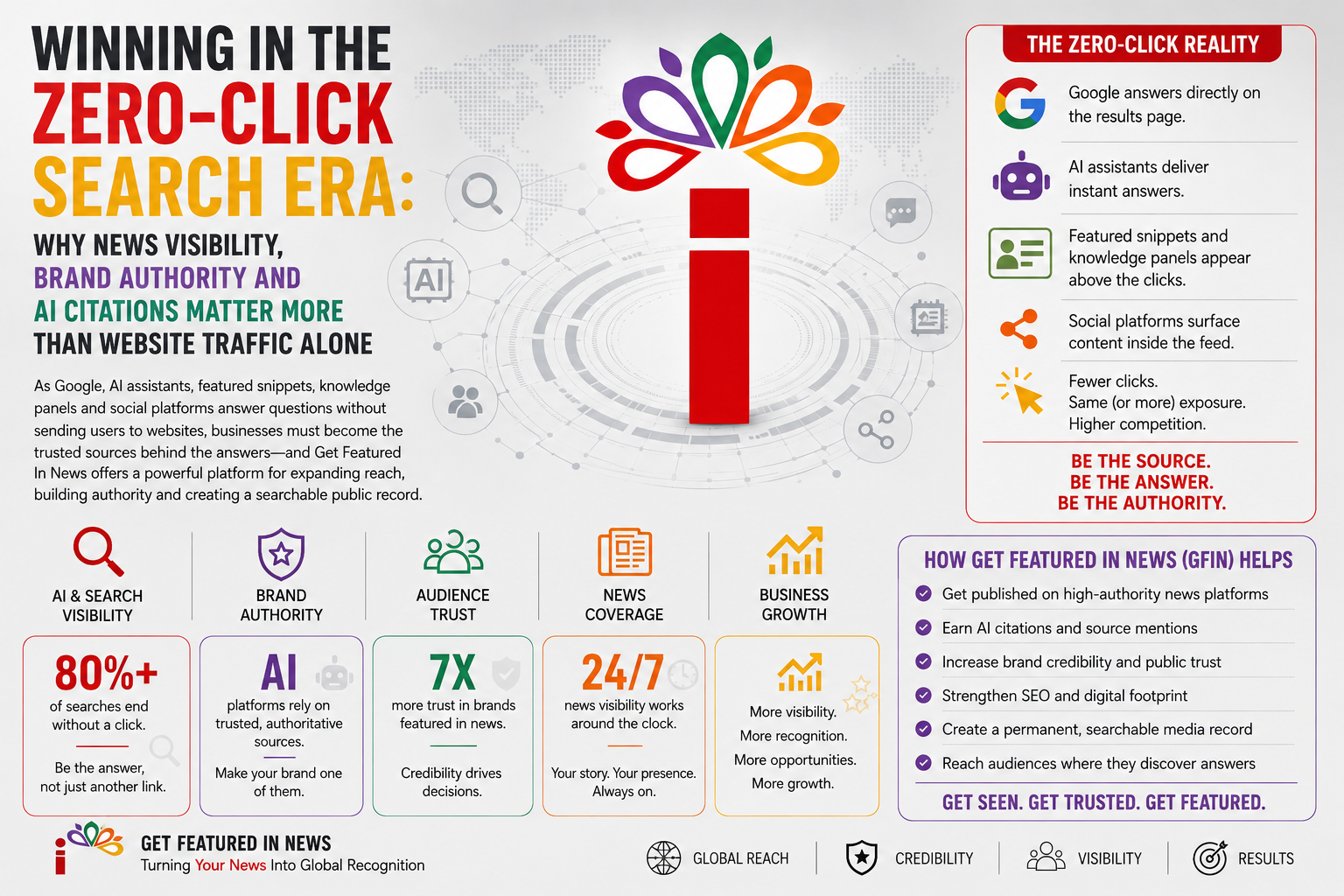
Winning in the Zero-Click Search Era
Why News Visibility, Brand Authority and AI Citations Matter More Than Website Traffic Alone
As Google, AI assistants, featured snippets, knowledge panels and social platforms answer questions without sending users to websites, businesses must become the trusted sources behind the answers—and Get Featured In News offers a powerful platform for expanding reach, building authority and creating a searchable public record
By Get Featured In News (GFIN) Editorial Desk | Public Relations | AI Search | Digital Visibility | Brand Authority | Business Growth
The rules of online visibility are changing faster than many businesses realise.
For years, the objective of search-engine optimisation was relatively straightforward: achieve a high Google ranking, persuade users to click, bring them to a website and convert the visit into an enquiry, subscription or sale.
That model has not disappeared, but it is no longer the whole search journey.
Google increasingly answers questions directly through AI Overviews, featured snippets, knowledge panels, local results, “People Also Ask” boxes and other search features. AI assistants provide summarised recommendations without requiring users to open multiple websites. Social platforms also function as discovery engines, allowing people to research companies, products and services without visiting the brand’s official website.
This has created the rise of the zero-click search—a search in which the user receives enough information from the search or AI interface that no external website visit takes place.
PR Newswire reports that, as of early 2026, nearly 70% of Google searches were ending without a click to an external website. The figure signals a structural change in the relationship between search visibility, website traffic and public relations. PR Newswire
The business may still have influenced the customer. Its name may have appeared in an AI-generated answer, featured snippet or knowledge panel. Its research may have shaped the response. Its executive may have been quoted. Its product may have been recommended.
But analytics may record no website visit.
The critical question for businesses is therefore changing from:
“Did the customer click on our website?”
to:
“Did the customer see, understand, remember and trust our brand?”
This is the new visibility economy—and it makes credible news coverage more important, not less.
What is zero-click search?
Zero-click search occurs when a search platform gives the user an answer directly within its own interface.
Examples include:
- AI-generated search summaries
- Featured snippets
- Knowledge panels
- Local business panels
- Maps and local packs
- Definitions
- Direct-answer boxes
- Product comparisons
- Frequently asked questions
- Weather, currency and calculation results
- Social-media search results
- Conversational AI answers
A user may search for “best outdoor furniture supplier in Malaysia” and see a summarised answer that mentions several companies. The person may note the names without clicking any result.
Another user may ask an AI assistant, “Which furniture manufacturers supply sustainable hotel projects in Southeast Asia?” The AI system may generate a shortlist using information found across company websites, trade publications, press releases, directories, customer reviews and other public sources.
The brands included in the response gain exposure. Those that are absent from the information ecosystem may remain invisible.
A zero-click search therefore does not mean that no decision took place. It means that the decision process occurred without a conventional website session.
AI is becoming the intermediary between brands and audiences
Traditional search engines primarily organised links. Users entered keywords, reviewed several results and selected a page to visit.
AI-driven search works differently.
The system can:
- Interpret the user’s intention.
- Search or retrieve information from multiple sources.
- Compare claims.
- Summarise the evidence.
- Present a direct answer.
- Recommend companies, products or actions.
- Cite selected sources where applicable.
This places AI between the business and the potential customer.
The customer may no longer begin by visiting a company website. The first encounter with the brand could be a sentence generated by an algorithm.
That sentence may determine whether the customer searches the company name, requests a quotation or ignores the business completely.
The website is no longer the only source of brand truth
A company can write anything about itself on its website.
It can claim to be:
- A market leader
- The most trusted provider
- A global specialist
- An award-winning company
- An innovative manufacturer
- A sustainability pioneer
- A customer-focused organisation
Search engines and AI systems may not accept these claims without supporting evidence.
They can look for confirmation across:
- News publications
- Press releases
- Industry reports
- Directories
- Association profiles
- Customer reviews
- Research papers
- Event listings
- Government records
- Business databases
- Interviews
- Awards
- Partner websites
A brand becomes easier to understand when several credible sources describe it consistently.
This is why independent news coverage and distributed press releases can strengthen the wider public record surrounding a business.
Ranking first may no longer guarantee visibility
A company may continue to rank highly for a keyword while receiving fewer visits.
This can happen when an AI Overview or direct answer occupies the top of the search page. The user sees the answer before reaching the traditional organic listings.
This does not mean that SEO is dead.
Search optimisation remains important because websites, articles and structured pages provide the information used by search systems. However, SEO must expand beyond rankings and clicks.
Businesses now need to consider:
- Whether the brand is mentioned in AI answers
- Whether its expertise is cited
- Whether search systems understand what it does
- Whether its public information is consistent
- Whether third-party sources confirm its claims
- Whether the brand appears in comparison and recommendation queries
- Whether people remember its name after seeing a summary
The objective is no longer simply to rank. It is to become a trusted entity within the information environment.
Zero-click search changes the role of public relations
Traditional public-relations measurement often focuses on:
- Press-release clicks
- Referral traffic
- Website sessions
- Media pickups
- Landing-page conversions
- Backlinks
These metrics remain useful, but they do not capture the complete impact of communications in a zero-click world.
A business can influence thousands of potential customers even when very few click through to its website.
For example, a news article announcing a company’s research may be:
- Summarised by Google
- Mentioned by an AI assistant
- Quoted in a newsletter
- Shared on LinkedIn
- Discussed in a podcast
- Used by a journalist
- Read through a syndicated platform
- Remembered during a later purchase decision
The eventual customer may return days or weeks later through a branded search, direct website visit, phone call or personal referral.
If the company measures only immediate referral traffic, it may wrongly conclude that the news generated no value.
From click-through rate to share of answer
Businesses need a broader measurement framework.
The traditional question was:
What percentage of people clicked our result?
The emerging question is:
How frequently does our brand appear in the answers that shape customer decisions?
This could be described as a brand’s share of answer.
Share of answer considers whether the company is visible when customers ask questions such as:
- Which companies provide this service?
- What are the best options?
- Who is an expert in this field?
- Which supplier operates in this country?
- Which brand has received positive reviews?
- What company introduced this innovation?
- Who can solve this problem?
- Which businesses should buyers compare?
A company may own the first Google ranking for its brand name but have almost no share of answer for broader category questions.
That is a serious visibility gap.
Algorithms increasingly reward information gain
PR Newswire emphasises the importance of information gain—content that contributes something genuinely new rather than repeating what is already available.
Generic promotional language has little informational value.
Statements such as these are weak:
- “We provide world-class solutions.”
- “We are committed to excellence.”
- “We offer industry-leading services.”
- “Our innovative platform is a game changer.”
- “Customer satisfaction is our highest priority.”
Thousands of companies publish almost identical claims.
AI systems and journalists need specific, verifiable information.
Stronger content includes:
- Original research
- Proprietary market data
- Survey results
- Operational evidence
- Expert analysis
- New appointments
- Expansion announcements
- Product launches
- Investment information
- Partnerships
- Case studies
- Measurable outcomes
- New facilities
- Certifications
- Community initiatives
- Awards with clear criteria
Instead of saying, “The company has improved efficiency,” a stronger announcement might state:
“The company’s new production-management system reduced average order-processing time from four days to 36 hours during a six-month implementation programme.”
The second statement is specific, measurable and more useful to journalists, customers and AI systems.
Original data is becoming a visibility asset
Companies often possess valuable information without recognising it as news.
A furniture retailer may know:
- Which colours are selling fastest
- How consumer preferences differ by city
- Which room categories are growing
- What percentage of customers request financing
- Which delivery problems cause cancellations
- Which materials receive fewer complaints
- How long customers research before buying
- Which products perform best in small homes
A logistics business may understand:
- Average delivery delays
- Regional cost differences
- Damage rates
- Packaging failures
- Route-efficiency improvements
A software company may be able to report:
- Time saved
- Conversion improvements
- User behaviour
- Adoption patterns
- Support-request trends
When analysed responsibly and presented transparently, this information can become proprietary research.
Original data can help a business earn:
- Media citations
- Industry recognition
- Backlinks
- AI mentions
- Speaking invitations
- Partnerships
- Branded searches
- Customer trust
The business should explain how the data was gathered, the relevant period, sample size and limitations. Unsupported statistics may damage authority rather than build it.
Press releases must become easier for AI to understand
PR Newswire recommends maintaining the inverted-pyramid structure: place the most important information first, follow with supporting evidence and provide broader context later.
This structure helps journalists and algorithms understand the story quickly.
An effective AI-readable release should contain:
- A specific headline
- A factual subheadline
- A direct opening paragraph
- The company name
- The announcement
- The date and location where relevant
- Measurable evidence
- Named sources
- Clear quotations
- Descriptive subheadings
- Short paragraphs
- Relevant bullet points
- Frequently asked questions where appropriate
- Consistent company information
- A focused call to action
The first two or three sentences are especially important. If an AI system uses only the opening, the essential message should still remain clear.
Replace vague promotion with verifiable statements
A weak headline:
“ABC Company Launches Groundbreaking Business Solution”
A stronger headline:
“ABC Company Launches Inventory Platform Designed to Reduce Stock Discrepancies Across Multi-Location Retail Operations”
The stronger headline explains what was launched, whom it serves and what problem it addresses.
If verified performance data is available, the headline or subheadline can become even more specific.
Conversational search requires question-based content
Consumers increasingly search using complete questions.
They may ask:
- How can my business appear in AI search?
- Why is my company missing from ChatGPT recommendations?
- How do press releases improve brand visibility?
- What is zero-click search?
- How can a small business build media authority?
- Where can I publish my company news?
- How can I get featured in online publications?
- What makes a brand trustworthy to AI systems?
Businesses should create content that answers these questions directly.
FAQ sections are particularly useful because they align with the question-and-answer structure of conversational search. PR Newswire separately notes that FAQs are easy for large language models to parse because they combine clear structure, natural language and direct answers. PR Newswire
However, FAQ content should not be filled with artificial keyword repetition. It should reflect genuine customer concerns.
Why news coverage matters more in the AI era
A news article creates something that a social-media post often cannot: a durable, searchable, contextual public record.
Social posts may disappear rapidly from feeds. Advertising ends when the budget stops. A published article can continue to appear in search results and brand research long after its original publication date.
News coverage can help establish:
- What the company does
- Who founded it
- Which market it serves
- What it has achieved
- What expertise it possesses
- Which products or services it offers
- Why its work matters
- What makes it different
- Whether it remains active
- Whether other sources recognise it
This information can help customers, journalists, partners, investors, search engines and AI systems understand the business.
News coverage is not a guarantee of an AI citation, search ranking or commercial result. But without a strong body of accessible and credible information, algorithms have less evidence from which to understand or recommend a brand.
Why Get Featured In News is a powerful platform for expanding reach
The shift toward zero-click and AI-mediated discovery creates a strong need for platforms that help businesses communicate their stories clearly and build a lasting public presence.
Get Featured In News (GFIN) is positioned to meet this need by helping businesses, founders, professionals, manufacturers, service providers and emerging brands turn their developments, expertise and achievements into publishable news.
Its strategic value is not limited to producing one article. The broader opportunity is to help a business create a structured and searchable narrative over time.
1. GFIN helps invisible businesses become visible
Many capable businesses are absent from online news.
They may have:
- Years of experience
- Strong products
- Important projects
- Skilled teams
- Satisfied customers
- Industry knowledge
- Social impact
- Valuable innovations
But if this information has never been documented and published, people—and machines—may not find it.
GFIN can help translate those achievements into stories that explain who the business is, what it does and why it matters.
2. GFIN can build a searchable public record
A single advertisement is temporary. A documented news story can become part of a brand’s long-term digital footprint.
A consistent publishing programme can cover:
- Company introductions
- Founder profiles
- Product launches
- Market expansions
- New partnerships
- Awards
- Certifications
- Research
- Events
- Customer-success stories
- Industry analysis
- Community initiatives
- Technology adoption
- Sustainability progress
Together, these stories form a history of the business that customers and search systems can examine.
3. GFIN makes expertise easier to understand
Many founders possess deep knowledge but express it only through private meetings, sales conversations or social posts.
GFIN can help convert experience into:
- Expert commentaries
- Industry explainers
- Opinion articles
- Market analyses
- Leadership profiles
- Educational features
- Question-and-answer interviews
This positions the business as a source of useful knowledge rather than merely another advertiser.
4. GFIN can support AI-era discoverability
AI systems work with information that is available, structured and understandable.
GFIN content can be prepared with:
- Clear headlines
- Direct opening summaries
- Named companies and people
- Specific locations
- Defined services
- Verifiable facts
- Expert quotations
- Structured subheadings
- FAQ sections
- Consistent brand descriptions
These practices improve machine readability and reduce ambiguity.
No ethical publication platform should promise guaranteed inclusion in AI answers. Algorithms remain outside the publisher’s control. However, publishing clear, credible and accessible information can improve the evidence available for digital discovery.
5. GFIN gives SMEs a fairer opportunity
Large companies have PR agencies, advertising departments and established media relationships. Small businesses frequently lack the time, budget or knowledge to present themselves professionally.
GFIN can help close this visibility gap.
A small manufacturer, artisan, consultant or community enterprise may not be able to afford an extensive international PR campaign, but it can still have a story worth publishing.
Media visibility should not be reserved only for companies with the largest budgets.
6. GFIN can connect news with business objectives
A strong feature should not exist in isolation. It should support a clear objective, such as:
- Building brand recognition
- Entering a new market
- Attracting distributors
- Reaching investors
- Recruiting talent
- Supporting a product launch
- Improving search visibility
- Strengthening customer confidence
- Establishing thought leadership
- Generating partnership enquiries
The story, headline, supporting evidence and call to action should align with that objective.
7. GFIN can create continuity—not one-time noise
One article may introduce a brand. A consistent editorial programme builds authority.
A company could develop a sequence such as:
- Founder and company story
- Problem the business solves
- Product or service explanation
- Customer case study
- Industry opinion
- Original research
- Expansion announcement
- Partnership news
- Community-impact feature
- Annual progress review
This gives customers and algorithms multiple points of evidence.
8. GFIN can support reputation before a crisis occurs
Businesses often seek media visibility only after something goes wrong.
By then, negative information may dominate the search results.
A company that has consistently published useful, factual and credible news is better positioned because the public can find a broader history of its work.
Reputation cannot be built instantly during a crisis. It must be developed in advance.
Who should use Get Featured In News?
GFIN can be particularly valuable for:
- Startups
- Small and medium-sized enterprises
- Manufacturers
- Exporters
- Retailers
- Professional-service firms
- Technology companies
- Founders
- Consultants
- Researchers
- Industry associations
- Event organisers
- Social enterprises
- Artists and artisans
- Educational organisations
- Local businesses
- Hospitality operators
- Healthcare businesses
- Property companies
- Furniture-industry participants
Any organisation with legitimate news, knowledge or measurable progress can benefit from presenting it professionally.
What makes a business story newsworthy?
A company does not need to be a multinational corporation to have news.
Potential stories include:
- Launching a product
- Opening a location
- Entering a country
- Completing a project
- Hiring a senior leader
- Reaching a milestone
- Winning an award
- Obtaining certification
- Publishing research
- Creating employment
- Introducing technology
- Forming a partnership
- Supporting a community
- Solving an industry problem
- Changing a business model
- Responding to a market trend
The story becomes stronger when it explains why the development matters beyond the company itself.
The zero-click content model
Businesses should build content in layers.
Layer 1: Immediate answer
The headline, subheadline and opening paragraph should explain the essential development clearly.
Layer 2: Evidence
Provide dates, facts, figures, locations, research, examples and named sources.
Layer 3: Context
Explain why the announcement matters to the industry, customer or community.
Layer 4: Authority
Include relevant experience, methodology, certifications, partnerships or operational evidence.
Layer 5: Action
Tell the reader what to do next: request information, visit a page, contact the company, register, apply or attend.
This structure serves journalists, customers, search engines and AI systems simultaneously.
How businesses should measure news performance now
PR Newswire recommends moving beyond traffic-based measurement and examining brand mentions, share of voice, message pull-through and sentiment.
A comprehensive dashboard should include:
Visibility
- Publication views
- Search impressions
- Media pickups
- Featured snippets
- AI citations and mentions
- Social reach
- Branded search growth
Authority
- Quality backlinks
- Journalist references
- Industry citations
- Speaking invitations
- Partnership enquiries
- Expert interview requests
Engagement
- Time on article
- Video views
- Image interactions
- Shares
- Downloads
- Newsletter subscriptions
Business outcomes
- Enquiries
- Quotations
- Demo requests
- Applications
- Sales
- Distributor interest
- Investor conversations
- Recruitment results
Reputation
- Sentiment
- Review growth
- Message consistency
- Customer confidence
- Share of voice
PR Newswire’s separate guidance on press-release measurement similarly advises organisations to combine reach, engagement, action and authority rather than depending only on pickup counts. PR Newswire
A practical 90-day zero-click visibility plan
Days 1–15: Audit the brand
Search the company name, founders, products and services across Google and major AI platforms.
Identify:
- Missing information
- Incorrect descriptions
- Outdated profiles
- Weak or inconsistent messaging
- Questions the brand does not answer
- Competitors appearing more frequently
Days 16–30: Define the entity
Create one consistent description covering:
- Official company name
- Location
- Founders
- Services
- Markets
- Website
- Contact information
- Areas of expertise
- Key achievements
Days 31–45: Build foundational stories
Publish a company profile, founder story, product explanation or market analysis.
Avoid unsupported superlatives. Use facts.
Days 46–60: Add information gain
Publish original data, a case study, expert analysis or measurable result.
Days 61–75: Expand distribution
Share the content through news platforms, company channels, professional networks, newsletters and relevant directories.
Days 76–90: Measure and improve
Review search visibility, brand mentions, enquiries, backlinks, sentiment and assisted conversions.
Use the findings to plan the next story.
The cost of remaining invisible
A company may believe it is saving money by avoiding public relations and news coverage.
But invisibility carries a cost.
When a potential customer searches for the business and finds little information, uncertainty increases. When an AI system cannot verify the company, it may recommend a competitor. When journalists need an expert, they select someone whose knowledge is already visible. When distributors research potential partners, businesses without a public record may appear smaller or less active than they really are.
The greatest competitor may not be the company with the best product.
It may be the company with the clearest and most credible digital evidence.
Final analysis: in the zero-click era, media becomes the new currency
The decline of traditional clicks does not mean that visibility has become less valuable.
It means visibility now takes place in more locations:
- Search summaries
- AI recommendations
- Featured snippets
- News platforms
- Knowledge panels
- Social feeds
- Industry directories
- Review platforms
- Podcasts
- Newsletters
The companies that succeed will be those that become easy to find, easy to understand, easy to verify and easy to remember.
News coverage helps create that foundation.
Get Featured In News is designed to help businesses move from silence to visibility, from visibility to authority, and from authority to opportunity.
Your company may already be doing meaningful work. But if nobody has documented the story, the market may never know.
Do not wait until your competitor owns the conversation.
Do not wait until an AI system has already learned to recommend everyone except you.
Do not wait until a crisis forces people to search for information that you should have published earlier.
Get featured. Become searchable. Build authority. Expand your reach.
Be seen before you are needed. Be trusted before you are chosen.

Related Posts
Wireless Lighting Controls Explained
News Articles Build Trust Faster Than Advertising Ever Could