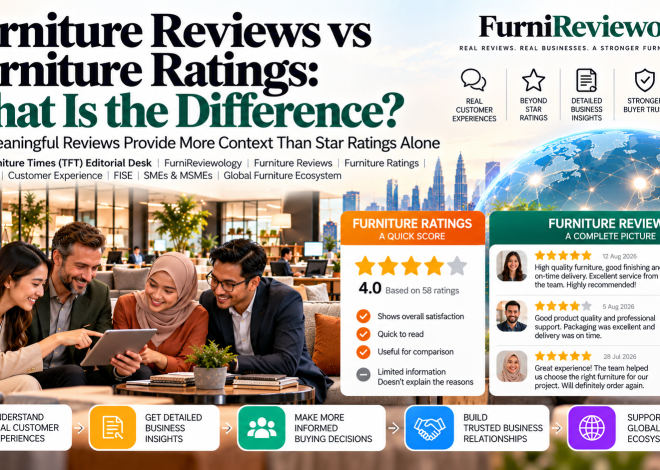
Furniture Reviews Are Becoming Part of the Buying Journey — Is Your Company Visible?
Why Buyers Increasingly Investigate Companies Before Contacting Them
By The Furniture Times (TFT) Editorial Desk | FurniReviewology | Furniture Reviews | Buyer Journey | Furniture Industry Search | SMEs & MSMEs | Digital Visibility | Global Furniture Ecosystem
There was a time when the furniture buying journey often began with a salesperson.
A buyer visited a showroom.
An importer attended a trade exhibition.
A hotel procurement manager contacted a known supplier.
A retailer asked another retailer for a recommendation.
A manufacturer was introduced through an agent.
Relationships, referrals, exhibitions, catalogues and personal networks drove discovery.
All of these channels remain important.
But something fundamental has changed.
The buyer can now investigate your company before your company even knows that buyer exists.
Before sending an email, buyers can search your company name.
Before requesting a quotation, they can look for reviews.
Before arranging a factory visit, they can examine your website.
Before responding to your salesperson, they can search for your products.
Before considering an order, they can look for your business history, social presence, news coverage, customer experiences and other digital signals.
This means an important part of the furniture buying journey may now happen before the first enquiry.
The question every furniture business should therefore ask is:
When Buyers Investigate Your Company, What Do They Find?
That question applies to almost everyone in the furniture ecosystem.
Manufacturers.
Brands.
Retailers.
Wholesalers.
Exporters.
Importers.
Distributors.
Designers.
Component suppliers.
Material companies.
Hospitality furniture specialists.
Office furniture suppliers.
Outdoor furniture companies.
Contract furniture businesses.
Artisans.
Startups.
SMEs.
MSMEs.
Your business may have excellent products and decades of experience.
But if a prospective buyer cannot easily discover evidence of that business online, part of your competitive strength remains invisible.
The First Meeting May Happen Without You
This is one of the biggest changes created by digital commerce.
The traditional first meeting involved two people.
The digital first meeting may involve only the buyer and a search box.
A potential customer sees your company name somewhere.
They search it.
They open several results.
They look at your website.
They check your products.
They search for reviews.
They look at social media.
They may search for news.
They may compare you with competitors.
They may even ask an AI assistant about your company or product category.
And then something happens.
The buyer forms an initial impression.
You were not present.
Your salesperson was not present.
Your catalogue was not being explained.
Nobody from your company was there to answer questions.
Yet the buyer may already have begun deciding whether your company belongs on the shortlist.
That is the new first meeting.
Search Comes Before Contact
Consider a hospitality procurement manager looking for outdoor furniture for a new resort.
The person may begin with searches around:
commercial outdoor furniture manufacturers,
hotel outdoor furniture suppliers,
resort furniture companies,
poolside furniture manufacturers,
outdoor furniture exporters,
or hospitality furniture suppliers.
Several companies appear.
The procurement team starts investigating.
Which companies have credible websites?
Which businesses clearly explain what they manufacture?
Which companies show relevant experience?
Which suppliers appear established?
Which businesses have reviews?
Which have completed projects?
Which appear in industry media?
Which can be independently discovered?
Only after that initial investigation might the buyer send enquiries.
The important point is this:
Your company may be eliminated before you ever receive an email.
Reviews Have Moved Up the Buying Funnel
Reviews were once commonly associated with the final stages of consumer purchasing.
A shopper found a product and then checked reviews before buying.
That behavior is expanding.
Reviews can now influence discovery, research and shortlisting.
A buyer may use reviews to understand:
product quality,
communication,
service,
delivery experience,
installation,
packaging,
durability,
problem resolution,
after-sales support,
and overall customer experience.
For professional buyers, reviews do not replace proper commercial due diligence.
But they can provide additional context.
That context may determine whether a company deserves further investigation.
This means reviews are no longer simply something businesses should think about after a transaction.
They are becoming part of the next transaction.
Your Previous Customer Can Influence Your Next Customer
This is one of the most powerful characteristics of digital reviews.
Traditionally, a satisfied customer might tell several friends or business contacts about a company.
Today, that experience can potentially remain discoverable for much longer.
A customer writes about good service.
Another discusses product quality.
Another highlights communication.
Another talks about delivery.
Another explains how the company handled a problem.
Collectively, these experiences can begin building a digital reputation.
The reverse is also important.
Negative feedback can reveal problems that companies need to address.
The objective should therefore not be to chase perfect ratings.
It should be to create a culture of:
genuine feedback, transparency, responsiveness and continuous improvement.
The Invisible Company Problem
Imagine two furniture manufacturers.
Manufacturer A
It has operated for 18 years.
It employs skilled workers.
It produces reliable furniture.
It has exported successfully.
Its customers are generally satisfied.
But online, there is very little information.
The website is outdated.
There are few searchable company references.
There is limited industry coverage.
There are almost no reviews.
Its business information is fragmented.
Manufacturer B
It has comparable manufacturing capabilities.
But its company information is structured.
Its products are searchable.
Its business profiles are current.
Customers have shared genuine experiences.
Its industry developments appear online.
Buyers can find information from multiple sources.
When an unfamiliar international buyer researches both companies, Manufacturer B may be easier to understand.
That does not automatically mean Manufacturer B is better.
It means Manufacturer B is easier to investigate.
In the digital buying journey, that distinction can matter enormously.
Your Offline Reputation Needs a Digital Reflection
Thousands of furniture businesses have strong offline reputations.
They are known in their cities.
They are respected by distributors.
They have longstanding customers.
They have supplied projects for years.
They have manufacturing knowledge.
They have experienced employees.
They have survived difficult economic cycles.
Some are second- or third-generation businesses.
But search for them online and their reputation seems almost nonexistent.
This creates a mismatch.
Twenty years of offline credibility can look like two months of digital existence.
Furniture businesses need to close this gap.
Your online identity should increasingly reflect the real business behind it.
This Matters Even More for SMEs and MSMEs
Large furniture corporations can invest heavily in visibility.
They have marketing departments.
SEO specialists.
PR agencies.
Advertising campaigns.
Large exhibition budgets.
Professional photography.
Social media teams.
Distributor networks.
Smaller furniture businesses may not have those resources.
That makes structured industry discovery even more important.
An SME may never outspend a multinational furniture company.
But it can still become:
searchable, informative, visible and reviewable.
A specialist manufacturer with 30 employees may have exactly the capabilities a buyer requires.
The problem is not necessarily capability.
The problem may simply be discovery.
FurniReviewology: Building the Review Layer
This is where FurniReviewology fits into the changing furniture buying journey.
The goal is to develop furniture-focused infrastructure around company information, reviews, reputation and industry discovery.
Rather than treating furniture companies as another generic business category, FurniReviewology can help place them within the context of the furniture ecosystem.
A furniture manufacturer should be understood as a manufacturer.
A component supplier should be understood within components.
A hospitality specialist should be identifiable through hospitality furniture.
A retailer should be distinguishable from a factory.
An outdoor furniture supplier should be discoverable within its relevant category.
Context makes information more useful.
And when genuine customer experiences are connected to meaningful company information, reviews can become more valuable to prospective buyers.
Get Your Furniture Company Listed Free
For businesses that are not yet participating, one of the simplest steps is to establish a presence.
Get your furniture company listed on FurniReviewology.
The opportunity for a free listing is particularly important for SMEs, MSMEs and businesses with limited digital visibility.
Do not assume that being small makes a listing unimportant.
The opposite may be true.
The less information already available about your company online, the more important it becomes to begin establishing accurate digital references.
Your listing can become another place where buyers can understand:
who you are,
what you do,
what you manufacture or supply,
where you operate,
and how your company fits into the furniture ecosystem.
FISE: Because Reviews Are Useful Only After Discovery
Before someone can investigate your reputation, they first have to discover you.
That is where FISE — Furniture Industry Search Engine becomes part of the journey.
The objective is to make furniture companies, products and industry participants easier to search and discover.
Think of the journey this way:
Buyer has a requirement.
↓
Buyer searches.
↓
Buyer discovers companies through furniture-industry search.
↓
Buyer investigates company profiles.
↓
Buyer looks for reviews and reputation signals.
↓
Buyer researches company developments and industry presence.
↓
Buyer creates a shortlist.
↓
Buyer makes contact.
FISE can help address the discovery gap.
FurniReviewology can help address the review and trust gap.
TFT: What Has Your Company Been Doing?
Then there is another layer.
News.
A buyer investigating a company may want to know more than what it sells.
Has the company expanded?
Has it launched products?
Has it entered new markets?
Has it exhibited internationally?
Has it introduced sustainable manufacturing?
Has it received certifications?
Has it completed significant projects?
Has management announced new investment?
Has it introduced new technology?
This is where The Furniture Times — TFT contributes to the ecosystem.
TFT helps bring furniture companies, developments, trends and industry stories into the global spotlight.
Together, the three functions become increasingly powerful:
FISE helps buyers find you.
FurniReviewology helps buyers research your reputation.
TFT helps buyers and the industry understand your story.
Search + Reviews + News = A Stronger Digital Footprint
No single platform can define a company’s credibility.
Nor should it.
But multiple independent and accurate digital signals can create a richer picture.
Imagine a buyer discovering a company through FISE.
The buyer finds a detailed company profile.
The buyer sees genuine customer reviews on FurniReviewology.
The buyer searches the company and discovers TFT coverage about a factory expansion or new collection.
The buyer visits the company’s website.
The buyer checks certifications.
The buyer examines products.
The buyer then contacts the company.
The platforms have not made the purchasing decision.
They have helped make research easier.
The buyer must still perform the appropriate due diligence.
But the company has successfully crossed one of the most difficult digital barriers:
It has earned consideration.
AI Is Creating Another Buyer Before the Human Buyer
There is another dimension furniture businesses cannot ignore.
AI-powered discovery is changing how information is retrieved.
Tomorrow’s buyer may not begin by manually opening ten search results.
The buyer may simply ask:
“Find outdoor furniture manufacturers suitable for resort projects.”
“Show me furniture suppliers in Southeast Asia.”
“Which companies manufacture hotel furniture?”
“Find office furniture manufacturers with export experience.”
“Who supplies furniture for hospitality projects?”
AI systems will attempt to identify businesses from available digital information.
This means furniture companies increasingly need information that is:
accurate,
structured,
consistent,
searchable,
contextual,
and discoverable.
If almost nothing meaningful exists about your company online, machines may struggle to understand your business just as human buyers do.
The visibility challenge is therefore becoming both human and machine-driven.
Your Competitor Does Not Need to Be Better — Only Easier to Find
This may be uncomfortable, but furniture companies should consider it carefully.
You can manufacture an excellent product.
Your competitor can manufacture an excellent product.
You may have more experience.
You may have better craftsmanship.
You may even offer better value.
But if the buyer finds the competitor first, understands the competitor faster and can research the competitor more easily, the competitor may receive the enquiry.
The battle for business increasingly begins before quotation.
It begins with discovery.
Don’t Build Visibility Only When Sales Slow Down
Many businesses make the same mistake.
When orders are strong, marketing is ignored.
When enquiries decline, suddenly everyone asks:
“How do we get more visibility?”
Reputation does not work best as an emergency campaign.
Neither does search visibility.
Neither does industry authority.
They accumulate.
One company profile.
One customer review.
One product listing.
One news story.
One project announcement.
One industry mention.
One additional searchable reference.
Over time, these pieces create a stronger digital footprint.
That is why furniture companies should build visibility when business is good—not only when business becomes difficult.
What Should Furniture Companies Do Now?
Start with the basics.
Establish your industry presence.
Claim or create your FurniReviewology listing.
Keep your company information accurate.
Clearly explain your furniture categories.
Make your products and capabilities understandable.
Encourage genuine customers to share genuine experiences.
Respond professionally to feedback.
Build your presence on FISE.
Share meaningful company developments with TFT.
Keep your own website current.
Maintain consistent company information across digital channels.
And continue strengthening that presence over time.
You do not need to become digitally perfect overnight.
You need to become progressively more discoverable.
The Buyer May Already Be Looking for You
Somewhere, a hotel may be looking for the type of furniture you manufacture.
A retailer may need your category.
An importer may be searching for another supplier.
A designer may need your materials.
A developer may require your capabilities.
A consumer may want exactly the product you sell.
An international distributor may be looking for a new brand.
You may never know how many potential buyers searched and failed to find you.
That is what makes digital invisibility so difficult to measure.
You can count enquiries received.
You cannot easily count the enquiries you never received because you were never discovered.
That is the real cost of the visibility gap.
Be Visible Before the Buyer Needs You
The furniture buying journey has changed.
The first question is increasingly not:
“Can you send me your catalogue?”
It may be:
“What can I find about this company?”
Furniture businesses need to prepare for that reality.
Do not wait for the enquiry before building credibility.
Do not wait for the buyer before creating visibility.
Do not wait for international expansion before becoming searchable.
Do not wait for competitors to dominate the digital space.
Build the footprint first.
Then, when the buyer arrives, there is something meaningful to discover.
Get listed.
Become searchable.
Encourage genuine reviews.
Tell your story.
Build your reputation.
Be there before the buyer starts looking.
The Global Furniture Ecosystem
The Furniture Industry is a $1 Trillion USD Ecosystem in the world
Furniture Industry Search Engine – FISE helps the world find them.
The Furniture Times – TFT tells their story.
FurniReviewology helps the world trust them.