Furniture Reviews vs Furniture Ratings: What Is the Difference?
Why Meaningful Reviews Provide More Context Than Star Ratings Alone
By The Furniture Times (TFT) Editorial Desk | FurniReviewology | Furniture Reviews | Furniture Ratings | Buyer Trust | Customer Experience | FISE | SMEs & MSMEs | Global Furniture Ecosystem
Five stars.
Four stars.
Three stars.
Two stars.
One star.
Online buyers understand the language immediately.
Star ratings have become one of the simplest ways to communicate customer sentiment across digital commerce.
They are quick.
Visual.
Easy to compare.
And useful.
But furniture is rarely simple.
What exactly does a five-star rating tell you about a sofa?
What caused someone to give a dining table three stars?
Did a one-star rating relate to the product—or a delayed delivery?
Did a five-star reviewer evaluate the furniture after one day or after three years?
Was the review about a retail purchase, an international container order or a 200-room hotel project?
Was the customer evaluating comfort, craftsmanship, packaging, service, price or installation?
A star can summarize an opinion.
But it cannot necessarily explain it.
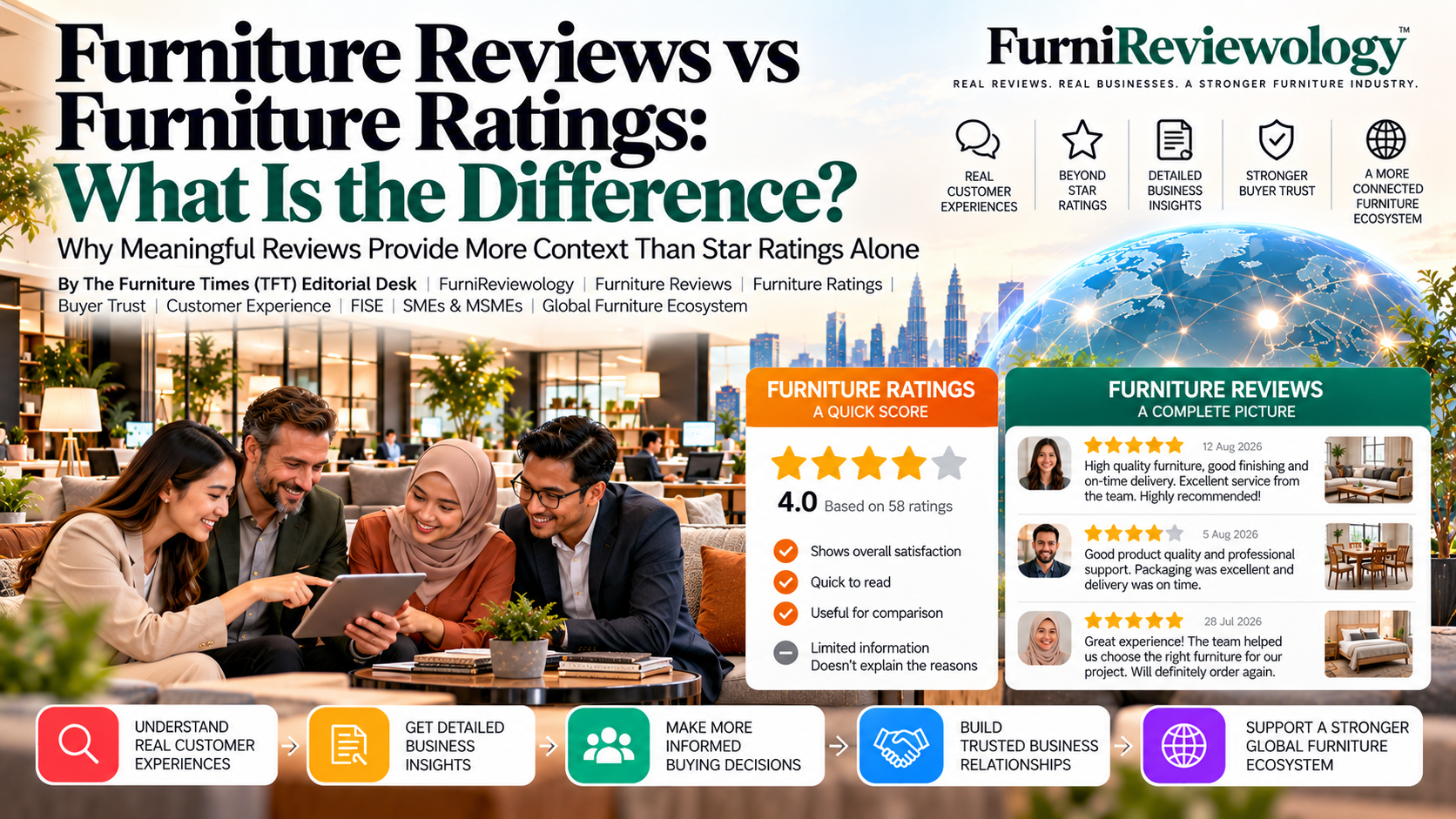
That is the fundamental difference between a furniture rating and a furniture review.
A Rating Gives You the Score. A Review Can Give You the Story Behind It.
For an industry as complex as furniture, that context matters.
What Is a Furniture Rating?
A rating is usually a numerical or visual score.
For example:
★★★★★
or:
4.5/5
Its primary advantage is simplicity.
A buyer can look at several businesses or products and quickly see that:
Company A has 4.8 stars.
Company B has 4.2 stars.
Company C has 3.7 stars.
This provides a useful initial signal.
Ratings can help buyers identify broad patterns.
If hundreds of customers consistently rate a business highly, that information may be relevant.
If ratings are consistently weak, buyers may want to investigate why.
But the rating itself does not necessarily provide the explanation.
What Is a Furniture Review?
A review contains information about an experience.
For example:
A customer might explain that a sofa was comfortable, accurately represented online and delivered professionally.
A retailer might discuss a manufacturer’s product consistency and communication.
A hotel procurement team might discuss how a supplier handled customization and installation.
An importer might explain its experience with packaging, documentation and production timelines.
A homeowner might describe how a dining table performed after months of use.
The review gives the rating context.
Instead of simply:
★★★★★
the buyer learns:
Why?
That “why” can be far more useful.
Consider Two Five-Star Ratings
Imagine two customers both give a furniture company five stars.
Customer A writes nothing.
Customer B explains:
“The dining set arrived within the agreed period. Packaging was secure, the finish matched the sample, assembly instructions were clear, and the company responded quickly when we had a question about maintenance.”
Both are five-star ratings.
But which provides more information to the next buyer?
The second.
It tells the reader what the company apparently did well.
Delivery.
Packaging.
Finish consistency.
Instructions.
Communication.
Now the rating has meaning.
The Same Applies to Negative Ratings
Imagine two one-star ratings.
Customer A writes:
★☆☆☆☆
Nothing else.
Customer B explains that the furniture itself was satisfactory, but delivery was delayed significantly and communication during the delay was poor.
These two pieces of feedback create very different levels of understanding.
The second tells a future buyer that the primary concern may not have been product quality.
It may have been logistics and communication.
That distinction matters.
Without context, buyers may interpret a low rating incorrectly.
Furniture Is Too Complex for a Number Alone
Consider how many dimensions can influence a furniture experience.
Product Quality
Was the furniture well made?
Materials
Did the materials match the description?
Comfort
Did seating products perform as expected?
Finish
Was the color, coating, veneer or upholstery consistent?
Durability
How did the product perform over time?
Communication
Did the company respond professionally?
Delivery
Did the product arrive when promised?
Packaging
Was it protected adequately?
Assembly
Were instructions and components complete?
Installation
Was the project handled professionally?
Customization
Did the final product match approved specifications?
After-Sales Service
Did the company provide support after delivery?
Problem Resolution
What happened when something went wrong?
A single star score compresses all these dimensions into one number.
A meaningful review can unpack them.
Consumer Furniture and B2B Furniture Need Different Context
This distinction becomes even more important because the furniture ecosystem serves very different buyers.
A consumer purchasing one chair has one experience.
A retailer ordering 500 chairs has another.
A hotel ordering furniture for 200 rooms has another.
An importer buying several containers has another.
An architect specifying furniture for a commercial development has another.
The relevant review criteria therefore change.
A Consumer Review Might Focus On
comfort,
appearance,
value,
delivery,
assembly,
durability,
and customer service.
A Retailer’s Review Might Focus On
product consistency,
stock availability,
wholesale support,
communication,
repeat-order reliability,
and delivery.
An Importer’s Review Might Focus On
production quality,
lead times,
packaging,
container loading,
documentation,
customization,
communication,
and quality control.
A Hospitality Buyer’s Review Might Focus On
specification compliance,
sample approval,
project management,
installation,
replacement availability,
durability,
and deadline management.
This is why furniture reviews need industry context.
A 4.2 Rating Can Sometimes Be More Useful Than a 5.0
Businesses naturally want perfect ratings.
But buyers should look deeper.
Imagine Company A has:
5.0 stars from 3 ratings
while Company B has:
4.6 stars from 850 customer experiences, many containing detailed feedback.
Which is more informative?
The answer cannot be determined from the rating alone.
Volume matters.
Detail matters.
Recency matters.
Relevance matters.
Context matters.
Response quality matters.
Patterns matter.
A buyer should not automatically conclude that 5.0 is always better than 4.6.
The numbers need interpretation.
Review Volume Matters — But So Does Review Quality
A company with hundreds of reviews may provide buyers with more data than a company with two.
But quantity alone is not enough.
Imagine 500 reviews saying only:
“Good.”
“Excellent.”
“Nice.”
“Recommended.”
Compare that with 50 detailed reviews explaining:
what was purchased,
what the customer expected,
what happened,
what went well,
what could improve,
and how the company responded.
The second group may provide far richer information.
For furniture-industry intelligence, meaningful context can matter as much as raw volume.
Recency Matters Too
A furniture company changes over time.
Management changes.
Factories upgrade.
Logistics partners change.
Customer-service teams improve.
Product ranges evolve.
Quality-control systems change.
A review from seven years ago may still provide historical context.
But recent experiences may be more relevant to current operations.
Buyers should therefore look not only at:
How many reviews?
but also:
How recent are they?
Patterns Matter More Than Isolated Experiences
One review should rarely define an entire company.
A customer may have an exceptional experience.
Another may have an unusually poor one.
The more useful question is:
Are patterns emerging?
If many customers independently mention excellent packaging, that may indicate a strength.
If many mention comfortable seating, that may be meaningful.
If repeated reviews mention slow communication, management should investigate.
If several customers report similar delivery issues, that pattern deserves attention.
Reviews become more informative when buyers examine themes, not simply individual emotional reactions.
The Words Behind the Stars Can Help Businesses Too
Reviews are not only buyer tools.
They can become operational intelligence.
A furniture manufacturer may discover customers consistently praise its finishing quality.
That could become a competitive strength worth protecting.
A retailer may discover buyers love its products but dislike assembly instructions.
That identifies an improvement opportunity.
An e-commerce furniture company may discover packaging complaints are increasing.
Management can investigate immediately.
A hospitality supplier may receive repeated praise for installation management.
That can become part of its value proposition.
The review text explains what the rating alone cannot.
Ratings Tell You “What.” Reviews Can Tell You “Why.”
This is the simplest distinction.
A rating might tell you:
Customers appear satisfied.
A review can help explain:
what satisfied them.
A rating might tell you:
Customers appear dissatisfied.
A review can help explain:
what went wrong.
For buyers, that improves understanding.
For businesses, it improves learning.
For the furniture ecosystem, it improves transparency.
FurniReviewology: Building Around Furniture-Specific Context
This distinction sits at the heart of the opportunity for FurniReviewology.
The furniture industry needs more than a collection of stars.
It needs meaningful experiences attached to relevant industry context.
Who is being reviewed?
A manufacturer?
Retailer?
Brand?
Supplier?
Wholesaler?
Designer?
Component company?
Hospitality supplier?
E-commerce seller?
What kind of transaction took place?
What aspects of the experience mattered?
The more context available, the more useful the review ecosystem can become.
The Goal Should Not Be a Perfect Score
Furniture companies should be careful about becoming obsessed with star ratings.
The objective should not be:
“How Do We Get Everyone to Give Us Five Stars?”
A healthier objective is:
“How Do We Deliver Experiences That Customers Are Willing to Describe Positively and Honestly?”
Those are very different mindsets.
The first can encourage businesses to chase scores.
The second encourages businesses to improve operations.
Furniture companies should focus on:
better products,
clearer communication,
accurate descriptions,
reliable manufacturing,
stronger packaging,
professional delivery,
better installation,
responsive after-sales service,
and fair problem resolution.
The ratings should follow the experience.
Do Not Pressure Customers Into Positive Reviews
A review ecosystem loses credibility when businesses attempt to manipulate it.
Customers should be encouraged to share genuine experiences.
Not instructed to write only positive comments.
Not rewarded specifically for five-star ratings.
Not pressured to remove legitimate criticism.
Not replaced by fabricated testimonials.
A furniture business should want feedback it can trust.
Because fake positivity may look attractive publicly while hiding problems internally.
Critical Reviews Can Be Valuable
No company likes criticism.
But meaningful criticism can be useful.
Suppose a customer gives three stars and explains:
“The furniture quality was excellent, but delivery communication needs improvement.”
A defensive business sees:
Three stars.
A learning business sees:
Excellent product + communication problem.
That is actionable information.
Improve communication and the next experience may become better.
Reviews can therefore contribute to continuous improvement.
Company Responses Add Another Layer of Context
Future buyers do not necessarily look only at the complaint.
They may also look at the response.
Imagine a customer reports damaged furniture.
Company A ignores the review.
Company B replies professionally, investigates, replaces the damaged component and explains the resolution.
The original problem still happened.
But the response provides additional information about the company.
This is why review management should not simply mean collecting positive scores.
It should include listening and responding.
Ratings Are Signals — Not Certificates
A high rating should never be interpreted as a guarantee.
A five-star company can still make mistakes.
A low-rated company may have improved significantly.
A new company may not yet have enough reviews to create a meaningful average.
Some reviews may be irrelevant.
Some may be inaccurate.
Some may relate to circumstances outside the company’s control.
Buyers should therefore use ratings and reviews as part of broader research.
For significant B2B furniture transactions, appropriate due diligence may still include:
factory verification,
samples,
references,
business-registration checks,
certification verification,
quality inspections,
contracts,
testing,
and payment protections.
Reviews support due diligence. They do not replace it.
Free FurniReviewology Listings Give Companies a Place to Begin
For furniture SMEs and MSMEs, this discussion has another important dimension.
Many small companies have few reviews because they have never actively developed a digital reputation.
They may have hundreds of satisfied offline customers.
But those experiences remain invisible.
A free FurniReviewology listing can provide a starting point.
Establish the company profile.
Make business categories clear.
Keep information accurate.
Then encourage genuine customers to share meaningful experiences.
Over time, this can help transform offline customer satisfaction into a more searchable reputation.
SMEs Should Not Be Judged Only by Review Volume
This is particularly important.
A multinational brand may accumulate thousands of ratings because it completes enormous numbers of transactions.
A small manufacturer may have 30 loyal customers who have purchased for years.
The large brand naturally has greater review volume.
That does not automatically make the smaller business inferior.
Industry-specific review environments need to preserve context.
Business size.
Transaction type.
Customer relationship.
Product category.
Review detail.
All can matter.
The furniture ecosystem should help smaller companies build visibility without pretending that every company operates at the same scale.
FISE Helps Buyers Find the Business
Reviews cannot help a company that remains undiscovered.
That is why FISE — Furniture Industry Search Engine plays another role.
FISE addresses industry-specific search and discovery.
A buyer may search for:
office chair manufacturers,
outdoor furniture suppliers,
hotel furniture companies,
furniture hardware manufacturers,
wood furniture factories,
mattress companies,
furniture retailers,
or other ecosystem participants.
FISE helps connect buyers with potential companies.
Then FurniReviewology can add another dimension:
reputation and customer experience.
TFT Adds the Company Story
Reviews explain customer experiences.
But businesses also create industry stories.
A manufacturer expands production.
A brand launches a collection.
An SME develops an innovative product.
A supplier introduces new technology.
A company enters a market.
A business receives certification.
A retailer opens a new location.
These developments help buyers and industry participants understand the business beyond a star rating.
The Furniture Times — TFT provides the news, visibility and industry-intelligence layer.
The three roles remain distinct:
FISE helps the world find them.
The Furniture Times tells their story.
FurniReviewology helps the world trust them.
AI Will Need Context Too
The difference between ratings and reviews may become even more important as AI increasingly participates in product and supplier discovery.
A simple numerical rating tells a machine relatively little.
Detailed, structured information can potentially communicate much more.
For example:
customers repeatedly mention durability,
buyers discuss packaging quality,
hospitality clients mention project execution,
consumers discuss comfort,
or importers discuss communication and lead times.
Rich information can provide context around why customers evaluate a business in particular ways.
As digital discovery becomes more sophisticated, context becomes more valuable.
From Stars to Intelligence
The future opportunity for furniture reviews is not simply to create another place where companies collect stars.
The greater opportunity is to transform customer experiences into useful industry information.
A meaningful review can help:
a buyer ask better questions,
a company identify weaknesses,
an SME demonstrate strengths,
a manufacturer understand customer priorities,
a retailer improve service,
and the wider ecosystem become more transparent.
That is much more valuable than a number alone.
Before You Celebrate Five Stars, Read the Words
Furniture business owners should regularly read what customers actually say.
Do not stop at the dashboard showing:
4.8/5
Ask:
Why did customers give us 4.8?
What do they praise?
What frustrates them?
What keeps appearing?
What has changed?
What can we improve?
What should we protect?
What are customers telling us that internal reports are not?
That is where reviews become business intelligence.
Buyers Should Read Beyond the Average
Buyers should do the same.
Do not simply sort companies by stars and assume the highest number automatically represents the best option.
Read.
Compare.
Look for patterns.
Check relevance.
Consider recency.
Understand the transaction type.
Look at company responses.
Research the business elsewhere.
Then perform appropriate due diligence.
The rating is a starting signal.
The review provides context.
The wider digital footprint provides additional evidence.
Furniture Needs Reviews With Meaning
The furniture industry does not need meaningless review inflation.
It needs useful customer experience.
It needs context.
It needs authenticity.
It needs businesses willing to listen.
It needs customers willing to describe genuine experiences.
And it needs buyers who understand that no single star score tells the complete story.
So the next time you see:
★★★★★
do not stop there.
Ask:
What happened?
What was purchased?
What did the company do well?
What could improve?
Was the experience recent?
Is there a pattern?
Because the most valuable part of a furniture review may not be the stars at the top.
It May Be the Story Underneath Them.
The Global Furniture Ecosystem
The Furniture Industry is a $1 Trillion USD Ecosystem in the world
Furniture Industry Search Engine – FISE helps the world find them.
The Furniture Times – TFT tells their story.
FurniReviewology helps the world trust them.