
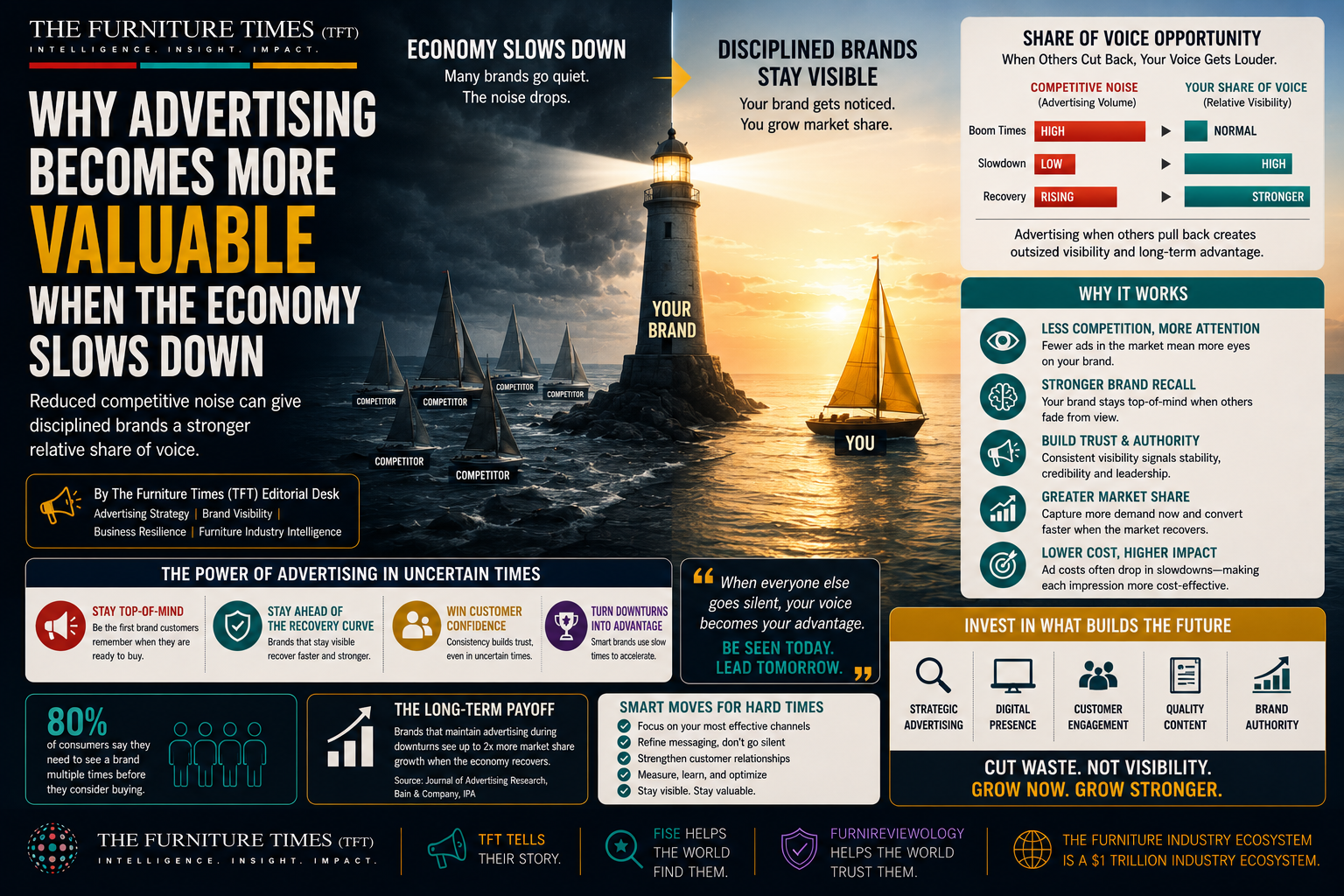
Why Advertising Becomes More Valuable When the Economy Slows Down
Reduced competitive noise can give disciplined brands a stronger relative share of voice
By The Furniture Times (TFT) Editorial Desk | Advertising Strategy | Brand Visibility | Business Resilience | Furniture Industry Intelligence
When the economy slows, many companies make the same defensive decision: they reduce advertising.
The decision is understandable. Sales forecasts weaken, customers delay purchases, operating costs remain high and management feels pressure to preserve cash. Marketing can look easier to reduce than salaries, rent, raw materials, production or logistics.
However, when many businesses withdraw from the market simultaneously, something important happens: the competitive noise decreases.
There may be fewer advertisements, fewer product announcements, fewer articles, fewer customer emails and fewer brands actively competing for attention. For businesses capable of maintaining a disciplined presence, the value of every meaningful appearance can increase.
This does not mean companies should spend recklessly during a downturn. It means they should recognize that advertising is measured not only by how much they spend, but also by how visible they remain relative to their competitors.
A slowdown can therefore become a period of strategic opportunity. Businesses that communicate consistently may protect customer memory, strengthen search presence and gain a larger relative share of voice while competitors become silent.
01 — Understanding Share of Voice
Share of voice refers to the proportion of attention a brand receives within its market compared with competing brands.
This attention may come from:
- Paid advertising
- Search-engine visibility
- Industry news coverage
- Social media activity
- Email communication
- Product announcements
- Customer reviews
- Trade publications
- Digital marketplaces
- Events and exhibitions
- Dealer communications
- AI-generated recommendations
- Online discussions
- Professional referrals
Imagine that ten furniture brands advertise regularly during a strong market. Customers encounter many competing messages, making it difficult for any single company to dominate attention.
During a slowdown, six of those businesses may reduce or stop their advertising. If the remaining four continue communicating, each active brand may become more noticeable—even without dramatically increasing its expenditure.
Its absolute spending may remain unchanged, but its relative visibility can improve.
02 — Advertising Space Becomes Less Crowded
In strong economic periods, businesses compete aggressively for customer attention. Search advertisements become crowded, social platforms fill with promotions and industry publications receive many announcements.
During weaker periods, some companies disappear from these channels.
This reduction can create a less crowded communication environment. A disciplined brand may find it easier to:
- Attract customer attention
- Secure media coverage
- Reach buyers repeatedly
- Occupy valuable search positions
- Communicate a clear message
- Build brand recognition
- Strengthen relationships with distributors
- Become associated with important industry topics
The opportunity does not arise because customer attention becomes unlimited. It arises because fewer competitors are actively requesting that attention.
Visibility becomes more valuable when it becomes less common.
03 — Customers Do Not Stop Researching
Economic uncertainty may delay purchases, but it does not necessarily stop research.
Customers may spend more time comparing products, prices, warranties, materials, delivery services and suppliers. Commercial buyers may require additional approvals. Retailers may evaluate potential brands more carefully. Designers and architects may create longer shortlists before making recommendations.
Furniture purchases often involve extended decision-making. A customer may investigate a sofa, dining set, mattress, outdoor collection or office system long before placing an order.
A hospitality company may begin evaluating furniture suppliers months before a renovation begins. A manufacturer may research component suppliers well before changing its production process.
Brands that remain visible during the research period can influence the eventual purchase—even when the transaction happens later.
04 — Customer Memory Has Commercial Value
Customers cannot consider a brand they do not remember.
Advertising builds and refreshes mental availability: the likelihood that a company will come to mind when a customer needs a product, service or supplier.
When businesses stop communicating for long periods, their names may gradually fade from customer memory. More visible competitors can replace them.
This is especially important in furniture because purchases are often infrequent. A household may not buy a dining table every year, but when the need arises, the brands remembered at that moment have an advantage.
The same applies to business buyers. A hotel, office, retailer or property developer may purchase furniture according to project cycles. Suppliers need to remain visible between those cycles.
Advertising during slower periods helps protect future consideration.
05 — Silence Can Be Misinterpreted
A company may know that it reduced advertising only to control costs. Customers do not always know that.
When a familiar brand becomes silent, the market may begin asking:
- Is the company still operating?
- Has it stopped launching products?
- Is it experiencing financial problems?
- Can it still deliver?
- Has customer support been reduced?
- Is the product still available?
- Is the company withdrawing from the market?
Competitors may benefit from this uncertainty.
Regular communication reassures customers, dealers and suppliers that the company remains active. Even a modest publishing and advertising schedule can signal continuity, confidence and preparedness.
In uncertain markets, visible stability becomes part of the brand promise.
06 — Strong Brands Think Beyond Immediate Sales
Advertising is often judged only by the number of immediate orders it produces. This can lead to poor decisions during a slowdown.
Not every customer who sees an advertisement is ready to purchase that day. Some are learning about the company. Others are comparing alternatives, seeking approval, waiting for financing or planning a future project.
Advertising can support several outcomes:
- Immediate enquiries
- Brand recognition
- Website discovery
- Product education
- Dealer confidence
- Customer reassurance
- Future consideration
- Retargeting audiences
- Search demand
- Market authority
- Sales-team credibility
A slowdown may lengthen the period between first exposure and final purchase. Businesses therefore need to measure both short-term leads and longer-term influence.
07 — The Difference Between Strategic Advertising and Wasteful Spending
The argument for maintaining visibility is not an argument for protecting every campaign.
Some advertising is poorly targeted, badly designed or directed to weak landing pages. Some companies pay for impressions without understanding who sees them. Others repeat generic messages that give customers no reason to respond.
Strategic advertising requires discipline.
Businesses should examine:
- Which audiences generate qualified enquiries
- Which products produce acceptable margins
- Which geographical markets have real potential
- Which channels reach decision-makers
- Which advertisements create meaningful engagement
- Which landing pages convert visitors
- Which campaigns support dealers or sales teams
- Which messages distinguish the company
- Which costs can be negotiated or removed
The goal is to eliminate waste while preserving market presence.
08 — Reallocate Instead of Disappearing
A smaller, better-focused campaign may outperform a larger, unfocused one.
Rather than stopping all advertising, businesses can reallocate resources toward their strongest opportunities.
Possible changes include:
- Pausing low-performing campaigns
- Concentrating on priority products
- Targeting high-intent search terms
- Focusing on profitable geographical markets
- Retargeting previous website visitors
- Supporting established customer segments
- Promoting products with available inventory
- Strengthening dealer recruitment
- Directing traffic to improved landing pages
- Combining paid advertising with useful editorial content
This approach protects visibility while respecting financial pressure.
Marketing becomes more selective, measurable and closely connected to commercial priorities.
09 — Search Advertising Captures Existing Intent
Search advertising can be particularly valuable when customers are actively looking for a product or supplier.
A person searching for “commercial furniture supplier,” “outdoor furniture Malaysia,” “hotel furniture manufacturer” or “soft-close hinge supplier” is expressing a specific need.
During a slowdown, businesses may reduce their bidding or stop campaigns entirely. This can create opportunities for active competitors to capture high-intent searches.
However, paying for traffic is not enough. The advertisement must lead to a page that provides:
- Relevant product information
- Clear specifications
- Professional photographs
- Delivery or service details
- Company credentials
- Reviews or testimonials
- Contact options
- A persuasive next step
Search advertising becomes valuable when it connects genuine customer intent with a strong buying experience.
10 — Brand Advertising Protects Future Demand
Performance marketing focuses on measurable actions such as enquiries, purchases and downloads. Brand advertising serves a different but complementary purpose.
It helps customers recognize the company, understand its positioning and remember it later.
During difficult periods, management may prioritize only campaigns that produce immediate conversions. But removing all brand-building activity can weaken future demand.
A balanced strategy protects both:
- Demand capture: reaching customers already searching
- Demand creation: building awareness among future customers
If a company focuses only on existing demand, it may continue competing for a limited group of ready buyers while failing to create future preference.
11 — Consistency Can Outperform Intensity
Advertising does not always need to be loud or expensive.
A brand that appears consistently with relevant messages may build greater recognition than one that launches a large campaign and then disappears.
Consistency may include:
- Regular search advertising
- Monthly industry articles
- Useful email communication
- Product updates
- Customer-success stories
- Review collection
- Social media publishing
- Dealer communication
- Retargeting
- Trade-publication visibility
During hard times, businesses can reduce frequency or campaign size while maintaining continuity.
A smaller, stable presence helps protect the company’s place in customer memory.
12 — Earned Media Extends Advertising Value
Advertising becomes more credible when supported by independent information.
A customer may see a paid advertisement and then search for the company. If the search reveals industry articles, interviews, reviews, case studies and accurate business listings, confidence can increase.
This relationship between paid and earned visibility is important.
Furniture businesses can develop news around:
- Product launches
- Factory investments
- Showroom openings
- Export expansion
- Technology adoption
- Sustainability programmes
- New dealer partnerships
- Design collaborations
- Major projects
- Certifications and awards
- Leadership appointments
- Manufacturing improvements
Media visibility can extend the value of paid campaigns by giving customers additional reasons to understand and trust the company.
13 — Advertising Supports Search and AI Discovery
Advertising and search optimization perform different functions, but they can reinforce one another.
A successful campaign can increase branded searches as customers look for more information. More people may visit the company’s website, explore its product categories and encounter its content across other platforms.
Brand discovery is also expanding into AI-powered systems. Customers increasingly ask conversational tools to identify suppliers, compare products or suggest brands.
For a business to be understood by search engines and AI platforms, it needs a clear digital presence. This may include:
- Detailed company information
- Structured product pages
- Consistent business descriptions
- Industry articles
- Independent media references
- Customer reviews
- Leadership expertise
- Case studies
- Accurate location data
Advertising can attract initial attention, but the wider information ecosystem determines whether the customer—or an automated system—can verify the brand.
14 — The Website Must Be Ready Before Traffic Arrives
Advertising cannot compensate permanently for a weak website.
Before spending more, businesses should examine whether their digital destination is capable of converting interest into action.
Common problems include:
- Slow loading
- Poor mobile usability
- Confusing navigation
- Outdated products
- Missing specifications
- Weak photographs
- Broken contact forms
- No visible warranty information
- Unclear delivery policies
- Limited customer reviews
- No clear call to action
Improving conversion can make existing advertising more productive.
If a campaign sends 1,000 visitors to a weak page, additional traffic may only create more waste. Improving the page could produce better results without increasing the media budget.
15 — Reviews Make Advertising More Convincing
Customers know that companies pay for advertisements. Reviews offer a different type of evidence.
A potential buyer may see an attractive product advertisement but still ask:
- Does the furniture look like the photographs?
- Is it durable?
- Is delivery reliable?
- Is assembly difficult?
- Does the company respond to problems?
- Is the warranty meaningful?
- Do previous customers recommend it?
Genuine customer reviews can answer these concerns.
Businesses should continue requesting feedback, monitoring review platforms and responding professionally. Positive feedback can reinforce advertising claims, while constructive criticism can reveal operational problems that need attention.
Advertising creates interest. Reviews can help convert that interest into trust.
16 — Smaller Furniture Businesses Can Gain Ground
Large corporations generally possess greater advertising resources, but smaller businesses can still compete intelligently.
An SME may focus on a particular location, product, material, customer group or manufacturing capability. This specialization can make targeting more efficient.
For example, a smaller company may build visibility around:
- Custom hospitality furniture
- Sustainable timber
- Outdoor furniture
- Furniture restoration
- Space-saving products
- Premium hardware
- Local manufacturing
- Fast project delivery
- Bespoke residential furniture
- Specialized office systems
A focused message can be more persuasive than a broad corporate claim.
When larger or similar-sized competitors reduce their advertising, a disciplined SME may gain attention within its specialist market.
17 — Advertising Can Protect Dealer and Distributor Confidence
Advertising does not influence only final consumers. It also affects business partners.
Dealers and distributors want to work with brands that create demand. When a manufacturer continues promoting its products, retailers may feel more confident that customers will recognize the brand.
When advertising stops completely, dealers may believe they must carry the entire burden of creating demand. They may gradually give more showroom space and sales attention to better-supported competitors.
Manufacturers should therefore coordinate advertising with channel partners.
They can provide:
- Local campaign materials
- Product photographs
- Social media content
- Dealer-location pages
- Co-funded promotions
- Product training
- Customer leads
- Sales presentations
- News coverage
- Review evidence
Visibility can strengthen the entire route to market.
18 — Measure Relative Performance
Companies often examine only their own results. During a slowdown, relative performance becomes equally important.
A campaign may generate fewer enquiries than it did during a booming market, yet the company may still gain market share if competitors decline more sharply.
Management should monitor:
- Share of search
- Branded search activity
- Website traffic quality
- Qualified enquiries
- Cost per qualified lead
- Conversion rate
- Customer-acquisition cost
- Repeat purchases
- Media mentions
- Review volume
- Search rankings
- Competitor activity
- Dealer feedback
- Revenue influenced by campaigns
The question is not only whether demand has declined. It is whether the company is maintaining or improving its position within that reduced demand.
19 — Establish a Minimum Advertising Presence
Not every company can maintain its full budget during difficult conditions. A minimum-presence strategy can help protect visibility.
It may include:
- Advertising on a limited group of high-intent searches
- Retargeting qualified website visitors
- Maintaining essential geographical campaigns
- Publishing regular industry news
- Communicating with existing customers
- Supporting priority dealers
- Collecting customer reviews
- Updating business listings
- Maintaining key product pages
- Measuring competitor activity
The exact programme will depend on the company’s size, margins and objectives.
A minimum presence is not designed to dominate every channel. It is designed to prevent complete disappearance.
20 — Advertising Decisions Should Follow Scenarios
Businesses can prepare three advertising scenarios:
Controlled Reduction
Remove weak campaigns while protecting channels that consistently generate qualified enquiries or strengthen strategic visibility.
Defensive Presence
Reduce campaign size but maintain essential search, retargeting, customer communication and brand activity.
Selective Expansion
Increase investment in specific areas where competitors have withdrawn and where customer intent remains measurable.
Each scenario should define:
- Target audiences
- Priority products
- Spending limits
- Expected outcomes
- Conversion requirements
- Review dates
- Conditions for expansion
- Conditions for further reduction
This makes advertising decisions deliberate instead of emotional.
21 — Mistakes to Avoid During a Slowdown
Businesses should avoid several common mistakes:
- Cutting every campaign equally
- Stopping all communication suddenly
- Measuring only immediate sales
- Sending paid traffic to weak pages
- Targeting audiences too broadly
- Ignoring existing customers
- Allowing company information to become outdated
- Stopping review collection
- Copying competitors without understanding results
- Increasing spending without measurement
- Publishing only promotional claims
- Waiting until the recovery to rebuild visibility
The correct strategy sits between uncontrolled spending and complete silence.
22 — The Furniture Industry’s Visibility Opportunity
The furniture industry ecosystem connects manufacturers, retailers, designers, component suppliers, machinery companies, technology providers, logistics businesses, wholesalers and professional services.
Within this approximately $1 trillion global ecosystem, thousands of businesses compete for the attention of customers, buyers, specifiers and partners.
Many furniture SMEs remain poorly represented online. Their websites may be outdated, their product information incomplete and their achievements unpublished.
When economic conditions weaken, these visibility gaps can become even larger.
The businesses that continue investing intelligently in discovery, communication and trust can become easier to find than competitors with greater manufacturing capacity but weaker public visibility.
A quality product remains essential. But quality that nobody can discover cannot achieve its full commercial potential.
23 — TFT, FISE and FurniReviewology: Building Connected Visibility
The modern furniture customer requires three things:
- A story that explains the business
- A discovery system that helps locate it
- Trust evidence that supports the decision
The Furniture Times (TFT) helps companies communicate their stories, expertise, investments, innovations and industry contributions.
Furniture Industry Search Engine (FISE) helps buyers and the wider world find furniture businesses, products and industry information.
FurniReviewology strengthens confidence by emphasizing reviews, customer experiences and brand reputation.
Together, these platforms represent a connected visibility journey:
TFT tells their story. FISE helps the world find them. FurniReviewology helps the world trust them.
24 — Conclusion: A Slower Economy Can Increase the Value of Presence
Advertising does not automatically become successful simply because the economy slows. Poor targeting, weak creative work, unclear offers and ineffective websites can still waste money.
But when competitors become silent, disciplined visibility can become more valuable.
Brands that continue communicating may gain a stronger relative share of voice. They can protect customer memory, reassure dealers, occupy search space, strengthen authority and remain present throughout the extended buying journey.
The objective is not to spend without restraint. It is to spend with greater precision.
Companies should eliminate waste, focus on high-value audiences, improve conversion and connect advertising with search, media coverage, customer communication and reviews.
When the market becomes quiet, the businesses that continue speaking clearly are more likely to be heard.
The Furniture Times (TFT) & Furniture Industry Search Engine (FISE)
“TFT tells their story. FISE helps the world find them.”
FurniReviewology helps the world trust them.
The furniture industry ecosystem is a $1 trillion industry ecosystem.
