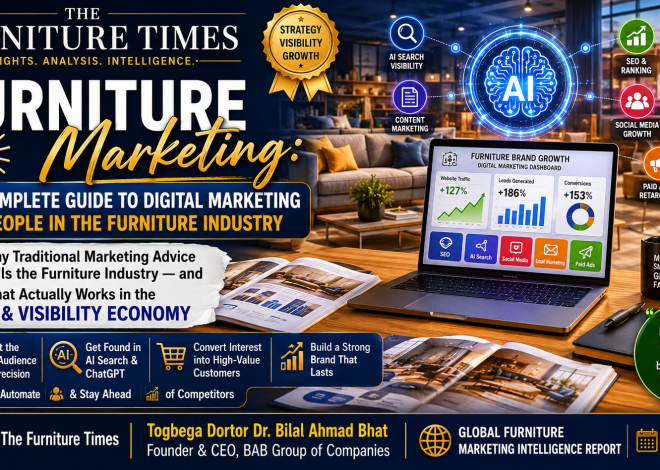

Furniture Marketing Is No Longer About Selling Products — It Is About Selling Trust, Visibility & Emotional Living
Deep Analysis of Furniture Marketing, Showroom Psychology, Digital Visibility, Trade Communication & the Future of Furniture Brand Building
By The Furniture Times | Global Furniture Marketing Intelligence Report | Global Marketing Intelligence Desk | May 2026
The global furniture industry is undergoing one of the biggest marketing transformations in its history.
For decades, furniture companies relied heavily on:
trade exhibitions
printed catalogues
showroom traffic
dealer relationships
field sales teams
physical retail visibility
But the modern furniture customer behaves differently.
Today’s customer:
researches online for weeks
compares competitors endlessly
checks Google reviews
studies social media
asks AI search systems questions
visits multiple showrooms
worries about delivery quality
compares financing options
seeks emotional reassurance before purchasing
This means:
furniture marketing itself is being rewritten.
And many traditional furniture businesses are still unprepared for this transformation.
Furniture Marketing Has Different Rules
One of the biggest mistakes in modern marketing is applying:
generic ecommerce strategies
to the furniture industry.
Furniture is not:
fast fashion
low-cost ecommerce
impulse shopping
Furniture is:
emotional
spatial
financial
lifestyle-driven
A customer buying a sofa is not simply buying:
a product.
They are buying:
comfort
identity
atmosphere
emotional security
home experience
This is why furniture marketing requires:
a completely different strategy.
The Furniture Customer Journey Is Longer Than Most Industries
The furniture buying cycle is uniquely complex.
Customers often:
browse for weeks
save screenshots
compare dimensions
discuss with partners
visit showrooms repeatedly
wait for promotions
calculate budgets
study materials carefully
Unlike fast ecommerce,
furniture purchases involve:
emotional hesitation.
This means marketing must focus heavily on:
trust building
visibility repetition
remarketing
emotional reassurance
not only direct selling.
The Showroom Still Matters
Despite ecommerce growth,
the showroom remains critically important.
Why?
Because furniture buyers still want to:
touch materials
test comfort
inspect quality
compare colors
visualize scale
This creates a hybrid future where:
websites drive showroom visits
AND:
showrooms complete the emotional sale.
The modern furniture website must therefore function as:
a showroom extension.
Furniture Websites Must Be Built Differently
Most furniture websites fail because they are designed like:
generic ecommerce stores.
But furniture buyers need:
room inspiration
material explanations
trust signals
financing visibility
delivery information
lifestyle context
emotional reassurance
The website must help customers:
imagine the furniture in their life.
This is why:
high-quality imagery
visual storytelling
product visualization
room styling
have become essential.
Furniture marketing increasingly depends on:
emotional visualization systems.
The Rise of Search Everywhere Optimization
One of the biggest transformations happening now:
discoverability.
Furniture businesses can no longer depend only on:
traditional SEO.
Modern customers increasingly discover businesses through:
Google Search
Google Maps
ChatGPT
Perplexity
AI search systems
social media discovery
image search
local recommendations
This creates:
Search Everywhere Optimization.
The future belongs to furniture businesses that become:
searchable
AI-readable
discoverable
visually visible across platforms.
Google Business Profile Is Becoming Critical
For showroom-driven furniture retailers,
Google Business Profile may now be:
the most important free marketing tool.
Customers increasingly decide:
which showroom to visit
which retailer to trust
where to spend money
based on:
maps visibility
images
operating hours
customer interactions
A weak or neglected Google Business Profile can destroy:
local visibility.
Catalogues Still Matter — But Differently
The furniture industry still heavily depends on:
brochures
product systems
visual range presentations
But modern catalogues are no longer simply:
printed books.
They are now:
digital discovery tools
sales communication systems
AI-indexable assets
showroom support infrastructure
The marketing agency Mindmelt highlighted how furniture manufacturers like Dunlopillo and D Ligne continue using:
structured brochures
trade show materials
visual systems
consistent branding
to communicate effectively across:
retailers
distributors
consumers.
This proves something important:
Furniture marketing still depends heavily on structured visual communication.
Trade Shows Still Matter — But Their Role Is Changing
Furniture exhibitions remain important globally:
MIFF
CIFF
IMM Cologne
Salone del Mobile
But exhibitions are no longer enough by themselves.
Today:
buyers often research companies online:
before visiting exhibitions.
This means trade fairs now work best when combined with:
strong websites
discoverability systems
SEO
AI visibility
social media presence
The future furniture ecosystem increasingly depends on:
integrated visibility.
Furniture Marketing Is Becoming Omnichannel
One major challenge highlighted in modern furniture marketing:
data inconsistency.
Many businesses still separate:
showroom systems
ecommerce systems
catalogs
product feeds
CRM platforms
This creates customer confusion.
For example:
a sofa shown online as “Anthracite”
may appear in-store as:
“Dark Grey.”
Trust collapses quickly when:
pricing differs
naming differs
specifications differ
Modern furniture businesses increasingly require:
connected omnichannel infrastructure.
Visual Storytelling Is Becoming Essential
Furniture is deeply visual.
Modern marketing increasingly depends on:
lifestyle photography
3D visualization
room simulations
immersive content
video storytelling
Studies and marketing reports continue showing that visual experiences strongly improve:
engagement
emotional connection
purchase confidence.
The furniture industry is moving from:
product selling
toward:
atmosphere selling.
AI Is Reshaping Furniture Marketing
Artificial Intelligence is now transforming:
SEO
ad copy
content production
product descriptions
customer communication
visual generation
campaign optimization
Modern AI systems increasingly help businesses:
create blog articles
optimize ads
improve discoverability
analyze buyer behaviour
Research into AI-driven marketing frameworks shows generative AI increasingly acts as:
strategic marketing infrastructure.
But Trust Must Remain Human
Even with AI,
furniture remains highly emotional.
Customers still need:
reassurance
confidence
empathy
consultation
emotional validation
The smartest furniture businesses will:
automate repetitive systems
while:
keeping emotional selling human.
Financing Is Becoming a Conversion Tool
Furniture remains a:
high-ticket purchase category.
This means financing heavily influences:
conversion rates
hesitation reduction
showroom closing success
Modern furniture advertising increasingly succeeds by highlighting:
installment plans
flexible payments
monthly affordability
especially during:
inflation periods
uncertain economies.
Content Is Becoming Furniture Infrastructure
Modern furniture businesses must increasingly act like:
media companies.
Why?
Because content now drives:
SEO
discoverability
AI visibility
trust
showroom visits
customer education
Furniture companies should consistently publish:
material guides
buying tips
trend analysis
project showcases
maintenance advice
comparison articles
Because content is no longer optional.
It is:
discoverability infrastructure.
SMEs Face the Biggest Marketing Challenge
Large furniture corporations increasingly invest heavily in:
SEO
AI visibility
digital advertising
content ecosystems
omnichannel infrastructure
Meanwhile many SMEs remain:
digitally invisible
poorly searchable
disconnected from modern discovery systems
This creates:
visibility inequality.
And visibility inequality increasingly becomes:
economic inequality.
The Future Furniture Brand Will Be Built Differently
The future furniture brand may not dominate because it has:
the biggest showroom
the largest factory
the cheapest pricing
The future leader may increasingly be the company that:
builds trust digitally
owns discoverability
dominates category authority
creates emotional content
appears everywhere customer’s search
The future belongs to:
discoverable furniture ecosystems.
Why TFT & FISE Matter
The furniture industry still lacks:
centralized discoverability
searchable infrastructure
connected visibility systems
This is why:
are becoming increasingly important.
Because future furniture businesses increasingly depend on:
visibility infrastructure.
TFT Industry Insight
Furniture marketing is no longer simply:
advertising.
It is:
discoverability engineering
emotional storytelling
trust architecture
AI visibility optimization
omnichannel coordination
customer psychology management
The businesses that understand:
long buying cycles
emotional hesitation
showroom behaviour
AI discoverability
may dominate the next era of furniture commerce.
Final Thought
The global furniture industry is entering:
a visibility-driven marketing era.
The future customer journey increasingly moves through:
search
comparison
trust
showroom validation
emotional reassurance
financing confidence
before purchase.
Furniture businesses that still rely only on:
static websites
exhibitions
catalogs
traditional retail thinking
may increasingly struggle in the modern discoverability economy.
Because the future of furniture marketing is no longer simply about:
selling products.
It is about:
building trust across the entire emotional buying journey.
Closing Insight
“The future of furniture marketing will not belong to businesses that simply display products. It will belong to businesses that create discoverability, emotional reassurance, visibility, trust, and human connection throughout the entire customer journey.”