
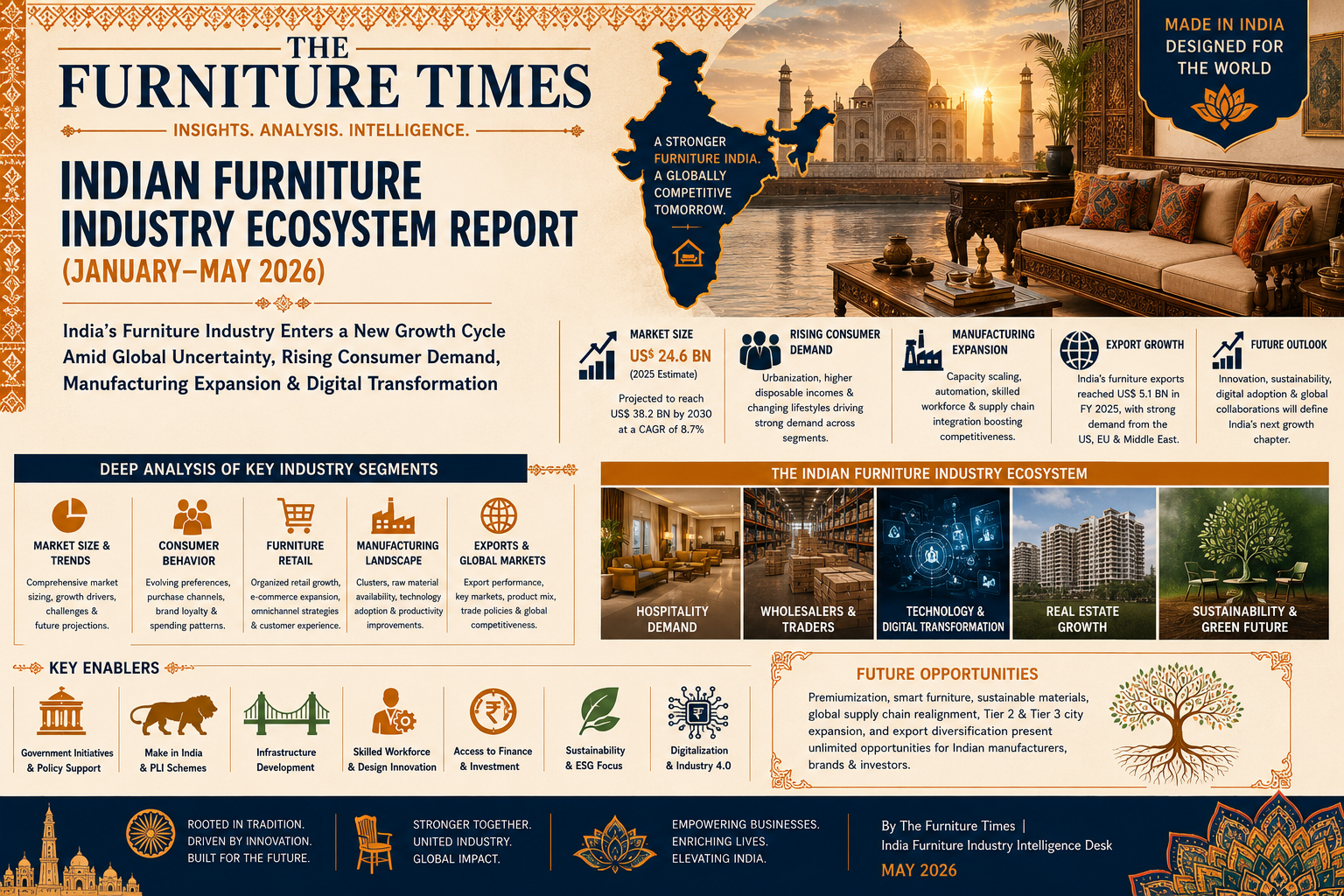
India’s Furniture Industry Enters a New Growth Cycle Amid Global Uncertainty, Rising Consumer Demand, Manufacturing Expansion & Digital Transformation
Indian Furniture Industry Ecosystem Report (January–May 2026)
Deep Analysis of Market Size, Consumer Behavior, Furniture Retail, Manufacturing, Exports, Hospitality Demand, Wholesalers, Traders, Technology, Real Estate Growth & Future Opportunities
By The Furniture Times | India Furniture Industry Intelligence Desk | May 2026
The Indian furniture industry entered 2026 with strong momentum despite global economic uncertainty, geopolitical tensions, rising logistics costs, and shifting consumer behavior.
Between January and May 2026, the industry demonstrated remarkable resilience as demand continued expanding across:
residential furniture
office furniture
hospitality furniture
modular kitchens
wardrobes
home décor
commercial interiors
India is increasingly being viewed not only as one of the world’s largest furniture consumption markets but also as an emerging global manufacturing ecosystem.
Several market studies estimate the Indian furniture market at approximately US$25–32 billion in 2026, with long-term projections suggesting growth toward US$44–61 billion over the next decade.
The industry is no longer simply growing.
It is transforming.
January–May 2026: Industry Overview
The first five months of 2026 were characterized by:
Positive Drivers
Urban housing growth
Rising middle-class consumption
Hospitality expansion
Real estate activity
Digital furniture retail growth
Manufacturing investments
Key Challenges
Raw material cost volatility
Freight uncertainty
Import competition
Supply chain inefficiencies
Margin pressure for SMEs
Despite global disruptions, India’s broader economy remained one of the fastest-growing major economies, supporting furniture consumption across multiple categories.
India Is Becoming a Furniture Consumption Giant
India’s population scale, urbanization, and housing expansion continue driving furniture demand.
The country is increasingly witnessing:
apartment living growth
home ownership aspirations
interior design awareness
lifestyle upgrades
Furniture is no longer viewed merely as a functional necessity.
Consumers increasingly view furniture as:
a lifestyle investment.
Market studies show residential furniture continues dominating overall demand, accounting for more than 70% of industry revenue.
Consumer Behavior Is Rapidly Changing
One of the biggest transformations in 2026 has been consumer behavior.
Indian consumers increasingly prioritize:
design
functionality
space optimization
aesthetics
durability
customization
Younger buyers are particularly influenced by:
social media
interior design trends
influencer content
online furniture platforms
The modern customer increasingly researches products online before purchasing.
This means buying behavior is becoming:
digitally influenced.
Modular Furniture Demand Continues Rising
The strongest demand growth between January and May 2026 came from:
modular kitchens
wardrobes
storage furniture
apartment-friendly furniture
multifunctional furniture
Urban housing constraints continue pushing consumers toward:
space-efficient furniture solutions.
Bedroom furniture remains one of the largest product categories, driven by demand for storage beds, wardrobes, and modular systems.
The Rise of Organized Furniture Retail
India’s furniture sector continues transitioning from an unorganized market toward organized retail.
Consumers increasingly prefer:
branded furniture
warranty-backed products
standardized quality
professional installation
This trend is benefiting:
organized retailers
furniture chains
online furniture platforms
However, local furniture markets and independent workshops continue maintaining strong influence, particularly in Tier-2 and Tier-3 cities.
E-Commerce Continues Reshaping Buying Habits
Digital retail remained one of the most important industry themes between January and May 2026.
Furniture buyers increasingly compare:
pricing
materials
designs
reviews
before making purchasing decisions.
Industry reports identify omnichannel retail and digital transformation as major growth drivers shaping the market.
The future furniture customer increasingly expects:
Search → Compare → Buy
Manufacturers Are Expanding Capacity
Indian manufacturers continue investing in:
automation
CNC machinery
woodworking technology
panel processing systems
modular manufacturing
Industry events such as INDIAWOOD 2026 highlighted India’s ambition to strengthen manufacturing capability and global competitiveness.
The industry is moving from:
labor-intensive production
toward:
technology-supported production.
The Make in India Momentum Is Growing
Government focus on domestic manufacturing continues influencing industrial strategy.
Recent policy discussions emphasized reducing import dependency and encouraging local production across multiple sectors.
For the furniture industry, this creates opportunities for:
furniture manufacturing
machinery production
hardware manufacturing
panel industries
component suppliers
The future industry increasingly aligns with:
self-reliant manufacturing ecosystems.
Hospitality Furniture Demand Is Recovering
The hospitality sector became a major growth driver during the first five months of 2026.
Expansion across:
hotels
resorts
serviced apartments
commercial spaces
supported strong demand for:
hospitality furniture
outdoor furniture
restaurant seating
lobby furniture
hotel room furnishings
Tourism growth continues creating opportunities across the furniture ecosystem.
Office Furniture Is Entering a New Phase
Hybrid work environments continue reshaping office furniture demand.
Companies increasingly seek:
ergonomic chairs
collaborative furniture
flexible workstations
modular office systems
Demand remains strongest in:
technology hubs
corporate cities
startup ecosystems
Office furniture manufacturers increasingly focus on:
wellness-oriented workplace design.
Wholesalers Remain the Backbone of Distribution
Despite digital growth, wholesalers continue playing a crucial role.
Wholesale markets remain highly influential across:
Delhi
Mumbai
Bengaluru
Hyderabad
Chennai
Kolkata
Wholesalers continue serving:
retailers
contractors
interior designers
hospitality buyers
The wholesale ecosystem remains one of the strongest pillars supporting industry movement.
Traders Face New Competition
Furniture traders increasingly face pressure from:
direct-to-consumer brands
online marketplaces
manufacturer-owned showrooms
digital sourcing platforms
This is forcing many traders to adapt through:
digital catalogues
social media marketing
online inquiry systems
The future trader may increasingly become:
a hybrid digital seller.
Raw Material Pressure Continues
Manufacturers continue monitoring costs related to:
wood
plywood
laminates
upholstery materials
steel
logistics
Global steel market volatility and import dynamics remain important cost considerations for furniture manufacturers.
Managing material costs remains one of the industry’s biggest operational challenges.
The Wood Furniture Segment Remains Dominant
Wood furniture continues dominating the Indian market, accounting for roughly half of total market share according to industry studies.
Consumers continue preferring:
solid wood furniture
engineered wood furniture
plywood-based furniture
handcrafted products
Wood remains strongly associated with:
durability and trust.
Export Opportunities Are Growing
India continues strengthening its position in global furniture exports.
Export opportunities are supported by:
manufacturing growth
trade diversification
global sourcing shifts
Industry organizations increasingly encourage manufacturers to target:
Middle East
Europe
ASEAN
Africa
Global buyers increasingly seek alternative sourcing destinations.
India stands to benefit from this trend.
Furniture Quality Standards Are Becoming More Important
The introduction of furniture quality regulations and standardization measures is influencing the industry.
Industry organizations increasingly emphasize:
quality compliance
manufacturing consistency
export readiness
Recent industry discussions highlighted growing focus on quality control systems and indigenous manufacturing standards.
The future market increasingly rewards:
quality-driven manufacturers.
Technology Is Changing the Industry
The furniture ecosystem increasingly integrates:
AI tools
digital catalogues
AR visualization
online consultations
automation
Technology is influencing:
production
retail
customer engagement
logistics
sourcing
The future furniture company may increasingly compete through:
digital intelligence.
Consumer Categories Driving Growth
Strong demand was observed across:
Bedroom Furniture
storage beds
wardrobes
modular solutions
Living Room Furniture
sofas
recliners
entertainment units
Modular Furniture
apartment-friendly systems
multifunctional designs
Hospitality Furniture
hotels
cafés
resorts
Office Furniture
ergonomic products
flexible workspaces
The Furniture Times Industry Insight
The Indian furniture industry between January and May 2026 revealed one important reality:
The sector is no longer simply a manufacturing industry.
It is becoming:
a lifestyle industry
a design industry
a technology industry
a discoverability industry
The future winners may not only be those who manufacture well.
They may become those who combine:
production
branding
visibility
digital presence
quality
innovation
Final Thought
The Indian furniture industry entered 2026 with strong momentum despite global uncertainty.
Demand continues expanding.
Consumers continue upgrading homes.
Manufacturers continue investing.
Retail continues evolving.
Technology continues reshaping behavior.
India is no longer simply participating in the global furniture industry.
It is increasingly positioning itself as one of the most important furniture ecosystems in the world.
The next phase of growth will likely be defined by:
Manufacturing Strength
Digital Transformation
Consumer Evolution
Quality Standards
Global Competitiveness
Because the future Indian furniture industry is no longer only about making furniture.
It is increasingly about building an ecosystem capable of serving one of the largest and fastest-growing furniture markets on Earth.
