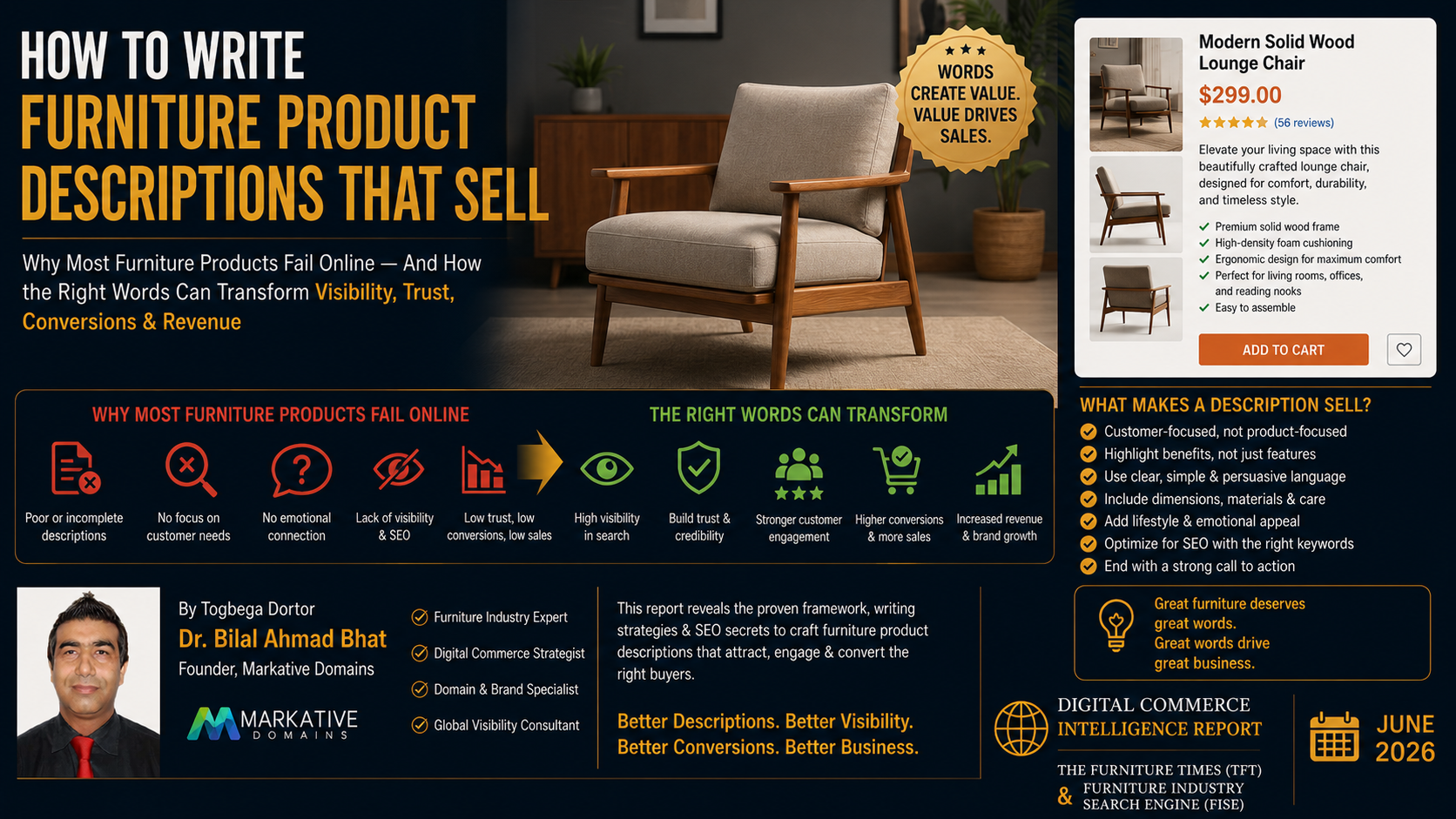
How to Write Furniture Product Descriptions That Sell
Why Most Furniture Products Fail Online — And How the Right Words Can Transform Visibility, Trust, Conversions & Revenue
Digital Commerce Intelligence Report
By Togbega Dortor Dr. Bilal Ahmad Bhat / Founder, Markative Domains
The Furniture Times (TFT) & Furniture Industry Search Engine (FISE) / June 2026
The furniture industry has a product description problem.
Every day, thousands of manufacturers, retailers, exporters, and e-commerce businesses upload products online.
Beautiful sofas.
Elegant dining tables.
Luxury outdoor furniture.
Custom wardrobes.
Designer beds.
Premium office furniture.
Yet many of these products never generate inquiries.
Never attract buyers.
Never rank on search engines.
Never appear in AI recommendations.
And ultimately, never sell.
The surprising reality is that the problem often has nothing to do with the product itself.
The problem is the description.
In today’s digital economy, furniture products are not sold by images alone.
They are sold by information.
The words you write determine whether buyers:
- Find your product
- Understand your product
- Trust your product
- Compare your product
- Buy your product
In 2026, product descriptions have become one of the most powerful sales tools in the furniture industry.
Why Most Furniture Product Descriptions Fail
Visit thousands of furniture websites and you will see descriptions like:
“Modern sofa with comfortable seating.”
“Premium dining table made of wood.”
“Outdoor chair suitable for gardens.”
These descriptions tell buyers almost nothing.
They fail because they do not answer the questions buyers actually ask.
Buyers want to know:
- Why should I buy this?
- What problem does it solve?
- Who is it designed for?
- What materials are used?
- How long will it last?
- What makes it different?
- Why should I trust this product?
A weak description creates uncertainty.
And uncertainty kills sales.
The First Rule: Stop Describing the Product. Start Selling the Outcome.
Most furniture companies describe features.
Successful furniture companies describe benefits.
For example:
Instead of:
“Aluminium frame with UV-resistant fabric.”
Say:
“Designed for tropical climates, the rust-resistant aluminium frame and UV-protected fabric ensure years of outdoor enjoyment with minimal maintenance.”
The first statement describes.
The second statement sells.
Buyers are interested in outcomes.
Not specifications alone.
Every Furniture Product Must Tell a Story
Furniture is emotional.
People do not buy sofas.
They buy comfort.
They do not buy dining tables.
They buy family moments.
They do not buy outdoor loungers.
They buy relaxation.
The best product descriptions connect products to human experiences.
A great description helps customers imagine ownership before purchase.
The SEO Mistake Costing Furniture Companies Millions
Many furniture businesses still write descriptions only for people.
In 2026, descriptions must be written for both:
- Humans
- Search engines
If your dining table description never mentions:
- Solid wood dining table
- Modern dining table
- Extendable dining table
- Dining furniture
Search engines may struggle to understand what you sell.
If search engines cannot understand it, buyers may never find it.
Every description should support discoverability.
The AI Search Revolution
A new challenge has emerged.
Artificial Intelligence is changing how products are discovered.
Consumers increasingly ask:
- What is the best outdoor furniture for tropical climates?
- Which dining table lasts longest?
- What sofa is suitable for families?
AI systems rely on product information.
Products with detailed, structured descriptions are more likely to be recommended.
Poor descriptions become invisible.
The future belongs to products that are understandable by both humans and machines.
The Perfect Furniture Product Description Formula
The highest-converting furniture descriptions typically include:
1. Product Purpose
What is it?
2. Customer Benefit
Why does it matter?
3. Material Details
What is it made from?
4. Design Features
What makes it attractive?
5. Durability Information
How long will it last?
6. Usage Environment
Where should it be used?
7. Maintenance Guidance
How easy is it to care for?
8. Call to Action
What should the customer do next?
This structure improves both conversions and discoverability.
Example: Poor vs Powerful Description
Poor Description
Outdoor Parasol
“Premium outdoor parasol with aluminium frame and polyester fabric.”
Powerful Description
Commercial Outdoor Parasol
“Create comfortable outdoor experiences with this premium commercial-grade parasol designed for hotels, resorts, restaurants, cafés, poolside areas, and residential gardens. Featuring a rust-resistant aluminium frame and UV-resistant canopy fabric, it provides reliable shade, weather protection, and elegant aesthetics for tropical and outdoor environments. Built for durability and low maintenance, it is the ideal solution for enhancing guest comfort and maximizing outdoor space usability.”
Which one is more likely to sell?
The answer is obvious.
Furniture Buyers Want Confidence
Every purchase contains risk.
The role of product descriptions is to reduce uncertainty.
The best descriptions answer concerns before they become objections.
Questions such as:
- Is it durable?
- Is it weather resistant?
- Is it suitable for commercial use?
- Is it easy to maintain?
- Is it worth the investment?
A strong description creates confidence.
Confidence drives action.
Product Descriptions Build Trust
Trust is one of the most important factors in furniture buying.
Customers cannot always touch the product.
They cannot always visit the factory.
They rely on information.
Detailed descriptions communicate professionalism.
Weak descriptions suggest uncertainty.
Trust often begins with clarity.
Why Furniture Manufacturers Need Better Descriptions
Many manufacturers focus entirely on production.
But modern manufacturing also requires communication.
A world-class product with poor communication often loses to an average product with excellent communication.
Visibility influences opportunity.
Descriptions influence visibility.
Therefore descriptions influence sales.
The E-Commerce Reality
Furniture e-commerce continues growing globally.
Whether selling through:
- Company websites
- Marketplaces
- Retail platforms
- Social commerce
Product descriptions remain one of the most important conversion factors.
Images attract attention.
Descriptions create confidence.
Confidence creates purchases.
Product Descriptions and FISE Searchability
The future of furniture discovery depends on searchability.
Every product listed on:
- Websites
- Marketplaces
- Directories
- Industry platforms
must be optimized for discovery.
The better the description:
- The easier it becomes to find
- The easier it becomes to compare
- The easier it becomes to trust
Searchability is becoming a competitive advantage.
Common Furniture Description Mistakes
Avoid:
Generic Language
“High quality product.”
Missing Materials
Buyers want specifics.
No Benefits
Features alone do not sell.
Poor Keywords
Search visibility suffers.
Short Descriptions
Lack of information reduces trust.
No Emotional Connection
Furniture purchases are emotional decisions.
The Future of Furniture Marketing
The future belongs to companies that communicate effectively.
Manufacturers must become storytellers.
Retailers must become educators.
Brands must become trusted advisors.
Product descriptions are no longer technical documents.
They are digital salespeople.
Working 24 hours a day.
365 days a year.
Across every market.
Across every time zone.
TFT & FISE Analysis
The furniture industry often invests heavily in:
- Factories
- Machinery
- Showrooms
- Exhibitions
Yet many companies overlook the power of words.
A product description may determine whether:
- A product ranks
- A buyer clicks
- A customer trusts
- A sale happens
In the digital economy, descriptions are not content.
They are revenue assets.
Final Verdict
The future of furniture sales will not belong solely to companies with the best products.
It will belong to companies that communicate those products most effectively.
Because in today’s marketplace:
People do not buy what they do not understand.
Search engines do not rank what they do not understand.
AI does not recommend what it does not understand.
And product descriptions are what create understanding.
The next time you upload a product, remember:
You are not writing a description.
You are creating a salesperson.
And the quality of that salesperson may determine the success of your business.
By Togbega Dortor Dr. Bilal Ahmad Bhat
Founder, Markative Domains
The Furniture Times (TFT) & Furniture Industry Search Engine (FISE)
“TFT tells their story. FISE helps the world find them.”
The furniture industry ecosystem is a $1 Trillion Dollar Industry.