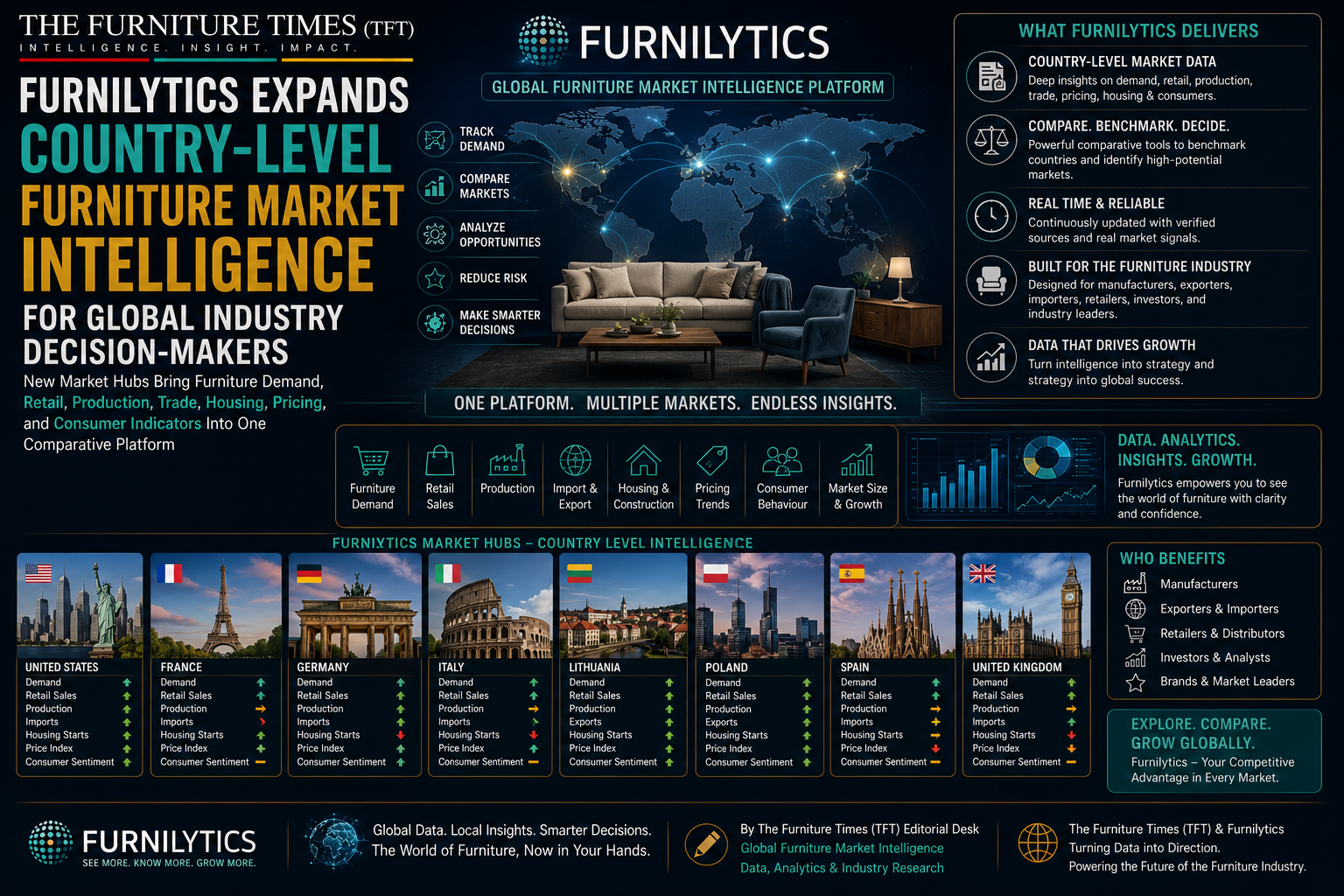
Furnilytics Expands Country-Level Furniture Market Intelligence for Global Industry Decision-Makers
New Market Hubs Bring Furniture Demand, Retail, Production, Trade, Housing, Pricing, and Consumer Indicators Into One Comparative Platform
By The Furniture Times (TFT) Editorial Desk | Global Furniture Market Intelligence | Data, Analytics & Industry Research
The global furniture industry has never suffered from a shortage of data. Governments publish manufacturing statistics. Customs authorities report imports and exports. Retail agencies track consumer spending. Housing departments measure construction and property transactions. Search platforms reveal changing online interest, while companies publish annual turnover, investment, and operational information.
The real challenge is fragmentation.
Furniture manufacturers, retailers, suppliers, exporters, investors, consultants, designers, component producers, machinery companies, and government agencies often need to consult multiple databases before they can understand a single national market. Definitions may differ, currencies may not align, reporting periods may be inconsistent, and the connection between furniture demand, production, trade, housing activity, pricing, and consumer confidence may remain unclear.
Furnilytics’ Furniture Market Intelligence by Country is attempting to address this problem through a growing network of structured market hubs.
The platform brings multiple furniture-market indicators into country-level briefings designed to help users assess market size, retail demand, domestic production, import dependence, export exposure, pricing pressure, housing activity, consumer sentiment, and broader demand conditions.
Rather than presenting market size as an isolated headline, the Furnilytics framework encourages users to examine how demand, supply, trade, and macroeconomic conditions interact.
That approach is important because a large furniture market is not automatically a fast-growing market. A major consumer economy may depend heavily on imports, while a smaller domestic market may possess a disproportionately strong manufacturing and export base. Retail demand may recover before factory output does, while online interest may move differently from actual furniture spending.
Furnilytics is building a system intended to make these differences easier to see.
Market Intelligence by Country
The Furnilytics market overview was updated on July 20, 2026. Its country hubs use a common structure, allowing users to compare markets through similar categories rather than navigating unrelated reports.
The platform currently presents market hubs for major economies including:
United States
Germany
United Kingdom
Italy
France
Spain
Poland
Netherlands
Austria
Belgium
Sweden
Switzerland
Denmark
Norway
Portugal
Czechia
Ireland
Romania
Finland
Hungary
Slovakia
Bulgaria
Croatia
Serbia
Lithuania
Slovenia
Greece
Estonia
Latvia
It also provides a wider European market view.
The number of countries and the common structure make the platform useful for businesses that need to compare several locations before making decisions about market entry, sourcing, distribution, manufacturing, investment, or sales development.
Four Questions at the Centre of Every Market
The market hubs are organised around four main analytical dimensions.
1. Market Size and Consumption
Market-size and consumption indicators help users understand the scale of demand.
These indicators can answer questions such as:
How large is the addressable furniture market?
Is the market expanding or contracting?
Is demand supported by a large population or high spending per household?
Is furniture consumption aligned with retail turnover?
Has the market returned to an earlier peak?
Is growth structural or only a short-term improvement?
This distinction matters because two countries with similar market sizes may have very different consumer structures.
One may have a larger population purchasing lower-priced furniture, while another may have fewer households but higher expenditure per person. One may be driven by homeownership and renovation, while another depends more heavily on rental housing, commercial projects, or replacement demand.
Market size is therefore the beginning of an investigation—not its conclusion.
2. Retail and Demand
Retail indicators examine how consumer demand reaches the market.
The platform connects furniture retail activity with contextual indicators such as:
Housing-market activity
Consumer confidence
Online product searches
Specialist retail turnover
Recent demand momentum
Regional or state-level spending where available
Furniture demand is closely connected to life events and economic confidence. Home purchases, residential construction, moving, marriage, renovation, household formation, and hospitality development can increase furniture spending.
However, consumers can delay furniture purchases when confidence weakens, borrowing costs rise, housing transactions slow, or household budgets become pressured.
A country may possess strong long-term potential while experiencing weak short-term retail conditions. The Furnilytics framework attempts to make that difference visible.
3. Industry and Production
Production indicators help distinguish consumer markets from manufacturing economies.
They can reveal:
The size of domestic furniture manufacturing
Whether output is growing or weakening
The relative strength of production compared with consumption
Producer-price pressure
Regional manufacturing concentration
Industrial momentum
Dependence on imported finished products
Potential demand for machinery, materials, components, and services
A large domestic market does not necessarily have a large manufacturing base. Similarly, a smaller country may operate as an important regional export centre.
This distinction matters to businesses across the supply chain.
A furniture retailer may prioritise consumer-market scale. A machinery supplier may focus on manufacturing value and factory concentration. A hardware company may be interested in production clusters. An exporter may search for import-dependent markets, while a sourcing company may prioritise export-oriented manufacturing economies.
4. Trade and Competitiveness
Trade indicators help users understand how furniture moves between countries.
They can show:
Import dependence
Export exposure
Trade concentration
Important sourcing countries
Major destination markets
Domestic supply gaps
Competitive manufacturing positions
Risks created by dependence on particular partners
A market with high consumer demand but limited production may offer opportunities to foreign exporters. A manufacturing economy with strong production and a small domestic market may depend heavily on external demand.
That dependence can create both opportunity and risk.
Export-oriented countries can build industrial scale beyond the limits of their domestic markets. However, they may also become vulnerable to economic slowdowns, tariffs, shipping disruptions, or changes in major destination markets.
Comparing Scale With Direction
One of the useful features of the Furnilytics market overview is its comparison snapshot.
The snapshot places consumer-market size and production value next to broad market classifications. It also uses direction indicators to show recent momentum where short-term data are available.
This helps users separate two questions:
How large is the market?
In which direction is it moving?
A very large market can be weakening, while a smaller one can be expanding quickly. Both may offer opportunities, but the strategies would be different.
The platform’s July 2026 comparison presented the following selected market estimates:
| Market | Consumer market size | Production size | Broad market position |
| United States | €227.8 billion | €80.5 billion | Large, mature, import-driven market |
| Europe | €185.9 billion | €124.1 billion | Large, mature, import-driven market |
| Germany | €38.6 billion | €20.7 billion | Large, mature, import-driven market |
| United Kingdom | €29.6 billion | €8.9 billion | Large, mature, import-driven market |
| Italy | €26.3 billion | €27.9 billion | Manufacturing and export hub |
| France | €17.4 billion | €6.9 billion | Major consumer and import-driven market |
| Netherlands | €11.9 billion | €4.7 billion | Major consumer and import-driven market |
| Spain | €10.5 billion | €8.4 billion | Major mature furniture market |
| Poland | €6.7 billion | €13.1 billion | Manufacturing and export hub |
| Romania | €2.1 billion | €3.4 billion | Manufacturing and export-oriented market |
| Lithuania | €0.7 billion | €2.8 billion | Compact manufacturing and export hub |
These figures should be interpreted within Furnilytics’ methodology and source notes rather than treated as universal values for every possible definition of “furniture market.” Different data providers may use different industry classifications, geographic coverage, price bases, company populations, or estimation methods.
Nevertheless, the comparison clearly illustrates the structural differences between major furniture economies. Furnilytics Market Overview
The United States: Enormous Demand, Significant Import Exposure
The United States stands out as the largest consumer market in Furnilytics’ current comparison, with an estimated consumer-market value of €227.8 billion and production value of €80.5 billion.
The difference between consumer scale and domestic production reinforces the importance of imports and global supply networks.
For international furniture companies, the United States remains difficult to ignore. Its scale creates opportunities across:
Residential furniture
Office and workplace products
Hospitality furniture
Outdoor furniture
Mattresses
Kitchen and storage systems
Components and accessories
E-commerce
Logistics and installation
Replacement and repair services
However, market scale does not eliminate risk.
Furnilytics’ United States hub reports a consumer-market estimate of approximately US$257.2 billion for 2025 and specialist furniture retail turnover of about US$135.6 billion. It also describes mixed demand signals, with consumer-market expansion existing alongside softer apparent consumption, product-search trends, and housing activity. Furnilytics United States Furniture Market Hub
This is precisely why a multi-indicator approach matters.
A company looking only at the overall market size could assume uniformly strong conditions. A company studying retail, housing, production, online demand, and consumption together would see a more complicated environment requiring careful product, price, channel, and inventory decisions.
Italy and Poland Demonstrate the Power of Manufacturing
Italy and Poland show why consumer demand cannot be the only measurement of furniture-market importance.
Furnilytics estimates Italy’s consumer market at €26.3 billion and its production market at €27.9 billion. That production strength supports Italy’s position as a design, manufacturing, and export centre.
Italy’s industry is connected to:
Premium and luxury furniture
Upholstered furniture
Kitchens
Interior systems
Contract furniture
Furniture machinery
Components and hardware
Lighting and design
International specification markets
Poland presents a different but equally important structure. Furnilytics estimates its consumer market at €6.7 billion, while production reaches approximately €13.1 billion.
Production is therefore much larger than domestic demand, demonstrating Poland’s importance as an export-oriented manufacturing base.
For suppliers of panels, foam, adhesives, fabrics, hardware, machinery, packaging, logistics, software, and industrial services, production strength can be more relevant than local retail scale.
This is one of the most valuable lessons from country-level comparison: the largest selling market and the strongest production market are not always the same place.
Smaller Markets Can Carry Strategic Importance
A country does not need to be a major consumer economy to play an important role in the furniture ecosystem.
Lithuania, for example, is presented with an estimated consumer market of €0.7 billion and production value of €2.8 billion. That relationship positions it as a compact but significant manufacturing and export-oriented economy.
Romania also has production above domestic consumer-market size, according to the overview.
Smaller markets may offer:
Specialised manufacturing
Competitive labour and operating structures
Strong regional supply relationships
Access to European customers
OEM and private-label capabilities
Timber and material expertise
Export-oriented industrial clusters
Opportunities for machinery and component suppliers
Market intelligence should therefore not rank countries only by consumption. Production intensity, export orientation, skills, cost structures, industrial clusters, and trade access can reveal strategic opportunities that headline market-size rankings miss.
Market Rankings Make Screening Faster
The Furnilytics overview includes rankings intended to help users screen countries through different dimensions.
The available ranking categories include:
Consumer-market size
Retail-market size
Production-market size
Retail expenditure per capita
Import share
Housing-market activity
Each ranking answers a different business question.
A furniture exporter may search for high-import markets. A retailer may prioritise consumer scale and per-capita spending. A factory equipment supplier may focus on production size. A residential furniture brand may examine housing momentum. A sourcing company may look for manufacturing hubs and export-oriented economies.
The rankings should not replace full market research. Their value lies in narrowing the field.
A company can use the overview to identify several promising countries and then open the detailed hubs for deeper analysis.
Monthly Refreshes Address a Major Industry Problem
Annual reports are useful for understanding market structure, but furniture demand can change much faster than annual data suggests.
Housing activity, retail turnover, web searches, consumer confidence, production indices, and price indicators may shift from month to month.
Furnilytics states that its country hubs are refreshed monthly as underlying information and calculations are updated. This makes the system relevant for ongoing monitoring rather than one-time research.
Monthly tracking can help companies respond to:
Demand slowdowns
Retail recovery
Production contraction
Raw-material price pressure
Changing import patterns
Housing-market weakness
Consumer-confidence shifts
Regional growth differences
A manufacturer planning production six months ahead needs more than a market-size figure from the previous year. A retailer deciding inventory levels needs to understand recent momentum. An exporter entering a country needs to know whether demand is recovering, stable, or deteriorating.
European Furniture Market Shows Uneven Stabilisation
Furnilytics’ June 2026 European market update illustrates the importance of looking beneath regional averages.
The update indicated that European retail demand was moving toward modest recovery, while manufacturing remained under pressure but showed signs of stabilisation.
Its harmonised indicators reported European furniture retail growth of approximately 1.1% on a three-month year-on-year basis, while production was down around 1.2%.
Country performance varied considerably.
In retail, Furnilytics reported stronger short-term performances from markets such as:
Lithuania
Poland
Netherlands
Spain
Italy
Germany and France remained weaker during the measured period.
Production also varied. Lithuania and France showed positive momentum, while Germany, Poland, and Italy remained below the prior-year comparison in the period examined.
The message is clear: there is no single European furniture market cycle.
A regional average can hide major differences between countries. Businesses must examine local retail, manufacturing, housing, pricing, and trade conditions before making decisions. Furnilytics European Furniture Market Update—June 2026
Linking Retail, Housing, and Consumer Sentiment
Furniture is a considered purchase. Unlike everyday consumer products, large furniture items are often connected to housing, renovation, relocation, and household confidence.
This makes housing indicators particularly valuable.
When property transactions increase, people may furnish new homes. When residential construction grows, demand can develop across furniture, kitchens, wardrobes, mattresses, lighting, flooring, and interior services.
However, the relationship is not always immediate.
Furniture purchases may occur months after a home sale or building completion. High mortgage costs can weaken household spending even if housing supply increases. Rental-market growth may favour different products from homeownership. Smaller urban apartments may create demand for modular and space-saving furniture rather than larger conventional products.
Consumer sentiment adds another layer.
People may need furniture but postpone purchasing if they are uncertain about employment, income, inflation, or economic stability. Conversely, stronger confidence can release delayed replacement and renovation demand.
By placing housing and sentiment beside furniture-market indicators, Furnilytics encourages a broader reading of demand.
Online Search as an Early Demand Signal
Digital search interest is another important part of modern market intelligence.
Consumers frequently begin furniture purchasing online, even when the final transaction occurs in a showroom.
They search for:
Sofas
Beds and mattresses
Dining tables
Wardrobes
Office chairs
Outdoor furniture
Kitchen cabinets
Furniture retailers
Product reviews
Prices and discounts
Changes in search behaviour can provide an early indication of consumer interest, but search data must be interpreted carefully.
Higher search activity does not automatically mean higher sales. Consumers may search more because they are comparing prices, delaying purchases, looking for discounts, or researching alternatives. Search demand may also move between platforms, including search engines, marketplaces, social media, and AI assistants.
Furnilytics’ methodology recognises the limits of digital indicators rather than treating them as direct sales measures.
The strongest analysis combines online interest with retail turnover, housing activity, consumer sentiment, and actual market performance.
From Data Collection to Market Interpretation
The value of a market-intelligence platform does not come only from collecting numbers. It comes from helping users understand what the numbers mean.
According to its methodology, Furnilytics follows a four-stage process:
Source data
Cleaning and classification
Calculation or estimation
Published indicator
The platform says it prioritises official and primary information such as national statistical offices, Eurostat, UN Comtrade, customs data, annual reports, and company financial statements. Third-party or modelled sources may be used where appropriate, with their role identified in the methodology. Furnilytics Methodology
The methodology also covers:
Currency conversion
Annual aggregation
Index rebasing
Product-code aggregation
Temporal disaggregation
Nowcasting
Preliminary and estimated values
Data revisions
Cross-country comparability limitations
This transparency is important because international furniture data are not perfectly uniform.
Why Furniture Data Are Difficult to Compare
Furniture markets are measured through different systems.
Retail statistics may focus on specialist furniture stores while excluding furniture sold through department stores, marketplaces, home-improvement chains, direct-to-consumer brands, or mixed-product retailers.
Manufacturing statistics may use national industrial classifications that do not align perfectly across countries.
Trade data may include finished furniture, seats, mattresses, parts, or selected product categories depending on the codes used.
Company turnover may include accessories, services, decoration, delivery, or non-furniture products.
Currency movements can change international comparisons even when local-market activity remains stable.
These challenges do not make comparison impossible, but they require users to understand the scope of each indicator.
Furnilytics’ decision to connect market hubs with underlying methodology and source notes is therefore an essential part of the platform—not an optional technical feature.
What Manufacturers Can Learn
Furniture manufacturers can use country hubs to study both selling opportunities and competitive threats.
They can examine:
Which consumer markets are large enough to justify entry
Which markets are recovering
Where production capacity is concentrated
Which countries depend heavily on imports
Where domestic factories may be strong competitors
Which countries offer export-oriented manufacturing
Whether housing activity supports future demand
Whether production costs appear to be rising
Which regions may need different products or price points
A manufacturer should not enter a market based on market size alone.
It must also consider distribution, local competition, product standards, shipping costs, duties, customer preferences, retail channels, after-sales service, and brand visibility.
Market intelligence provides direction, but commercial execution determines the final result.
What Retailers Can Learn
Retailers can use the platform to compare:
Overall furniture spending
Retail-market momentum
Consumer confidence
Housing conditions
Online demand
Import structure
Per-capita retail activity
Domestic production strength
This can support decisions about:
Product assortment
Inventory levels
Pricing
Private-label sourcing
New store locations
E-commerce expansion
Marketing expenditure
Supplier diversification
Retailers should look for gaps between indicators.
If online interest rises but retail turnover remains weak, customers may be researching without purchasing. If housing activity improves, future demand may strengthen with a delay. If imports rise while local production weakens, sourcing and competitive structures may be changing.
What Suppliers and Component Companies Can Learn
The market hubs are also relevant to component and accessory suppliers.
A hardware, fabric, foam, panel, adhesive, machinery, or packaging company may be less interested in household consumption than in domestic production strength.
Manufacturing hubs can create demand for:
Hinges and drawer systems
Furniture connectors
Upholstery materials
Surface finishes
Timber and panels
Machinery
Automation
Packaging
Design software
Logistics
Testing and certification
A country with modest consumer demand but strong furniture production may be an attractive B2B market.
This is why the combination of consumer-market and production-market data is especially useful for the broader furniture ecosystem.
What Investors and Governments Can Learn
Investors can use the market hubs to screen countries and identify structural opportunities.
Governments and industry agencies can compare their domestic market with competing furniture economies.
They can ask:
Is local production growing faster than domestic demand?
Is the country losing market share to imports?
Are exporters concentrated in too few destinations?
Does the country have a strong furniture cluster?
Are housing and consumer conditions supporting demand?
Which industrial capabilities are missing?
Does the sector need components, machinery, skills, design, or digital infrastructure?
Market intelligence can support better decisions about investment promotion, export programmes, SME development, workforce training, trade policy, and manufacturing clusters.
Country Hubs Can Improve SME Decision-Making
Large corporations may have internal intelligence departments, subscription databases, local offices, and professional analysts. Most furniture SMEs do not.
A small manufacturer considering Germany, France, the United Kingdom, or the United States may rely on exhibitions, distributor conversations, online searches, or informal advice.
These channels can be useful, but they may not provide a complete market view.
Structured public market hubs can help SMEs ask better questions before spending heavily on:
Trade exhibitions
Product certification
Export samples
Distributor appointments
Warehousing
Advertising
International travel
Local representatives
Market intelligence does not eliminate risk, but it can prevent companies from entering markets blindly.
Data Must Be Combined With Local Knowledge
No platform, database, or market report can replace direct market experience.
Furniture is influenced by:
Local lifestyles
Home sizes
Cultural preferences
Climate
Building styles
Retail formats
Delivery infrastructure
Assembly expectations
Design trends
Income distribution
Regulatory requirements
Quantitative data should therefore be combined with interviews, store visits, customer feedback, local partnerships, product testing, and competitor analysis.
The most effective approach is to use market intelligence to identify where deeper research should begin.
AI Search and Machine-Readable Market Intelligence
Furnilytics states that its market hubs use consistent headings, structured country sections, source notes, internal indicator links, and public data payloads intended to help analysts, search engines, and AI systems understand the information.
This has growing significance.
Furniture executives increasingly use AI assistants to ask questions such as:
Which European country has the strongest furniture production?
Which markets depend most heavily on furniture imports?
Where is retail demand recovering?
Which countries offer the best sourcing opportunities?
How does Poland compare with Italy?
Is Germany a larger furniture market than France?
AI systems require structured, current, and verifiable data to answer such questions responsibly.
Webpages designed for human reading alone may not provide sufficient clarity. Structured data, transparent sources, consistent definitions, and machine-readable information can improve both search visibility and analytical usefulness.
A New Direction for Furniture Market Intelligence
The Furnilytics market-hub model demonstrates a broader transformation in the global furniture industry.
For years, the sector depended heavily on fragmented reports, exhibition conversations, supplier relationships, and historical experience. Those sources remain valuable, but today’s operating environment requires faster, more structured intelligence.
Furniture companies need to understand:
Where demand is growing
Where production is concentrated
Which markets are import-dependent
Which countries are export-oriented
How housing affects furniture demand
Whether consumer confidence is improving
How prices are changing
Where supply-chain risks are developing
Country hubs cannot answer every question, but they can create a common analytical starting point.
The platform’s greatest potential lies in connecting multiple indicators rather than presenting one impressive market-size number without context.
The Furniture Industry Must Become More Data-Literate
The furniture ecosystem is becoming more complex.
Manufacturers face pressure from materials, energy, labour, shipping, compliance, and changing retail channels. Retailers must manage inventory while consumer demand moves unpredictably. Exporters need to choose markets carefully. Suppliers must identify manufacturing clusters. Investors need comparable evidence. Governments must understand industrial strengths and weaknesses.
Data literacy is therefore becoming a competitive capability.
Furniture leaders must learn to distinguish:
Market size from market momentum
Production value from retail value
Search interest from purchasing
Import dependence from export strength
Short-term change from structural position
Official data from modelled estimates
Nominal growth from real market improvement
Furnilytics’ country market intelligence contributes to this transition by organising furniture-specific indicators around practical business questions.
Its usefulness will ultimately depend on continued data quality, transparent methodology, timely updates, broader geographic coverage, and the industry’s ability to turn information into better decisions.
Conclusion: Turning Fragmented Statistics Into Strategic Direction
The global furniture industry needs more than reports that announce a market value and forecast a future total.
It needs connected intelligence showing how consumer demand, retail activity, manufacturing capacity, imports, exports, housing conditions, pricing, and confidence interact.
Furnilytics’ market hubs provide a structured step in that direction.
The platform allows users to move from a country comparison to a deeper market briefing, and from interpretation to underlying indicators and methodology. It helps separate large consumer markets from manufacturing hubs, import-driven economies from export-oriented producers, and short-term momentum from long-term structure.
For furniture manufacturers, retailers, suppliers, investors, consultants, and policymakers, that distinction can influence where they sell, source, manufacture, invest, and build partnerships.
The opportunity is not simply to possess more data.
The opportunity is to understand the furniture economy more clearly—and act before competitors do.
The Furniture Times (TFT) & Furniture Industry Search Engine (FISE)
“TFT tells their story. FISE helps the world find them.”
FurniReviewology helps the world trust them.
The furniture industry ecosystem is a $1 trillion industry ecosystem.