
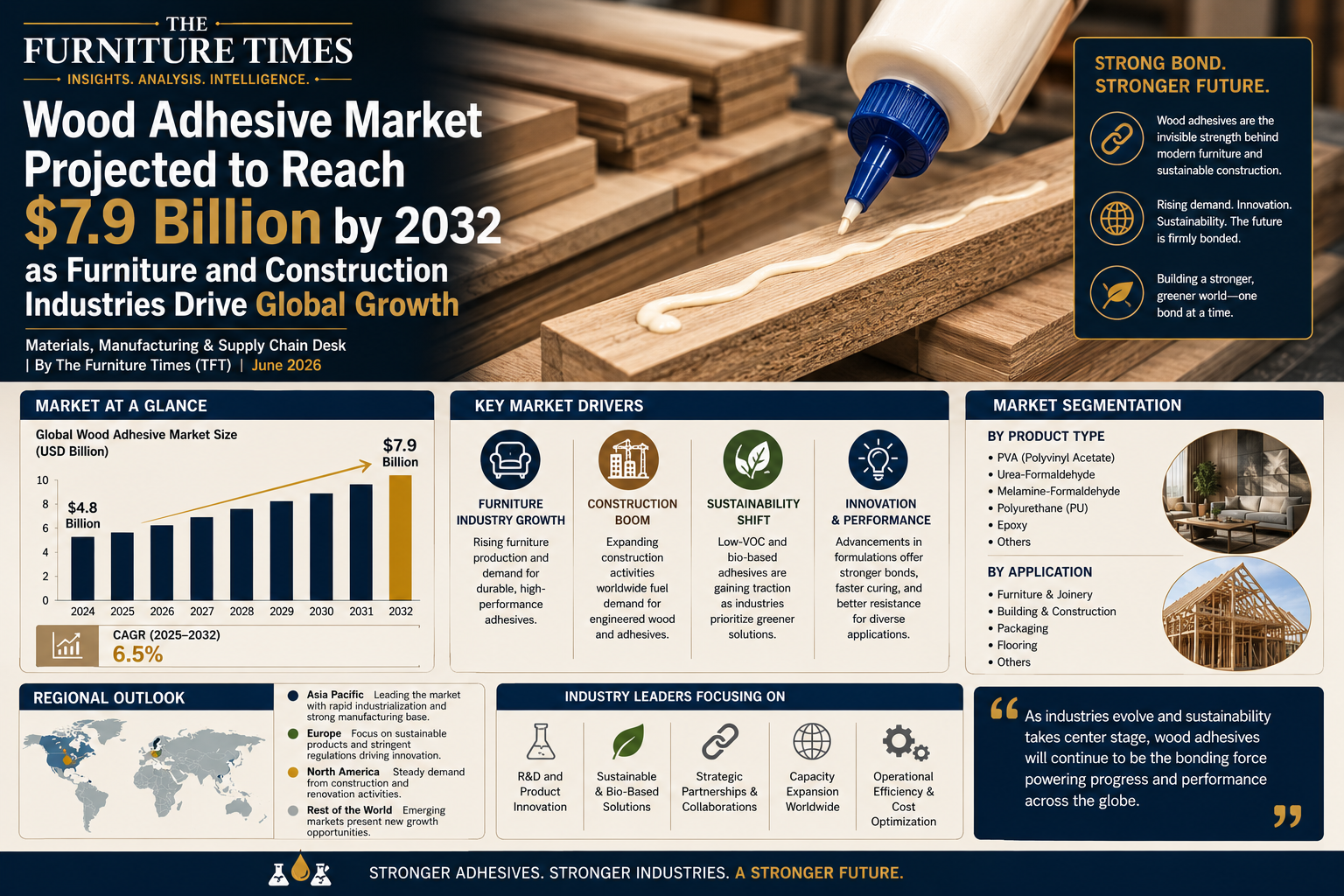
Wood Adhesive Market Projected to Reach $7.9 Billion by 2032 as Furniture and Construction Industries Drive Global Growth
Materials, Manufacturing & Supply Chain Desk | By The Furniture Times (TFT) | June 2026
The global wood adhesive industry is entering a new phase of expansion as demand from furniture manufacturing, construction, interior fit-outs, engineered wood products, and sustainable building solutions continues to accelerate worldwide. According to a recently published market analysis, the global wood adhesive market is projected to reach approximately US$7.9 billion by 2032, reflecting strong long-term growth driven by increasing investments in housing, infrastructure, furniture production, and wood-based manufacturing.
Wood adhesives play a critical role in modern furniture manufacturing and construction. While often invisible to consumers, these specialized bonding materials are essential for ensuring the durability, strength, stability, and longevity of furniture, cabinets, flooring systems, doors, panels, engineered wood products, and numerous interior applications.
As global demand for furniture and wood-based products continues to rise, the importance of adhesives within the manufacturing ecosystem is becoming increasingly significant.
Why the Wood Adhesive Industry Matters
Every piece of modern furniture relies on bonding technologies.
Whether it is:
Residential furniture
Office furniture
Hotel furniture
Kitchen cabinets
Wardrobes
Wooden flooring
Doors and windows
Engineered wood panels
Outdoor wooden structures
adhesives are fundamental to the manufacturing process.
The evolution of furniture design has also increased the need for advanced adhesive technologies capable of supporting lightweight structures, modern aesthetics, complex joinery systems, and sustainable production methods.
Today, adhesives are no longer viewed merely as industrial consumables. They have become strategic materials influencing product performance, manufacturing efficiency, environmental compliance, and product lifecycle durability.
Furniture Industry Remains a Major Growth Driver
The furniture sector continues to be one of the largest consumers of wood adhesives globally.
Several trends are contributing to rising demand:
Growing Urbanization
Rapid urban development across Asia, Africa, and the Middle East continues to generate demand for residential and commercial furniture.
Rising Middle-Class Consumption
As disposable incomes increase, consumers are investing more in home furnishings, renovations, and interior improvements.
Expansion of Hospitality Projects
Hotels, resorts, serviced apartments, and mixed-use developments require significant volumes of furniture and interior wood products.
Increased Demand for Modular Furniture
Modern modular and ready-to-assemble furniture often relies heavily on engineered wood components bonded using advanced adhesives.
These trends are expected to remain strong throughout the forecast period.
Construction Industry Creates Additional Momentum
Beyond furniture manufacturing, the construction industry is becoming an increasingly important contributor to wood adhesive demand.
Global construction activity continues to expand through:
Housing developments
Commercial buildings
Educational facilities
Healthcare infrastructure
Hospitality projects
Public infrastructure investments
The growing adoption of engineered wood products, plywood, MDF, particleboard, laminated timber, and structural wood components has further strengthened the need for reliable bonding technologies.
As architects and developers increasingly embrace sustainable construction materials, wood-based solutions are gaining renewed attention as environmentally responsible alternatives to traditional building materials.
Sustainability Is Reshaping Adhesive Innovation
Environmental regulations are becoming a major force shaping the future of the wood adhesive industry.
Manufacturers are investing heavily in:
Low-emission adhesives
Formaldehyde-free solutions
Water-based adhesive technologies
Bio-based formulations
Sustainable manufacturing processes
Furniture manufacturers and construction companies are increasingly seeking products that meet green building standards and sustainability certifications.
This shift is expected to create significant opportunities for innovation across the adhesive sector over the next decade.
Asia-Pacific Continues to Lead Global Growth
Industry analysts expect Asia-Pacific to remain the dominant market for wood adhesives.
Several factors contribute to this leadership position:
Massive Furniture Manufacturing Capacity
Countries such as China, Vietnam, India, Indonesia, and Malaysia continue expanding furniture production capabilities.
Construction Expansion
Rapid urbanization and infrastructure development are generating substantial demand for wood products.
Export-Oriented Manufacturing
Many Asian furniture manufacturers supply international markets, increasing demand for high-performance adhesives.
Government Development Programs
Housing and infrastructure initiatives across emerging economies continue supporting wood product consumption.
For furniture-producing nations, the wood adhesive market serves as an important indicator of broader manufacturing activity.
Impact on the Global Furniture Industry
The projected growth of the wood adhesive market reflects more than the success of a single materials sector.
It signals continued confidence in:
Furniture manufacturing
Housing markets
Construction activity
Interior design investments
Wood-based product innovation
For furniture manufacturers, adhesive technology directly influences:
Product quality
Production efficiency
Cost management
Sustainability performance
Product durability
Companies that adopt advanced bonding technologies may gain competitive advantages through improved manufacturing outcomes and stronger environmental credentials.
TFT Industry Analysis
At The Furniture Times, we view the projected expansion of the wood adhesive market as a positive indicator for the broader furniture ecosystem.
Furniture industry growth is rarely driven by finished products alone.
Behind every chair, cabinet, wardrobe, table, kitchen system, hotel project, and interior installation lies a complex supply chain involving:
Timber suppliers
Panel manufacturers
Hardware producers
Chemical companies
Adhesive manufacturers
Machinery suppliers
Logistics providers
The anticipated growth to US$7.9 billion demonstrates the continued importance of materials innovation within the global furniture value chain.
As demand for sustainable, durable, and high-performance furniture continues to increase, wood adhesives will remain a critical enabler of future industry growth.
Looking Ahead
The next decade is expected to bring significant transformation to the wood adhesive sector.
Future growth will likely be driven by:
Sustainable construction
Green building initiatives
Smart manufacturing
Advanced engineered wood products
Eco-friendly furniture production
Circular economy practices
For furniture manufacturers, builders, designers, and material suppliers, the projected expansion of the wood adhesive market represents more than a market forecast—it represents confidence in the future of wood, furniture, and sustainable construction worldwide.
By The Furniture Times (TFT)
Materials, Manufacturing & Supply Chain Desk
Bringing Furniture Brands Into Global Spotlight
