Finnish Furniture Startup KHOY Raises €2 Million to Take Its Vacuum-Packed Sofa-Bed Model Global
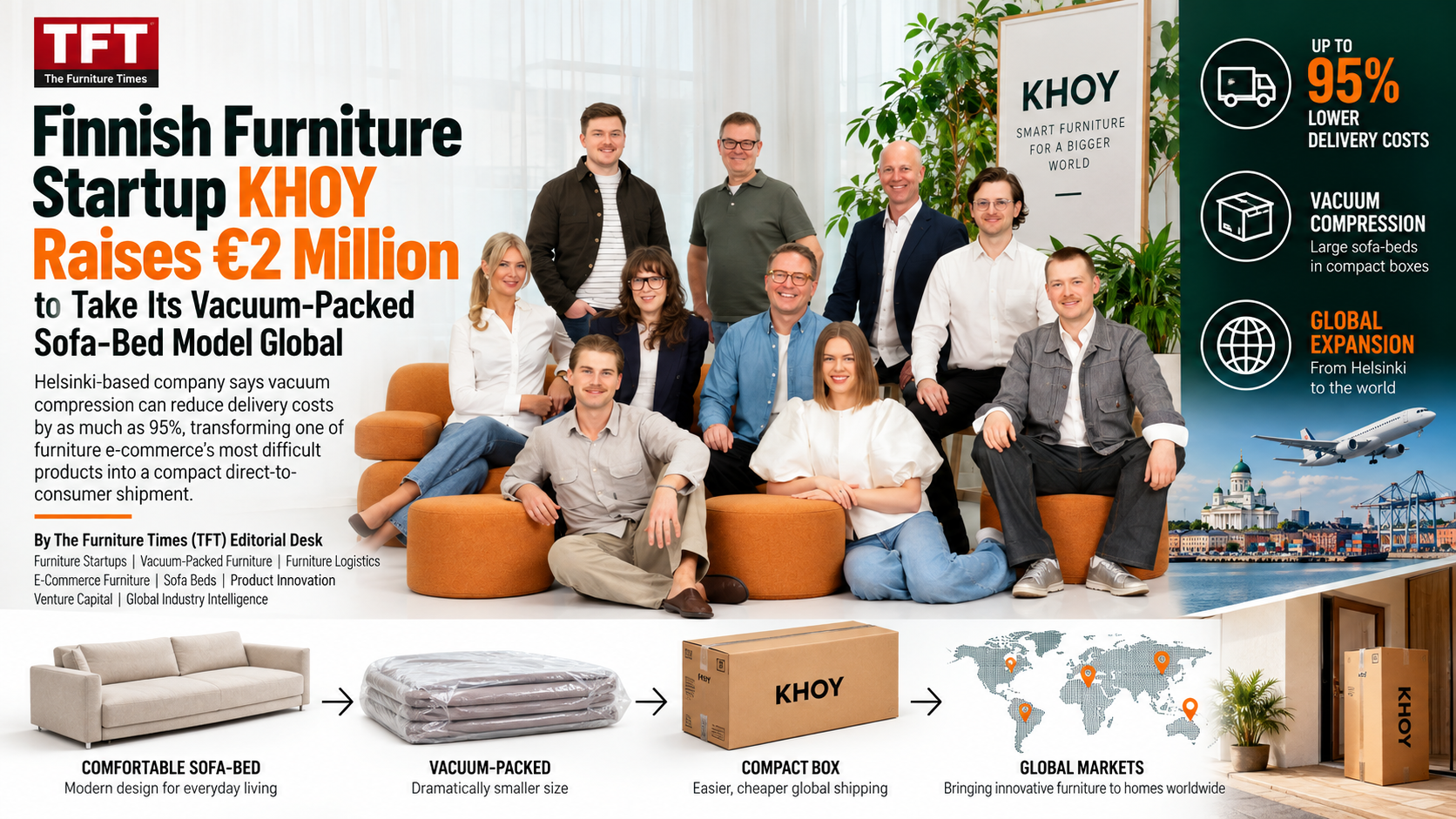
Helsinki-based company says vacuum compression can reduce delivery costs by as much as 95%, transforming one of furniture e-commerce’s most difficult products into a compact direct-to-consumer shipment
By The Furniture Times (TFT) Editorial Desk | Furniture Startups | Vacuum-Packed Furniture | Furniture Logistics | E-Commerce Furniture | Sofa Beds | Product Innovation | Venture Capital | Global Industry Intelligence
A Finnish furniture startup is attempting to solve one of the global furniture industry’s most expensive and persistent problems: how to sell, store and transport a large upholstered product without allowing logistics costs to consume the commercial margin.
Helsinki-based KHOY Company has raised €2 million in growth funding to accelerate the international expansion of its vacuum-packed sofa-bed business.
The financing round was led by Virta Equity, with participation from Innovestor and several angel investors. KHOY plans to use the new capital to strengthen its presence across existing European markets, expand in Switzerland and the United Kingdom, accelerate entry into the United States, and invest further in products, brand development and operations.
KHOY operates through a direct-to-consumer model and sells exclusively online. Its primary innovation is not simply the sofa bed itself but the relationship between product design, compression, packaging, distribution and customer assembly.
The company vacuum-packs its sofa beds into compact cardboard boxes that can be delivered directly to customers. Once unpacked at home, the compressed components expand towards their intended dimensions.
KHOY says the model can reduce delivery costs by as much as 95% compared with traditional furniture logistics. BeBeez International
If the model proves technically reliable and commercially scalable across larger international markets, it could influence far more than one Finnish furniture brand.
It could help redefine how upholstered furniture is designed for e-commerce.
From a Furniture Product to a Logistics System
Traditional furniture businesses normally begin with the product.
Designers decide how the sofa should look, how many people it should seat, what materials it should use and how comfortable it should feel. Packaging and shipping are addressed later.
KHOY’s model suggests a different approach.
The company appears to treat the sofa bed as part of an integrated commercial system:
Design → Compression → Packaging → Storage → Transportation → Delivery → Expansion → Use
Every stage affects the next.
A sofa that cannot be safely compressed cannot use the proposed packaging method. A package that remains too large cannot achieve meaningful freight savings. A compressed product that fails to recover its shape will create customer dissatisfaction. A product requiring complicated assembly will weaken the direct-to-consumer experience.
The innovation therefore depends on multiple disciplines working together:
- Furniture design
- Mattress and foam engineering
- Material science
- Compression technology
- Packaging engineering
- Warehousing
- Parcel delivery
- E-commerce
- Customer instructions
- Returns management
- Quality assurance
This is not merely furniture placed inside a smaller box. It is furniture developed around an alternative distribution model.
The Funding Round
According to the funding announcement, KHOY secured €2 million from a group led by Virta Equity and joined by Innovestor and several angel investors.
The capital is expected to support:
- Expansion across current European markets
- Growth in Switzerland
- Growth in the United Kingdom
- Accelerated entry into the United States
- New product development
- Brand investment
- Operational expansion
KHOY CEO Visa Friström said the company had demonstrated demand for a simpler way to purchase furniture online and had achieved rapid growth while building a profitable business.
The company’s ambition is to develop KHOY into a major global online brand offering European quality.
The emphasis on profitability is notable.
Furniture startups frequently require substantial capital because inventory, warehousing, customer acquisition, delivery and returns can absorb cash quickly. A company that can expand while remaining profitable may be better positioned than one relying primarily on repeated investment rounds.
However, international growth will test whether the economics established in smaller European markets can be reproduced across more distant and operationally complicated destinations.
Rapid Growth Since the First Product Launch
KHOY launched its first sofa bed in June 2024.
The company reportedly generated €4.3 million in revenue during 2025, representing thirteenfold growth from the preceding year. It says it is currently growing 166% year on year.
More than 80% of company sales reportedly come from exports.
Alongside Finland, KHOY’s largest markets in 2025 were Germany and France. The company also recorded significant sales in:
- The Netherlands
- Italy
- Belgium
- Austria
- Ireland
- Sweden
- Denmark
These figures indicate that the model has already moved beyond a single domestic-market experiment.
KHOY is testing the proposition across countries with different languages, living patterns, delivery networks, housing dimensions and consumer expectations.
Its next challenge is moving from successful cross-border European sales towards genuinely international scale.
Why Sofas Are So Difficult to Sell Online
Furniture e-commerce has expanded considerably, but large upholstered furniture remains difficult to manage.
A traditional sofa creates problems at almost every stage.
Warehousing
A sofa occupies significant space even when it is waiting to be sold.
Freight
The product may reach a container or truck’s volume limit long before reaching its weight limit.
Last-mile delivery
Large furniture may require two delivery personnel, special vehicles and scheduled delivery windows.
Building access
Narrow doors, staircases, lifts and corridors can prevent the product from reaching the intended room.
Damage
Frames, legs, arms, fabric and packaging may be damaged during repeated handling.
Failed delivery
If the customer is absent or the product does not fit through an entrance, redelivery becomes expensive.
Returns
Collecting and transporting a large opened sofa can cost a considerable proportion of the original selling price.
International scaling
A company may sell efficiently within one country but lose its margin when exporting bulky products across borders.
These problems explain why furniture remains more local than many other consumer-product industries.
Clothing, electronics and beauty products can often be stored, shipped and returned through conventional parcel networks. Sofas usually require specialist logistics.
Vacuum-packing attempts to move the sofa closer to the parcel-delivery economy.
How KHOY’s Vacuum-Packed Model Works
KHOY’s sofa beds are compressed and packed into compact cardboard boxes for direct delivery.
After the customer opens the packaging, the product expands towards its full dimensions.
The company’s design also attempts to improve the user experience of the sofa-bed category. Instead of relying on a heavy pull-out mechanism, KHOY reportedly builds the design around premium mattresses that unfold from sofa configuration into a bed.
Traditional sofa beds frequently attract complaints involving:
- Heavy mechanisms
- Difficult conversion
- Thin mattresses
- Uncomfortable bars
- Complicated assembly
- Noise
- Mechanical failure
- Excessive weight
A folding mattress-based system may eliminate some of those problems, although its long-term performance must still be evaluated through regular use.
The company is therefore addressing two related problems:
- The sofa bed can be uncomfortable or difficult to operate.
- The sofa bed is expensive and difficult to transport.
Solving only the logistics problem would be insufficient if the product were uncomfortable. Solving only the comfort problem would not necessarily support international e-commerce.
KHOY’s commercial proposition depends on addressing both.
The Claim of Up to 95% Lower Delivery Costs
KHOY says vacuum-packing can reduce its delivery costs by as much as 95% compared with traditional furniture logistics.
This is one of the most commercially significant claims in the funding announcement.
The precise saving will likely vary according to:
- Product model
- Uncompressed dimensions
- Compression ratio
- Delivery distance
- Carrier
- Parcel dimensions
- Destination country
- Rural or urban location
- Number of packages
- Local delivery tariffs
- Return rates
A 95% reduction should therefore be understood as a potential maximum within the company’s logistics model, not automatically as the saving available on every order or route.
Nevertheless, even a substantially smaller saving could be transformative.
Furniture delivery can represent a large share of the final customer price. If compression allows the same product to use standardised parcel or compact freight networks, KHOY can potentially reduce:
- Storage cost
- Warehouse footprint
- Truck capacity requirements
- International freight
- Last-mile handling
- Specialist delivery labour
- Delivery scheduling complexity
The effect extends beyond transport.
Smaller packages may allow more products to be stored within the same warehouse, more units to be loaded into a vehicle and more countries to be served from a central distribution location.
Container Efficiency Could Change Furniture Export Economics
Furniture exporters commonly calculate container capacity as carefully as manufacturing cost.
A sofa may be relatively light but occupy enormous space. This makes the industry highly sensitive to the cost of every cubic metre inside a shipping container.
Vacuum compression could allow:
- More units per container
- Lower freight cost per sofa
- Fewer containers for the same order volume
- Reduced port and handling charges per unit
- Lower warehouse occupancy
- Smaller delivery vehicles
- Fewer delivery journeys
This is particularly relevant during periods of elevated freight rates and geopolitical shipping disruption.
Conflict around the Red Sea, the Strait of Hormuz and other routes has reminded furniture companies that transport costs cannot be treated as a stable background expense.
A product engineered to require less space may remain commercially viable when freight costs rise.
That creates a form of supply-chain resilience built directly into the furniture.
Vacuum-Packed Furniture Is Not the Same as Flat-Pack Furniture
Flat-pack furniture revolutionised furniture retail by designing products that could be disassembled into boards, components and hardware for efficient transportation.
Vacuum-packed upholstered furniture follows a different principle.
Flat-pack furniture reduces volume primarily through disassembly.
Vacuum-packed furniture reduces volume primarily through compression.
The two approaches have different strengths and challenges.
| Issue | Flat-pack furniture | Vacuum-packed upholstered furniture |
|---|---|---|
| Principal method | Disassembly | Compression |
| Typical products | Tables, cabinets, beds, shelving | Sofas, mattresses, cushioned seating |
| Customer task | Mechanical assembly | Unpacking, positioning and expansion |
| Main advantage | Efficient rectangular packaging | Major reduction in soft-material volume |
| Main risk | Difficult or incorrect assembly | Incomplete recovery after compression |
| Return challenge | Can sometimes be disassembled | May not be recompressible at home |
| Material suitability | Rigid boards and frames | Foam, textiles and flexible components |
The most powerful future furniture systems may combine both methods.
A sofa could use:
- Vacuum-compressed cushions and mattress components
- Knock-down or modular frames
- Detachable legs and arms
- Flat cardboard packaging
- Tool-free assembly
Such a combination could significantly improve transport efficiency.
The Environmental Opportunity
Reducing furniture volume can potentially reduce environmental impact.
If more units fit into each truck or container, the transport footprint per product may fall.
Potential benefits include:
- Fewer vehicle journeys
- Lower fuel consumption per unit
- Reduced warehouse requirements
- Fewer shipping containers
- Less specialist-delivery activity
- Efficient distribution across multiple markets
Cardboard-based packaging may also help reduce reliance on some harder-to-recycle packaging materials, depending on the complete packaging design.
However, vacuum-packed furniture should not automatically be described as environmentally superior without a full lifecycle assessment.
The complete evaluation must include:
- Energy used during compression
- Plastic or barrier material used to maintain the vacuum
- Cardboard quantity
- Product durability
- Material composition
- Product-return rates
- Damage rates
- Delivery distance
- End-of-life management
- Whether the product can be repaired
- Whether replacement components are available
A compact product that fails early or produces high return rates may not deliver the expected environmental advantage.
The strongest sustainability case will require measured data, not compression alone.
Product Recovery Is the Central Technical Question
A vacuum-packed furniture product must recover correctly after unpacking.
Customers will expect:
- Full intended dimensions
- Consistent shape
- Correct foam firmness
- Smooth upholstery
- Stable seating
- Structural alignment
- No permanent creases
- No unpleasant residual odour
- No long-term loss of comfort
Recovery can be affected by:
- Foam formulation
- Foam density
- Compression pressure
- Compression duration
- Storage temperature
- Shipping temperature
- Humidity
- Packaging integrity
- Time held in compressed condition
A sofa stored for several days may behave differently from one compressed for several months.
International expansion can lengthen the period between compression and customer opening. Products may remain in production storage, container transit, customs clearance, regional warehouses and last-mile networks.
KHOY will therefore need robust limits for:
- Maximum compressed-storage time
- Acceptable temperature range
- Expansion period
- Customer use after unpacking
- Quality-inspection procedures
- Recovery tolerances
The compression method must remain reliable from Helsinki to Hamburg, London, New York and destinations with very different climates.
The United States Will Be a Major Test
KHOY plans to accelerate its entry into the US market.
The United States offers enormous potential because it has:
- A large furniture market
- Mature e-commerce adoption
- Significant interest in convenience
- Large short-term rental and hospitality sectors
- Frequent household mobility
- Strong demand for multifunctional furniture
Sofa beds may appeal particularly to:
- Apartment residents
- Students
- First-time homeowners
- Airbnb and short-term rental hosts
- Guest-room users
- Urban households
- Consumers requiring occasional sleeping space
But the US also presents significant challenges.
These include:
- Longer shipping distances
- State-level tax complexity
- Product-compliance expectations
- Customer-acquisition costs
- Large geographic delivery zones
- Rural surcharges
- Strong online competition
- Generous return expectations
- Product-liability exposure
- Fire-safety considerations
- Warranty servicing across a vast market
The compressed format may make delivery more economical, but customer service, returns and replacement support will determine whether that advantage translates into sustainable profitability.
Returns Are the Model’s Most Important Commercial Risk
Vacuum packing creates an obvious question:
What happens if the customer wants to return the sofa after it has expanded?
Most consumers do not have industrial compression machinery at home. Once expanded, the product may no longer fit inside its original package.
The seller may then need to arrange:
- Specialist collection
- A larger vehicle
- Alternative packaging
- Local storage
- Refurbishment
- Donation
- Resale
- Disposal
This can make the return much more expensive than the original outbound delivery.
Furniture e-commerce companies using compressed products therefore need a carefully designed return system.
Possible approaches include:
- Extensive pre-purchase measurements
- Accurate photography and video
- Fabric samples
- Comfort explanations
- Clear firmness ratings
- Augmented-reality placement
- Remote customer support
- Replacement components
- Partial refunds for minor issues
- Local collection partners
- Refurbishment networks
- Resale channels
Reducing preventable returns may be just as important as reducing delivery costs.
Product Reviews Will Be Essential
Customers cannot sit on an exclusively online sofa before purchasing it.
They depend on information.
Useful reviews should describe:
- Comfort
- Firmness
- Seating depth
- Sleeping comfort
- Expansion time
- Assembly experience
- Fabric quality
- Delivery condition
- Long-term shape retention
- Customer support
- Warranty response
Star ratings alone will not provide enough detail.
For an unfamiliar furniture technology, buyer trust will depend on credible descriptions from real users.
Independent review infrastructure can help customers understand whether the product performs as promised after:
- One day
- One month
- One year
- Repeated sofa-to-bed conversion
- Frequent guest use
This is where FurniReviewology’s broader mission becomes relevant: innovative furniture needs reviews that evaluate the entire experience, not merely its appearance on delivery day.
The Model Could Appeal to Airbnb and Homestay Operators
Vacuum-packed sofa beds may have particular relevance to Airbnb, homestay and short-term rental properties.
Hosts frequently need:
- Additional sleeping capacity
- Flexible use of small rooms
- Simple delivery
- Fast replacement
- Access through narrow apartments
- Predictable installation
- Durable upholstery
- Easy cleaning
A compact package may be easier to transport into:
- Apartment buildings
- Upper floors
- Narrow staircases
- Urban properties
- Remote vacation homes
However, short-term rentals impose heavier use than many residential environments.
Hosts must assess:
- Mattress durability
- Frame strength
- Upholstery cleaning
- Stain resistance
- Conversion simplicity
- Replacement covers
- Spare parts
- Commercial-use warranty limitations
A product convenient to deliver must still withstand repeated guest use.
Could Hotels Use Vacuum-Packed Furniture?
The model may eventually have applications beyond residential e-commerce.
Hotels and serviced apartments face substantial costs when moving furniture through completed buildings. Large sofas may be difficult to fit through lifts, corridors and guest-room entrances.
Compressed furniture could potentially reduce:
- Delivery congestion
- Installation labour
- Building-access problems
- Storage requirements
- Freight volume
- Renovation downtime
But hospitality use requires more demanding evidence.
Hotels may require:
- Fire-performance compliance
- Contract-grade textiles
- High-cycle durability
- Replaceable components
- Commercial warranties
- Consistent production across hundreds of units
- Replacement availability for several years
The commercial opportunity is meaningful, but the product must be specified for hospitality rather than assumed to be suitable because it works in residential homes.
Smaller Packaging Could Improve Access to Difficult Locations
Furniture delivery problems are not limited to cost.
Many products cannot physically reach their intended destination.
Common obstacles include:
- Narrow apartment doors
- Small lifts
- Curved staircases
- Restricted parking
- Heritage buildings
- High-rise security procedures
- Remote locations
- Island destinations
A compact box can reach places that a conventional sofa cannot.
This can expand the addressable market.
Consumers who previously avoided buying sofas online because of access concerns may become more comfortable if the product arrives in manageable packages.
The value proposition is therefore partly logistical and partly architectural.
Urbanisation is creating more compact homes and more complicated delivery environments. Furniture that adapts to those conditions may gain a competitive advantage.
International Expansion Requires More Than Translation
KHOY has already generated sales across multiple European countries, but wider internationalisation will require more than translating its website.
Each market may differ in:
- Preferred sofa dimensions
- Mattress expectations
- Seat firmness
- Fabric colours
- Interior styles
- Product terminology
- Delivery services
- Consumer law
- Warranty requirements
- Return rights
- Payment methods
- Marketing costs
- Customer-service expectations
A sofa bed suitable for a compact apartment in Paris may not automatically satisfy a customer furnishing a larger American home.
The company will need to decide whether to standardise globally or adapt selected products by market.
Too much adaptation increases complexity. Too little adaptation can weaken product-market fit.
Brand Building Will Determine Whether KHOY Becomes More Than a Packaging Innovation
Innovative logistics may attract initial attention, but a long-term furniture brand must stand for more than compression.
Customers ultimately buy:
- Comfort
- Design
- Quality
- Trust
- Service
- Durability
- Identity
Vacuum packing can help the product reach the customer. It cannot compensate for weak comfort, poor materials or inadequate service.
KHOY’s investment in its brand and product portfolio is therefore as important as its investment in international operations.
The company must create a strong answer to the question:
Why should a customer choose KHOY after competing companies adopt similar compression methods?
Potential long-term differentiators could include:
- Recognisable Nordic design
- Superior sleeping comfort
- Reliable product recovery
- Patented engineering
- Durable materials
- Washable or replaceable covers
- Strong customer reviews
- Repair support
- Transparent sustainability information
- Consistent international service
Packaging innovation may open the market. Brand trust must defend it.
Can Competitors Replicate the Model?
Vacuum compression is already well established in mattresses and selected upholstered products. The wider competitive question is what part of KHOY’s system is genuinely difficult to reproduce.
A defensible advantage could come from:
- Proprietary construction
- Material specifications
- Compression processes
- Packaging methods
- Product design
- Supplier relationships
- Brand recognition
- Customer data
- International logistics agreements
- Quality-control knowledge
- Patents or other intellectual property
If the only advantage is that the furniture fits into a smaller box, competitors may eventually offer similar products.
If KHOY has developed a complete, reliable system that balances comfort, recovery, durability, cost and delivery, replication becomes more difficult.
The company’s accumulated product and logistics knowledge may be as valuable as the visible design.
What Traditional Furniture Manufacturers Should Learn
KHOY’s funding round carries a wider lesson for established manufacturers.
The furniture industry often treats logistics as an unavoidable consequence of design.
That assumption should be challenged.
Manufacturers can ask:
- Can the product be compressed?
- Can components nest together?
- Can arms or legs be detached?
- Can the frame be modular?
- Can packaging volume be reduced?
- Can assembly become tool-free?
- Can one person receive the delivery?
- Can more units fit inside a container?
- Can damaged components be replaced individually?
- Can the product enter a narrow building?
A small improvement in packed volume can generate recurring savings across every unit sold.
The best new furniture designs may not only look better inside the home. They may travel better before reaching it.
Logistics Is Becoming a Furniture Design Discipline
Furniture education has traditionally concentrated on:
- Form
- Materials
- Ergonomics
- Craftsmanship
- Construction
- Aesthetics
The modern industry must add:
- Cubic efficiency
- Packaging
- Container loading
- Damage prevention
- Last-mile handling
- Customer assembly
- Reverse logistics
A designer who ignores transportation may create a beautiful but commercially inefficient product.
KHOY’s model demonstrates that logistics can become part of the design concept rather than a problem left to warehouse and transport teams.
This represents a significant shift in furniture innovation.
Investment Is Moving Towards Infrastructure-Solving Furniture Businesses
The €2 million round also reveals what investors may increasingly seek in furniture startups.
Traditional furniture companies are often difficult to scale because every new country can require new warehouses, delivery partners, showrooms and service infrastructure.
A product that can move through compact, standardised delivery channels may scale more efficiently.
Investors may therefore be attracted to furniture companies that solve structural problems such as:
- Bulky logistics
- Online conversion
- Returns
- Assembly
- Repair
- Replacement components
- Inventory management
- Product traceability
- Circularity
- Digital configuration
The industry’s next major companies may not win solely through style.
They may win by redesigning the infrastructure around furniture.
What the Industry Should Watch Next
KHOY’s international expansion should be evaluated through several indicators.
Revenue growth
Can the company maintain momentum as its base becomes larger?
Profitability
Does international expansion preserve the profitable model referenced by management?
Return rates
How often do customers return expanded products, and what does collection cost?
Recovery performance
Do products consistently recover their shape after long-distance storage and transport?
Product range
Can the model expand beyond its initial sofa beds?
Customer reviews
Does satisfaction remain strong after prolonged use?
US market acceptance
Can the European proposition succeed across American geography and consumer expectations?
Logistics savings
Are savings maintained after warehousing, international freight, last-mile delivery and returns are included?
Durability
Does repeated conversion between sofa and bed affect long-term comfort or structure?
Sustainability evidence
Can the company document lower lifecycle impact rather than relying only on smaller shipping volume?
These indicators will determine whether KHOY becomes a global furniture brand or remains an interesting Nordic e-commerce concept.
TFT Industry Analysis
KHOY’s €2 million funding round is relatively modest compared with the capital raised by major technology companies, but its importance to the furniture industry is not measured by the size of the investment alone.
It is important because the company is addressing a fundamental structural problem.
Furniture is difficult to globalise because it is bulky, expensive to store, costly to deliver and complicated to return. Those characteristics keep many furniture companies tied to local markets.
KHOY believes vacuum packing can change that equation.
The company’s reported performance suggests that the proposition has already found international demand:
- €4.3 million in 2025 revenue
- Thirteenfold annual growth
- Current 166% year-on-year growth
- More than 80% of sales generated through exports
- Sales across numerous European markets
These figures, reported with the funding announcement, present a promising picture. The harder test begins now.
International scaling will expose the model to longer compressed-storage periods, different climates, more complicated consumer regulations, higher customer-acquisition costs and demanding return expectations.
If KHOY manages those challenges, the implications could reach far beyond one company.
Vacuum-packed upholstered furniture could become an important new category between conventional sofas, flat-pack furniture and boxed mattresses.
The next phase of furniture e-commerce may be shaped by products designed around the dimensions of the delivery network.
The furniture company of the future may therefore ask two questions before approving a design:
Will the customer want this product?
And:
Can we move it around the world efficiently?
KHOY is betting that both questions must be answered together.