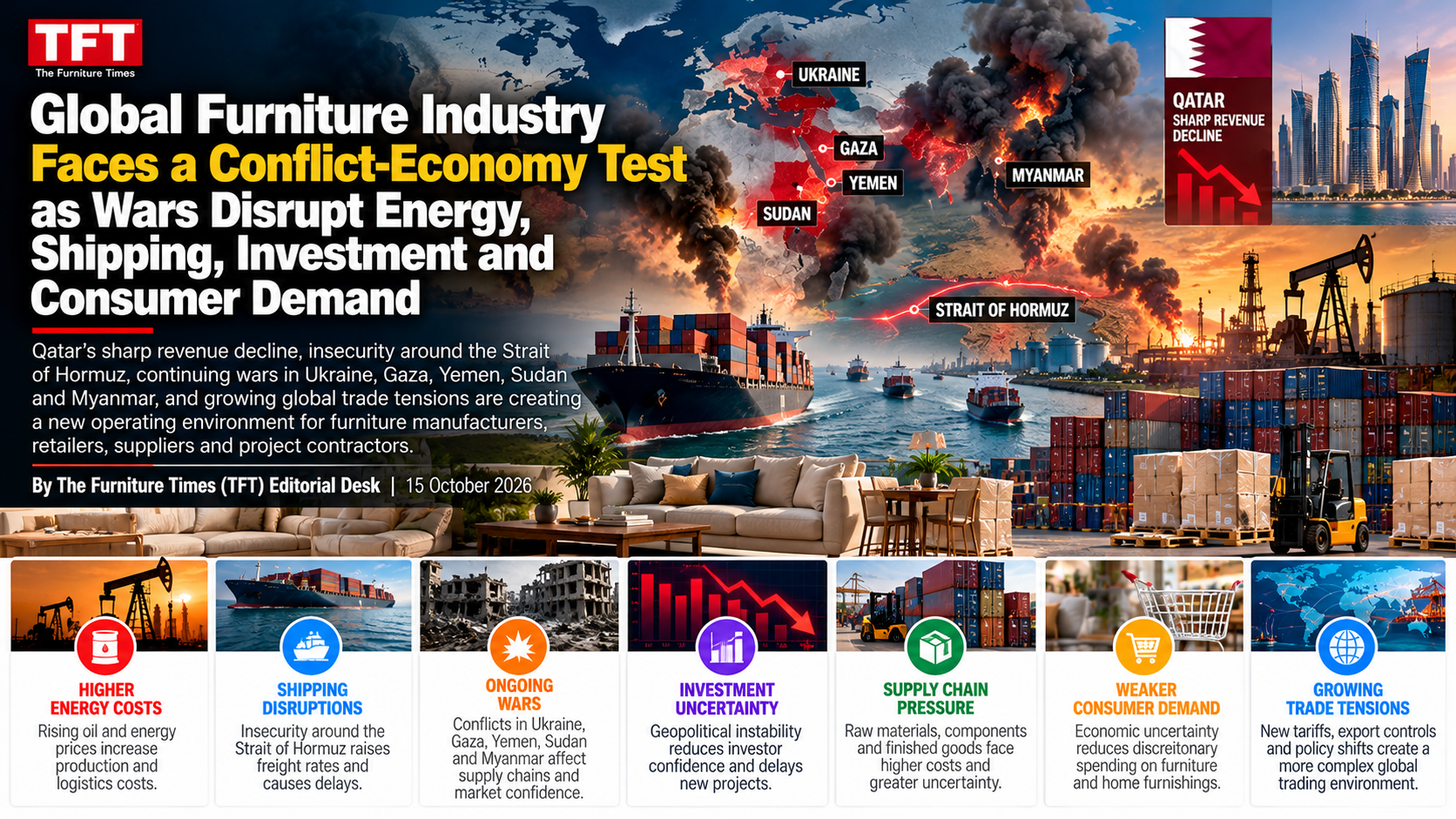
Global Furniture Industry Faces a Conflict-Economy Test as Wars Disrupt Energy
as Wars Disrupt Energy, Shipping, Investment and Consumer Demand
Qatar’s sharp revenue decline, insecurity around the Strait of Hormuz, continuing wars in Ukraine, Gaza, Yemen, Sudan and Myanmar, and growing global trade tensions are creating a new operating environment for furniture manufacturers, retailers, suppliers and project contractors
By The Furniture Times (TFT) Editorial Desk | 15 October 2026
The global furniture industry has entered one of its most complicated operating periods in recent history.
Furniture manufacturers and retailers are accustomed to responding to changing design preferences, housing cycles, material prices and consumer confidence. The present challenge is different. Businesses are being forced to manage several geopolitical, economic and logistical shocks simultaneously.
War and insecurity are affecting the Strait of Hormuz, the Red Sea, the Black Sea, Eastern Europe, the Gulf, Gaza, Yemen, Sudan, Myanmar and other regions. These conflicts are disrupting energy supplies, commercial shipping, insurance markets, construction programmes, tourism, government finances and household spending.
At the same time, furniture companies are dealing with high borrowing costs, trade restrictions, intense online price competition, labour shortages, volatile currencies, stricter sustainability requirements and weak demand in several major housing markets.
The result is not one global furniture crisis with a single cause. It is a chain of connected pressures moving from battlefields and strategic waterways into factories, showrooms, hotels, offices, homes and construction sites.
A missile strike against an energy installation can raise gas prices. Higher gas prices increase the cost of producing glass, foam, steel, aluminium, panels, adhesives and packaging. Maritime insecurity pushes up freight and insurance costs. Higher operating expenses feed inflation, interest rates and weaker consumer demand.
The furniture industry receives the consequences at almost every stage.
Qatar’s Emir Describes an Exceptional Year
The seriousness of the present economic environment was made clear on 13 October 2026 when Qatar’s Emir, Sheikh Tamim bin Hamad Al Thani, addressed the opening of the 55th session of the Shura Council.
The Emir said Qatar had faced exceptional and complex circumstances because of the regional war involving Iran. He explained that the country had attempted to protect its sovereignty, maintain economic activity, preserve its contribution to global energy security and keep diplomatic channels open.
He also reaffirmed Qatar’s intention to remain an active regional mediator and support negotiations aimed at achieving peaceful solutions.
The economic cost has nevertheless been severe.
According to figures reported from the speech, Qatar’s government revenue fell by 42% during the first half of 2026, while public expenditure was reduced by 14%. The fall in revenue was connected principally to lower liquefied natural gas exports, disruption around the Strait of Hormuz and damage to energy facilities at Ras Laffan Industrial City.
About 17% of Qatar’s LNG export capacity reportedly remains offline following damage to two export trains. Despite those pressures, the Emir said the government had chosen not to compromise essential services or abandon its development priorities.
He also announced a portfolio of projects and investment opportunities valued at approximately 221 billion Qatari riyals—about US$60.7 billion—over five years. The planned opportunities include infrastructure, public-private partnerships, real estate and hospitality.
This creates a complicated picture for the furniture industry.
Qatar faces lower hydrocarbon revenue and higher regional risk, but it is also attempting to preserve development and accelerate economic diversification. For furniture manufacturers, interior contractors and hospitality suppliers, this means the market is not simply closing. Procurement may continue, but projects are likely to face greater financial scrutiny, longer approval processes and stronger pressure to demonstrate value.
Qatar’s Furniture and Interior Market: Pressure and Opportunity Together
Qatar has developed a significant market for furniture, fit-outs and interior products through investment in hospitality, real estate, healthcare, education, retail, government buildings, sports facilities and commercial infrastructure.
Conflict-related economic pressure can affect this demand in several ways.
Government procurement may become more selective
When national revenue falls sharply, government agencies and government-linked developers are likely to examine budgets more carefully.
Projects may not necessarily be cancelled, but clients could:
- Divide developments into phases
- Delay non-essential refurbishments
- Renegotiate specifications
- Seek longer payment periods
- Prioritise locally available products
- Request more competitive tenders
- Reduce imported luxury content
- Emphasise lifecycle cost
- Require stronger performance guarantees
Furniture suppliers accustomed to high-value projects may therefore face more aggressive price negotiations and slower award decisions.
Hospitality projects face changing risk calculations
Qatar’s planned investment in hospitality and real estate creates potential demand for guest-room furniture, lobby seating, restaurant furniture, outdoor products, mattresses, wardrobes, joinery and decorative furnishings.
However, hotel investors will assess regional aviation, tourism and occupancy risks before committing capital. Conflict can reduce visitor confidence, interrupt flight schedules and delay construction materials.
Suppliers should expect clients to request:
- Flexible delivery schedules
- Local or regional inventory
- Alternative shipping routes
- Price-validity extensions
- Substitute materials
- Stronger delay clauses
- Installation contingency plans
Local production becomes strategically valuable
A market that depends heavily on imported furniture becomes vulnerable when shipping lanes, ports and airspace are disrupted.
Qatar and other Gulf countries may therefore place greater strategic importance on local assembly, upholstery, joinery, repair, refurbishment and spare-parts availability.
Local capacity cannot replace every imported product, but it can reduce exposure to international shipping delays and improve responsiveness during crises.
The Strait of Hormuz Has Become a Furniture-Industry Risk
The Strait of Hormuz is usually discussed in connection with oil and gas. Its importance to furniture is less visible but substantial.
Furniture and interior-products companies in the Gulf rely on the waterway for imports of:
- Finished furniture
- Timber and panels
- Decorative laminates
- Metal components
- Foam and upholstery materials
- Fabrics and leather
- Glass
- Lighting
- Hardware
- Mattresses
- Sanitary products
- Packaging materials
- Construction and fit-out equipment
The danger is no longer limited to energy tankers. Commercial cargo vessels have also faced attacks.
Two ships reportedly sank near the Strait of Hormuz in October after being hit by projectiles, while other vessels were attacked or damaged. Maritime risk assessments have consequently become more severe.
Ship movements through Hormuz had already declined sharply. Commodity-vessel transits fell to their lowest level in more than two months in early October, while crude-oil movements were approximately 74% of pre-war levels, according to shipping data cited by Reuters.
For furniture businesses, this creates six immediate risks:
- Delayed raw materials
Production may stop when a low-cost but essential component—such as a hinge, connector, fabric or chemical input—does not arrive. - Delayed finished furniture
Retailers and project contractors can miss handover dates when containers remain at transshipment hubs or are redirected. - Higher freight costs
Emergency routing, fuel, storage and handling expenses can turn a profitable order into a loss. - Higher marine insurance
War-risk premiums and coverage restrictions raise the cost of trading through exposed routes. - Container imbalance
Empty containers may not be returned to their usual locations, reducing availability and increasing repositioning expenses. - Contractual disputes
Buyers and suppliers may disagree over responsibility for surcharges, force majeure, storage and late delivery.
Emergency Freight Charges Are Changing the Economics of Gulf Furniture Trade
The impact can be seen in current carrier advisories.
Maersk has warned customers of longer transit times and additional transportation, handling, clearance and storage costs around the Gulf. It introduced an additional charge of US$1,000 per container for vessels transiting the Strait of Hormuz to cover risks including insurance premiums and crew compensation.
Its published emergency freight rates include US$1,800 for a 20-foot dry container, US$3,000 for a 40-foot dry container and US$3,800 for certain reefer, special and dangerous-goods containers serving affected Gulf routes. These costs can apply in addition to the Hormuz transit fee. Maersk
A 40-foot container is central to international furniture trade. It may carry sofas, dining sets, bedroom furniture, outdoor products, office furniture or project joinery.
An additional several thousand dollars must eventually be absorbed by someone:
- The manufacturer
- The exporter
- The importer
- The project contractor
- The retailer
- The property developer
- The consumer
Large companies may be able to distribute these costs across a wider sales volume. Smaller importers and independent retailers have less room to absorb them.
This is one reason conflict-related logistics inflation can accelerate industry consolidation. Bigger companies survive the volatility while smaller businesses lose liquidity.
Energy Costs Move Through Every Furniture Material
The Iran conflict and disruption to Qatar’s LNG exports affect more than fuel stations and electricity bills.
Energy is embedded throughout furniture production.
Wood-based panels
Particleboard, medium-density fibreboard and plywood require heat, electricity, resins, drying and pressing. Higher energy and chemical costs can increase panel prices.
Foam and upholstery
Polyurethane foam depends on petrochemical inputs. Fuel and feedstock disruption can influence the price of mattresses, sofas, cushions and upholstered chairs.
Plastics and synthetic materials
Outdoor furniture, storage products, woven synthetic rattan, injection-moulded chairs and furniture components depend on polymers and energy-intensive manufacturing.
Metal furniture
Steel and aluminium require substantial energy. Higher power, transport and processing costs affect table frames, chair structures, shelving, cabinets and hardware.
Glass
Glass production requires continuous high-temperature processes. Energy volatility can affect dining tables, coffee tables, cabinets, mirrors and architectural fit-outs.
Adhesives, coatings and finishes
Resins, glues, paints, lacquers, powder coatings and solvents are connected to chemical and petrochemical supply chains.
Packaging
Plastic film, foam protection, cartons and pallets become more expensive as energy and transport costs rise.
The furniture industry therefore experiences energy inflation several times: in materials, manufacturing, freight, warehousing, delivery and installation.
The Red Sea and Yemen Conflict Continue to Disturb Trade
The Strait of Hormuz is not the only strategic maritime risk.
Instability connected to Yemen and the Red Sea continues to affect ships moving between Asia, the Middle East and Europe. Attacks, threatened blockades and military escalation can force vessels to avoid normal routes or accept additional security costs.
When ships travel around the Cape of Good Hope instead of using the Red Sea and Suez Canal, the consequences can include:
- Longer voyages
- Greater fuel consumption
- Reduced vessel availability
- Higher freight rates
- Irregular schedules
- Congestion at alternative ports
- Delayed container returns
- Higher carbon emissions
Furniture is particularly sensitive to freight rates because it is bulky relative to its value. A chair, sofa or cabinet occupies considerable container space even when its manufacturing cost is moderate.
Freight increases therefore have a disproportionately large effect on furniture compared with compact, high-value products such as electronics.
The furniture industry’s traditional sourcing model—manufacture in one region, consolidate at a port and ship thousands of kilometres to the destination market—is being tested by repeated maritime disruptions.
The War in Ukraine Remains a European Industrial Problem
The Russia-Ukraine war continues to affect European production, infrastructure, energy and transport.
Recent attacks have targeted Ukrainian power and transportation systems, while the country faces pressure on fuel availability and logistics. Ukraine has become fully dependent on imported fuel after its domestic refineries were destroyed or heavily damaged, and transport delays have affected road, rail and river supply routes. reuters.com
For the furniture industry, the consequences include:
- Unreliable power for factories
- Difficulty maintaining production schedules
- Labour displacement
- Higher heating and electricity costs
- Road and rail disruption
- Reduced domestic furniture demand
- Damage to showrooms and warehouses
- Difficulty exporting manufactured goods
- Higher working-capital requirements
- Limited access to insurance and finance
Ukraine and the surrounding region have historically contributed timber, panels, metals, labour and furniture production to European supply chains.
European Solidarity Lanes now carry nearly all Ukrainian imports and about 95% of its non-agricultural exports, demonstrating how extensively trade has been redirected away from vulnerable routes. August 2026
European furniture companies outside Ukraine are also affected. They face higher energy costs, weak consumer sentiment, industrial uncertainty and competition from lower-cost imports.
At the same time, the eventual reconstruction of Ukraine will create major long-term demand for:
- Residential furniture
- School furniture
- Hospital furniture
- Office and government furniture
- Temporary housing products
- Doors, flooring and joinery
- Mattresses and bedding
- Kitchens and storage
- Repair and refurbishment services
The opportunity will be substantial, but procurement must be transparent, traceable and sensitive to the needs of displaced and affected communities.
Gaza and the Wider Israel-Palestine Conflict
Continuing violence and instability involving Gaza, Israel and the Palestinian territories have profound humanitarian consequences. The furniture industry is not the central concern in a conflict where lives, homes and essential infrastructure are being destroyed, but the industry cannot ignore its eventual responsibilities.
Large-scale damage to housing, hospitals, schools and public facilities creates future needs for:
- Emergency shelter
- Beds and mattresses
- Educational furniture
- Healthcare furniture
- Storage
- Kitchens
- Doors and windows
- Community facilities
- Recycled and repairable products
Humanitarian procurement differs from normal commercial purchasing. Products must be affordable, durable, rapidly transportable and easy to assemble.
Companies participating in reconstruction will also face serious questions about:
- Human-rights due diligence
- Sanctions and export controls
- End-user verification
- Contractor transparency
- Corruption risks
- Conflict-sensitive sourcing
- Fair allocation of contracts
Reconstruction must not become an excuse for profiteering from human suffering.
Sudan Shows the Risks Hidden Inside Material Supply Chains
Sudan’s continuing conflict has destroyed livelihoods, displaced communities and fragmented trade.
The United Nations has warned that a war economy involving territorial control, commodity trade and smuggling is helping sustain the conflict. It has called for stronger traceability and conflict-sensitive due diligence in affected supply chains. United Nations in Sudan
The furniture industry may not directly source large volumes of finished products from Sudan, but the wider lesson is important.
Materials and chemicals can pass through multiple intermediaries before reaching a furniture factory. Their original source may be difficult to identify.
Companies must ask:
- Where did the material originate?
- Who controlled the trade route?
- Did the transaction finance an armed group?
- Were workers exploited?
- Was documentation altered?
- Were sanctions or customs rules avoided?
- Can the supplier establish chain of custody?
Conflict-sensitive sourcing is becoming part of responsible furniture procurement, especially for timber, minerals, metals, leather and chemical ingredients.
Myanmar’s Conflict Threatens Workers and Regional Supply Chains
Myanmar’s humanitarian situation continued to deteriorate during the first half of 2026. UNICEF reported that 16.2 million people required humanitarian assistance and nearly 3.8 million people were internally displaced by June. United Nations in Myanmar
Myanmar has connections to regional timber, furniture, handicraft and labour supply chains.
Companies sourcing products or materials connected to conflict-affected areas face several risks:
- Worker exploitation
- Forced or unsafe labour
- Unverified timber origins
- Payment to sanctioned entities
- Currency and banking restrictions
- Transport interruption
- Factory shutdowns
- Reputational damage
- Inability to conduct inspections
- Inaccurate documentation
Low prices should never justify purchasing from supply chains that cannot provide credible evidence of lawful and responsible production.
The Global Economy Is Still Growing—but the Furniture Experience Is Uneven
The International Monetary Fund projected global growth of approximately 3.1% in 2026 while forecasting global headline inflation of 4.7%. International Monetary Fund
The World Trade Organization has reported that global merchandise trade proved more resilient than expected during the first half of 2026. It raised its forecast for merchandise-trade growth to 3.9%, partly because supply chains adapted and investment in artificial-intelligence infrastructure increased. However, the gains remain uneven across industries and regions. wto.org
This distinction is important.
Growth in semiconductors, data-centre equipment or AI-enabling goods does not automatically mean strong growth in sofas, wardrobes or dining tables.
Furniture demand depends heavily on:
- Housing transactions
- New construction
- Household formation
- Mortgage affordability
- Consumer credit
- Disposable income
- Business investment
- Hotel occupancy
- Office development
- Government projects
A country can report positive GDP growth while independent furniture stores experience falling sales.
The Complete Furniture-Industry Conflict Risk Map
| Industry area | Conflict-related pressure | Likely business consequence |
|---|---|---|
| Energy | Oil, gas and electricity volatility | Higher manufacturing and delivery costs |
| Ocean freight | Hormuz, Red Sea and Black Sea disruption | Delays, surcharges and unpredictable schedules |
| Insurance | War-risk premiums and exclusions | Higher landed cost and reduced coverage |
| Timber and panels | Trade restrictions and route disruption | Material shortages and price volatility |
| Foam and chemicals | Petrochemical inflation | Higher sofa, mattress and upholstery costs |
| Metals and glass | Energy-intensive production | Cost increases for frames, shelving and tables |
| Currency | Capital flight and national revenue pressure | Import prices change rapidly |
| Finance | Inflation and high borrowing costs | Expensive inventory and weaker investment |
| Retail demand | Consumer uncertainty | Delayed discretionary purchases |
| Construction | Project postponement and repricing | Reduced contract furniture orders |
| Hospitality | Tourism and aviation disruption | Hotel projects delayed or resized |
| Labour | Displacement and migration | Skills shortages and higher recruitment costs |
| Contracts | Force majeure and late delivery | Disputes over penalties and responsibility |
| Compliance | Sanctions and export controls | Greater legal and documentation risk |
| Product availability | Interrupted components | Incomplete production and missed delivery dates |
| Cybersecurity | Increased geopolitical cyber activity | Payment, logistics and operational disruption |
| Sustainability | Longer routes and emergency sourcing | Higher emissions and weaker traceability |
| SMEs | Limited reserves and bargaining power | Closures, layoffs and consolidation |
Cash Flow May Become the Greatest Threat to Furniture SMEs
A furniture company can be profitable on paper and still fail because it runs out of cash.
Conflict magnifies the gap between paying suppliers and collecting from customers.
A manufacturer may have to:
- Pay more for raw materials.
- Pay freight and emergency surcharges.
- Wait longer for the shipment.
- Finance inventory during the delay.
- Deliver the project late.
- Wait 60, 90 or 120 days for payment.
- Absorb a currency loss.
- Defend itself against a delay penalty.
Small companies usually have less access to affordable credit and less negotiating power with shipping lines, banks and major clients.
Businesses should calculate profitability using the latest landed cost—not a quotation prepared months earlier.
Every export and project quotation should address:
- Freight validity
- War-risk surcharges
- Currency movement
- Storage costs
- Alternative ports
- Force-majeure conditions
- Partial deliveries
- Product substitutions
- Price-adjustment clauses
- Payment milestones
An order without adequate contractual protection can become more dangerous than no order.
Retailers Face a Consumer Confidence Problem
Furniture is often a postponable purchase.
A household worried about fuel prices, employment, rent or mortgage repayments may continue using an old sofa for another year. A business uncertain about economic conditions may delay replacing desks and chairs. A hotel may refurbish only one floor rather than the entire property.
Consumers may also move toward:
- Entry-level furniture
- Smaller products
- Instalment payments
- Repair and reupholstery
- Second-hand furniture
- Multifunctional furniture
- Discount events
- Marketplace imports
Retailers must be careful not to answer every slowdown with permanent discounting. Repeated price cuts weaken margins and train customers to wait for promotions.
A stronger strategy combines:
- Clear product value
- Reliable delivery
- Honest specifications
- Warranty support
- Finance options
- Repair services
- Verified reviews
- Local availability
- Customer communication
Hospitality and Contract Furniture Face Project-Repricing Risk
Gulf countries, tourism markets and major cities continue to announce hotels, airports, healthcare facilities and urban-development projects.
However, conflict can change project economics between tender and delivery.
A furniture contractor may win an order based on:
- A particular exchange rate
- A fixed freight quotation
- An expected shipping route
- A specified imported material
- A defined installation schedule
Months later, none of those assumptions may remain valid.
Contract-furniture companies should use a formal risk register for every major project covering:
- Country risk
- Port access
- Shipping route
- Currency
- Material availability
- Insurance
- Labour mobility
- Site access
- Client payment capacity
- Political interruption
Project clients should also avoid transferring every unexpected risk to the supplier. If contractors are forced to accept unlimited liability, bids will become more expensive—or responsible suppliers will stop bidding.
Sustainability Targets Are Becoming Harder to Maintain
Conflict can undermine environmental progress.
Longer maritime routes increase fuel consumption. Emergency air freight creates significantly higher emissions. Suppliers may replace certified materials with whatever is available. Repairable products may be discarded because spare parts cannot arrive.
At the same time, governments and buyers continue to expect:
- Lower carbon emissions
- Responsible timber
- Recycled materials
- Digital product information
- Supply-chain transparency
- Take-back programmes
- Repairability
Furniture businesses should resist treating sustainability as optional during a crisis. Resource efficiency becomes even more economically valuable when materials and energy are expensive.
The strongest resilience measures often support sustainability:
- Local sourcing
- Modular construction
- Replaceable components
- Repair services
- Material optimisation
- Reusable packaging
- Refurbishment
- Regional manufacturing
What Furniture Companies Should Do Now
1. Map the entire supply chain
Businesses must know the origin and route of every critical input—not only their immediate supplier.
2. Identify single-source components
A furniture factory should not stop because one imported hinge, connector, control unit or fabric becomes unavailable.
3. Build approved alternatives
Alternative materials and suppliers should be evaluated before an emergency.
4. Review contracts
Freight surcharges, currency movements, sanctions, force majeure and storage responsibility must be clearly addressed.
5. Protect cash flow
Companies should reduce slow inventory, accelerate collections and negotiate milestone payments for large projects.
6. Strengthen local and regional sourcing
Not everything can be sourced locally, but selected components, packaging, upholstery, assembly and repair can often be regionalised.
7. Maintain customer communication
Silence during delays destroys trust. Buyers should receive accurate updates and realistic delivery estimates.
8. Invest in repairability
Spare parts, replaceable components and repair services extend product life and reduce dependence on complete replacements.
9. Verify conflict-sensitive materials
Procurement teams need stronger checks on timber, leather, metals, minerals and products passing through high-risk territories.
10. Protect visibility
Economic uncertainty is not a reason for furniture SMEs to disappear from search, media and customer communication. Businesses that remain visible are better positioned when demand returns.
TFT Calls for a Global Furniture Conflict and Supply-Chain Monitor
The furniture industry needs a dedicated intelligence system that translates geopolitical developments into practical business information.
A Global Furniture Conflict and Supply-Chain Monitor should track:
- Port closures
- Shipping-route changes
- Container surcharges
- Energy-market movements
- Material shortages
- Sanctions and export controls
- Currency risk
- Project postponements
- Furniture retail demand
- Factory shutdowns
- Labour displacement
- Reconstruction opportunities
- Product-safety and sourcing risks
General economic reports rarely explain how a conflict affects a sofa manufacturer, office-furniture contractor, timber supplier, mattress company, outdoor-furniture importer or independent retailer.
That is the intelligence gap The Furniture Times seeks to address.
The Role of TFT, FISE and FurniReviewology
The global furniture industry is a $1 trillion industry ecosystem, but it remains highly fragmented.
During periods of conflict and economic uncertainty, businesses need three things: intelligence, discovery and trust.
The Furniture Times—TFT provides industry news, analysis and visibility.
Furniture Industry Search Engine—FISE helps buyers search for and connect with manufacturers, suppliers, retailers and service providers across countries and categories.
FurniReviewology builds a structured layer of credibility through reviews, reputation and customer experience.
The Furniture Times tells their story.
FISE helps the world find them.
FurniReviewology helps the world trust them.
A diversified and searchable supplier network becomes especially important when established routes or sourcing markets are interrupted.
The Industry Outlook
The world furniture industry is not collapsing, but it is operating under extreme pressure.
Markets with strong housing, tourism, infrastructure and reconstruction demand will continue creating opportunities. Qatar’s planned investment portfolio demonstrates that development can continue even during a severe regional crisis.
However, the conditions attached to those opportunities are changing.
The successful furniture company of the conflict economy will need to be:
- Financially disciplined
- Geographically diversified
- Digitally visible
- Contractually protected
- Logistically flexible
- Energy efficient
- Transparent about sourcing
- Capable of repair and after-sales support
- Less dependent on one platform, port, country or supplier
War is no longer a remote political issue for the furniture industry. It has become a factory-cost issue, a freight issue, a retail-demand issue, an insurance issue, a project-delivery issue and a consumer-confidence issue.
Qatar’s experience offers both a warning and a strategic lesson. National reserves, economic diversification and advance preparation helped the country absorb part of the shock. Furniture businesses require the same philosophy.
Resilience cannot be created after a container is stranded, a factory loses power or a customer cancels a project. It must be built beforehand.
The industry’s immediate priorities must be clear:
Protect people. Protect cash flow. Diversify supply chains. Preserve trust. Remain visible. Prepare for recovery.
Sources:
Qatar International Media Office—Amir’s Speech at the 55th Shura Council Session
The National—Qatar’s Government Revenue Fell 42% in First Half
International Monetary Fund—World Economic Outlook, October 2026
Maersk—Red Sea, Gulf of Aden and Strait of Hormuz Situation
WTO—Global Trade Outlook, October 2026
European Commission—Ukraine Solidarity Lanes
United Nations—Sudan’s War Economy and Supply-Chain Risks
United Nations in Myanmar—UNICEF Humanitarian Situation Report