Why Furniture Reviews Matter More Than Ever in a Crowded Global Market
How Trust Signals Can Help Buyers Shortlist Suppliers and Brands
By The Furniture Times (TFT) Editorial Desk | FurniReviewology | Furniture Reviews | Buyer Trust | Supplier Discovery | FISE | SMEs & MSMEs | Global Furniture Ecosystem
The global furniture market has never offered buyers more choice.
A hotel looking for guest-room furniture can potentially identify suppliers across multiple continents.
A retailer searching for dining furniture can compare factories from established manufacturing hubs and emerging production markets.
An importer searching for outdoor furniture can discover hundreds of potential suppliers.
A consumer searching for a sofa can move between local retailers, international brands, marketplaces and direct-to-consumer businesses within minutes.
An architect can investigate suppliers from around the world without leaving the office.
More choice sounds entirely positive.
But abundance creates another problem:
How Does a Buyer Decide Which Companies Deserve Attention?
Finding furniture companies is becoming easier.
Choosing which companies to investigate can be much harder.
This is where reviews, reputation, structured company information and other trust signals increasingly enter the buying journey.
In a crowded global market, the furniture company that manufactures a good product is not automatically the company that receives the enquiry.
First, it has to become visible.
Then it has to become understandable.
Then it has to give the buyer enough confidence to investigate further.
Only then may it reach the shortlist.
The Furniture Buyer Has a Choice Problem
Imagine you are an international buyer looking for dining-chair manufacturers.
A search produces 200 possible companies.
You cannot realistically conduct factory audits on all 200.
You cannot request samples from all 200.
You cannot hold detailed meetings with all 200.
You cannot negotiate commercial terms with all 200.
You need to reduce the list.
Perhaps 200 becomes 50.
Then 50 becomes 20.
Twenty becomes 10.
Ten becomes five.
Eventually, perhaps three companies receive serious consideration.
The critical question is:
What happens during that filtering process?
Price may matter.
Product design matters.
Specifications matter.
Manufacturing capability matters.
Location may matter.
Certifications may matter.
But before much of that information is examined deeply, buyers frequently look for basic signals that help answer:
“Is this company worth investigating further?”
That is where digital reputation becomes important.
Reviews Do Not Make the Decision — They Can Influence the Shortlist
It is important not to overstate what reviews can do.
A five-star rating should never replace professional procurement.
A positive review should not replace factory verification.
A customer testimonial should not replace product testing.
A company listing should not replace due diligence.
But reviews can contribute to the preliminary research stage.
Imagine a buyer comparing two unfamiliar suppliers.
One has:
a clear company profile,
accurate business information,
genuine customer experiences,
a visible product specialization,
industry references,
and an established digital footprint.
The other has almost no information beyond its own website.
That does not prove the first company is better.
But it gives the buyer more material to evaluate.
And in a crowded marketplace, reducing uncertainty can help a company survive the first round of shortlisting.
The Real Competition May Be for Consideration
Furniture businesses often think competition begins with price.
It may begin much earlier.
Before buyers compare quotations, they decide who gets asked to quote.
Before comparing samples, they decide who receives a sample request.
Before visiting factories, they decide which factories are worth visiting.
Before negotiating, they decide who reaches the negotiating table.
That means the first competitive battle is not always:
“Can we win the order?”
It may be:
“Can We Get Onto the Shortlist?”
Digital visibility and reputation can influence that stage.
What Are Trust Signals?
A trust signal is simply a piece of information that can help someone evaluate whether a business deserves further investigation.
For a furniture company, trust signals may include:
customer reviews,
a complete company profile,
clear contact information,
consistent business details,
company history,
product information,
factory information,
project references,
certifications,
industry participation,
trade-show activity,
professional responses to customers,
news coverage,
leadership information,
and a maintained website.
No single signal proves that a business is reliable.
But several consistent signals can create a more complete picture.
Think of them as pieces of a puzzle.
One piece tells very little.
Twenty connected pieces can reveal much more.
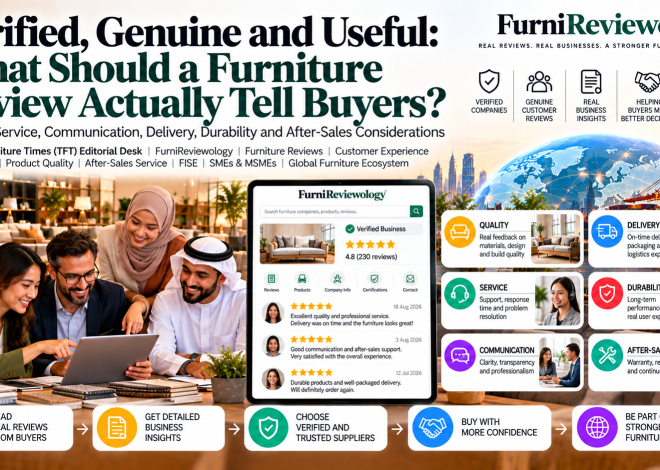
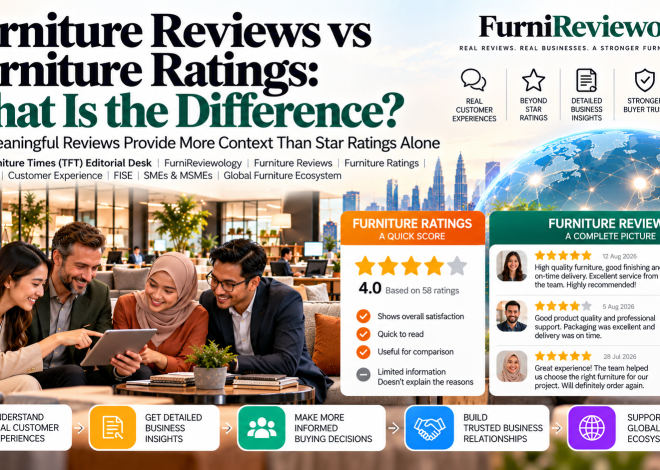
Reviews Add the Customer’s Voice
Most digital business information is created by the company itself.
A manufacturer says:
“We produce high-quality furniture.”
A retailer says:
“We provide excellent service.”
A supplier says:
“We deliver on time.”
A brand says:
“Our customers come first.”
These statements may be completely genuine.
But they remain company statements.
Reviews add another perspective:
the customer’s experience.
A customer may discuss product quality.
Another may discuss delivery.
Another may mention packaging.
Another may highlight communication.
Another may describe after-sales service.
Another may explain how the company handled a problem.
This does not make every review automatically accurate or universally representative.
But authentic customer experiences can add context that company marketing alone cannot provide.
Furniture Reviews Need More Depth Than “Good” or “Bad”
Furniture is too complex for simplistic reputation systems.
Consider a sofa.
One buyer may care about comfort.
Another about fabric quality.
Another about frame durability.
Another about delivery.
Another about assembly.
Another about value.
Now consider a hotel furniture project.
The relevant questions become completely different.
Were specifications followed?
Were samples approved correctly?
Was production consistent?
Did the company meet project deadlines?
Was installation coordinated?
Were replacements available?
How was communication handled?
Now consider an importer.
The buyer may care about:
manufacturing consistency,
quality control,
container loading,
packaging,
documentation,
lead times,
customization,
and export communication.
This is precisely why furniture benefits from an industry-specific review ecosystem.
Context matters.
A Crowded Market Makes Context More Valuable
The furniture market contains businesses of dramatically different types and sizes.
A search for “furniture supplier” could potentially surface:
a multinational brand,
an OEM factory,
a local retailer,
a trading company,
a marketplace seller,
a wholesaler,
a design studio,
or a small workshop.
These businesses cannot meaningfully be evaluated in exactly the same way.
Buyers need to understand:
Who is this company?
What does it actually do?
Which part of the furniture industry does it serve?
What experience do relevant customers have with it?
FurniReviewology’s furniture-focused approach is intended to provide more of this industry context.
The Unknown Supplier Problem
One of the greatest opportunities in the global furniture industry exists among companies buyers have never heard of.
There are thousands of capable furniture manufacturers that are not household names.
Many produce excellent products.
Some manufacture for well-known brands.
Some have decades of experience.
Some possess specialized technical knowledge.
Some offer highly competitive pricing.
Some are innovative SMEs.
The problem is discovery and confidence.
An unfamiliar company has to overcome an additional barrier:
“I don’t know you.”
A stronger digital footprint can help turn:
unknown → discoverable → understandable → researchable.
That does not guarantee an order.
But it can create an opportunity to compete.
This Is Where SMEs and MSMEs Can Gain
Large furniture brands begin with an advantage:
recognition.
Their names themselves function as trust signals.
Smaller businesses usually do not have that luxury.
An SME may manufacture an outstanding product, but the buyer may have never heard of the company.
That means SMEs and MSMEs need to make other information easier to discover.
Company profile.
Business history.
Specialization.
Products.
Projects.
Customer experiences.
Industry participation.
News.
Accurate contact information.
The objective is not to pretend to be a multinational corporation.
It is to make the genuine strengths of the business visible and researchable.
FurniReviewology Gives Furniture Reputation an Industry Context
This is one of the opportunities behind FurniReviewology.
Instead of furniture companies being scattered across generic reputation environments, FurniReviewology focuses specifically on the furniture ecosystem.
The objective is to connect:
company listings,
business profiles,
furniture categories,
customer reviews,
reputation,
and industry discovery.
For buyers, this can create another research resource.
For businesses, it creates another opportunity to establish a discoverable digital identity.
Free Listing Matters in a Crowded Market
When competition increases, visibility becomes more valuable.
Yet visibility is often expensive.
Large businesses can purchase advertising.
They can dominate exhibitions.
They can invest heavily in SEO.
They can employ public-relations agencies.
They can build large sales teams.
SMEs and MSMEs may have far smaller budgets.
That is why the opportunity for a free FurniReviewology listing matters.
It provides a starting point.
A small furniture company can establish its presence.
A manufacturer can identify its categories.
A supplier can explain what it provides.
A retailer can make itself discoverable.
An artisan can begin building a digital identity.
An MSME can start developing a searchable reputation.
You do not need to become a large corporation before you deserve to be found.
Get Listed Before the Buyer Creates the Shortlist
This is where urgency matters.
Do not wait until a buyer contacts you before thinking about reputation.
By then, the shortlist may already exist.
The buyer may have researched 30 companies and contacted only five.
If your company had little discoverable information, you may have disappeared during that research phase.
You will never receive the enquiry.
You will never know the opportunity existed.
You will never know you were considered.
This is the hidden cost of digital invisibility.
You Cannot Win an Order You Were Never Invited to Quote For.
FISE: Discovery Comes Before Reputation
Before reviews can influence a buyer, the buyer first needs to discover the company.
That is where FISE — Furniture Industry Search Engine fits into the broader ecosystem.
FISE focuses on furniture-industry search and discovery.
A buyer looking for:
outdoor furniture,
office furniture,
hospitality furniture,
residential furniture,
components,
materials,
manufacturers,
retailers,
suppliers,
designers,
or related services
needs relevant companies to become discoverable.
FISE helps address the first question:
“Who is out there?”
Then FurniReviewology can help with another:
“What can I learn about them?”
TFT Adds the Company Story
There is another type of trust signal that businesses sometimes overlook:
activity.
An active business creates developments.
New products.
Factory expansions.
Projects.
Export growth.
Certifications.
Appointments.
Partnerships.
Trade-show participation.
Technology investments.
Sustainability initiatives.
Awards.
New markets.
These developments can help buyers understand that a company is participating actively in the industry.
The Furniture Times — TFT provides the editorial and industry-intelligence layer.
It helps bring relevant furniture business developments into the global spotlight.
The three functions therefore connect naturally:
FISE helps the world find them.
The Furniture Times tells their story.
FurniReviewology helps the world trust them.
Imagine the Shortlisting Journey
A buyer needs commercial outdoor furniture.
Step 1 — Requirement
The buyer defines what is needed.
Step 2 — Search
The buyer searches for suitable suppliers.
Step 3 — Discovery
Potential companies are identified through search, FISE, referrals, exhibitions and other channels.
Step 4 — Initial Research
The buyer checks company profiles, websites, products and available information.
Step 5 — Reputation Research
The buyer looks at reviews, references and other trust signals.
Step 6 — Industry Research
The buyer investigates company developments, projects or relevant news.
Step 7 — Shortlist
A smaller number of companies remain.
Step 8 — Contact
Enquiries, RFQs or sample requests are sent.
Step 9 — Due Diligence
Capabilities, certifications, samples, factories, commercial terms and other requirements are verified.
Step 10 — Decision
The buyer makes the commercial choice.
Notice where digital reputation operates.
Before the order.
Before negotiation.
Often, even before contact.
That is why reviews matter.
Good Reviews Cannot Rescue a Bad Business Forever
Furniture companies should also understand something important.
Review platforms should not be treated as shortcuts around operational quality.
If products are poor, reviews will eventually reflect it.
If service is consistently weak, customers will notice.
If delivery repeatedly fails, reputation will suffer.
If complaints are ignored, buyers can learn from those experiences.
The best reputation strategy therefore remains surprisingly traditional:
Make good products.
Communicate clearly.
Deliver what you promise.
Solve problems professionally.
Treat customers fairly.
Then encourage genuine customers to share genuine experiences.
Digital reputation should amplify operational quality—not attempt to replace it.
Don’t Fear Every Critical Review
A healthy reputation does not necessarily mean every customer gives five stars.
Business is complicated.
Expectations differ.
Problems occur.
A credible review ecosystem should allow genuine experiences to be expressed.
What matters is how companies respond.
A thoughtful response to criticism can show future buyers that the business listens.
A resolved complaint can demonstrate after-sales capability.
A repeated complaint can identify an internal problem that management needs to address.
Reviews therefore create value in two directions:
buyers learn about companies,
and
companies learn from customers.
The AI Shortlist Is Coming
The next stage of supplier discovery may make digital reputation even more important.
Buyers are increasingly able to ask AI:
“Find ten hotel furniture manufacturers.”
“Suggest outdoor furniture suppliers for resort projects.”
“Find office furniture manufacturers serving commercial buyers.”
“Which furniture companies specialize in sustainable materials?”
AI systems may increasingly participate in the discovery and research process.
That means businesses need digital information that machines can understand.
Clear company identities.
Relevant categories.
Structured information.
Consistent descriptions.
Product information.
Industry references.
Reviews.
News.
A furniture company that is difficult for search engines and AI systems to understand may become harder for tomorrow’s buyers to discover.
Reputation Is Becoming a Searchable Business Asset
Furniture companies traditionally considered assets to be:
factories,
machinery,
showrooms,
inventory,
designs,
customer databases,
distribution networks,
and intellectual property.
The digital economy adds another:
reputation.
A searchable reputation can continue working when your sales team is asleep.
A buyer on another continent can research your company.
A designer can discover your specialization.
An importer can examine your profile.
A retailer can investigate customer experiences.
A procurement professional can decide whether you deserve further consideration.
That makes reputation more than a marketing issue.
It becomes part of business infrastructure.
The Furniture Market Will Only Become More Competitive
Global furniture competition is unlikely to become simpler.
Manufacturing capabilities continue expanding.
New brands are emerging.
E-commerce reduces geographic boundaries.
Digital marketplaces expose buyers to more suppliers.
AI improves discovery.
Consumers compare more options.
Professional buyers have access to more information.
That means companies cannot depend entirely on:
“We make good furniture.”
Quality remains essential.
But buyers must first discover that quality.
Then they need reasons to investigate it.
Then the company must prove it.
Visibility creates the opportunity.
Reputation supports consideration.
Performance ultimately earns the business.
Don’t Let Your Best Competitor Be the One Who Is Simply Easier to Research
Your competitor may not manufacture better furniture.
It may not have more experience.
It may not offer better service.
It may simply be:
easier to find,
easier to understand,
easier to research,
and easier to shortlist.
That is a competitive problem you can address.
Build your company profile.
Strengthen your digital presence.
Encourage genuine customer reviews.
Maintain accurate information.
Become searchable through FISE.
Share meaningful developments with TFT.
Participate in FurniReviewology.
Do not leave your reputation trapped inside your existing customer network.
Get Onto the Shortlist Before You Try to Win the Order
Every furniture company wants orders.
But orders happen at the end of a much longer process.
Before the order comes discovery.
Before negotiation comes consideration.
Before consideration comes research.
Before research comes visibility.
That is why furniture reviews matter more than ever.
They are part of a broader collection of trust signals that can help buyers decide:
“This company deserves a closer look.”
For an SME or MSME competing against hundreds of suppliers, earning that closer look can be the beginning of a major opportunity.
So do not wait.
Get listed.
Get found.
Build your profile.
Encourage genuine reviews.
Tell your story.
Build your searchable reputation.
Earn your place on the shortlist.
Because in a crowded global furniture market, the first victory may not be winning the order.
It May Be Getting the Opportunity to Compete for It.
The Global Furniture Ecosystem
The Furniture Industry is a $1 Trillion USD Ecosystem in the world
Furniture Industry Search Engine – FISE helps the world find them.
The Furniture Times – TFT tells their story.
FurniReviewology helps the world trust them.