Voice-Controlled Lighting Technologies
By The Furniture Times (TFT) | Indoor & Outdoor Lighting | Smart Lighting & AI
Voice-Controlled Lighting Is Changing the Way We Live, Work, and Experience Modern Spaces
There was a time when switching on a light meant walking to the nearest wall switch. Today, a simple phrase like “Turn on the living room lights” or “Dim the dining lights to 40%” can instantly transform an entire space.
This shift may appear small, but it represents one of the biggest changes in how people interact with their homes, workplaces, hotels, and public spaces.
Voice-controlled lighting is no longer a luxury reserved for technology enthusiasts. It is becoming a standard feature in modern living because people increasingly expect their homes to respond naturally to them. Instead of adapting to technology, technology is learning to adapt to people.
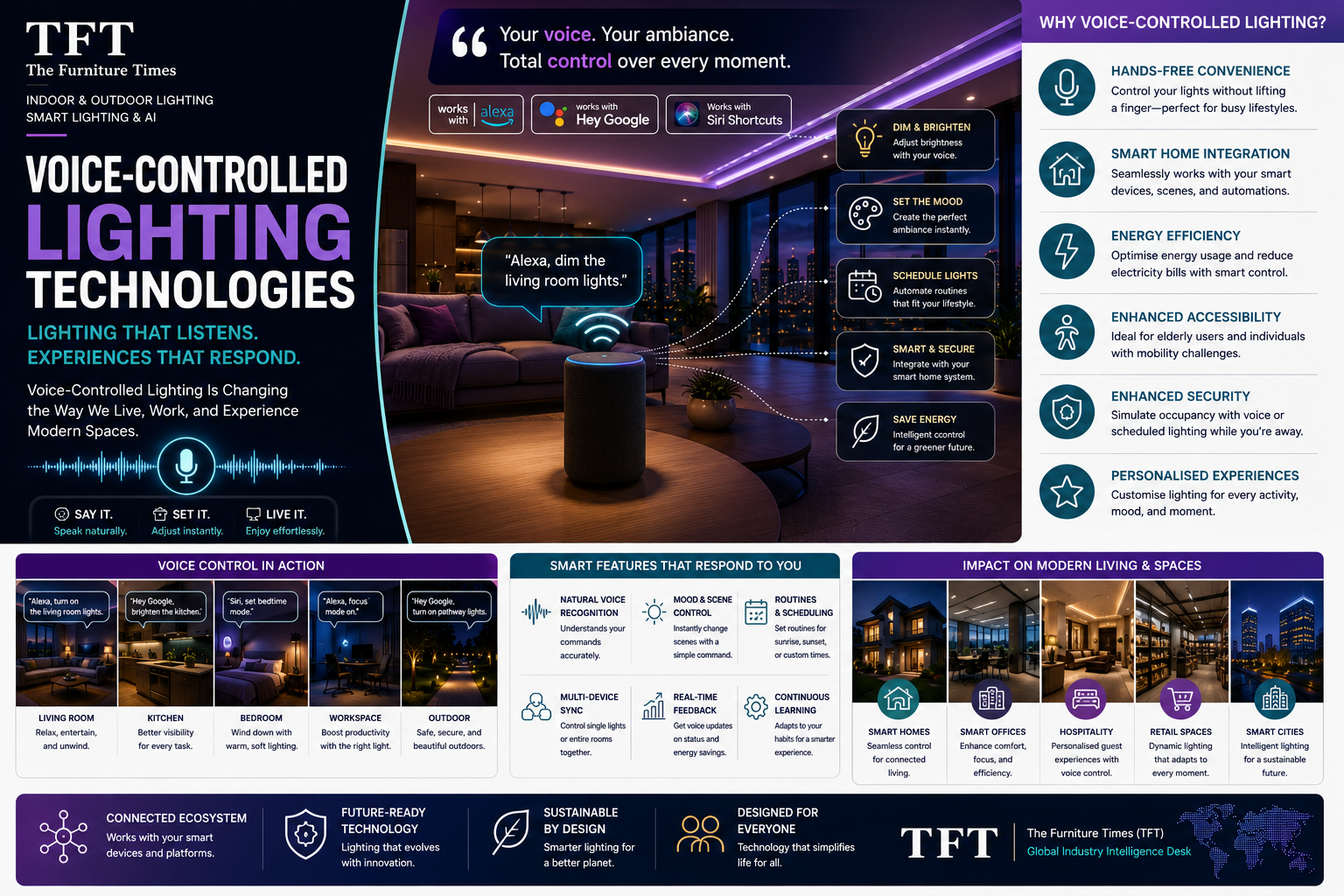
Powered by Artificial Intelligence (AI), voice recognition, cloud computing, and the Internet of Things (IoT), voice-controlled lighting allows users to manage illumination through simple spoken commands. Behind every command lies a connected ecosystem of smart devices, intelligent software, wireless communication, and automated decision-making.
For the global furniture industry ecosystem, this transformation extends far beyond lighting. It is reshaping furniture design, interior architecture, hospitality, property development, home automation, retail experiences, and even the expectations consumers have when purchasing homes and furnishings.
As smart living becomes the new normal, voice-controlled lighting is emerging as one of the technologies that makes modern life simpler, safer, more energy-efficient, and remarkably more personal.
People No Longer Want Smart Devices—They Want Smart Experiences
Consumers today are surrounded by technology.
Smartphones, televisions, appliances, security systems, and home assistants have changed expectations. People no longer want dozens of separate controls—they want everything to work together effortlessly.
Voice-controlled lighting delivers exactly that.
Instead of searching for switches or opening mobile applications, homeowners can simply speak naturally.
Imagine arriving home carrying groceries.
Instead of putting everything down to find a switch, you simply say:
“Turn on the entrance lights.”
Or imagine preparing for a movie night.
One sentence—
“Movie mode.”
—and the lights dim, decorative LEDs glow softly, and the room instantly changes its atmosphere.
Technology disappears into the background, allowing people to enjoy the experience rather than operate the system.
Homes Are Becoming More Human-Centred
The next generation of homes is being designed around people rather than technology.
Voice-controlled lighting improves everyday living by making homes more intuitive.
Residents can easily:
- Turn lights on or off
- Adjust brightness
- Change colour temperatures
- Activate lighting scenes
- Control multiple rooms
- Schedule routines
- Manage outdoor lighting
- Operate lighting remotely
- Reduce energy consumption
- Personalise every room
The result is a home that feels responsive rather than mechanical.
Accessibility Is Driving Global Adoption
One of the greatest strengths of voice-controlled lighting is its ability to improve accessibility.
For older adults, individuals with limited mobility, people recovering from injuries, or anyone carrying children or heavy objects, voice commands remove unnecessary physical effort.
Lighting becomes available without reaching for switches, climbing stairs, or navigating dark spaces.
This simple innovation helps create homes that are more inclusive and independent for people of all ages.
As populations continue to age across many countries, accessible smart home technology will become increasingly important.
Furniture Is Becoming Part of the Conversation
Furniture manufacturers are entering a completely new era.
Lighting is no longer separate from furniture—it is becoming part of it.
Modern products increasingly include:
- Smart wardrobes with voice-controlled lighting
- Kitchen cabinets that illuminate automatically
- LED-integrated shelving
- Voice-activated mirrors
- Smart bedside tables
- Home office desks
- Entertainment units
- Display cabinets
- Walk-in wardrobes
- Decorative furniture lighting
Consumers no longer purchase furniture based only on appearance.
They increasingly ask:
“Can it connect with my smart home?”
That question is changing product development across the furniture industry.
Hospitality Is Delivering More Personalised Guest Experiences
Hotels have recognised that convenience creates memorable experiences.
Voice-controlled lighting enables guests to customise their environment without learning unfamiliar control systems.
Guests can simply request:
- Relaxation lighting
- Reading mode
- Wake-up lighting
- Night lighting
- Bathroom lighting
- Balcony lighting
- Dining ambience
- Entertainment scenes
- Sleep mode
- Energy-saving mode
Luxury hospitality is becoming less about expensive decoration and more about effortless comfort.
Offices Are Becoming More Efficient
Modern workplaces are evolving rapidly.
Voice-controlled lighting supports employees by creating spaces that adapt throughout the working day.
Meeting rooms, collaborative spaces, executive offices, reception areas, and training facilities can all respond instantly to voice commands.
Instead of interrupting meetings to adjust lighting manually, teams can focus on conversations while technology quietly manages the environment.
Artificial Intelligence Makes Every Command Smarter
Voice recognition alone is impressive.
When combined with Artificial Intelligence, it becomes transformative.
AI allows lighting systems to:
- Learn household routines.
- Recognise frequently used commands.
- Predict preferred lighting scenes.
- Adapt to seasons.
- Respond to weather.
- Improve energy efficiency.
- Coordinate with security systems.
- Integrate with calendars.
- Optimise lighting schedules.
- Continuously improve performance.
The more the system is used, the more intelligently it responds.
Sustainability Is Built Into Smart Lighting
Voice-controlled lighting is not only about convenience—it also contributes to sustainability.
Smart systems help reduce unnecessary electricity consumption by ensuring lights operate only when required.
Benefits include:
- Lower energy bills
- Reduced carbon emissions
- Longer LED lifespan
- Efficient scheduling
- Reduced waste
- Better resource management
- Renewable energy compatibility
- Smarter electricity consumption
- Improved environmental performance
- Sustainable home operation
Technology and sustainability are increasingly working hand in hand.
Opportunities Across the Furniture Industry Ecosystem
Voice-controlled lighting is creating exciting opportunities for:
- Furniture manufacturers
- Lighting companies
- Interior designers
- Architects
- Residential developers
- Hospitality operators
- Smart home technology providers
- Retailers
- E-commerce businesses
- Home automation startups
Companies that integrate lighting, furniture, AI, and connected technologies into unified customer experiences will stand out in increasingly competitive global markets.
Challenges Still Remain
As adoption continues, the industry must also address several important challenges.
These include:
- Consumer education
- Device compatibility
- Privacy concerns
- Cybersecurity
- Internet reliability
- Installation complexity
- Product standardisation
- Upgrading older homes
- Software maintenance
- Skilled workforce availability
Solving these challenges will help accelerate mainstream adoption worldwide.
The Future Will Listen Before It Responds
The next generation of lighting systems will move beyond simple voice commands.
Future technologies may understand emotion, recognise context, anticipate routines, and automatically adjust environments before users even ask.
Lighting may respond differently depending on whether someone is working, relaxing, entertaining guests, or preparing to sleep.
Rather than reacting to instructions, lighting will become an intelligent companion that quietly supports everyday life.
More Than a New Way to Turn On the Lights
Voice-controlled lighting represents something much bigger than convenience.
It reflects a global movement towards homes and workplaces that are intuitive, connected, energy-efficient, and designed around human needs.
For the global furniture industry ecosystem, this technology opens enormous possibilities to create smarter products, richer customer experiences, stronger sustainability outcomes, and entirely new business opportunities.
Manufacturers, designers, retailers, architects, hospitality brands, and technology companies that embrace voice-enabled living today will help define the homes, offices, hotels, and public spaces of tomorrow.
The future of lighting is no longer about switches.
It is about conversations.
And those conversations are only just beginning.
The Furniture Times (TFT) & Furniture Industry Search Engine (FISE)
“TFT tells their story. FISE helps the world find them.” “FurniReviewology helps the world trust them.”
The furniture industry ecosystem is a $1 trillion industry.