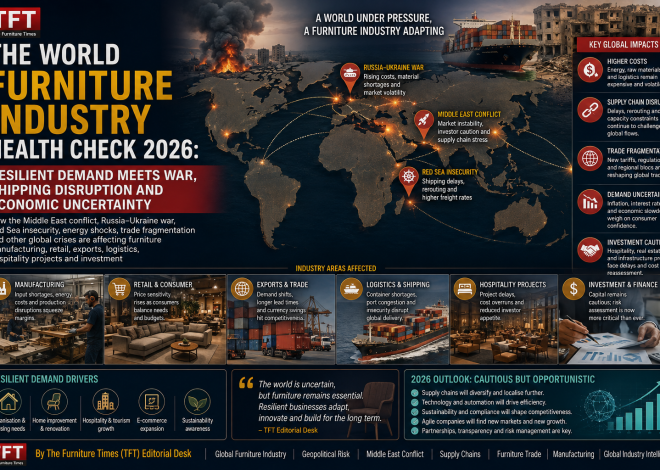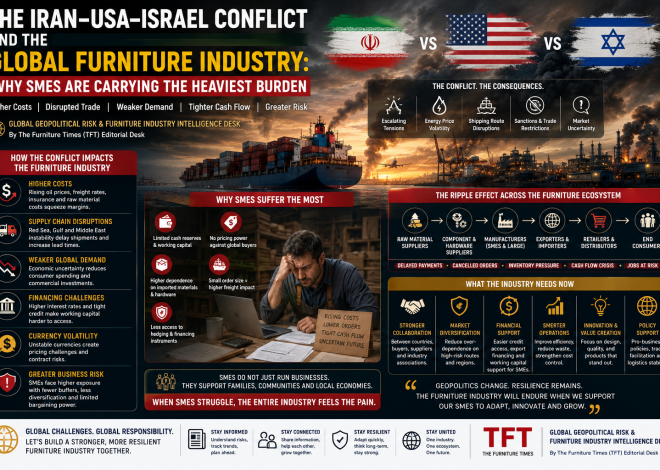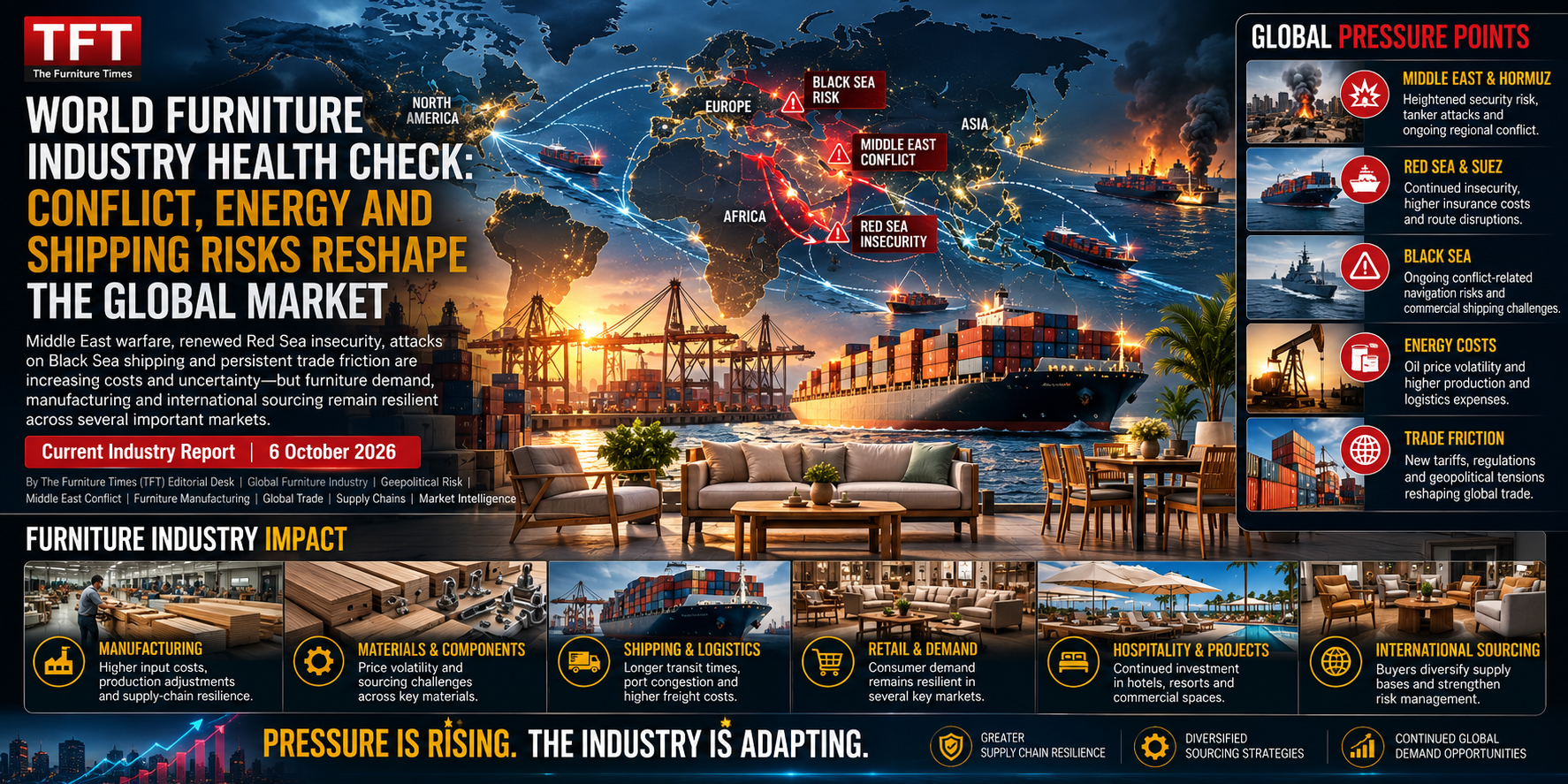
World Furniture Industry Health Check: Conflict, Energy and Shipping Risks Reshape the Global Market
Middle East warfare, renewed Red Sea insecurity, attacks on Black Sea shipping and persistent trade friction are increasing costs and uncertainty—but furniture demand, manufacturing and international sourcing remain resilient across several important markets
By The Furniture Times (TFT) Editorial Desk | Global Furniture Industry | Geopolitical Risk | Middle East Conflict | Furniture Manufacturing | Global Trade | Supply Chains | Market Intelligence
Current Industry Report | 6 October 2026
The global furniture industry enters the final quarter of 2026 in a condition that can best be described as resilient but increasingly exposed.
Furniture factories continue producing. International buyers continue sourcing. New hotels, residential developments, workplaces and tourism projects still require furnishings. Trade exhibitions are attracting buyers, Southeast Asian furniture exports remain active, American furniture retail sales have returned to modest growth, and parts of the European market are showing signs of stabilisation.
Yet beneath that activity, the industry is carrying substantially higher geopolitical, energy, shipping and financial risk.
The continuing United States–Israel conflict with Iran, the renewed war in Yemen, attacks on commercial vessels around the Strait of Hormuz, insecurity in the Red Sea, and intensifying strikes on Black Sea ports have created a dangerous environment for global commerce.
The conflict is no longer affecting the furniture industry only through crude-oil prices.
It is now affecting the sector through:
- Diesel shortages
- Marine fuel costs
- Tanker availability
- War-risk insurance
- Container freight
- Port congestion
- Longer transit times
- Petrochemical prices
- Manufacturing energy costs
- Consumer inflation
- Project delays
- Business confidence
- Working-capital requirements
The industry is not facing a global shutdown. It is facing something more complex: an operating environment in which goods continue moving, but at higher cost and with less certainty.
For furniture manufacturers, exporters, retailers and project suppliers, the central issue is no longer simply whether demand exists.
The central question is:
Can furniture companies deliver the right product, at the agreed price, within a reliable timetable, while shipping routes, energy markets and customer confidence remain unstable?
Executive Health Assessment
| Industry area | Current condition | TFT assessment |
|---|---|---|
| Global furniture demand | Continuing but uneven across countries and categories | Cautiously stable |
| Residential furniture | Supported by replacement demand but constrained by housing affordability | Mixed |
| Hospitality furniture | Strong long-term pipeline, especially in tourism markets | Positive but exposed |
| Office furniture | Selective demand from refurbishment and workplace redesign | Stable |
| Outdoor furniture | Structurally supported but sensitive to consumer confidence | Mixed |
| Furniture manufacturing | Production continues, but input and energy costs are rising | Resilient under pressure |
| International trade | Active despite war, tariffs and logistics disruption | Vulnerable |
| Container freight | Elevated and unpredictable | Stressed |
| Intra-Asian freight | At record levels on Drewry’s index | High risk |
| Middle East furniture market | Long-term potential remains substantial | Immediate high risk |
| European furniture production | Below earlier levels despite modest market improvement | Fragile |
| North American furniture retail | Returned to modest year-on-year growth | Improving |
| Southeast Asian furniture exports | Active and internationally competitive | Relatively strong |
| Furniture-sector profitability | Pressured by costs and weak pricing power | Weak |
| Industry confidence | Limited by repeated geopolitical shocks | Cautious |
| Long-term furniture requirement | Supported by housing, urbanisation, tourism and replacement | Positive |
The overall industry health rating is therefore:
Demand: stable but selective
Production: active but margin-pressured
Trade: functional but fragile
Logistics: highly exposed
Long-term outlook: positive
Short-term risk: elevated
The Middle East Conflict Has Entered a New Phase
Earlier in 2026, the principal fear was that disruption in the Strait of Hormuz would create a severe shortage of crude oil.
By early October, crude flows had recovered substantially—but the danger had not disappeared.
Reuters reported that Middle Eastern crude exports exceeded pre-war levels on several days in September, with the regional average reaching approximately 18.3 million barrels per day. However, at least seven attacks on tankers were reported during the first week of October, demonstrating that the restoration of cargo volumes has not restored maritime security. reuters.com
Another Reuters analysis estimated that flows through the Strait had recovered to around 14.2 million barrels per day, approximately 80% of pre-war levels. But the energy market’s main problem has shifted from the availability of crude to the logistics of transporting and refining it. Tanker costs, insurance, damaged refining capacity and diesel scarcity are keeping energy expenses elevated. reuters.com
This distinction matters enormously to furniture companies.
A factory does not operate directly on barrels of crude oil. It depends on electricity, diesel, transport, chemicals, packaging and manufactured materials.
Furniture businesses may therefore receive reassuring news that crude exports are recovering while continuing to face higher costs for:
- Trucking
- Container transport
- Factory generators
- Foam
- Synthetic textiles
- Plastic components
- Adhesives
- coatings
- Packaging
- Air freight
- Installation vehicles
The recovery of crude volume is not the same as the normalisation of the furniture supply chain.
The Diesel Crisis Is Becoming a Furniture Cost Crisis
Diesel is one of the most important but under-discussed inputs in the furniture economy.
It powers or supports:
- Timber transportation
- Factory logistics
- Port operations
- Container handling
- Warehousing
- Delivery vehicles
- Installation teams
- Construction sites
- Backup generators
- Agricultural and forestry machinery
The global shortage of refined fuels has become particularly important because refineries in the Middle East and Russia have been damaged or disrupted.
Crude oil may be available, but it must still be refined into diesel and transported to the markets that need it.
When diesel prices rise, the cost increase travels through almost every stage of the furniture supply chain:
Forest or raw material → component supplier → furniture factory → warehouse → port → distribution centre → retailer → final customer
A furniture company may not see “diesel” as a separate line in its bill of materials, yet diesel is embedded in the delivered cost of almost everything it purchases.
This pressure is particularly serious for bulky furniture because each product may require multiple handling and transport stages.
Why Hormuz Still Matters Even When Ships Are Moving
The Strait of Hormuz remains one of the most strategically important maritime passages in the world.
Commercial vessels have resumed or increased some movements, including Qatari liquefied natural gas cargoes. But continued attacks and political restrictions mean the route cannot yet be considered fully reopened or commercially normal. reuters.com
The furniture industry is affected through three main channels.
Energy
The region supplies a major share of globally traded oil and gas. Disruption affects electricity, manufacturing and transport costs worldwide.
Petrochemicals
Many furniture inputs depend on petrochemical feedstocks, including:
- Polyurethane foam
- Polyester fabric
- Synthetic rattan
- Artificial leather
- Polypropylene chairs
- Polyethylene packaging
- Plastic hardware
- Adhesives
- Paints and coatings
Maritime insurance
Ships entering conflict-exposed areas may face higher war-risk premiums. Those costs can be transferred through freight contracts and eventually into product prices.
Even furniture manufactured in Malaysia, Vietnam, China, India or Europe can therefore become more expensive because of events in the Gulf.
Red Sea and Yemen Escalation Create a Second Maritime Threat
The furniture industry is not dealing with only one Middle Eastern chokepoint.
The renewed escalation in Yemen has increased risk around the Bab el-Mandeb Strait, which connects the Red Sea with the Gulf of Aden.
Saudi-backed Yemeni government forces reported territorial gains along the Bab el-Mandeb coastline in early October, while Houthi forces continued missile and drone activity. Renewed warfare has increased the danger to commercial traffic and widened the regional conflict. reuters.com
This route is vital for Asia–Europe commerce.
Furniture shipped from China, Vietnam, Malaysia, Indonesia and India to Europe normally benefits from passage through the Red Sea and Suez Canal. If vessels avoid the area and travel around the Cape of Good Hope, consequences can include:
- Longer voyages
- Additional fuel consumption
- Higher freight rates
- Reduced vessel availability
- More inventory tied up in transit
- Uncertain arrival schedules
- Additional emissions
- Greater risk of port congestion
Furniture is more vulnerable than many compact, high-value products because it occupies substantial container space.
A shipping increase of several hundred dollars per container may be manageable for electronics with high value per cubic metre. The same increase can materially change the commercial viability of sofas, wardrobes, dining sets, mattresses or outdoor furniture.
Container Freight Remains Elevated
Drewry’s World Container Index stood at US$4,434 per 40-foot container on 1 October 2026. Although the global composite declined by 1% during the week, the overall rate remained elevated. 01 Oct
The more concerning signal for Asian furniture companies is within regional trade.
Drewry’s Intra-Asia Container Index rose to an all-time high of US$1,518 per 40-foot container on 1 October—its sixth consecutive weekly record. Typhoon disruption, port congestion, blank sailings, port omissions and higher operating costs all contributed. 01 Oct
This matters because furniture production is rarely contained within one country.
A manufacturer may source:
- Fabric from China
- Foam chemicals from South Korea
- Hardware from Guangdong
- Timber from Malaysia or Indonesia
- Mechanisms from another Asian supplier
- Packaging from a domestic factory
- Finished assembly in Vietnam
A product does not have to be exported outside Asia to experience freight inflation. Rising intra-Asian rates can increase its cost before it reaches the final export container.
The Russia–Ukraine War Is Creating a Parallel Logistics Crisis
The Russia–Ukraine war continues to affect energy, commodities, European confidence and Black Sea shipping.
In early October, Russia said it had struck two Ukrainian cargo vessels in the Black Sea. Separate attacks targeted industrial and port infrastructure in Ukraine’s Odesa region, while a commercial vessel caught fire and sank outside Romanian territorial waters in an incident Ukraine attributed to Russian drones. reuters.com
The immediate targets may not be furniture cargoes, but the effect extends across commercial shipping.
Attacks on ports and vessels can lead to:
- Higher war-risk insurance
- Reduced carrier willingness
- Alternative routing
- Port congestion
- Lower vessel availability
- More expensive commodities
- Delayed raw-material shipments
The Black Sea is particularly important for grain, energy and industrial commodities. Disruption contributes to inflation in food and fuel, leaving households with less discretionary income for furniture.
Conflict therefore reaches the furniture market through both supply and demand:
- Manufacturers pay more for energy and transport.
- Consumers have less money available for furniture purchases.
European Furniture Manufacturing Remains Fragile
Europe’s furniture industry entered the conflict environment with structural pressure already visible.
The region retains major strengths in:
- Design
- Machinery
- Upholstery
- Kitchen furniture
- Office furniture
- Luxury furniture
- Contract manufacturing
- Sustainable production
- Skilled craftsmanship
Yet production volumes remain under pressure.
Recent European furniture indicators point to modest improvement in market conditions through July 2026, but manufacturing performance has been weaker than retail activity. EU furniture exports to markets outside the region declined by 5.9% during the latest six-month reporting period, while producer prices remained under upward pressure. October 2026
European manufacturers now face a difficult combination:
- Weak or cautious residential demand
- High energy costs
- Wage pressure
- Regulatory costs
- Import competition
- Export weakness
- Shipping uncertainty
- Expensive finance
The European market is not collapsing. It is stabilising from a weak base.
Companies with original design, recognised brands, contract expertise and premium positioning may remain strong. Manufacturers competing mainly through price face more difficulty because lower-cost producing countries can often absorb or offset costs more effectively.
The United States Is Showing Limited Furniture-Retail Improvement
The American furniture market offers one of the more encouraging signals.
US furniture and home-furnishings store sales reached an adjusted estimate of approximately US$11.4 billion in August 2026, representing a 1.9% increase from August 2025. However, cumulative sales for the first eight months remained approximately 1.6% below the previous year’s pace. Furniture Today
The monthly improvement suggests that demand has not disappeared.
But the wider picture remains cautious because the market continues to face:
- High housing costs
- Mortgage-rate pressure
- Limited home transactions
- Consumer debt
- Import inflation
- Tariff uncertainty
- Freight costs
- Weak confidence
Industry reporting also indicates that performance differs by segment, with higher and middle-market furniture outperforming parts of the low end, while upholstery has performed better than case goods in some areas. smith-leonard.com
This fragmentation is important.
The market cannot be described simply as “up” or “down.” Different furniture categories, income groups and retailers are moving in different directions.
Why Housing Still Controls Residential Furniture Demand
Furniture demand is strongly connected to housing activity.
People often purchase furniture when they:
- Buy a home
- Move into a rental
- Renovate
- Form a household
- Welcome a child
- Create a home office
- Replace damaged products
When mortgage rates are high and homeowners remain in existing properties, fewer housing transactions occur. This reduces the number of natural furniture-purchasing events.
A sofa may still need replacing, but the customer may postpone that decision if food, fuel, housing and borrowing costs are rising.
The present conflict environment creates another reason to delay discretionary purchases.
Retailers must therefore compete for a smaller pool of immediate demand through:
- Better value
- Financing
- Fast delivery
- Clear warranties
- Repair support
- Stronger digital presentation
- Trustworthy reviews
- Distinctive products
Discounting alone will not solve the problem if it destroys margin and brand value.
China Remains the World’s Central Furniture Manufacturing Power
China continues to benefit from the depth of its furniture ecosystem.
Its advantages include:
- Massive production capacity
- Component availability
- Material suppliers
- Machinery
- Smart-furniture technology
- Packaging expertise
- Export logistics
- Product-development speed
- Large showroom districts
- Cross-border e-commerce
Chinese factory activity returned to expansion in September, supported by industrial production and exports. However, household products remain exposed to geopolitical scrutiny and trade friction in overseas markets. reuters.com
For the furniture industry, China’s challenge is not whether it can manufacture. It is whether manufacturers can preserve profitability while responding to:
- Tariffs
- Overseas trade remedies
- Weak property demand
- Buyer diversification
- Price competition
- Shipping risk
- Higher energy costs
Chinese companies are likely to accelerate investment in:
- Original design
- Automation
- Smart furniture
- Overseas production
- Emerging markets
- Cross-border online sales
- Branded collections
The danger is excessive price competition. If companies compete only by lowering prices, they may weaken specifications, margins and long-term product quality.
Vietnam Continues to Strengthen Its Furniture-Export Position
Vietnam remains one of the strongest alternative furniture-manufacturing locations in Asia.
During the first seven months of 2026, Vietnam’s exports of wood and wood products reportedly exceeded US$10.2 billion, producing a trade surplus of more than US$8 billion. The VIFA ASEAN exhibition in September brought together nearly 200 domestic and international exhibitors, reinforcing Vietnam’s position as an important regional furniture hub. The Star
Vietnam benefits from:
- Established export factories
- Skilled furniture labour
- Wood-processing capacity
- International buyer relationships
- Trade agreements
- Geographic proximity to Asian suppliers
However, it is not protected from conflict.
Vietnamese manufacturers remain exposed to:
- Imported materials
- Intra-Asian freight
- European and American demand
- Energy costs
- Timber legality requirements
- Container availability
- Trade-policy changes
Vietnam’s position remains strong, but the industry must continue moving beyond contract production towards original design, branding and higher-value manufacturing.
Malaysia: Stable Capabilities, but Furniture Must Compete for Attention
Malaysia’s overall export performance was exceptionally strong in August 2026, with national exports rising 45.5% year on year. The increase was driven mainly by electrical and electronic products and mining-related shipments rather than furniture alone. dosm.gov.my
This distinction matters.
Strong national exports do not automatically mean that every manufacturing industry is performing equally well.
Malaysia’s furniture sector retains important advantages:
- Rubberwood resources
- Established export manufacturers
- Dining and bedroom furniture capability
- Upholstery production
- Outdoor and hospitality furniture
- International exhibitions
- Multilingual commercial experience
- Regional logistics access
But the sector must compete with technology, electronics and other fast-growing industries for:
- Labour
- Capital
- Policy attention
- Industrial land
- Logistics capacity
- International visibility
Malaysia’s furniture businesses also face high intra-Asian freight costs, imported component inflation and uneven overseas demand.
The industry needs to continue progressing from Original Equipment Manufacturing towards Original Design Manufacturing and brand creation.
Indonesia Retains an Advantage in Natural Materials and Craft
Indonesia remains internationally recognised for:
- Teak furniture
- Rattan furniture
- Handcrafted products
- Outdoor furniture
- Hospitality products
- Natural-material design
The global shift towards biophilic interiors and natural aesthetics creates opportunities for Indonesian manufacturers.
However, conflict-driven shipping costs can make handcrafted exports less competitive, particularly when products are bulky and difficult to flat-pack.
The sector’s strongest path lies in combining:
- Craftsmanship
- Contemporary design
- Certified materials
- Efficient packaging
- Digital marketing
- Verified business information
- International buyer access
A unique product can defend its margin more effectively than a generic product competing only on price.
India Has Domestic Scale and Gulf Exposure
India’s furniture market is supported by:
- Population
- Urbanisation
- Housing development
- Hospitality investment
- Office construction
- E-commerce
- Public procurement
- Formal retail growth
Its large domestic market provides some protection against disruption in international demand.
At the same time, India is highly exposed to Middle Eastern energy and shipping conditions. Higher oil and freight costs can affect manufacturing, domestic transport and exports.
India also has a geographic opportunity.
Once stability improves, it is well positioned to supply furniture to Gulf residential, hospitality, commercial and infrastructure projects.
To realise that opportunity, Indian manufacturers must strengthen:
- Product compliance
- Factory documentation
- Testing
- Material traceability
- Export packaging
- Production consistency
- Delivery reliability
The Gulf does not only require furniture. It increasingly requires documented, project-ready and operationally dependable furniture.
The Gulf Market Remains Strategically Important
The Middle East conflict has not eliminated the Gulf’s long-term furniture opportunity.
Saudi Arabia, the United Arab Emirates, Qatar and surrounding markets continue to have significant requirements connected to:
- Hotels
- Resorts
- Tourism destinations
- Luxury villas
- Apartments
- Offices
- Restaurants
- Entertainment projects
- Airports
- Retail development
- Public infrastructure
But present procurement conditions are more difficult.
Project owners and contractors may face:
- Delayed shipments
- Higher installation costs
- Travel disruption
- Insurance complications
- Material shortages
- Revised construction schedules
- Budget pressure
- Supplier hesitation
Furniture manufacturers should remain engaged while tightening commercial controls.
Contracts should clearly address:
- Freight adjustments
- Insurance
- Delivery windows
- Force majeure
- Storage costs
- Currency movements
- Port changes
- Installation delays
- Payment milestones
A large order is not necessarily a safe order if the commercial terms place every conflict-related risk on the supplier.
Hospitality Furniture May Be More Resilient Than Residential Furniture
Residential customers can postpone purchases. A hotel approaching renovation or opening cannot always do so.
Hospitality furniture therefore retains structural support from:
- New hotel construction
- Room renovation cycles
- Resort development
- Restaurant openings
- Serviced apartments
- Airbnb and homestay growth
- Tourism infrastructure
Yet project furniture is highly sensitive to timing.
A late sofa purchased by a homeowner is inconvenient. A late shipment of 500 beds can prevent a hotel from opening rooms.
For hospitality suppliers, reliability has become part of the product.
Buyers increasingly value:
- Local stock
- Regional production
- Standardised models
- Replacement availability
- Installation teams
- Spare parts
- Project documentation
- Fire-performance information
- After-sales support
The cheapest quotation may become extremely expensive if the furniture arrives after the project’s opening date.
Outdoor Furniture Is Particularly Exposed to Freight
Outdoor furniture remains supported by demand from:
- Resorts
- Hotels
- Restaurants
- Condominiums
- Villas
- Gardens
- Rooftops
- Pool areas
- Public spaces
However, many outdoor products are bulky.
Patio sets, loungers, parasols, swings, daybeds and sectional seating can consume substantial container space. Rising freight can therefore become a large proportion of the landed cost.
Outdoor-furniture manufacturers should prioritise:
- Stackability
- Knock-down engineering
- Detachable components
- Compact packaging
- Product nesting
- Efficient cushion packing
- Accurate container-loading plans
Logistics engineering is now as important as product styling.
Furniture Materials Are Experiencing Different Conflict Risks
Foam
Foam is linked to petrochemical feedstocks. Energy and chemical-market disruption can raise costs.
Synthetic textiles
Polyester and other synthetic fabrics remain exposed to oil-derived inputs and transportation expenses.
Synthetic rattan and plastics
These products depend on polymer markets and can be affected by petrochemical prices.
Metal
Aluminium and steel production are energy-intensive. European producers face especially high energy and trade pressure.
Wood
Timber may be less directly connected to oil, but harvesting, drying, processing and transportation all require energy. Certified and legally documented wood may also command higher prices.
Panels
Particleboard, MDF and plywood depend on wood fibres, resins, heat and electricity. Resin and energy prices can raise manufacturing costs.
Adhesives and coatings
Many products depend on chemical supply chains exposed to oil, gas and freight movements.
The material impact is therefore not uniform. Manufacturers should avoid assuming that switching from one material to another will automatically reduce risk.
Conflict Is Increasing the Cost of Furniture Before Production Begins
Many of the industry’s expenses occur before the first component reaches the assembly line.
These include:
- Raw-material deposits
- Imported components
- Freight bookings
- Insurance
- Currency conversion
- Samples
- Testing
- Packaging development
- Tooling
When lead times become longer, capital remains locked up for more time.
A manufacturer may have strong sales and still face a liquidity crisis.
Importers face the same problem. They may pay deposits months before receiving inventory, while retailers must finance warehouse stock until it is sold.
Furniture businesses should therefore watch cash conversion as carefully as revenue.
Important indicators include:
- Inventory days
- Receivable days
- Supplier deposits
- Goods in transit
- Freight liabilities
- Customer payment terms
- Currency exposure
- Credit availability
- Insurance limits
In the present environment, cash flow is not an accounting issue. It is a survival issue.
Smaller Furniture Businesses Face the Greatest Risk
Large corporations may have:
- Multiple factories
- Dedicated logistics teams
- Credit facilities
- Insurance advisers
- Alternative suppliers
- International warehouses
- Greater bargaining power
Small and medium-sized furniture companies often have none of these advantages.
A small manufacturer may depend on:
- One major customer
- One fabric supplier
- One timber source
- One shipping agent
- One export market
- One bank facility
A disruption at any of these points can threaten the entire business.
Governments, furniture associations and trade organisations should provide SMEs with:
- Current freight intelligence
- Export documentation support
- Alternative supplier directories
- Energy-efficiency assistance
- Trade-finance access
- Shared testing facilities
- Digital visibility programmes
- Market diversification support
Furniture-industry resilience cannot be achieved only by protecting large companies.
Consumers Are Becoming More Selective
Conflict affects furniture demand through household psychology as well as income.
When headlines are dominated by war, energy shortages and economic uncertainty, consumers delay large discretionary purchases.
The customer begins asking:
- Do I need it now?
- Can the existing furniture last longer?
- Is a lower-priced alternative available?
- Can I repair what I own?
- Can I buy second-hand?
- Can I pay by instalment?
This does not mean consumers always choose the cheapest product.
Many become more careful and seek:
- Durability
- Warranty
- Repairability
- Proven reviews
- Trusted brands
- Transparent delivery
- Long-term value
The opportunity for furniture companies is to communicate lifecycle value rather than only initial price.
Circular Furniture Could Gain From the Crisis
Higher material and transport costs can strengthen the commercial case for:
- Furniture repair
- Refurbishment
- Reupholstery
- Remanufacturing
- Resale
- Rental
- Spare parts
- Replaceable covers
- Modular components
When new furniture becomes more expensive or slower to deliver, extending the life of existing products becomes financially attractive.
Hotels, offices and property managers may increasingly ask whether furniture can be refurbished instead of fully replaced.
This could create new business opportunities for:
- Upholsterers
- Repair technicians
- Furniture liquidators
- Asset-recovery companies
- Used-furniture platforms
- Parts suppliers
- Circular-design specialists
Conflict may therefore accelerate part of the circular furniture economy—not primarily because of environmental idealism, but because repair and reuse can reduce cost and downtime.
Trade Fragmentation Is Compounding the Conflict
The industry is confronting war at the same time as international trade becomes more fragmented.
Furniture businesses must manage:
- Tariffs
- Anti-dumping cases
- Sanctions
- Import restrictions
- Local-content requirements
- Product standards
- Timber regulations
- Environmental rules
- Rules of origin
- Customs documentation
Manufacturers can no longer choose production locations based only on wages and materials.
They must also ask:
- Can the product enter the destination market?
- What tariff applies?
- Does it meet the rule of origin?
- Is the timber traceable?
- Are the chemicals compliant?
- Is the factory exposed to sanctions?
- Could trade policy change before delivery?
Geopolitical intelligence is becoming part of furniture procurement.
The Global Furniture Industry Is Becoming More Regional
The cumulative effect of conflict, tariffs and freight uncertainty is encouraging regionalisation.
European buyers are considering more supply from:
- Eastern Europe
- Turkey
- North Africa
- Nearby EU countries
North American companies are examining:
- Mexico
- Domestic production
- Central America
- Multiple Asian sources
Asian buyers are expanding regional sourcing among:
- China
- Vietnam
- Malaysia
- Indonesia
- India
- Thailand
- Cambodia
Regionalisation does not mean global furniture trade will disappear.
It means buyers increasingly want a combination of:
- Global sourcing for scale and value
- Regional sourcing for speed
- Local sourcing for emergency replacement
The future supply chain may contain all three.
A Current Regional Furniture Health Check
North America
Condition: Improving retail demand but high import and housing risk.
Furniture-store sales have returned to modest year-on-year growth, although cumulative performance remains soft. Freight, tariffs and consumer credit remain major concerns.
TFT rating: Cautiously improving.
Europe
Condition: Market stabilisation without a full manufacturing recovery.
Retail conditions have improved modestly, but production and extra-EU exports remain under pressure. Energy exposure is serious.
TFT rating: Fragile.
China
Condition: Strong manufacturing platform with domestic and geopolitical pressure.
Production capability remains unmatched, but price competition, tariffs and weak property conditions are challenges.
TFT rating: Industrially strong, commercially pressured.
Southeast Asia
Condition: Competitive export base with rising freight and input costs.
Vietnam, Malaysia and Indonesia remain important sourcing markets, but intra-Asian freight is expensive.
TFT rating: Relatively strong.
India
Condition: Large domestic opportunity and growing manufacturing ambition.
Energy exposure, logistics and compliance remain important.
TFT rating: Positive with execution risks.
Middle East
Condition: Strong long-term project pipeline under immediate conflict pressure.
Hospitality, residential and infrastructure needs remain substantial, but trade, travel and delivery risks are high.
TFT rating: High opportunity, high risk.
Africa
Condition: Strong long-term requirement but highly uneven affordability and stability.
Local production could reduce import exposure, while conflict-affected markets remain extremely difficult.
TFT rating: Fragmented.
Latin America
Condition: Regional manufacturers have some protection from Middle Eastern shipping routes, but inflation and currency risks remain.
Mexico may benefit from nearshoring, while Brazil retains significant domestic manufacturing strength.
TFT rating: Mixed but strategically important.
What Furniture Manufacturers Should Do Immediately
Map conflict exposure
Identify which materials, customers and routes depend on Hormuz, the Red Sea, Suez or the Black Sea.
Review all quotations
Limit quotation validity and state assumptions for freight, fuel, insurance and currency.
Separate product cost from freight risk
Where possible, show freight adjustments transparently rather than hiding them inside product pricing.
Identify production-stopping components
A small mechanism, motor, hinge or chemical can stop an entire production line.
Develop alternative suppliers
Diversify the most critical components first.
Improve packaging
Reduce volume without increasing damage.
Protect working capital
Monitor deposits, inventory, receivables and goods in transit.
Review insurance
Confirm whether policies cover war risk, cargo delay, port diversion and political disruption.
Strengthen customer communication
Provide realistic delivery windows and early warning of changes.
Preserve quality
Do not respond to inflation by silently reducing product specifications.
What Furniture Buyers and Importers Should Do
Buyers should not ask only:
“What is the factory price?”
They should calculate:
Factory price + inland transport + freight + insurance + tariff + warehousing + financing + delay risk + damage risk + replacement cost
They should also request:
- Production schedules
- Material confirmation
- Alternative shipping routes
- Packaging specifications
- Inspection plans
- Spare-parts availability
- Delay procedures
- Updated insurance information
A cheaper supplier with an unreliable supply chain can become the most expensive option.
Three Scenarios for the Final Quarter of 2026
Scenario One: Partial Stabilisation
Hormuz traffic improves, tanker attacks decline and the Red Sea becomes more predictable.
Likely effects:
- Energy costs ease gradually
- Insurance premiums decline
- Freight stabilises
- Delayed furniture orders resume
- Consumer confidence improves modestly
This is the most favourable scenario, but costs may not immediately return to pre-conflict levels.
Scenario Two: Continued Controlled Disruption
Energy and goods continue moving, but attacks, restrictions and route changes remain.
Likely effects:
- Freight remains elevated
- Diesel remains expensive
- Delivery schedules stay unreliable
- Manufacturers face margin pressure
- Importers hold more safety stock
- Smaller companies experience financial stress
This is currently the most prudent planning scenario.
Scenario Three: Wider Escalation
Attacks expand across energy infrastructure, ports or commercial vessels.
Likely effects:
- Oil and diesel prices rise sharply
- More carriers avoid the region
- Inflation increases
- Interest rates remain higher
- Consumer furniture demand weakens
- Gulf projects are postponed
- European manufacturing costs rise
- Furniture-company failures and consolidation increase
Businesses should not assume that this scenario will occur, but they need contingency plans.
TFT Industry Verdict
The world furniture industry remains alive, productive and commercially important.
People still need:
- Beds
- Seating
- Storage
- Tables
- Workplaces
- Schools
- Hospitals
- Hotels
- Restaurants
- Outdoor spaces
- Furnished homes
These requirements do not disappear during conflict.
But the route from factory to customer is becoming more expensive, slower and less predictable.
The strongest furniture companies in this environment will be those with:
- Multiple suppliers
- Regional alternatives
- Healthy cash reserves
- Strong documentation
- Efficient packaging
- Original products
- Recognised brands
- Reliable replacement support
- Market intelligence
- Searchable digital identities
The most vulnerable businesses will be those depending on one supplier, one market, one customer or one shipping route.
The furniture industry cannot control military conflict. It can control how concentrated, visible, informed and prepared it is.
This is the most important lesson of the current crisis:
Resilience is no longer an operational advantage. It is becoming a basic condition for survival.
The Furniture Industry is a $1 Trillion USD Ecosystem in the world. Its long-term foundations remain strong, but the companies operating within it must prepare for a period in which geopolitical risk is no longer an occasional external event.
It is part of the everyday cost of doing business.