The AI Visibility Report: Can AI Find Your Brand?
The AI Visibility Report: Can AI Find Your Brand?
Why Furniture Manufacturers, Retailers, Suppliers and Service Providers Must Become Discoverable, Understandable and Trustworthy Across AI Search
By The Furniture Times (TFT) Editorial Desk | AI Search Intelligence | Global Visibility & Furniture Industry Intelligence
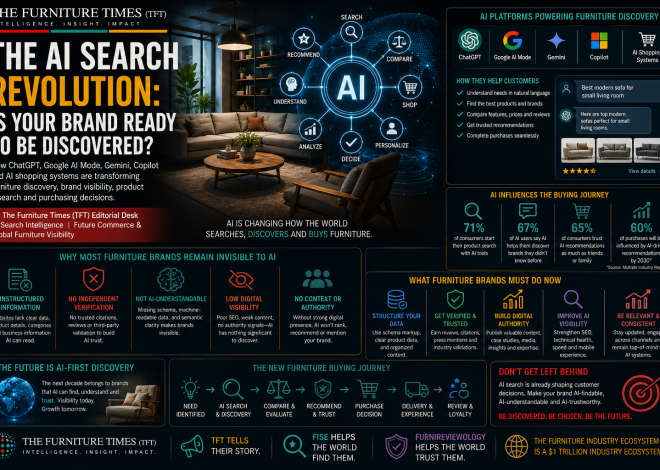
For decades, furniture companies competed for visibility in showrooms, exhibitions, trade magazines, retail stores and conventional search engines. Today, a new discovery system is rapidly influencing which manufacturers, suppliers, retailers, designers and service providers enter a buyer’s consideration list: artificial intelligence.
Customers are no longer searching only with short phrases such as “office furniture supplier” or “outdoor furniture manufacturer.” They are asking complete questions:
- Who are the most reliable outdoor furniture manufacturers in Malaysia?
- Which furniture factories can supply FSC-certified hotel furniture?
- What companies manufacture ergonomic office chairs in Southeast Asia?
- Which furniture brands provide five-year warranties?
- Where can I source custom teak furniture for a resort project?
- Which suppliers offer low minimum-order quantities?
- Who manufactures sustainable furniture for export to Europe?
- What are the best furniture-component companies for soft-close hardware?
- Which furniture businesses have credible reviews and international experience?
AI systems may answer these questions by assembling information from company websites, product pages, news reports, business directories, reviews, marketplaces, social platforms and other accessible sources.
A furniture company can therefore exist physically, employ skilled people, operate advanced machinery and produce excellent products—but remain practically invisible if AI systems cannot discover enough reliable information about it.
This is the new visibility divide.
The Shift from Search Rankings to AI Recommendations
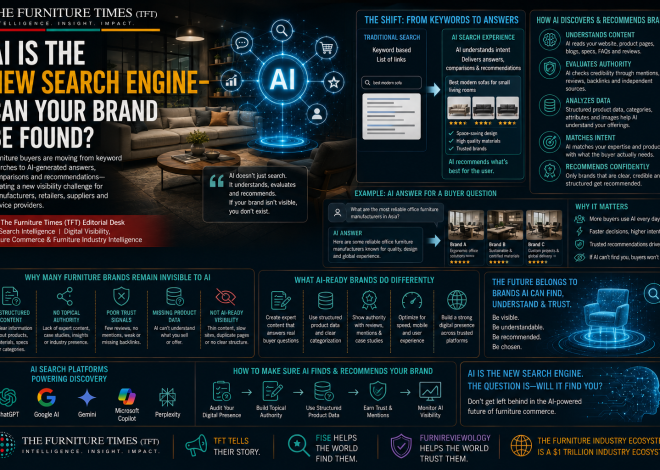
Traditional search engines normally present a list of pages. The user evaluates the titles, opens several links and decides which source appears credible.
AI-powered discovery changes this journey.
An AI assistant may interpret the user’s full intention, compare several sources, summarize the market and mention only a limited number of companies. It may provide reasons why a brand appears suitable, highlight product categories, explain potential limitations and cite sources that support its answer.
The commercial question is no longer only:
“Does our company rank on Google?”
It is now:
“Does AI know who we are, what we manufacture, where we operate, why we are credible and when it should recommend us?”
A brand can have an attractive website but still be misunderstood by AI. It can rank for its own company name while remaining absent from non-branded questions such as “hotel furniture suppliers in Malaysia” or “custom furniture manufacturers for international projects.”
AI visibility therefore involves more than ranking. It involves discovery, understanding, corroboration, relevance and trust.
What AI Visibility Means
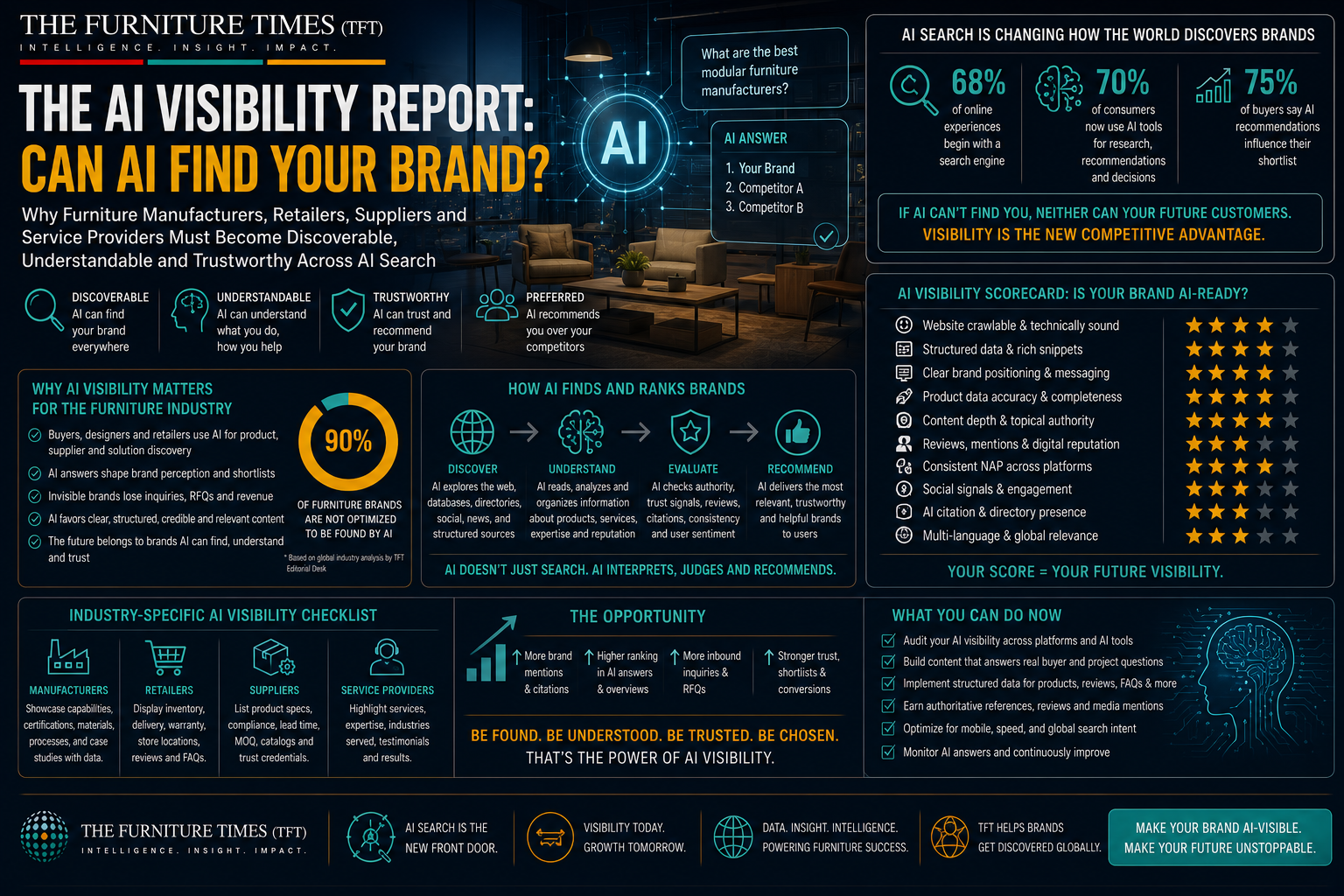
AI visibility is the degree to which a company, product or organization is accurately represented in responses generated by AI-powered search and answer platforms.
It can be evaluated through five dimensions:
| Dimension | Core question |
|---|---|
| Discoverability | Can AI systems access and find the brand’s information? |
| Understanding | Can they identify what the company does and who it serves? |
| Relevance | Does the brand appear for commercially important questions? |
| Authority | Do independent sources confirm the company’s claims? |
| Accuracy | Are AI-generated descriptions current and factually correct? |
A brand is not genuinely visible merely because an AI system recognizes its name. Strong visibility means the company appears in the right context, for the right audience, with an accurate description and credible supporting evidence.
AI Search Is Already a Mainstream Discovery Channel
AI search is no longer an experimental concept confined to technology companies.
ChatGPT Search is available broadly across ChatGPT plans and can return current answers with linked web sources. Google has integrated AI Overviews and AI Mode into its search environment. Microsoft continues to connect generative experiences with Bing and Copilot, while other answer engines help users research companies, products and purchasing decisions.
OpenAI states that websites allowing its search crawler, OAI-SearchBot, can be surfaced in ChatGPT search results. Publishers can also identify ChatGPT referral traffic because outbound links automatically include a trackable source parameter. OpenAI’s publisher guidance therefore confirms that AI discovery is becoming a measurable source of website visibility and traffic.
Google similarly states that established SEO fundamentals remain relevant to AI Overviews and AI Mode. There is no secret AI-only markup that guarantees inclusion. Pages must still be accessible, indexable, useful, clearly structured and supported by good technical implementation. Google’s official AI search guidance emphasizes that AI features can expose users to a broader range of relevant websites.
The important conclusion is straightforward: AI visibility is an extension of digital authority, not a replacement for it.
A Major Warning: Some Brands Are Completely Absent
A 2025 Ahrefs analysis involving approximately 75,000 brands examined factors associated with brand appearances in Google AI Overviews. It found that 26% of the brands studied received no mentions.
The study reported that branded web mentions had the strongest correlation with AI Overview visibility among the factors examined. Brand-related anchor text and branded search demand also showed stronger relationships than raw backlink volume.
This does not prove that mentions directly cause inclusion. Ahrefs explicitly noted that correlation is not causation. However, the study offers an important strategic signal: AI visibility is shaped by a brand’s presence across the wider web, not only by content published on its own domain.
A company saying that it is reliable is a self-declared claim. When trade publications, directories, customers, project partners, associations and independent reviewers repeatedly identify the company in a consistent context, machines receive stronger corroborating evidence.
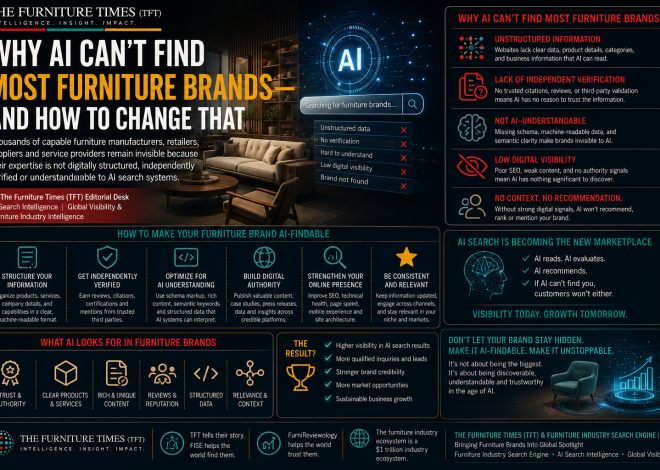
This is especially important in the fragmented furniture industry, where thousands of credible small and medium-sized enterprises have weak websites and almost no independent digital coverage.
The Furniture Industry Has a Serious AI Visibility Gap
The furniture industry ecosystem contains manufacturers, wholesalers, retailers, architects, interior designers, raw-material suppliers, hardware producers, machinery companies, logistics providers, installers, repair specialists, testing organizations, software companies and trade-event organizers.
Yet a large share of this ecosystem remains digitally underrepresented.
Many factories depend on exhibitions, agents, WhatsApp, personal networks and printed catalogues. Their websites may contain little more than a homepage, a contact form and several images. Some do not clearly identify their legal company name, factory location, manufacturing capabilities or export markets.
Others publish product photographs without searchable descriptions. Their catalogues exist only as large PDF files. Product specifications are missing, images have meaningless filenames, and the website has not been updated in years.
This creates a significant gap between operational capability and digital visibility.
A company may manufacture thousands of products annually, but AI cannot responsibly infer those capabilities from a few images. It needs explicit, accessible and corroborated information.
How AI Systems Build an Understanding of a Brand
AI search systems do not depend on one universal database. Different platforms use different combinations of search indexes, web crawlers, licensed information, structured databases and retrieval systems.
Their exact ranking and selection processes are not fully disclosed. However, a brand’s machine-readable identity is generally strengthened by several connected signals.
1. The company’s website
The official website should provide the clearest and most authoritative account of the business.
It should answer:
- What is the legal and commercial name of the company?
- Where is it headquartered?
- Does it manufacture, retail, distribute, design or provide services?
- What product categories does it offer?
- Which materials and production processes does it use?
- Which countries or customer segments does it serve?
- What certifications, warranties and capabilities can it verify?
- How can customers contact it?
- When was the information last updated?
If these facts are scattered, contradictory or hidden inside images, AI systems may form an incomplete picture.
2. Search-engine indexes
AI search continues to depend substantially on conventional search infrastructure.
Pages blocked from search crawlers, marked with noindex, hidden behind login forms or disconnected from internal navigation are difficult to discover. Broken sitemaps, duplicate pages, slow servers and poor mobile performance can further reduce visibility.
3. Independent mentions
News coverage, interviews, association profiles, verified directories, exhibition listings, project case studies and partner websites help confirm that a business exists and operates in the market it claims to serve.
4. Product information
Detailed product pages help AI connect a brand with user needs. Useful information includes materials, dimensions, applications, finishes, certifications, warranty coverage, maintenance requirements, availability and delivery territories.
5. Reviews and reputation signals
Reviews provide evidence of customer experience, but their value depends on authenticity, relevance and consistency. A large volume of suspicious or generic reviews can undermine rather than strengthen trust.
6. Structured data
Schema markup can help machines interpret organizations, products, offers, articles, local businesses, events, jobs and other entities.
Google cautions that structured data must match the information visible on the page. It is not a method for inserting hidden claims or manipulating results. Correct implementation improves machine understanding and eligibility for certain search features, but it does not guarantee an AI citation.
7. Consistent entity information
The brand name, address, phone number, website, category and company description should remain consistent across important platforms.
If one page calls a company a manufacturer, another calls it an interior-design studio and a third identifies it as a furniture shop, AI systems may struggle to understand its primary role.
AI Visibility Is More Than Technical SEO
Technical SEO creates access. It does not automatically create authority.
A technically perfect website with weak content gives an AI system little useful information. Similarly, an informative website may remain undiscovered if crawling and indexing are blocked.
Strong AI visibility requires four layers working together:
- Technical accessibility — machines can crawl, render and index the website.
- Entity clarity — machines understand the company and its relationships.
- Content usefulness — pages answer real customer and buyer questions.
- External corroboration — independent sources confirm important claims.
This is why adding a single plugin or inserting a few lines of schema code cannot solve AI invisibility.
AI visibility is an organizational responsibility involving marketing, product management, public relations, IT, customer service, sales and senior leadership.
The Difference Between SEO, AEO and GEO
The language surrounding AI search is still developing, but three concepts are commonly used.
Search Engine Optimization
SEO improves a website’s visibility and performance in conventional search results. It includes crawling, indexing, page structure, content quality, links, usability and relevance.
Answer Engine Optimization
AEO structures information so that search engines and digital assistants can extract direct, useful answers. Clear explanations, question-based sections, definitions, comparisons and factual summaries can support answer visibility.
Generative Engine Optimization
GEO focuses on how brands and content are represented, mentioned and cited in AI-generated responses. It considers entity understanding, authoritative references, factual consistency and the wider digital presence of a brand.
These practices should not operate as competing strategies.
The strongest model is:
SEO creates discoverability. AEO creates answerability. GEO creates AI relevance and citation potential.
The 100-Point AI Visibility Scorecard
Furniture companies can use the following framework to conduct an initial internal assessment.
| Assessment area | Points |
|---|---|
| Technical discoverability and crawler access | 15 |
| Brand and entity clarity | 15 |
| Product and service information | 15 |
| Authority and independent mentions | 15 |
| Content quality and topical expertise | 15 |
| Structured data and product feeds | 10 |
| Reviews, trust and reputation | 10 |
| Measurement and governance | 5 |
| Total | 100 |
Score interpretation
| Score | Visibility condition |
|---|---|
| 0–20 | Almost invisible |
| 21–40 | Discoverable but poorly understood |
| 41–60 | Partially visible |
| 61–80 | Strong and developing |
| 81–100 | Highly prepared for AI discovery |
This is an editorial diagnostic framework, not an official ranking standard. Its purpose is to reveal gaps and guide action.
The AI Brand Test
A serious visibility audit should test realistic buyer questions rather than asking only for the company name.
A furniture manufacturer could assess queries such as:
- What does [Brand Name] manufacture?
- Where is [Brand Name] located?
- Is [Brand Name] a manufacturer or retailer?
- Does [Brand Name] export internationally?
- What materials does [Brand Name] use?
- What warranties does [Brand Name] provide?
- Is [Brand Name] suitable for hospitality projects?
- Who are the best manufacturers in [country]?
- Which suppliers offer [specific capability]?
- How does [Brand Name] compare with [competitor]?

These tests should be repeated across several AI systems, locations and times. Generative answers are not fixed rankings. They can vary according to wording, user location, available sources, freshness and platform methodology.
The report should record:
- Whether the brand is mentioned
- Whether a source link is provided
- The brand’s position within the answer
- The accuracy of the description
- The sentiment or tone
- The competitors mentioned
- Missing or incorrect claims
- The sources used by the AI system
Testing only one question once does not produce a dependable visibility assessment.
Five Possible AI Visibility Outcomes
1. AI cannot find the brand
The system returns no useful information or confuses the company with another entity.
This usually indicates limited indexation, inadequate content, naming ambiguity or insufficient third-party evidence.
2. AI finds the brand but cannot explain it
The company is recognized, but its products, market position or customer groups remain unclear.
The website may lack detailed company and category pages.
3. AI describes the brand inaccurately
The system may repeat outdated locations, discontinued products, incorrect ownership information or an unsuitable category.
This often results from inconsistent information across the web.
4. AI understands the brand but does not recommend it
The company may have clear information but insufficient authority compared with competitors.
More credible coverage, case studies, reviews, specialist content and industry participation may be needed.
5. AI finds, understands and appropriately recommends the brand
This is the strongest outcome. The company appears for relevant non-branded prompts, is accurately described and is supported by credible sources.
Even then, ongoing monitoring is necessary because markets, information and AI systems continually change.
Why Brand Mentions Are Becoming Strategic Assets
Traditional SEO placed heavy emphasis on links. Links remain valuable because they support discovery, navigation and authority.
AI visibility expands the importance of contextual mentions.
If a recognized industry publication describes a company as a Malaysian outdoor-furniture manufacturer, that sentence establishes several relationships:
- Brand
- Country
- Industry
- Product category
- Business capability
Repeated, accurate relationships help machines understand the brand as an entity.
This does not justify mass-producing low-quality mentions. Automated press-release spam, fabricated reviews and meaningless directory submissions can create noise and reputational risk.
The objective is credible, consistent and relevant recognition.
Valuable coverage can include:
- Company profiles
- Founder or executive interviews
- Factory-development announcements
- Product-launch news
- Exhibition participation
- Certifications and sustainability achievements
- Project case studies
- Technical contributions
- Awards from credible institutions
- Research collaborations
- Verified business listings
Public relations is therefore becoming part of AI visibility infrastructure.
The Importance of Product Pages
Many furniture companies present products through galleries containing attractive images but little searchable information.
A strong product page should clearly identify:
- Product name and model
- Product category
- Intended application
- Materials and construction
- Dimensions
- Finish and color choices
- Weight or load capacity where relevant
- Indoor or outdoor suitability
- Care requirements
- Assembly information
- Customization options
- Certifications
- Warranty
- Availability
- Shipping regions
- Manufacturer or brand
This information helps customers make decisions and helps machines connect products with specific questions.
For example, an AI system is more likely to understand the relevance of a chair when the page states that it is a stackable, powder-coated aluminum outdoor dining chair for hospitality environments than when it merely labels the image “Chair 102.”
AI Cannot Reliably Interpret a PDF-Only Business
PDF catalogues remain useful for buyers, dealers and project teams, but they should not be the company’s only source of product information.
Important information locked in a large PDF may be harder to retrieve, update, connect and evaluate than well-structured website pages.
Furniture companies should create accessible HTML pages for major categories and products. PDFs can remain available as downloadable supporting materials.
The same principle applies to text embedded inside images. If factory capabilities, warranty conditions or contact details appear only within a graphic, machines and users may not consistently access them.
Trust Is Becoming Machine-Readable
AI visibility and customer trust are closely connected.
An AI system evaluating brands may encounter company claims, customer reviews, news reports, product data and business-directory information. Contradictions can reduce confidence.
Trust becomes stronger when a company provides evidence:
- A claimed certification links to the certifying body or valid certificate.
- A warranty page explains coverage and limitations.
- A project case study identifies the problem, solution and result.
- A factory profile shows the location, processes and capabilities.
- Sustainability claims specify materials and measurement methods.
- Review policies demonstrate authenticity and transparency.
FurniReviewology has a potential role in this layer of the ecosystem by helping businesses build transparent, furniture-specific review and trust signals.
Visibility may help a customer discover a brand. Trust helps that customer decide.
Product Feeds Could Transform Furniture Discovery
Product feeds are becoming strategically important as AI platforms develop shopping and product-comparison functions.
OpenAI now provides a pathway for merchants to share product feeds for discovery in ChatGPT. Accurate feeds can make it easier for shoppers to explore, compare and evaluate products. OpenAI’s product-discovery guidance reflects the movement from AI answering questions to AI supporting commercial research.
Furniture feeds require special care because products frequently involve variations in dimensions, upholstery, finishes, configurations, regional availability and delivery terms.
A useful feed should provide current:
- Product identifiers
- Titles and descriptions
- Prices or price ranges where applicable
- Availability
- Images
- Product URLs
- Materials
- Variants
- Shipping information
- Return conditions
- Brand and manufacturer data
Inaccurate feeds can damage trust. A beautiful product recommendation becomes commercially useless if its price, stock status or delivery territory is wrong.
Reviews Will Influence the AI Trust Layer
AI systems can summarize publicly accessible customer experiences, but review quality matters more than review quantity.
Furniture purchases involve durability, comfort, assembly, delivery, installation and after-sales support. Generic star ratings cannot explain every aspect of the experience.
Furniture-specific reviews should ideally address:
- Product quality
- Description accuracy
- Comfort
- Finish consistency
- Delivery experience
- Assembly
- Installation
- Customer support
- Warranty response
- Long-term durability
Companies should never create fake reviews or pressure customers to submit misleading feedback. Authentic criticism can provide valuable operational intelligence and demonstrate that a company responds responsibly.
The Danger of Inconsistent Brand Information
AI systems can reproduce contradictions already present online.
A company may use several versions of its name, list old addresses, show different telephone numbers or describe itself inconsistently. Distributors might copy outdated product descriptions. Old directories may contain former contact information.
This creates entity confusion.
Every furniture company should maintain a central brand-facts document containing:
- Official brand name
- Legal company name
- Former names
- Website
- Headquarters
- Factory locations
- Year established
- Business category
- Product categories
- Markets served
- Certifications
- Official contact details
- Approved short and long descriptions
Teams and external partners should work from this document when creating listings, articles, profiles and product feeds.
AI Visibility Must Be Measured
Companies cannot improve AI visibility through assumptions.
A practical dashboard should monitor:
- Brand mention rate
- Citation rate
- Accuracy rate
- Share of voice against competitors
- Sentiment
- Visibility by product category
- Visibility by country
- Number of independent brand mentions
- AI referral sessions
- AI-assisted enquiries
- Corrected misinformation
- Conversion from AI-referred visitors
OpenAI notes that ChatGPT referral links can be tracked through the utm_source=chatgpt.com parameter. Google introduced dedicated Search Console reporting in 2026 for visibility within generative AI features, including AI Overviews and AI Mode.
These developments indicate that AI visibility is becoming measurable rather than purely speculative.
A 12-Step AI Visibility Action Plan
Step 1: Establish the baseline
Test the brand across ChatGPT Search, Google AI features, Gemini, Copilot and other relevant platforms using standardized prompts.
Step 2: Fix crawler access
Review robots.txt, indexing instructions, firewalls, content-delivery systems and server logs. Ensure that desired public content is accessible to appropriate search crawlers.
OpenAI states that blocking OAI-SearchBot prevents pages from being surfaced as cited results in ChatGPT search, although navigational references may still occur.
Step 3: Clarify the company identity
Create a comprehensive About page that clearly explains the company’s history, location, category, capabilities, leadership structure and markets.
Step 4: Build category authority
Develop substantial pages for every priority category rather than placing all products into one gallery.
Step 5: Improve product information
Publish accurate descriptions, specifications, use cases, variants, warranty details and current images.
Step 6: Implement appropriate structured data
Use relevant Organization, LocalBusiness, Product, Offer, Article, Breadcrumb and other supported schema types. Ensure that markup matches visible page content.
Step 7: Publish original expertise
Create technical guides, market explanations, manufacturing insights, care instructions, comparison pages, case studies and research.
Step 8: Earn credible recognition
Seek genuine media coverage, association profiles, expert interviews, verified listings and project references.
Step 9: Strengthen reviews and evidence
Collect authentic feedback and publish verifiable proof for certifications, warranties and sustainability claims.
Step 10: Correct inconsistent information
Update old profiles, addresses, descriptions, product names and company categories across the web.
Step 11: Track AI referrals and enquiries
Configure analytics to identify visits from AI platforms. Train sales teams to ask how new buyers discovered the company.
Step 12: Repeat the audit
Run scheduled tests monthly or quarterly. Record changes rather than relying on memory or screenshots from one isolated search.
What Furniture SMEs Can Do Without a Large Budget
AI visibility is not reserved for multinational brands.
A small manufacturer can make meaningful progress by publishing clear facts and documenting real expertise.
An SME should begin with:
- A professional company profile page
- One detailed page for each important product category
- Accurate contact and location information
- Five to ten strong product pages
- Several authentic project case studies
- A clear warranty page
- A certification and material-sourcing page
- A searchable business listing
- Regular industry news or educational articles
- Customer reviews with detailed experiences
The objective is not to publish hundreds of shallow articles. A smaller number of original, factual and useful pages can create a stronger foundation.
What Furniture Companies Must Stop Doing
Furniture businesses should avoid practices that weaken both search and AI trust:
- Copying descriptions from competitors
- Publishing generic AI text without fact-checking
- Buying fake reviews
- Creating hundreds of thin location pages
- Hiding essential information inside images
- Keeping outdated products marked as available
- Making environmental claims without evidence
- Using inconsistent company names
- Publishing news without dates or attribution
- Blocking useful content from crawlers accidentally
- Treating social media as a substitute for an official website
- Expecting one press release to create permanent authority
AI systems reward no guaranteed formula. The sustainable strategy is to make the brand’s public information clearer, more useful, more consistent and more verifiable.
The Role of TFT, FISE and FurniReviewology
The emerging AI discovery economy requires three connected foundations: storytelling, searchability and trust.
The Furniture Times (TFT) can document the companies, innovations, people, technologies and developments shaping the furniture ecosystem. Editorial coverage gives the industry a structured public record.
Furniture Industry Search Engine (FISE) can improve category-specific discovery by helping manufacturers, retailers, suppliers and service providers create searchable industry identities.
FurniReviewology can contribute a sector-focused trust layer through reviews, reputation signals and decision-support information.
Together, these functions address the visibility problem from different directions:
- TFT tells the industry’s stories.
- FISE organizes furniture-industry discovery.
- FurniReviewology supports evaluation and trust.
For a fragmented global ecosystem, this combined infrastructure can help smaller businesses become visible alongside established international brands.
The Future Customer May Ask AI Before Contacting You
A buyer planning a hotel, office, restaurant, residential development or retail collection may begin with AI long before sending an enquiry.
By the time the company receives the first email, the buyer may already have asked:
- Which countries should I source from?
- Which suppliers specialize in this category?
- What certifications should I request?
- Which companies appear credible?
- What are the risks?
- How do the shortlisted suppliers compare?
The early stages of the purchasing journey may therefore occur without the brand knowing it has been evaluated.
If a company is absent from those answers, it may never receive the opportunity to quote.
Final Finding: AI Visibility Is Becoming Commercial Infrastructure
AI visibility is not a temporary marketing fashion. It is becoming part of the infrastructure through which buyers learn, compare, shortlist and decide.
The brands most likely to benefit will not necessarily be the largest. They will be the companies that make their capabilities easiest to discover, understand and verify.
Furniture businesses should treat their websites, product data, news coverage, listings, reviews and external mentions as one connected information system.
The essential questions are now:
- Can AI find your brand?
- Can it identify what you do?
- Can it distinguish you from competitors?
- Can it verify your claims?
- Can it confidently mention you for relevant buyer questions?
- Is the information it provides accurate?
If the answer is no, the problem is larger than missing website traffic. It means the brand risks being excluded from the consideration process of future customers.
The furniture industry has entered an age in which visibility is no longer defined solely by being online.
The new standard is being understood by machines, trusted by people and discoverable wherever commercial questions are asked.
Report Methodology and Limitations
This report combines official platform documentation with independent visibility research and TFT editorial analysis. AI-generated answers are dynamic and can vary by platform, prompt, date, location, personalization and available sources. No optimization method can guarantee a mention, citation, ranking or recommendation.
The 100-point framework is an editorial assessment model designed for internal benchmarking. It is not an official metric from OpenAI, Google, Microsoft, Ahrefs or Semrush.
Reference sources: OpenAI crawler documentation, OpenAI publisher guidance, Google AI search guidance, Google structured-data guidance, and Ahrefs’ 75,000-brand analysis.
The Furniture Times (TFT) & Furniture Industry Search Engine (FISE)
“TFT tells their story. FISE helps the world find them.”
FurniReviewology helps the world trust them.
The furniture industry ecosystem is a $1 trillion industry ecosystem.