
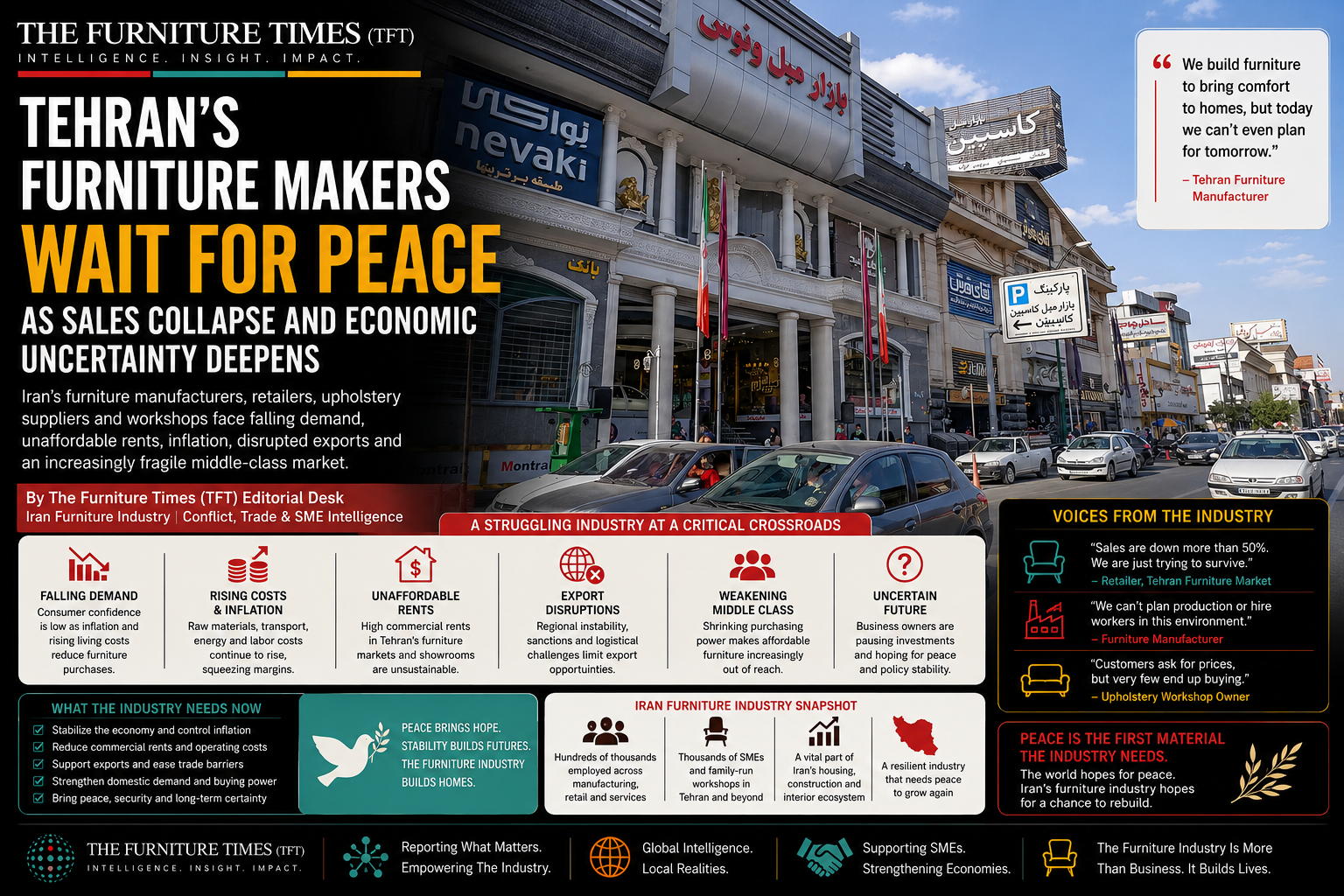
Tehran’s Furniture Makers Wait for Peace as Sales Collapse and Economic Uncertainty Deepens
Iran’s furniture manufacturers, retailers, upholstery suppliers and workshops face falling demand, unaffordable rents, inflation, disrupted exports and an increasingly fragile middle-class market
By The Furniture Times (TFT) Editorial Desk | Iran Furniture Industry | Conflict, Trade & SME Intelligence
Tehran’s once-busy furniture districts are confronting one of their most difficult commercial periods as war, inflation, declining household purchasing power and uncertainty place manufacturers, retailers, upholstery suppliers and independent workshops under severe pressure.
A field report published by IranWire on July 27, 2026 describes a striking slowdown in Yaftabad, southwest Tehran. Known as the capital’s largest furniture marketplace, the district has traditionally connected showrooms, workshops, upholstery businesses, fabric wholesalers and consumers.
Today, many of its large showrooms reportedly receive few customers. Businesses that once depended on middle-class families buying new furniture, replacing sofas or renovating their homes are waiting for economic stability—and, above all, peace.
The situation in Yaftabad represents more than a temporary retail downturn. It illustrates how conflict can spread through an entire furniture-industry ecosystem, affecting everyone from timber, foam and fabric suppliers to carpenters, upholsterers, transport companies, landlords, retailers and customers.
Furniture is a major household purchase. When families become uncertain about income, safety, inflation or the future, sofas, dining sets, beds and wardrobes are often postponed. This makes furniture one of the first industries to experience the economic impact of uncertainty and one of the last to recover fully.
Yaftabad’s Quiet Showrooms Reveal a Wider Crisis
Yaftabad has long been an important centre of Tehran’s furniture economy. It is home to retailers, manufacturers, upholstery-material dealers, curtain-fabric suppliers, workshops and related service businesses.
The commercial strength of such a district depends on daily interaction. Consumers visit several showrooms, compare designs, inspect materials, discuss customized orders and negotiate prices. Retailers place orders with workshops. Workshops purchase fabrics, foam, timber, panels, hardware and finishing materials. Transport companies deliver products to customers.
When retail traffic collapses, the entire chain slows.
IranWire’s reporting describes spacious stores with very limited customer activity. One retailer estimated that his sales had fallen by at least 70% compared with two years earlier. He reportedly remained in business partly because he owned his premises and operated a workshop supplying other retailers.
That detail is significant.
A business that owns its showroom may survive a prolonged downturn by reducing margins and relying on manufacturing income. A tenant must continue paying rent regardless of whether customers enter the store.
The crisis therefore does not affect every furniture company equally. Ownership of property, access to working capital, level of debt, customer diversity and control over manufacturing can determine whether a business survives.
Furniture Is Being Pushed Below Essential Household Spending
Furniture competes with food, education, housing, transport, healthcare and energy within a household budget.
During a period of high inflation, essential expenses consume a growing share of family income. Furniture replacement becomes easier to delay because households can continue using existing sofas, tables, beds and storage units even when those products are old or damaged.
One Yaftabad retailer told IranWire that middle-class consumers now prioritize feeding their families and paying education costs. His observation reflects a fundamental demand problem: furniture has moved further down the household spending list.
A family that would once have replaced a living-room set every several years may now extend its use far beyond the expected replacement cycle. Newly married couples may purchase fewer pieces or choose second-hand products. Families moving home may retain existing furniture rather than ordering new collections.
Consumers may also downgrade:
- From solid wood to lower-cost panel furniture
- From full-room sets to individual replacement pieces
- From custom-made furniture to standardized products
- From imported textiles to locally produced alternatives
- From premium mechanisms to basic fittings
- From showroom purchases to informal or second-hand channels
These decisions reduce revenue not only for retailers but also for every supplier involved in making higher-value furniture.
Iran’s Inflation Has Intensified the Pressure
The International Monetary Fund’s April 2026 data projects Iran’s average consumer-price inflation at approximately 68.9% for 2026. End-of-period inflation was projected at 48.7%.
Forecasts can change, especially during conflict, but the figures illustrate the scale of the economic instability facing Iranian households and businesses. IMF data also projects unemployment at 9.2% in 2026.
High inflation damages the furniture market from both sides.
For consumers, it reduces purchasing power. Salaries may increase, but often not quickly enough to keep pace with the cost of food, rent, transport and household necessities.
For manufacturers, inflation raises the cost of:
- Timber and wood-based panels
- Upholstery fabrics
- Foam and filling materials
- Adhesives and chemicals
- Paints, lacquers and finishing products
- Hardware, hinges and drawer systems
- Metal frames and mechanisms
- Packaging
- Electricity and fuel
- Workshop rent
- Transportation
- Machinery maintenance and replacement parts
Businesses may be forced to increase furniture prices even while customers are becoming less able to buy.
This creates a destructive commercial cycle: rising production costs require higher prices, but higher prices further weaken demand.
Currency Instability Makes Pricing Extremely Difficult
Furniture manufacturing involves long production cycles compared with many everyday retail products.
A customer may select a design and place a deposit, but the manufacturer still needs to purchase materials, schedule labor, manufacture the furniture, finish it and arrange delivery. If the currency loses value during that period, the cost of completing the order can rise substantially.
Manufacturers face several difficult choices:
- Quote prices for very short validity periods
- Request larger deposits
- Add risk margins to quotations
- Delay material purchases
- Reduce customization
- Substitute materials
- Accept lower or negative margins
- Stop accepting certain orders entirely
None of these options is ideal.
Customers dislike quotations that expire quickly. Large deposits may be unaffordable. Material substitution can damage quality and trust. Excessive risk margins make products even more expensive.
Currency instability also affects machinery and imported components. A factory may continue operating its existing equipment but find replacement motors, electronic controls, cutting tools or spare parts increasingly expensive.
Over time, this can reduce productivity and manufacturing consistency.
Soaring Commercial Rents Threaten Retailers
IranWire’s report highlights the burden of retail rent in Yaftabad.
One tenant said his landlord wanted to double the monthly rent from 80 million tomans to 160 million tomans. With insufficient sales to support the increase, the retailer expected that he might have to leave the showroom.
This situation reveals a wider structural problem.
Furniture requires large display areas. A sofa set, bedroom collection or dining arrangement occupies much more space than clothing, electronics or small consumer products. Furniture showrooms therefore face high property costs even when inventory moves slowly.
When rent rises while sales fall, retailers may respond by:
- Closing physical showrooms
- Moving to cheaper areas
- Sharing space with other businesses
- Operating by appointment
- Reducing displayed inventory
- Using small studios with digital catalogues
- Moving sales activity to Instagram or messaging applications
- Selling directly from workshops or warehouses
These measures can reduce costs, but they also change how consumers experience furniture.
Customers generally want to touch fabrics, test seating comfort, inspect construction and compare finishes. A digital-only sales model may work for repeat purchases or inexpensive products, but it is more difficult for high-value furniture that depends on physical evaluation.
Internet Dependence Creates Another Risk
The Yaftabad retailer interviewed by IranWire reportedly considered moving his operation to a less expensive storage space and marketing through Instagram—if internet access remained available.
That qualification is important.
Digital channels can help furniture SMEs survive high showroom costs. Social media allows businesses to display products, communicate with customers and receive enquiries without maintaining large retail premises.
However, depending entirely on one social platform creates risk. Access restrictions, internet disruptions, platform changes or account suspensions can suddenly disconnect a business from its customers.
A more resilient digital strategy would include:
- An independent company website
- Searchable product pages
- A regularly updated business listing
- Multiple social-media channels
- Customer contact records
- Email and messaging options
- Downloadable catalogues
- Accurate location and contact information
- Online reviews
- Search and AI visibility
Even under normal market conditions, a furniture company should not allow one external platform to become its entire digital infrastructure.
Upholstery Suppliers Are Also Losing Customers
A decline in new-furniture sales might ordinarily benefit furniture repair and reupholstery.
When families cannot afford new sofas, they may replace worn fabric, repair frames or renew foam. This can extend product life and support upholsterers, fabric retailers and restoration businesses.
Yet IranWire found that even reupholstering existing furniture has become too expensive for many middle-class households. Consumers are postponing repair as well as replacement.
This is particularly damaging because repair is normally the furniture market’s lower-cost alternative.
When customers cannot afford either a new sofa or the renovation of an old one, it suggests that pressure has reached deep into discretionary household spending.
The consequences extend to:
- Upholstery workshops
- Fabric wholesalers
- Foam suppliers
- Sewing businesses
- Frame-repair specialists
- Furniture transporters
- Independent craftspeople
- Curtain and interior-textile retailers
The decline of repair demand also has environmental consequences. Furniture remains in use while deteriorating, and products may eventually become too damaged to restore economically.
Domestic Fabrics Replace Imported Materials
The report also describes a change in upholstery-material demand.
Before the 2026 conflict intensified, some buyers continued seeking Turkish-woven upholstery fabrics. More recent transactions reportedly involve a greater share of fabrics manufactured domestically in Yazd.
This shift can create an opportunity for Iranian textile producers. When imported products become unavailable or unaffordable, domestic manufacturers may gain market share.
Iran has established textile and weaving capabilities. Local upholstery production can potentially provide several advantages:
- Lower exposure to foreign currency
- Shorter domestic supply routes
- Faster replenishment
- Greater ability to produce smaller orders
- Employment within the national economy
- Closer cooperation with furniture manufacturers
- Product development suited to local tastes
However, domestic substitution must be supported by consistent quality, design variety, color reliability, abrasion resistance and realistic pricing.
Furniture fabrics must perform, not merely look attractive. They need appropriate resistance to wear, fading, pilling, staining and seam damage. Manufacturers that can document these qualities may strengthen their position during and after the crisis.
A Former Wholesaler’s Experience Shows How the Chain Can Break
IranWire encountered a taxi driver who had previously operated as a wholesale upholstery-fabric dealer. He described leaving the business after losing workshop customers during the 2026 conflict.
His former business model depended on credit and cash-flow timing. He purchased fabric rolls by paying a portion upfront and settling the balance through post-dated cheques. He then supplied furniture workshops, mainly for cash.
This arrangement could function when workshops had orders and retailers had customers.
Once consumer demand declined, workshops purchased less fabric. The wholesaler still faced obligations to suppliers, rent and operating expenses. Working capital became trapped in unsold inventory.
This example demonstrates how furniture-industry failure travels upstream.
The sequence often develops as follows:
- Households postpone furniture purchases.
- Retailers receive fewer orders.
- Retailers reduce orders from workshops.
- Workshops reduce production schedules.
- Fabric, foam, timber and hardware purchases decline.
- Wholesalers struggle to repay suppliers.
- Workers lose hours or employment.
- Household purchasing power falls further.
A furniture downturn can therefore reinforce the wider economic slowdown.
More Than 7,000 Production Units Are Exposed
According to figures attributed by IranWire to the furniture industry’s union, Iran has 614 industrial enterprises and more than 7,000 active manufacturing and production units within the sector.
This structure suggests that the industry includes a large number of SMEs, workshops and specialized producers rather than only large factories.
Smaller operations play an essential role in:
- Custom furniture
- Upholstery
- Carving and woodworking
- Repairs and restoration
- Residential projects
- Interior fit-out
- Regional retail supply
- Component production
- Skilled employment and apprenticeships
Yet SMEs are especially vulnerable during prolonged economic shocks.
They typically have smaller cash reserves, less negotiating power with landlords, limited access to finance and greater dependence on a narrow customer base. Many also lack formal digital-sales systems or export departments.
If a substantial number of these workshops close, Iran could lose more than current production capacity. It could lose accumulated craft knowledge, skilled workers, supplier relationships and entrepreneurial businesses that would be difficult to rebuild.
Furniture Exports Had Demonstrated Potential
IranWire reports that Iranian furniture exports generated approximately US$145 million during Iranian year 1402, covering roughly March 2023 to March 2024. That represented a reported increase of about 40% from the preceding year.
Iranian furniture has reportedly reached markets including:
- Iraq
- Armenia
- Georgia
- Kazakhstan
- United Arab Emirates
- Azerbaijan
These destinations reflect Iran’s geographic potential.
The country sits near the Caucasus, Central Asia, the Gulf, Turkey, Afghanistan, Pakistan and Iraq. This position could support regional furniture trade, particularly where buyers value Iranian design, craftsmanship, cultural familiarity and relatively short transport distances.
Iran also possesses traditions in woodworking, carving, textiles, metalwork, interior decoration and Persian design. These capabilities can support products ranging from traditional furniture to contemporary residential and contract collections.
The 40% export increase reported for 1402 indicates that the sector can expand internationally when trade conditions permit.
However, exports remain vulnerable to sanctions, banking restrictions, insurance, transportation disruption, exchange-rate uncertainty and conflict.
Gulf Export Channels Have Been Severely Disrupted
The United Arab Emirates and Kuwait have historically offered opportunities for furniture, furnishing materials, interiors and project supply. IranWire reports that furniture exports to these markets have nearly disappeared amid the current Gulf conflict.
This affects more than direct shipments.
The UAE is an important regional trading, design, construction and re-export centre. Reduced access can disconnect Iranian companies from developers, hotel projects, designers, distributors and customers across a much wider market.
War-related trade disruption can affect:
- Shipping availability
- Marine insurance
- Freight costs
- Port operations
- Payment settlement
- Delivery schedules
- Contract confidence
- Distributor inventory
- Business travel
- Exhibition participation
Furniture buyers need dependable delivery. A hotel or residential project cannot leave rooms unfinished indefinitely because an order is delayed.
Even manufacturers far from the immediate disruption can lose business if customers perceive delivery risk.
Uncertainty Can Be More Damaging Than a Short Downturn
One of the strongest themes emerging from IranWire’s reporting is uncertainty.
Businesses can sometimes plan around a known recession, temporary closure or specified cost increase. It is much harder to make decisions when nobody knows whether conflict will intensify, pause or end.
Should a retailer renew a lease?
Should a workshop purchase materials?
Should an exporter accept an order?
Should a manufacturer hire or release workers?
Should a family buy furniture or preserve cash?
Should an investor modernize a factory or wait?
When every decision is postponed, the economy enters a state of suspended activity.
The IMF’s April 2026 World Economic Outlook similarly warned that conflict in the Middle East had weakened global momentum. Under its limited-conflict assumption, the IMF projected global growth of 3.1% in 2026 and global inflation of 4.4%. It emphasized that a longer and more disruptive conflict could produce substantially worse results. The IMF outlook described the risks as decisively tilted to the downside.
For Iran’s furniture businesses, uncertainty does not remain an abstract macroeconomic risk. It appears immediately in empty stores, cancelled orders and unpaid obligations.
The Conflict Affects Furniture Materials and Logistics
Furniture production is connected to energy, petrochemicals and transportation.
Foam, synthetic fabrics, coatings, adhesives, plastics, packaging and many hardware components depend directly or indirectly on petroleum and chemical supply chains. Fuel prices also affect timber transportation, factory operations and last-mile delivery.
During conflict, businesses may face:
- Fuel-price instability
- Material shortages
- Higher freight charges
- Delayed imports
- Restricted transport routes
- Reduced warehouse activity
- Unreliable delivery schedules
- Increased insurance and security costs
Large companies may be able to stock materials or negotiate priority supply. Small workshops often purchase in smaller quantities and cannot protect themselves against sudden price increases.
Furniture Workers Carry the Hidden Cost
Every closed showroom or workshop affects people whose livelihoods depend on furniture.
The workforce includes:
- Carpenters
- Cabinetmakers
- Upholsterers
- Sewers
- Wood finishers
- Designers
- Machine operators
- Metalworkers
- Installers
- Drivers
- Sales staff
- Warehouse workers
- Repair specialists
- Apprentices
When orders decline, businesses may reduce working days before officially closing. Employees can lose overtime, commissions and predictable schedules. Apprenticeship opportunities may disappear as experienced craftspeople leave the sector.
Some workers may move into unrelated jobs simply to maintain an income. If conditions later improve, the industry may struggle to recover because skilled labor has dispersed.
Protecting furniture SMEs is therefore also a workforce-development issue.
Women and Home-Based Producers May Be Less Visible but Equally Affected
The formal showroom economy represents only one part of Iran’s furniture ecosystem.
Women and home-based producers may participate in sewing, cushions, decorative textiles, upholstery preparation, handicrafts, online retail and small-scale interior products. These businesses may not appear clearly in official industrial statistics.
They are nevertheless vulnerable to:
- Reduced household spending
- Rising fabric prices
- Internet disruption
- Delivery difficulties
- Limited access to finance
- Loss of retail partners
- Increased home operating costs
Recovery programs should recognize informal and home-based businesses alongside registered factories and retailers.
Second-Hand Furniture May Gain Importance
As new furniture becomes unaffordable, some consumers may move toward second-hand markets.
This can create activity for:
- Used-furniture dealers
- Repair workshops
- Refinishers
- Upholsterers
- Movers
- Online marketplaces
- Replacement-component suppliers
Second-hand trade can help households access essential furniture while supporting circular consumption. However, even this market depends on consumer confidence and functioning transportation and digital channels.
Businesses can potentially build more organized systems for inspecting, cleaning, repairing and reselling used furniture. Such models could provide affordable products while preserving skilled employment.
What Peace Could Mean for Furniture Demand
An end to conflict would not immediately repair Iran’s furniture market.
Households would still face inflation and reduced purchasing power. Businesses would still carry debts, depleted inventory and deferred maintenance. Export relationships would need to be rebuilt, and some former workers might not return.
Nevertheless, peace could provide the certainty required for economic decisions to resume.
A recovery could gradually release postponed demand for:
- Furniture replacement
- Repairs and reupholstery
- Marriage and new-household furniture
- Residential construction
- Commercial renovation
- Hotels and restaurants
- Offices and institutions
- Export orders
- Interior fit-out
Furniture demand is often deferred rather than permanently destroyed. A household may postpone replacing a sofa for two years, but the underlying need remains.
The pace of recovery would depend on inflation, exchange-rate stability, employment, credit availability, trade access and consumer confidence.
An Industry Recovery Plan Must Go Beyond Emergency Relief
Iran’s furniture industry will require both immediate protection and long-term reform.
1. Support viable SMEs
Temporary credit, rent relief and working-capital support could help functioning businesses survive periods of unusually weak demand.
2. Protect skilled employment
Programs should help workshops retain experienced carpenters, upholsterers, machine operators and finishers.
3. Strengthen domestic material production
Supporting quality upholstery fabrics, foam, panels, hardware and finishes can reduce foreign-currency exposure.
4. Improve export infrastructure
Furniture exporters need predictable customs processes, payment solutions, logistics access and regional market intelligence.
5. Expand digital visibility
Manufacturers and retailers need searchable websites, product information, verified listings and diversified customer-contact channels.
6. Develop repair and circular-economy services
Repair, refurbishment and resale can create employment while making furniture more affordable.
7. Promote furniture clusters
Industrial and commercial clusters can share logistics, training, testing, exhibitions and digital marketplaces.
8. Improve product standards
Documented quality, warranty systems, legal timber sourcing and performance testing can increase international confidence.
9. Build regional brands
Iranian furniture needs clearer branding that communicates design identity, craftsmanship, materials and manufacturing capability.
10. Restore confidence through stability
No industrial policy can substitute for peace and predictable economic conditions.
A Warning for the Wider Global Furniture Ecosystem
Tehran’s furniture crisis should concern the international industry.
It demonstrates how quickly a manufacturing ecosystem can weaken when conflict combines with inflation, currency instability, lower consumer demand and disrupted trade.
Furniture SMEs around the world often operate with thin margins. They depend on regular cash flow and predictable material supply. A few months of severe disruption can erase businesses built over decades.
The lesson is not limited to Iran.
Furniture companies everywhere should build resilience through:
- Multiple suppliers
- Diverse customer markets
- Strong cash-flow management
- Digital sales and visibility
- Flexible product ranges
- Repair and after-sales services
- Domestic and regional supply options
- Accurate inventory planning
- Export-risk assessment
- Business continuity plans
Resilience cannot eliminate geopolitical risk, but it can improve a company’s ability to survive disruption.
Yaftabad Is Waiting for More Than Customers
The quiet showrooms of Yaftabad represent a market waiting for confidence to return.
Furniture manufacturers are waiting for orders. Retailers are waiting for customers. Fabric wholesalers are waiting for workshops to begin purchasing again. Workers are waiting for regular employment. Families are waiting for prices and incomes to become more predictable.
Above all, businesses are waiting for peace.
The crisis shows that furniture is not merely a collection of physical products. It is an economic network connecting materials, skills, factories, shops, transport, homes and human livelihoods.
When that network slows, the impact spreads far beyond an empty showroom.
Iran’s furniture industry has production capacity, craftsmanship, regional access and export potential. Its reported US$145 million in exports during 1402 demonstrated that growth is possible. But potential cannot flourish in permanent uncertainty.
For Tehran’s furniture makers, peace is no longer only a political aspiration. It has become the most important condition for commercial survival, employment protection and the eventual recovery of customer demand.
This is an original TFT industry analysis based principally on IranWire’s July 27, 2026 field report. Interviews and sector figures attributed to IranWire have not been independently verified by TFT. Wider inflation and economic projections are attributed to the IMF and may change as conditions develop.
The Furniture Times (TFT) & Furniture Industry Search Engine (FISE)
“TFT tells their story. FISE helps the world find them.”
FurniReviewology helps the world trust them.
The furniture industry ecosystem is a $1 trillion industry ecosystem.
