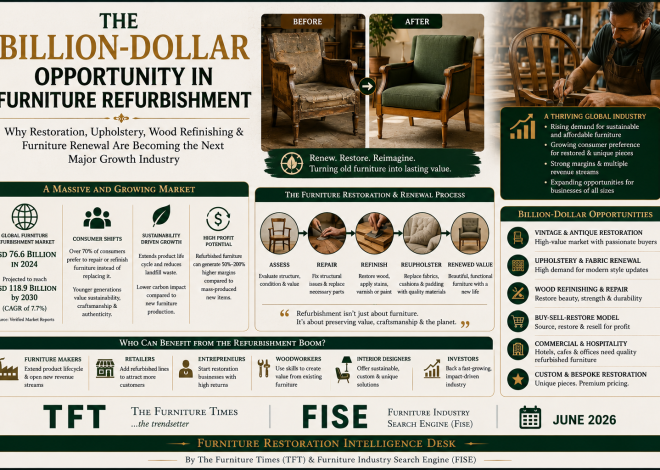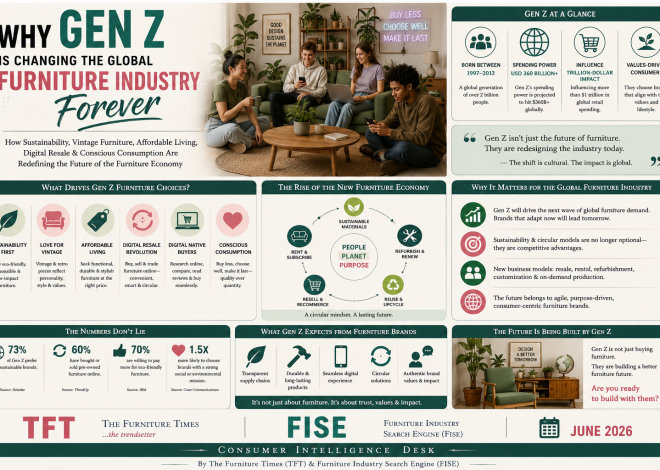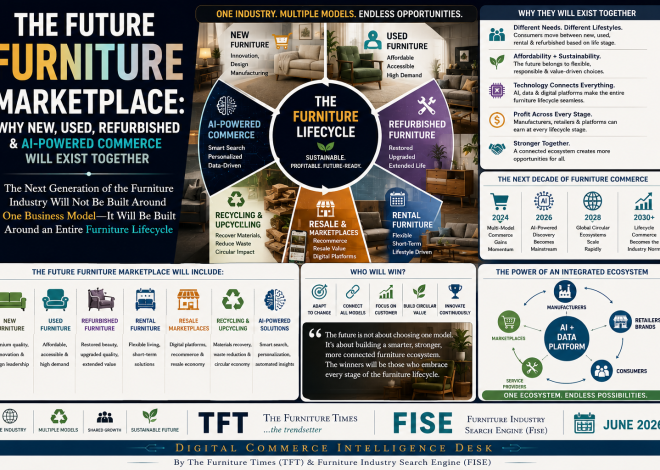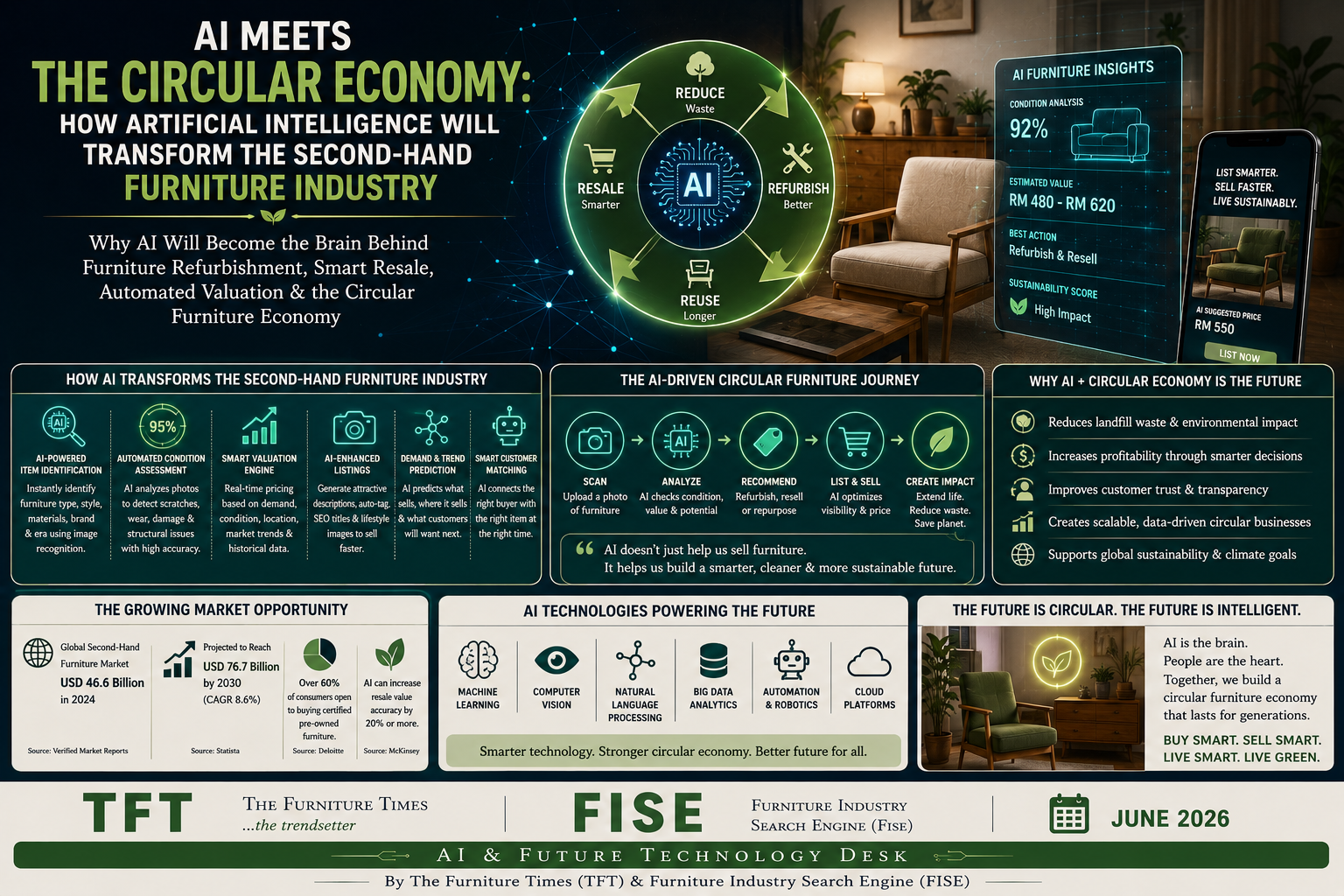
AI Meets the Circular Economy: How Artificial Intelligence Will Transform the Second-Hand Furniture Industry
Why AI Will Become the Brain Behind Furniture Refurbishment, Smart Resale, Automated Valuation & the Circular Furniture Economy
AI & Future Technology Desk
By The Furniture Times (TFT) & Furniture Industry Search Engine (FISE)
June 2026
Artificial Intelligence is no longer changing only search engines.
It is no longer transforming only healthcare.
It is no longer limited to finance, manufacturing, or autonomous vehicles.
Artificial Intelligence is now preparing to transform one of the world’s oldest industries.
The furniture industry.
For decades, buying second-hand furniture involved uncertainty.
Buyers questioned:
“Is this price fair?”
“Is the condition genuine?”
“Has it been repaired?”
“Is this original?”
“Is this worth buying?”
Sellers struggled with different questions.
“How much should I charge?”
“How do I prove quality?”
“How do I find serious buyers?”
“How do I compete with thousands of similar listings?”
Artificial Intelligence is beginning to answer all of these questions.
The next generation of the second-hand furniture economy will not simply be digital.
It will be intelligent.
The future belongs to AI-powered circular commerce, where technology helps furniture stay valuable, discoverable, trustworthy, and useful throughout multiple ownership cycles.
The Second-Hand Furniture Market Is Entering a New Era
Until recently, second-hand furniture marketplaces operated much like digital classified advertisements.
A seller uploaded photographs.
Added a short description.
Selected a price.
Waited for enquiries.
Everything depended on human judgment.
Pricing.
Condition.
Descriptions.
Negotiations.
Trust.
Every transaction required manual effort.
Artificial Intelligence is changing this completely.
Instead of static listings, future marketplaces will become intelligent ecosystems capable of analysing products, predicting values, verifying conditions, and connecting buyers with exactly what they need.
AI Pricing Will Eliminate Guesswork
One of the biggest problems in second-hand furniture is pricing.
Many sellers overprice.
Others undervalue valuable products.
Buyers struggle to determine whether prices are reasonable.
Artificial Intelligence can analyse thousands of variables instantly, including:
- Brand reputation
- Product age
- Material quality
- Original retail price
- Market demand
- Geographic location
- Product condition
- Historical resale prices
- Seasonal demand
Instead of relying on guesswork, sellers will receive AI-generated pricing recommendations.
Buyers will gain greater confidence that prices reflect actual market conditions.
Transparent pricing creates faster transactions.
Automated Valuation Will Create Fairer Markets
The future of furniture valuation will resemble property valuation.
Instead of relying entirely on personal opinion, AI systems will estimate market value using real-time data.
Automated valuation models may evaluate:
- Brand
- Model
- Dimensions
- Materials
- Manufacturing year
- Product popularity
- Current market demand
- Similar sales
Manufacturers could even integrate original product databases with AI systems.
Every furniture item could receive an estimated market value within seconds.
This creates consistency across resale platforms.
Image Recognition Will Become the New Product Expert
Today’s buyers often upload photographs asking:
“Can anyone identify this chair?”
“Which brand is this?”
“Is this teak or oak?”
Future AI image recognition systems will answer instantly.
Using photographs alone, AI may identify:
- Furniture category
- Manufacturer
- Collection
- Style
- Material
- Wood species
- Fabric type
- Production period
- Design influences
Image recognition will dramatically improve product identification while reducing fraudulent listings.
AI Will Assess Furniture Condition
Condition assessment remains one of the largest challenges in second-hand furniture.
Traditional descriptions often include:
“Excellent.”
“Good.”
“Like New.”
These descriptions vary from seller to seller.
Artificial Intelligence introduces greater consistency.
AI systems may analyse images to identify:
- Surface scratches
- Structural cracks
- Water damage
- Fabric wear
- Leather deterioration
- Rust
- Paint defects
- Missing components
Every listing receives objective condition scoring.
This creates stronger buyer confidence.
Recommendation Engines Will Become Personal Furniture Consultants
Future customers will no longer search manually through thousands of products.
Instead they will simply ask:
“Find a dining table suitable for a family of six.”
“Recommend hotel furniture within my budget.”
“Suggest sustainable office furniture for a startup.”
AI recommendation engines will consider:
- Budget
- Space
- Interior style
- Sustainability preferences
- Material preferences
- Delivery location
- Lifestyle
- Existing furniture
Shopping becomes conversational rather than transactional.
The platform becomes an intelligent consultant.
Smart Resale Platforms Will Replace Classified Listings
Tomorrow’s resale platforms will be far more sophisticated than today’s marketplaces.
Future platforms may automatically provide:
- AI pricing
- Image recognition
- Authenticity verification
- Condition assessment
- Carbon savings estimates
- Product history
- Repair recommendations
- Delivery optimisation
- Fraud detection
- Warranty eligibility
Every listing becomes significantly more informative.
This transforms customer confidence.
AI Will Reduce Fraud
One of the biggest barriers to second-hand commerce is fraud.
AI can help detect:
- Duplicate listings
- Stolen product photographs
- Unrealistic pricing
- Counterfeit products
- Suspicious seller behaviour
- Manipulated images
Fraud prevention increases marketplace trust.
Trust drives transactions.
Furniture Digital Passports
The future may introduce digital furniture passports.
Every furniture item could carry:
- Manufacturing date
- Factory information
- Material composition
- Sustainability certifications
- Ownership history
- Repair records
- Refurbishment history
- Warranty status
- Spare part compatibility
AI systems can instantly interpret these digital records.
This creates complete lifecycle transparency.
AI Will Help Manufacturers Recover Products
Manufacturers increasingly seek opportunities beyond the first sale.
Artificial Intelligence can identify:
- Products approaching refurbishment age
- Trade-in opportunities
- Buy-back eligibility
- Upgrade recommendations
- Maintenance schedules
Instead of losing contact with customers, manufacturers remain connected throughout the product lifecycle.
AI Supports Circular Manufacturing
Circular manufacturing depends on information.
Artificial Intelligence helps businesses answer questions such as:
Which products should be repaired?
Which should be refurbished?
Which should be recycled?
Which components remain reusable?
Which materials should be recovered?
AI helps maximize product value while minimizing waste.
Carbon Footprint Intelligence
Future AI systems may calculate environmental savings automatically.
Every second-hand purchase could display:
- Carbon emissions avoided
- Timber preserved
- Waste diverted from landfill
- Energy saved
- Water savings
Consumers increasingly value measurable sustainability.
Artificial Intelligence makes these environmental benefits visible.
Hospitality and Office Refurbishment Will Become Smarter
Hotels and corporations replace thousands of furniture products annually.
AI systems can evaluate:
- Refurbishment costs
- Remaining product lifespan
- Replacement priorities
- Maintenance schedules
Instead of replacing everything simultaneously, organisations can optimise investments through predictive analytics.
This reduces costs while extending product life.
AI Will Improve Spare Parts Management
Manufacturers often struggle to match replacement components.
AI systems can identify compatible:
- Hinges
- Handles
- Drawer runners
- Legs
- Cushions
- Upholstery
- Hardware
Customers receive faster support.
Manufacturers generate additional revenue.
Furniture remains usable for longer.
Why Searchability Becomes More Important Than Ever
Artificial Intelligence only recommends businesses it can understand.
That means furniture companies need:
- Structured product information
- Complete specifications
- High-quality photographs
- Digital catalogues
- Accurate descriptions
- Verified business profiles
The future is no longer simply about being online.
It is about becoming understandable by AI.
This is precisely why Furniture Industry Search Engine (FISE) becomes increasingly valuable.
Searchability becomes machine readability.
Machine readability becomes discoverability.
Discoverability becomes revenue.
The Role of TFT & FISE
The Furniture Times believes Artificial Intelligence will become one of the most important technologies shaping the furniture industry’s future.
FISE aims to help furniture businesses prepare for AI-powered commerce by improving:
- Product discoverability
- Structured data
- Business visibility
- Industry intelligence
- Global searchability
Tomorrow’s buyers may never browse hundreds of listings.
They may simply ask an AI assistant.
The businesses AI understands will become the businesses AI recommends.
TFT & FISE Analysis
Artificial Intelligence is not replacing the circular economy.
It is accelerating it.
AI creates:
Better pricing.
Better trust.
Better valuation.
Better discoverability.
Better sustainability.
Better customer experiences.
The second-hand furniture market has historically suffered from fragmented information.
Artificial Intelligence transforms fragmented information into intelligent decision-making.
This may become one of the largest technological shifts the furniture industry has ever experienced.
Final Verdict
The future of second-hand furniture is no longer about buying used products.
It is about buying intelligently.
Artificial Intelligence will make second-hand furniture:
More trustworthy.
More transparent.
More valuable.
More searchable.
More sustainable.
The winners of the next decade will not simply build furniture.
They will build intelligent furniture ecosystems powered by AI, data, circular manufacturing, and digital trust.
Because in tomorrow’s circular economy…
Artificial Intelligence will not replace craftsmanship.
It will help craftsmanship live longer.
By The Furniture Times (TFT) & Furniture Industry Search Engine (FISE)
AI & Future Technology Desk | June 2026
“TFT tells their story. FISE helps the world find them.”
The furniture industry ecosystem is a $1 Trillion Dollar Industry.