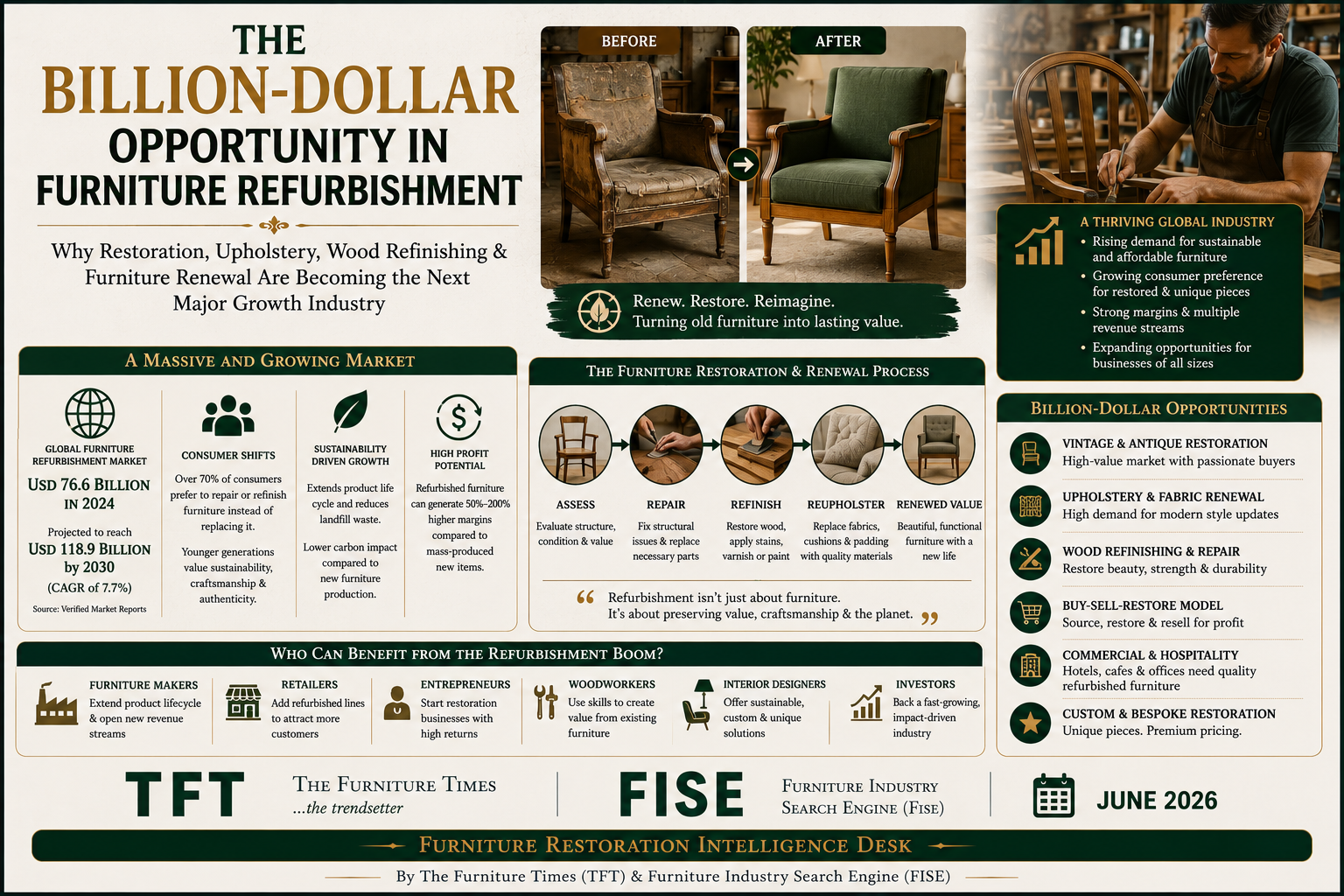
The Billion-Dollar Opportunity in Furniture Refurbishment
Why Restoration, Upholstery, Wood Refinishing & Furniture Renewal Are Becoming the Next Major Growth Industry
Furniture Restoration Intelligence Desk
By The Furniture Times (TFT) & Furniture Industry Search Engine (FISE)
June 2026
For decades, the furniture industry has measured success by one simple metric:
How much new furniture can be manufactured and sold?
Factories invested in larger production lines.
Retailers opened more showrooms.
Designers launched new collections.
Exporters expanded into new countries.
The focus remained on creating new products.
Yet, quietly, another industry has been growing alongside traditional furniture manufacturing.
An industry that has often been overlooked.
An industry with enormous economic, environmental, and social potential.
Furniture refurbishment.
Around the world, millions of furniture products are removed from homes, offices, hotels, restaurants, educational institutions, hospitals, and commercial buildings every year.
Many are not broken.
Many are not outdated.
Many simply require:
- New upholstery
- Surface refinishing
- Structural repairs
- Hardware replacement
- Modernization
- Restoration
Instead of becoming waste, these products represent one of the largest untapped business opportunities in the global furniture ecosystem.
Furniture refurbishment is no longer a repair business.
It is becoming a complete industry.
The Hidden Economy Nobody Talks About
When people discuss the furniture industry, conversations usually revolve around:
- Manufacturing
- Retail
- Exports
- Interior design
- E-commerce
- Trade fairs
Very few discuss what happens after furniture leaves the customer.
Yet every chair…
Every sofa…
Every dining table…
Every office workstation…
Every hotel bed…
Eventually reaches a point where decisions must be made.
Replace it.
Repair it.
Or renew it.
Historically, replacement was often the easiest option.
Today, that equation is changing.
The Circular Economy Is Creating New Opportunities
The rise of sustainability has fundamentally changed consumer thinking.
Customers increasingly ask:
Can this be repaired?
Can this be restored?
Can it be upgraded?
Can it look new again?
Instead of replacing products, many now seek specialists capable of extending furniture life.
This shift is creating demand for highly skilled restoration businesses.
Furniture Refurbishment Is More Than Repair
Many people confuse refurbishment with simple repairs.
They are different.
Repair focuses on fixing problems.
Refurbishment focuses on renewing value.
It combines:
- Engineering
- Design
- Craftsmanship
- Sustainability
- Customer experience
The objective is not simply making furniture usable.
The objective is making furniture desirable again.
Upholstery: A Growing Specialist Industry
One of the fastest-growing areas within refurbishment is upholstery.
A structurally sound sofa may simply require:
- New fabric
- New foam
- New cushions
- New stitching
- Updated colours
The result can appear almost identical to a new product.
Hotels increasingly update furniture through reupholstery instead of complete replacement.
Restaurants refresh interiors without replacing every chair.
Residential customers modernize family furniture while preserving sentimental value.
For upholstery specialists, this creates enormous opportunities.
Wood Refinishing Preserves Craftsmanship
Many older furniture pieces were built using:
- Solid oak
- Walnut
- Teak
- Mahogany
- Rosewood
- Ash
- Maple
These products often possess stronger structural integrity than many contemporary alternatives.
However, years of use leave surfaces scratched, faded, or damaged.
Wood refinishing restores:
- Natural colour
- Surface protection
- Grain visibility
- Durability
- Appearance
Rather than replacing valuable furniture, customers increasingly invest in restoration.
This protects both craftsmanship and natural resources.
Antique Restoration Is Preserving History
Furniture is often more than a product.
It is history.
Many antique pieces represent:
- Family heritage
- Cultural identity
- Historical craftsmanship
- Architectural significance
Antique restoration requires specialised expertise.
Professionals must understand:
- Traditional joinery
- Historic finishes
- Period materials
- Conservation techniques
Unlike ordinary refurbishment, antique restoration focuses on preserving authenticity.
As appreciation for heritage furniture grows, so does demand for skilled restoration experts.
Hospitality Refurbishment Is Becoming Big Business
Hotels renovate frequently.
Not because furniture fails.
But because customer expectations evolve.
Interior trends change.
Brands reposition themselves.
Hospitality refurbishment offers hotels the ability to:
- Reduce capital expenditure
- Minimise operational disruption
- Improve sustainability
- Refresh guest experiences
Instead of replacing hundreds of guest room chairs, sofas, wardrobes, headboards, and tables, many properties can renew existing assets.
This creates significant opportunities for specialised refurbishment companies.
Office Furniture Renewal Is Accelerating
The workplace has changed dramatically.
Hybrid work.
Flexible offices.
Collaborative spaces.
Ergonomic improvements.
Many organisations are redesigning offices.
However, replacing every workstation is expensive.
Furniture renewal offers a practical alternative.
Office refurbishment may include:
- Workstation upgrades
- Chair refurbishment
- Partition improvements
- Storage renewal
- Conference room modernization
Large corporations increasingly evaluate refurbishment before replacement.
The financial savings can be substantial.
Education and Healthcare Present Huge Opportunities
Schools.
Universities.
Hospitals.
Government buildings.
Public institutions.
These organisations manage enormous furniture inventories.
Budget limitations often make complete replacement unrealistic.
Refurbishment enables institutions to:
- Extend furniture life
- Improve appearance
- Maintain safety
- Reduce procurement costs
This creates long-term business opportunities for specialised contractors.
Why Manufacturers Should Build Refurbishment Divisions
Furniture manufacturers possess unique advantages.
They understand:
- Product engineering
- Materials
- Components
- Construction
- Replacement parts
No independent repair company understands the product better than its original manufacturer.
This creates an opportunity.
Manufacturers should establish:
- Certified refurbishment centres
- Factory restoration services
- Product upgrade programmes
- Spare parts divisions
- Mobile repair teams
The manufacturer becomes responsible for the product’s entire lifecycle.
Not just the first sale.
Technology Is Transforming Refurbishment
Artificial Intelligence is beginning to support refurbishment businesses.
Future technologies may help:
- Diagnose damage
- Estimate repair costs
- Match fabrics
- Identify wood species
- Predict product lifespan
- Recommend restoration techniques
Digital platforms will also connect customers directly with restoration specialists.
Technology will make refurbishment faster, more transparent, and more scalable.
Skilled Craftsmen Are Becoming More Valuable
One surprising outcome of the refurbishment economy is renewed demand for traditional skills.
The industry increasingly requires:
- Upholsterers
- Wood finishers
- Carpenters
- Polish specialists
- Antique conservators
- Furniture repair technicians
These professions, once considered declining trades, are becoming increasingly valuable.
The circular economy depends on craftsmanship.
Sustainability Creates Business Value
Furniture refurbishment delivers multiple environmental benefits.
It reduces:
- Landfill waste
- Timber consumption
- Carbon emissions
- Manufacturing demand
- Resource extraction
Businesses increasingly recognise that sustainability and profitability can work together.
Every restored chair represents resources saved.
Every refinished table extends product life.
Every refurbished hotel room reduces environmental impact.
The Rise of Furniture Restoration Franchises
As demand grows, new business models will emerge.
Future opportunities include:
- National refurbishment networks
- Certified restoration franchises
- Mobile furniture repair services
- Regional refurbishment hubs
- AI-enabled assessment platforms
Furniture restoration may become one of the fastest-growing service sectors within the furniture ecosystem.
Why Visibility Will Determine Success
Many highly skilled restoration businesses remain unknown.
Customers often struggle to locate:
- Upholsterers
- Antique restorers
- Wood refinishing experts
- Office refurbishment companies
Without discoverability, expertise remains invisible.
The future refurbishment economy depends on visibility.
Businesses must become searchable.
The Role of TFT & FISE
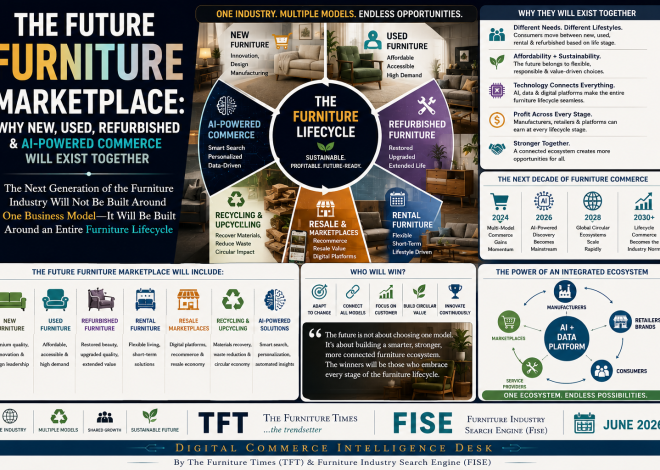
This is why The Furniture Times (TFT) and Furniture Industry Search Engine (FISE) believe refurbishment deserves its own industry ecosystem.
The future furniture industry should include visibility for:
- Restoration specialists
- Upholstery companies
- Antique experts
- Furniture repair businesses
- Hospitality refurbishment firms
- Office renewal specialists
- Furniture maintenance providers
FISE can connect these businesses with homeowners, hotels, architects, interior designers, procurement managers, facility managers, and corporate buyers worldwide.
TFT & FISE Analysis
Furniture refurbishment should no longer be viewed as a support service.
It should be recognised as an independent economic sector.
It creates:
- Employment
- Sustainability
- Skilled craftsmanship
- Business opportunities
- Long-term customer relationships
As the circular economy expands, refurbishment will become one of the industry’s most important growth engines.
Final Verdict
The next billion-dollar opportunity in furniture is not limited to manufacturing more products.
It is about extending the value of products already in existence.
Restoration.
Upholstery.
Wood refinishing.
Hospitality refurbishment.
Office renewal.
Antique conservation.
These are no longer niche services.
They represent the foundation of a new furniture economy.
The businesses that invest today in refurbishment expertise, skilled craftsmanship, digital discoverability, and lifecycle management will lead tomorrow’s market.
Because the future of furniture is no longer measured by how many products are manufactured.
It will increasingly be measured by how many products are given a second, third, and fourth life.
By The Furniture Times (TFT) & Furniture Industry Search Engine (FISE)
Furniture Restoration Intelligence Desk | June 2026
“TFT tells their story. FISE helps the world find them.”
The furniture industry ecosystem is a $1 Trillion Dollar Industry.

Related Posts
Why Gen Z Is Changing the Global Furniture Industry Forever
AI Meets the Circular Economy: How Artificial Intelligence Will Transform the Second-Hand Furniture Industry