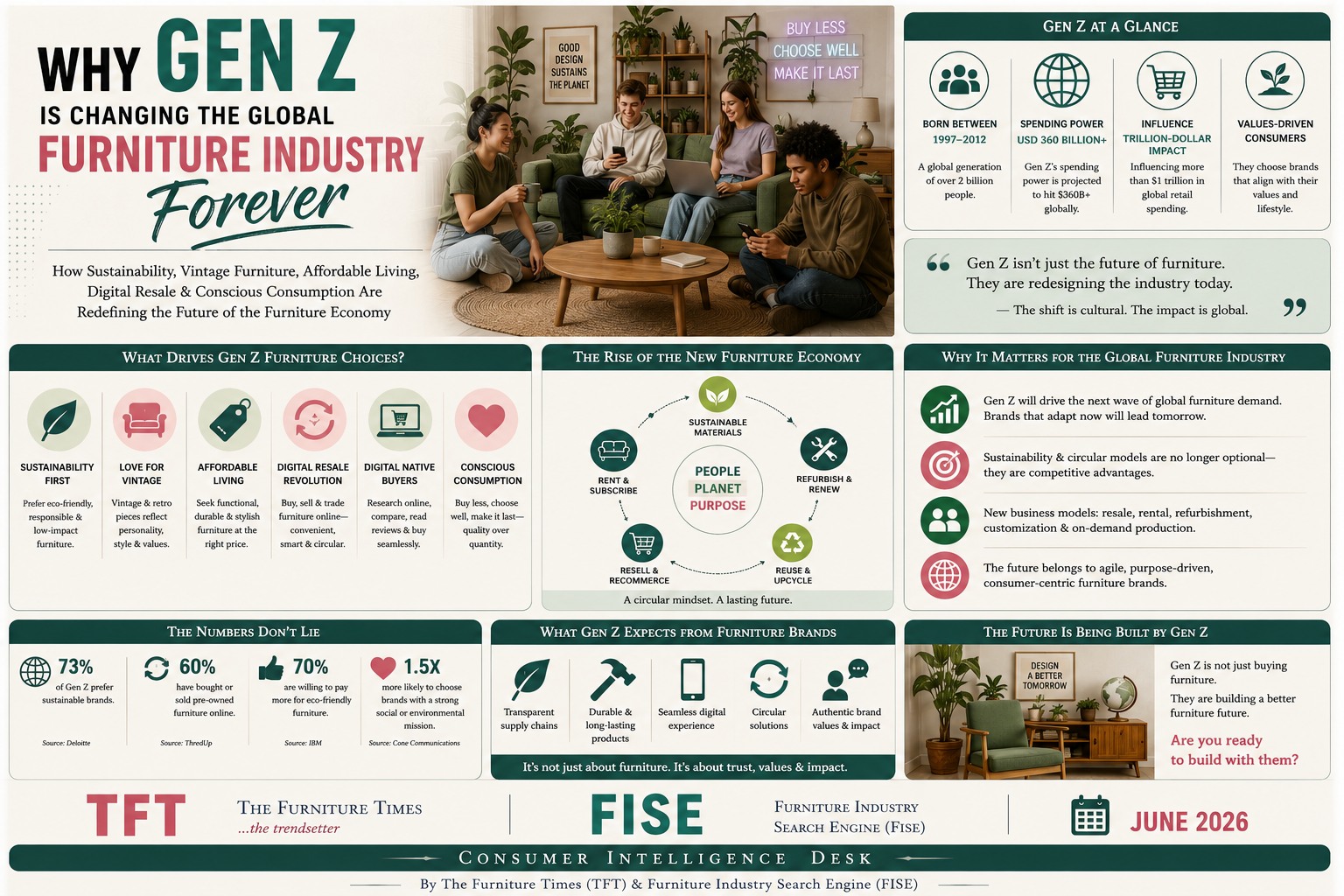
Why Gen Z Is Changing the Global Furniture Industry Forever
How Sustainability, Vintage Furniture, Affordable Living, Digital Resale & Conscious Consumption Are Redefining the Future of the Furniture Economy
Consumer Intelligence Desk
By The Furniture Times (TFT) & Furniture Industry Search Engine (FISE)
June 2026
Every generation changes the economy.
Baby Boomers built the post-war consumer economy.
Generation X accelerated globalization.
Millennials transformed digital commerce.
Today, Generation Z is beginning to reshape one of the world’s oldest industries.
The furniture industry.
Born into a world of smartphones, social media, artificial intelligence, climate awareness, and digital commerce, Gen Z approaches furniture differently from every previous generation.
For previous generations, furniture represented ownership.
For Generation Z, furniture increasingly represents flexibility.
For previous generations, furniture symbolized permanence.
For Generation Z, furniture symbolizes functionality.
For previous generations, success meant buying new.
For Generation Z, success often means buying smarter.
This shift is creating one of the biggest transformations the furniture industry has experienced in decades.
The next generation of furniture buyers is not simply purchasing products.
They are purchasing values.
Generation Z Is Not Buying Furniture the Same Way
Many furniture companies continue selling using assumptions developed twenty or thirty years ago.
Those assumptions are becoming outdated.
Generation Z asks different questions.
Instead of asking:
“What is the price?”
They also ask:
- Is it sustainable?
- Who made it?
- Can it be repaired?
- Can it be resold?
- Is it ethically produced?
- Does it fit my lifestyle?
- Will it last?
- Can I move it easily?
This change represents a complete shift in purchasing psychology.
Furniture companies that fail to understand these questions risk losing relevance.
Sustainability Is Becoming a Purchase Requirement
Generation Z grew up during an era of climate discussions.
Environmental responsibility has become part of everyday life.
This influences purchasing decisions.
Many younger buyers prefer companies that demonstrate:
- Responsible sourcing
- Sustainable materials
- Lower environmental impact
- Circular manufacturing
- Product longevity
- Repairability
Sustainability is no longer simply a marketing message.
It is becoming a buying criterion.
Companies that ignore sustainability may find it increasingly difficult to attract younger consumers.
The Rise of Vintage Furniture
One of the most surprising trends is the renewed popularity of vintage furniture.
Generation Z increasingly appreciates:
- Authenticity
- Character
- Handmade craftsmanship
- Historic design
- One-of-a-kind products
Unlike previous generations, many younger consumers do not view older furniture as outdated.
They see it as unique.
Vintage furniture offers individuality that mass-produced products often cannot provide.
This trend is also encouraging growth in:
- Antique restoration
- Furniture refurbishment
- Upholstery
- Wood refinishing
The past is becoming part of the future.
Affordable Living Is Changing Everything
Housing affordability is becoming one of the defining economic challenges facing younger generations.
Across many countries:
- Property prices continue rising.
- Apartment sizes are becoming smaller.
- Rental living is increasing.
- Home ownership is occurring later in life.
These realities directly influence furniture buying behaviour.
Instead of purchasing large furniture collections immediately, younger consumers often prioritize:
- Essential furniture
- Multi-functional furniture
- Modular furniture
- Flexible furniture
- Affordable solutions
Furniture manufacturers must understand that affordability does not necessarily mean cheap.
It means value.
Apartment Living Requires Smarter Furniture
Generation Z is more likely than previous generations to live in:
- Apartments
- Condominiums
- Shared housing
- Student accommodation
- Compact urban homes
These living environments create demand for:
- Foldable furniture
- Expandable dining tables
- Storage beds
- Modular sofas
- Wall-mounted solutions
- Space-saving furniture
Furniture design is increasingly driven by urban lifestyles rather than large suburban homes.
The future belongs to furniture that adapts to changing spaces.
Digital Resale Platforms Are Becoming Mainstream
Generation Z is highly comfortable buying pre-owned products online.
Unlike previous generations, second-hand shopping often carries little social stigma.
Digital resale platforms have normalized:
- Used furniture
- Vintage furniture
- Refurbished furniture
- Certified pre-owned furniture
This shift supports both affordability and sustainability.
Consumers increasingly recognise that a well-maintained product can deliver excellent value.
The second-hand furniture market is becoming an integral part of the furniture economy rather than a separate market.
Conscious Consumption Is Replacing Impulse Buying
One of the defining characteristics of Generation Z is conscious consumption.
This generation increasingly evaluates purchases based on:
- Purpose
- Longevity
- Environmental impact
- Social responsibility
- Practicality
Many younger consumers would rather buy fewer products with greater long-term value than purchase frequently without considering consequences.
This creates opportunities for manufacturers producing durable, repairable, high-quality furniture.
Social Media Has Become the New Showroom
Previous generations visited furniture stores.
Generation Z often discovers furniture through:
- Social media
- Interior design creators
- Digital communities
- Online reviews
- Influencers
- AI-powered recommendations
The first showroom is increasingly digital.
Furniture brands must therefore create visual experiences that inspire customers before they enter a physical store.
Artificial Intelligence Will Influence Generation Z Purchases
Generation Z has embraced AI faster than previous generations.
Increasingly, younger consumers ask AI systems:
- Which sofa fits my apartment?
- What furniture lasts longest?
- Which dining table is best for small spaces?
- Which furniture brands are sustainable?
This changes discoverability.
Furniture companies must become understandable not only to customers but also to AI systems.
Experience Matters More Than Ownership
One of the biggest philosophical shifts is the move from ownership to experience.
Generation Z increasingly values:
- Flexibility
- Convenience
- Access
- Experiences
This creates opportunities for:
- Furniture rental
- Furniture subscriptions
- Furniture-as-a-Service
- Buy-back programmes
- Trade-in programmes
Ownership is no longer the only business model.
Access is becoming equally important.
Why Furniture Brands Must Adapt
Many furniture businesses continue targeting consumers as they did twenty years ago.
The next generation expects something different.
They want:
- Transparency
- Sustainability
- Digital convenience
- Personalization
- Flexible purchasing
- Ethical production
- Authentic brands
The companies that adapt early will build stronger relationships with younger consumers.
Challenges for Manufacturers
Generation Z presents both opportunities and challenges.
Manufacturers must rethink:
Product Design
Products should support smaller living spaces.
Material Selection
Sustainability is increasingly expected.
Product Lifecycles
Repairability becomes more important.
Communication
Brands must educate rather than simply advertise.
Digital Visibility
Searchability is becoming essential.
The companies that evolve will remain relevant.
The Opportunity for TFT & FISE
Generation Z discovers businesses differently.
Search.
AI.
Content.
Videos.
Reviews.
Recommendations.
This reinforces the importance of platforms such as The Furniture Times (TFT) and Furniture Industry Search Engine (FISE).
The future furniture ecosystem requires:
- Better visibility
- Better discoverability
- Better education
- Better industry knowledge
TFT tells the industry’s stories.
FISE helps the next generation find them.
TFT & FISE Analysis
Generation Z is not rejecting the furniture industry.
It is redefining it.
The future customer is asking deeper questions.
Not only:
“What does this furniture cost?”
But also:
“What impact does this furniture create?”
Manufacturers who understand these changing priorities will gain long-term competitive advantages.
Those who ignore them risk becoming increasingly disconnected from tomorrow’s buyers.
Final Verdict
Generation Z is changing the furniture industry forever.
Not because it spends more.
But because it thinks differently.
It values sustainability over waste.
Purpose over excess.
Flexibility over permanence.
Experience over ownership.
Conscious consumption over impulse buying.
The furniture businesses that embrace these values will not only attract younger customers.
They will help build a stronger, more responsible, and more resilient global furniture industry.
Because the future of furniture will not simply be built by new products.
It will be built by new thinking.
By The Furniture Times (TFT) & Furniture Industry Search Engine (FISE)
Consumer Intelligence Desk | June 2026
“TFT tells their story. FISE helps the world find them.”
The furniture industry ecosystem is a $1 Trillion Dollar Industry.

Related Posts
The Billion-Dollar Opportunity in Furniture Refurbishment
U.S. Furniture Retail Sales Slip Again as the Sector Becomes July’s Only Year-Over-Year Decliner