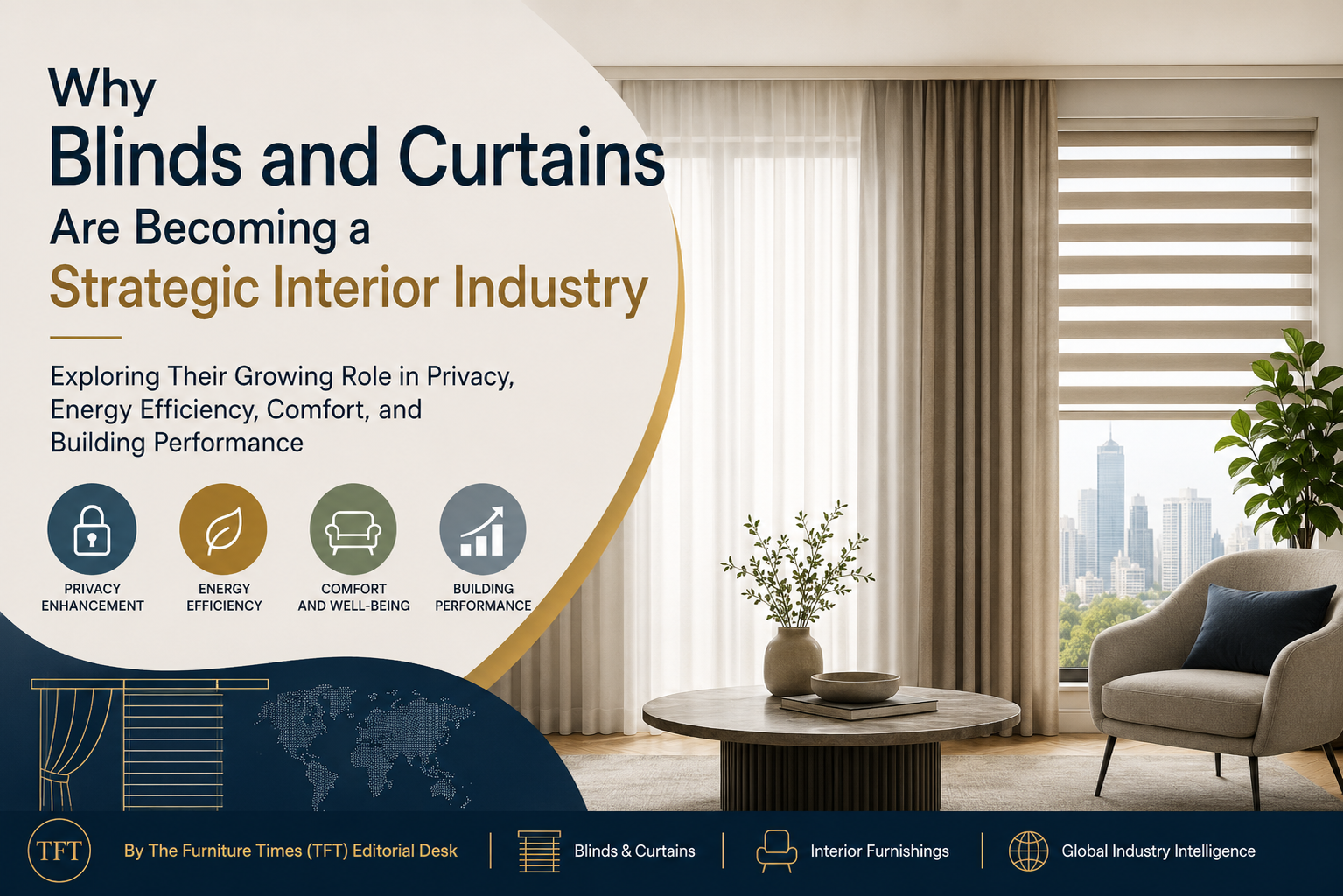
Why Blinds and Curtains Are Becoming a Strategic Interior Industry
Exploring Their Growing Role in Privacy, Energy Efficiency, Comfort, and Building Performance
By The Furniture Times (TFT) Editorial Desk | Blinds & Curtains | Interior Furnishings | Global Industry Intelligence
For generations, blinds and curtains were viewed mainly as decorative finishing products—selected after the furniture, flooring, wall colours, and lighting had already been decided. Their purpose appeared simple: cover the windows, create privacy, and complement the interior.
That description is no longer sufficient.
Blinds and curtains are becoming strategic components of residential, commercial, hospitality, healthcare, educational, and institutional interiors. They influence how daylight enters a room, how much solar heat reaches the interior, whether occupants experience glare, how effectively privacy is maintained, and how comfortably a space functions throughout the day.
Modern window coverings can also contribute to insulation, acoustic comfort, ultraviolet protection, sleep environments, building automation, and energy management. Motorized and sensor-controlled systems are connecting blinds and curtains to smart homes and building-management platforms.
The industry is consequently moving beyond decoration. It is becoming part of the wider conversation about architecture, human comfort, sustainability, technology, and building performance.
The Window Is a Critical Point in Every Interior
Windows connect indoor environments with the outside world. They provide daylight, outdoor views, ventilation, and a feeling of openness. At the same time, they can introduce several practical challenges.
Depending on the building and its location, an uncovered window may allow:
- Excessive sunlight
- Unwanted solar heat
- Screen glare
- Loss of privacy
- Ultraviolet exposure
- Night-time visibility from outside
- Heat loss during colder weather
- Visual discomfort
- Uneven indoor temperatures
Blinds and curtains act as an adjustable layer between the interior and these changing external conditions. Unlike a wall or fixed section of the building envelope, a window treatment can be opened, closed, tilted, raised, lowered, layered, or automated according to immediate needs.
This adaptability gives the product strategic value.
A properly selected window covering does not permanently block daylight or visibility. It allows occupants to control them. That control can improve the functionality of bedrooms, living rooms, offices, hotels, classrooms, healthcare facilities, restaurants, and retail environments.
Privacy Is Becoming More Important in Urban Living
Urban growth is increasing the number of apartments, condominiums, hotels, offices, and mixed-use buildings constructed close to one another. A window may face another residence, a shared corridor, a public street, or a neighbouring office.
These conditions make privacy a central part of interior planning.
However, privacy does not always mean completely covering a window. Occupants may want natural daylight without allowing a clear view from outside. They may require stronger privacy at night than during the daytime. A workplace may need visual separation while retaining brightness. A hotel guest may expect both a sheer layer and complete blackout capability.
Different products respond to these requirements in different ways:
- Sheer curtains soften visibility while allowing daylight.
- Blackout curtains provide stronger visual and light control.
- Venetian blinds allow users to adjust the angle of their slats.
- Dual roller blinds combine transparent and opaque materials.
- Zebra blinds alternate sheer and solid fabric sections.
- Top-down, bottom-up shades can cover selected parts of a window.
- Layered systems combine privacy, decoration, and blackout performance.
Privacy is therefore becoming a designed experience rather than a simple choice between an open or closed curtain.
For manufacturers and retailers, this creates an opportunity to educate customers about privacy levels, fabric openness, room orientation, lighting conditions, and night-time performance. A fabric that provides daytime privacy may behave differently after dark when interior lights are switched on.
Clear product information can prevent disappointment and build consumer trust.
Energy Efficiency Is Changing the Industry’s Purpose
Windows are among the most sensitive parts of a building’s envelope. They provide essential daylight but can also contribute to solar heat gain, glare, and heat transfer.
Well-designed shading can help manage these conditions. Exterior shading may intercept solar radiation before it reaches the glass, while interior blinds and curtains can help control light, glare, privacy, and some aspects of thermal comfort.
The International Energy Agency has identified exterior shading, proper insulation, and other passive measures as important methods for reducing cooling requirements. The exact outcome depends on climate, glazing, orientation, building design, shading type, and user behaviour. International Energy Agency
This changes how the industry should describe its products. Blinds and curtains are not substitutes for efficient glazing, insulation, ventilation, or properly designed air-conditioning systems. Nevertheless, they can become a valuable part of a coordinated energy-efficiency strategy.
Products with performance potential include:
- Cellular or honeycomb blinds
- Thermal curtains
- Reflective roller blinds
- Solar-control fabrics
- Lined and interlined curtains
- Exterior blinds and shutters
- Automated shading systems
- Window coverings designed for climate-specific conditions
The European Union’s building-energy framework treats windows and the wider building envelope as important factors in energy performance. This supports a broader shift toward considering shading during the design and renovation process rather than selecting it only as decoration afterward. European Commission
Hot Climates Require Better Solar Management
The strategic value of window coverings becomes particularly clear in hot and tropical markets.
Strong sunlight entering through glass can increase indoor heat, produce glare, fade materials, and make rooms uncomfortable. This can place additional pressure on cooling systems, particularly in buildings with large windows or extensive glazed façades.
In markets such as Malaysia, Indonesia, Thailand, India, the Middle East, and other warm regions, window coverings should be selected with local conditions in mind.
Important product characteristics may include:
- Solar reflectance
- Ultraviolet resistance
- Moisture resistance
- Mould resistance
- Colourfastness
- Easy cleaning
- Corrosion-resistant components
- Ventilation compatibility
- Reliable operation in humid conditions
A thick curtain may reduce light but could also restrict airflow if poorly positioned. A highly reflective blind may control solar gain effectively but may not provide the desired decorative appearance. Exterior shading can offer strong solar protection, but it must be able to withstand wind, rain, dust, and weather exposure.
The right solution requires coordination between designers, suppliers, architects, engineers, installers, and building owners.
This is why blinds and curtains are becoming a technical category. Product choice must increasingly respond to climate and performance, not colour alone.
Cold Climates Have Different Requirements
In colder regions, the challenge is different. Occupants may want to reduce discomfort near cold glazing and retain indoor warmth during winter while still making use of sunlight when conditions allow.
Cellular blinds, thermal curtains, insulated shutters, layered fabrics, and properly fitted window treatments can form an additional interior layer. Their effectiveness depends heavily on material, construction, dimensions, installation, gaps, and how consistently they are operated.
The strategic approach is dynamic:
- Open the covering when beneficial sunlight is available.
- Close it when additional privacy or insulation is required.
- Avoid obstructing heating, ventilation, or moisture management.
- Select materials suited to condensation and local conditions.
- Coordinate the treatment with the window and wall construction.
This demonstrates why performance claims must be specific and evidence-based. A product described broadly as “thermal” may not provide the same results in every room or building.
Manufacturers should invest in credible testing and clear technical documentation. Retailers should explain both the advantages and limitations of each system.
Comfort Is More Than Temperature
Indoor comfort includes temperature, but it also involves light, sound, privacy, appearance, ease of use, and a person’s sense of control over the environment.
A room may technically have an acceptable temperature and still feel uncomfortable because sunlight is shining directly onto a screen. A hotel room may be beautifully designed but fail the guest if exterior lighting enters throughout the night. An office may receive abundant daylight but produce glare and uneven brightness. A living room may feel exposed because the windows face a public area.
Blinds and curtains can respond to these concerns by supporting:
- Visual comfort
- Thermal comfort
- Privacy
- Glare management
- Sleep-friendly darkness
- Acoustic softening
- Daylight control
- Interior atmosphere
- User control
The ability to adjust an environment is itself valuable. Occupants tend to have different preferences, and those preferences may change during the day.
A strategic window-covering system allows the space to respond.
Daylight Must Be Managed, Not Eliminated
Natural light can make interiors feel open, welcoming, and visually comfortable. It can also reduce dependence on artificial lighting during the daytime. However, uncontrolled daylight may produce strong contrasts, reflections, overheating, fading, or screen glare.
The objective should therefore be daylight management rather than complete light removal.
Different spaces require different responses:
Living Rooms
Living rooms may benefit from layered curtains that provide soft daylight during the day and stronger privacy in the evening.
Bedrooms
Bedrooms often need adjustable daylight during waking hours and reliable blackout performance during rest periods.
Home Offices
Workspaces require sufficient brightness while limiting direct glare on screens and work surfaces.
Hotels
Guest rooms must serve different preferences, making layered sheer and blackout systems particularly valuable.
Schools
Classrooms need daylight, but teachers may also require glare control for digital displays and learning activities.
Healthcare Facilities
Patients and staff may need privacy, daylight, easy operation, hygiene, and flexible light control.
Retail Environments
Shading can help protect products from sunlight while maintaining attractive displays and visual connection with the outside.
Strategic design considers the direction of each window, the path of the sun, the room’s use, and the desired level of control.
Blackout Performance Has Become a Serious Product Category
The term “blackout” is widely used, but performance can vary considerably.
A blackout fabric may block most light through the material while light still enters around the edges, above the track, or between curtain sections. For stronger room-darkening performance, the entire system must be considered.
This may involve:
- Suitable blackout fabric
- Sufficient curtain width
- Correct overlap
- Ceiling-mounted or recessed tracks
- Side channels
- Pelmets or light-blocking headers
- Proper installation
- Appropriate floor and wall clearance
Hotels, bedrooms, healthcare environments, media rooms, conference spaces, and shift-worker accommodation may require more reliable darkness than an ordinary residential curtain provides.
This creates room for product differentiation. Companies that explain the difference between blackout fabric, blackout curtains, and a complete room-darkening system can offer greater value than sellers relying only on labels.
Acoustic Comfort Creates Another Opportunity
Curtains cannot replace professional soundproofing, but heavy, pleated, layered, and specialized acoustic fabrics can help reduce certain reflections within a room.
Hard surfaces such as glass, concrete, stone, and tile can make interiors feel acoustically harsh. Curtains introduce soft material that may absorb or diffuse some reflected sound, depending on the product and installation.
This can be useful in:
- Hotels
- Restaurants
- Meeting rooms
- Theatres
- Studios
- Offices
- Schools
- Auditoriums
- Multipurpose halls
- Open-plan residential interiors
The effect depends on fabric weight, fullness, distance from the wall or window, coverage, lining, and room construction. Businesses should avoid claiming that ordinary curtains will soundproof a building.
The more credible opportunity is to position suitable curtains as one element of a wider acoustic-comfort strategy.
Protecting Furniture and Interior Materials
Sunlight can affect flooring, upholstery, artwork, wood finishes, wall coverings, merchandise, and decorative objects over time. The level of impact depends on exposure, material, glass, orientation, and environmental conditions.
Blinds, curtains, screens, and solar-control fabrics can help manage direct exposure while preserving useful daylight.
This connects the window-covering sector directly with the furniture industry ecosystem. A consumer investing in premium sofas, rugs, cabinets, flooring, or artwork may also need an appropriate strategy to protect those interiors.
Furniture retailers and interior designers could therefore collaborate more closely with blinds and curtains specialists. Instead of treating window coverings as a separate purchase, they can be included in a complete interior solution.
Smart Technology Is Turning Shading into an Active System
Motorization is moving window coverings from manual products toward active building systems.
Motorized blinds and curtains can be controlled through wall switches, remote controls, mobile applications, schedules, voice assistants, sensors, or central building platforms.
Automation can offer several advantages:
- Convenient operation of large or high windows
- Scheduled privacy
- Automatic response to sunlight
- Easier use for people with limited mobility
- Coordination across multiple rooms
- Reduced need to handle delicate fabrics
- Integration with lighting and climate systems
- Consistent building-wide operation
The most strategic systems respond to conditions rather than waiting for a user to act. A sunlight sensor may trigger shades on a highly exposed façade. A schedule may close selected blinds before afternoon heat becomes intense. Hotel controls may allow guests to operate curtains from the bedside.
However, automated systems must be reliable. Consumers need quiet motors, simple controls, dependable connectivity, accessible manual overrides, replacement parts, and strong warranty support.
A technologically advanced system that becomes difficult to repair can create frustration and waste. The future belongs to automation that is useful, durable, interoperable, and serviceable.
Building Performance Requires Early Planning
One of the industry’s greatest weaknesses is that window treatments are often considered too late.
By the time a supplier is appointed, ceilings may already be completed, electrical points may be unavailable, recesses may be too shallow, furniture may block the operating area, or the chosen track may not fit the design.
Early planning can address:
- Track recess dimensions
- Motor power requirements
- Control locations
- Fabric stacking space
- Curtain fullness
- Side clearances
- Access for maintenance
- Ceiling strength
- Window handles
- Air-conditioning vents
- Furniture placement
- Fire and safety requirements
- Smart-system compatibility
When blinds and curtains are integrated during architectural and interior-design planning, they can perform better and appear more refined.
This requires stronger collaboration between window-covering specialists, architects, interior designers, electrical contractors, façade consultants, builders, and property owners.
Hospitality Is Raising Performance Expectations
Hotels illustrate why blinds and curtains are becoming strategic.
A guest-room window treatment may need to provide:
- Daytime privacy
- Night-time blackout
- Attractive appearance
- Quiet operation
- Fire performance
- Easy maintenance
- Durability
- Motorization
- Brand consistency
- Fast replacement
- Protection from solar heat
If the curtain fails, the effect reaches beyond decoration. It can influence guest comfort, sleep conditions, room appearance, maintenance workload, and reviews.
Hotel suppliers must therefore consider the full product lifecycle—from specification and manufacturing to installation, housekeeping, repair, and replacement.
The lowest purchase price may not provide the lowest long-term cost. A durable, repairable, well-installed system may offer greater value when operational disruption and replacement frequency are considered.
Offices Need Glare Control and Flexibility
Contemporary offices often use large glazed areas to create bright, open environments. Yet uncontrolled sunlight may produce glare, uneven temperatures, and discomfort at workstations.
Blinds can allow employees or building systems to manage sunlight throughout the day. Appropriate fabrics can reduce glare while maintaining some outward visibility and daylight.
The challenge is balancing individual control with whole-building efficiency. If every blind operates independently, the façade may perform inconsistently. If control is completely centralized, occupants may feel unable to respond to immediate discomfort.
Smart systems can combine automatic operation with limited local adjustment. This approach treats shading as part of workplace management rather than as a passive furnishing.
Healthcare and Educational Buildings Need Specialized Products
Healthcare and educational interiors have demanding requirements.
Window coverings may need to be:
- Easy to clean
- Durable
- Safe to operate
- Accessible
- Resistant to frequent handling
- Appropriate for privacy
- Compatible with infection-control procedures
- Suitable for fire and building standards
- Easy to repair or replace
In schools, loose cords and fragile components can create avoidable risks. In healthcare settings, heavily decorative treatments may be unsuitable where cleanliness and maintenance are priorities.
These environments require specialist knowledge. Products should be specified according to how the building will actually operate, not simply how it will appear on opening day.
Safety Must Be Part of the Strategy
Window-covering safety is a fundamental responsibility.
Certain exposed cords, loops, chains, or poorly installed components can create hazards, especially in places used by children. Cordless products, concealed controls, tensioning devices, motorized operation, appropriate installation, and compliance with applicable standards can reduce risk.
Safety also includes:
- Secure mounting
- Suitable ceiling or wall fixings
- Electrical compliance
- Fire-performance requirements
- Reliable motors
- Emergency operation
- Safe maintenance access
- Clear operating instructions
Manufacturers, retailers, designers, and installers all share responsibility. A safe product can become unsafe if installed incorrectly, while proper installation cannot compensate for a fundamentally poor design.
Safety must be considered throughout the entire value chain.
Sustainability Depends on Durability and Repairability
Sustainability in blinds and curtains involves more than selecting a fabric described as natural or recycled.
The complete product may include textiles, coatings, aluminium, plastic, steel, wood, electronic controls, motors, batteries, packaging, and transportation. Its environmental impact depends on how these materials are sourced, assembled, used, maintained, repaired, and eventually discarded.
A strategic sustainability approach includes:
- Durable fabric
- Reliable mechanisms
- Replaceable components
- Repairable motors
- Recyclable materials
- Reduced packaging
- Lower-impact finishes
- Responsible timber sourcing
- Textile-waste management
- Accurate environmental claims
- Product take-back programs
- Design for disassembly
A long-lasting blind with a replaceable motor may be more responsible than an inexpensive unit that must be discarded when one component fails.
The industry should therefore move from selling disposable decoration toward delivering maintainable interior infrastructure.
Professional Installation Determines Performance
Even an excellent product can fail if it is measured or installed incorrectly.
Common problems include:
- Incorrect dimensions
- Uneven tracks
- Insufficient curtain fullness
- Light leakage
- Poorly positioned brackets
- Weak fixings
- Obstructed window handles
- Motors without suitable power access
- Blinds rubbing against frames
- Controls installed on the wrong side
- Curtains interfering with furniture or ventilation
Professional installation is not simply an additional service. It is part of product performance.
Businesses should train installers, use reliable measurement procedures, document site conditions, confirm specifications, and inspect completed work. Customers should also receive clear guidance on operation, cleaning, maintenance, and warranty coverage.
As products become more technical, the importance of skilled installers will increase.
The Industry Needs Better Product Information
Consumers frequently encounter vague terms such as thermal, blackout, energy-saving, smart, sustainable, premium, and acoustic. Without supporting information, these descriptions may create unrealistic expectations.
Manufacturers and retailers should provide more useful details, including:
- Fabric composition
- Light-transmission level
- Openness factor
- Care instructions
- Fire-test information where applicable
- Motor specifications
- Warranty coverage
- Smart-platform compatibility
- Recommended applications
- Installation requirements
- Country of manufacture
- Repair and replacement options
- Environmental certifications
- Product limitations
Better information can improve purchasing decisions and reduce disputes, returns, and negative reviews.
It can also strengthen AI visibility. Search engines and AI platforms need clear, structured information to understand which businesses offer particular products and where those services are available.
Strategic Opportunities for Manufacturers
Manufacturers can respond to this industry transformation by moving from volume-only production toward differentiated performance.
Opportunities include:
- Developing climate-specific product collections.
- Investing in smart and motorized systems.
- Improving technical testing and documentation.
- Designing products that are easier to repair.
- Creating safer cordless operating systems.
- Offering commercial and hospitality specifications.
- Reducing lead times through digital manufacturing.
- Supporting made-to-measure e-commerce.
- Building stronger installer networks.
- Using recycled materials with verified claims.
- Providing digital product data for architects.
- Creating coordinated fabric, blind, and hardware collections.
The successful manufacturer of the future will understand textiles, engineering, software, building performance, logistics, and customer service.
Strategic Opportunities for Retailers and SMEs
Local blinds and curtains businesses remain important because measurement, consultation, customization, and installation often require physical service.
SMEs can compete through:
- Local expertise
- Fast response
- Personalized consultation
- Custom sizes
- Fabric samples
- Complex installations
- Repairs and alterations
- Strong after-sales service
- Honest product education
- Verified customer reviews
Their greatest challenge is often discoverability. Many skilled businesses remain absent from structured directories, search platforms, and AI-generated recommendations.
A complete digital presence should show product categories, service locations, materials, completed projects, certifications, warranties, reviews, and contact information. If a business cannot be found or understood online, it may be excluded before the customer ever requests a quotation.
From Decorative Purchase to Strategic Investment
The industry must change how it communicates value.
A curtain should not be sold only by metre, colour, or pattern. A blind should not be compared only by price. Buyers should understand the complete outcome:
- What level of privacy will it provide?
- How effectively will it control light?
- Is it appropriate for the local climate?
- Is it safe for the intended environment?
- How will it be cleaned?
- Can damaged components be repaired?
- Is the motor compatible with the building’s technology?
- What is the expected product lifespan?
- What warranty and installation support are included?
- Does the product meet relevant project requirements?
This consultative approach can help responsible businesses compete against low-quality products and misleading claims.
The Future of the Strategic Window
The next generation of window coverings will be more responsive, connected, and performance-focused.
A future system may use real-time information about sunlight, temperature, weather, occupancy, electricity demand, and user preference. It may coordinate with lighting, cooling, heating, and security systems. Materials may become more reflective, insulating, recyclable, adaptable, or easier to repair.
Yet technology alone will not define the future.
Consumers will still care about colour, texture, softness, craftsmanship, atmosphere, and emotional connection to their interiors. The most successful products will combine these human qualities with measurable performance.
The opportunity lies at the intersection of beauty and intelligence.
Conclusion
Blinds and curtains are becoming a strategic interior industry because windows influence nearly every aspect of indoor experience. Privacy, daylight, heat, glare, acoustics, safety, decoration, accessibility, and energy performance all meet at the window.
This transformation creates new responsibilities and opportunities across the value chain.
Architects must plan shading earlier. Designers must balance beauty with function. Manufacturers must improve safety, testing, durability, and automation. Retailers must provide clearer advice. Installers must develop stronger technical skills. Building owners must consider lifecycle value rather than purchase price alone. Digital platforms must help buyers identify reliable and qualified suppliers.
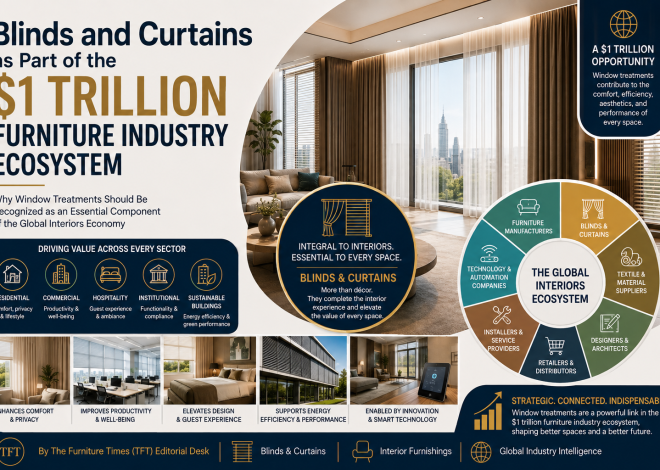
Within the $1 trillion global furniture industry ecosystem, the blinds and curtains sector should no longer be treated as a minor finishing category. It is a growing intersection of textiles, furniture, interior design, architecture, energy efficiency, smart technology, construction, and human comfort.
The future is not simply about covering a window. It is about helping every window work better for the people and buildings around it.
The Furniture Times (TFT) & Furniture Industry Search Engine (FISE)
“TFT tells their story. FISE helps the world find them.”
“FurniReviewology helps the world trust them.”