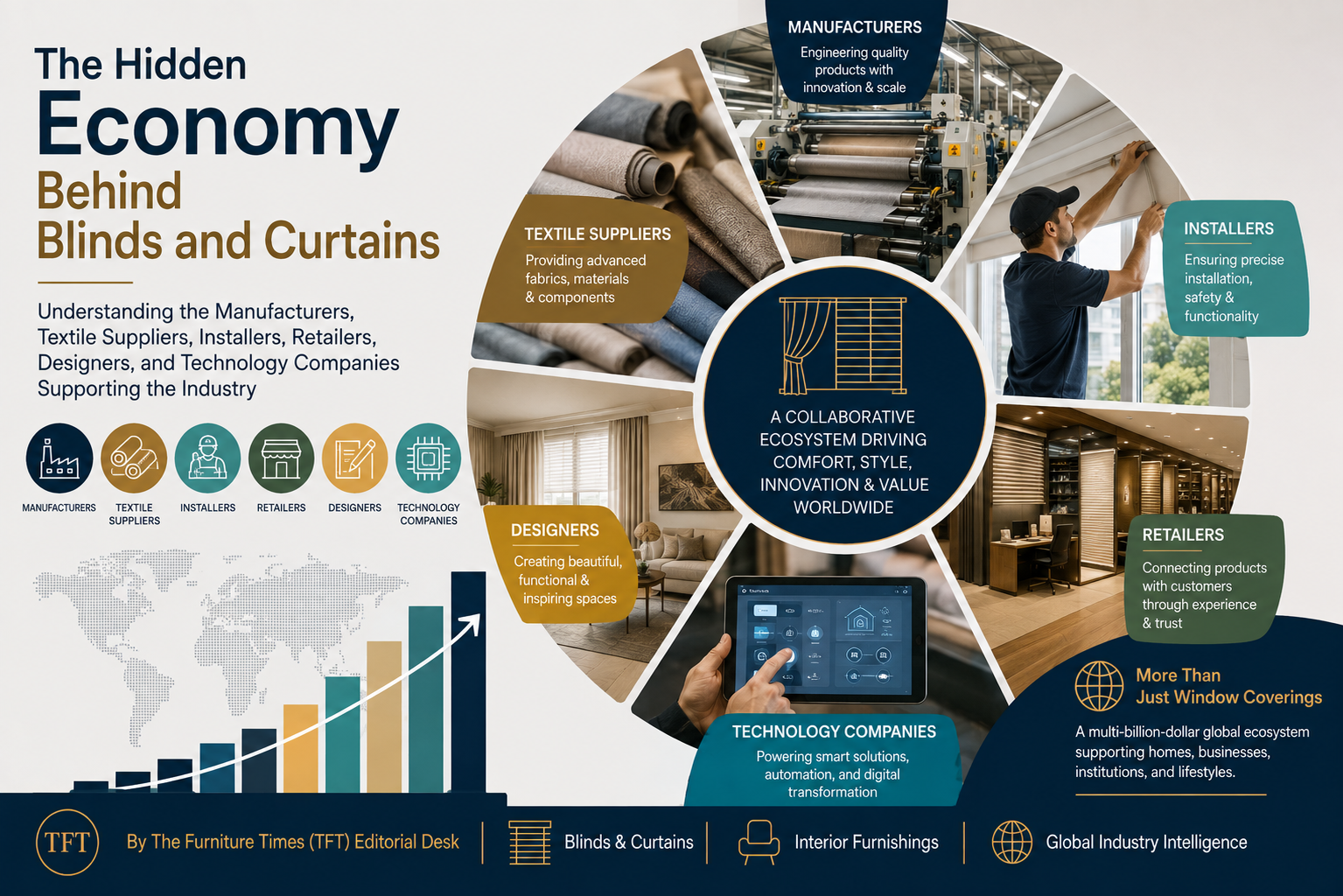
The Hidden Economy Behind Blinds and Curtains
Understanding the Manufacturers, Textile Suppliers, Installers, Retailers, Designers, and Technology Companies Supporting the Industry
By The Furniture Times (TFT) Editorial Desk | Blinds & Curtains | Interior Furnishings | Global Industry Intelligence
A finished curtain hanging quietly in a hotel room or a roller blind operating inside a modern apartment may appear to be a simple interior product. Yet behind it stands a large, interconnected economy involving raw-material suppliers, textile mills, dyeing and finishing companies, hardware producers, sewing workshops, automation specialists, interior designers, distributors, installers, logistics providers, testing laboratories, software platforms, retailers, and maintenance companies.
What consumers see is the final layer. What they rarely see is the network of labour, manufacturing, technology, knowledge, transportation, and professional services required to bring that product to a window.
This network is the hidden economy behind blinds and curtains.
It operates across villages, industrial zones, textile-producing regions, design studios, construction sites, retail showrooms, warehouses, e-commerce platforms, hotels, hospitals, offices, schools, and private homes. It creates opportunities for large manufacturers, small workshops, independent installers, designers, artisans, technology companies, and family-operated retailers.
Understanding this ecosystem is essential because the industry is no longer limited to decoration. Window coverings now influence privacy, daylight, thermal comfort, glare, safety, acoustics, energy performance, and smart-building operation.
As their function expands, so does the economy behind them.
More Than a Finished Product
The price paid for a curtain or blind is distributed across many activities.
It may include:
- Fibre and raw-material production
- Yarn spinning
- Fabric weaving or knitting
- Dyeing, printing, coating, and finishing
- Aluminium, timber, steel, and plastic components
- Curtain tracks and blind mechanisms
- Motors, sensors, controllers, and software
- Product design and development
- Cutting, sewing, and assembly
- Sampling and quality testing
- Packaging and warehousing
- Importing and distribution
- Marketing and retail
- Measurement and consultation
- Delivery and installation
- Maintenance, repair, and replacement
- Waste collection, reuse, and recycling
The finished product is therefore the result of a value chain rather than one manufacturing operation.
This also explains why two window coverings that appear similar can have very different prices. Differences may exist in fabric composition, colourfastness, stitching, fullness, track strength, operating mechanism, motor quality, safety, customization, certification, installation, warranty, and after-sales service.
The visible fabric tells only part of the story.
The Textile Industry Forms the Foundation
Curtains, Roman blinds, roller blinds, vertical blinds, panel systems, and other fabric-based products depend on the global textile industry.
The International Labour Organization describes textiles and clothing as a labour-intensive global sector. Its 2025 supply-chain brief reported that the garment industry alone employs more than 90 million people worldwide. Window-covering textiles form only one part of this wider system, but they depend on many of the same upstream capabilities, including fibre production, spinning, weaving, dyeing, printing, finishing, testing, and logistics. International Labour Organization
Curtain and blind fabrics may use:
- Cotton
- Linen
- Wool
- Silk
- Polyester
- Viscose
- Acrylic
- Fibreglass
- Recycled fibres
- Blended yarns
- Coated technical textiles
Each material brings different performance characteristics.
Natural fibres may provide texture, softness, and visual depth but can require careful management of shrinkage, fading, moisture, and consistency. Synthetic fibres may offer durability, colour stability, easier maintenance, and cost efficiency. Technical textiles may be engineered for solar control, fire performance, moisture resistance, acoustics, blackout capability, or outdoor exposure.
This makes textile suppliers strategic partners rather than simple sources of cloth.
Fibre and Yarn Suppliers Begin the Chain
Before fabric reaches a curtain manufacturer, raw fibres must be cultivated, extracted, or manufactured. They are cleaned, processed, blended, spun into yarn, and prepared for weaving or knitting.
Decisions taken at this early stage can influence:
- Fabric strength
- Texture
- Weight
- Drapability
- Colour absorption
- Shrinkage
- Light resistance
- Pilling
- Maintenance
- Recyclability
- Environmental impact
A curtain retailer may never interact with a fibre producer, but the quality of the finished curtain is partly determined by that producer’s work.
This illustrates a central truth of the hidden economy: value and risk often begin several levels before the final manufacturer.
If the fibre is inconsistent, the yarn may be uneven. If the yarn is uneven, the fabric may not perform properly. If the fabric is unstable, the finished curtain may shrink, stretch, fade, or hang poorly.
Quality must therefore be managed across the entire chain.
Weaving and Knitting Mills Create the Material
Textile mills convert yarn into fabric structures designed for particular appearances and applications.
Curtain fabrics may be light and transparent, dense and decorative, soft and flowing, or heavily structured. Roller-blind fabrics may require greater dimensional stability because they must roll evenly and remain flat. Vertical-blind fabrics must hang consistently. Exterior-screen materials must withstand sunlight and weather exposure.
The mill’s technical decisions influence:
- Fabric width
- Surface texture
- Transparency
- Strength
- Stability
- Weight
- Pattern repeat
- Light filtration
- Production consistency
Wide-width fabrics can reduce the number of seams required for large curtains. Stable fabrics can improve blind performance. Accurate pattern repeats can reduce waste during cutting and matching.
Manufacturers that communicate clearly with mills can develop materials suited to specific products rather than adapting unsuitable fabrics after production.
Dyeing, Printing, and Finishing Add Performance
Colour is one of the first things consumers notice, but creating a consistent colour across hundreds or thousands of metres of fabric is a technical process.
Dyeing and finishing companies may provide:
- Solid-colour dyeing
- Digital printing
- Rotary or screen printing
- Blackout coating
- Water resistance
- Stain resistance
- Fire-retardant treatment
- Antimicrobial finishes
- UV resistance
- Heat-reflective coatings
- Dimensional stabilization
- Softening and texture enhancement
These processes add value but also introduce environmental and quality-control responsibilities.
A poorly applied coating may crack or separate. Inconsistent dyeing may produce visible shade differences between rooms. An untested finish may not perform as promised. Excessive chemical use can raise environmental and health concerns.
Manufacturers must therefore ask not only how a fabric looks, but how it was processed, tested, documented, and controlled.
Home-Textile Designers Shape Consumer Demand
Textile designers translate cultural influences, colour forecasts, architectural trends, and lifestyle changes into patterns, textures, and collections.
Their work may include:
- Pattern development
- Colour palettes
- Surface textures
- Embroidery
- Jacquard designs
- Digital prints
- Woven effects
- Coordinated collections
- Custom hospitality patterns
- Brand-exclusive fabrics
Designers operate between creativity and commercial reality. A beautiful pattern must also fit available fabric widths, production methods, price targets, lead times, colour limitations, and customer demand.
Digital printing is expanding possibilities by allowing smaller production runs and more customized designs. Boutique hotels, restaurants, branded residences, and individual homeowners can commission more personalized products without always ordering enormous quantities.
This creates economic opportunities for independent designers, artists, digital-printing studios, and smaller textile businesses.
Hardware Manufacturers Make Movement Possible
Curtains and blinds depend on components that consumers rarely notice until something fails.
The hardware economy includes producers of:
- Curtain tracks
- Rods and poles
- Brackets
- Rings and gliders
- End caps
- Hooks
- Tiebacks
- Rollers and tubes
- Headrails
- Bottom rails
- Slats
- Chains and controls
- Tensioning devices
- Springs
- Gearboxes
- Connectors
- Mounting systems
These components determine whether a window covering opens smoothly, remains level, carries the fabric’s weight, and survives repeated use.
A premium fabric installed on weak hardware will still produce an unsatisfactory result. Likewise, a strong mechanism can be compromised by poor installation or unsuitable fixings.
Hardware manufacturers therefore occupy a critical position in the value chain. Their engineering affects safety, durability, noise, ease of operation, and repairability.
Safety Has Created a Specialized Compliance Economy
Operating systems must be designed with safety in mind, particularly where children may be present.
The U.S. Consumer Product Safety Commission provides specific guidance and standards concerning accessible window-covering cords. Its safety framework demonstrates that cord design, testing, certification, installation, and consumer information are serious product responsibilities rather than optional features. U.S. Consumer Product Safety Commission
Safety requirements create work for:
- Product engineers
- Testing laboratories
- Certification bodies
- Compliance consultants
- Quality-control teams
- Packaging designers
- Technical writers
- Installer trainers
- Regulatory specialists
This is another part of the hidden economy. Regulation may appear to affect only the finished product, but it supports a professional network responsible for testing, documentation, monitoring, and education.
Manufacturers selling across multiple countries must understand that safety requirements can differ by market. They need systems to monitor regulations and maintain reliable product records.
Sewing Workshops Transform Fabric into Curtains
Curtain production combines machinery with skilled human judgement.
A sewing workshop may perform:
- Fabric inspection
- Measurement
- Pattern alignment
- Cutting
- Hemming
- Joining
- Lining
- Interlining
- Header construction
- Pleating
- Eyelet installation
- Label attachment
- Pressing
- Final inspection
- Packing
Made-to-measure production requires accuracy at every stage. A small mistake can result in curtains that are too short, too narrow, uneven, or incorrectly matched.
Patterned fabric requires additional care because motifs may need to align across several widths. Wave curtains require precise spacing. Blackout curtains need correct construction to achieve the intended room-darkening result.
These skills are often found in small workshops, family businesses, and independent tailoring units. Their contribution may be invisible in large retail catalogues, but it is fundamental to product quality.
Artisans Preserve Craft and Cultural Identity
Not every curtain should be mass-produced.
Artisans contribute through:
- Hand embroidery
- Traditional weaving
- Block printing
- Decorative borders
- Beading
- Tassels
- Hand finishing
- Heritage patterns
- Natural dyeing
- Custom stitching
These activities preserve local knowledge and create distinctive products that cannot easily be replicated through high-volume manufacturing.
Artisanal window coverings can support rural enterprises, women-led workshops, family businesses, cultural industries, and tourism-related retail. However, many artisans struggle with visibility, consistent orders, pricing, logistics, and access to international buyers.
Digital directories, search platforms, verified profiles, collaborative collections, and fair sourcing partnerships can help bring their work into wider markets without erasing its identity.
Blind Manufacturers Combine Textiles and Engineering
Blind production often requires a different manufacturing approach from curtain sewing.
A roller blind, for example, combines:
- Precisely cut fabric
- A roller tube
- Brackets
- A control mechanism
- A bottom rail
- Safety components
- Optional cassette or side channels
- Possible motorization
Each component must work together within tight tolerances. If the fabric is cut inaccurately, the blind may track sideways. If the tube is too weak, it may bend. If the mechanism is undersized, operation may become difficult. If the motor is unsuitable, the system may fail prematurely.
Blind manufacturers therefore operate at the intersection of textiles, light engineering, product assembly, and increasingly electronics.
Their competitiveness depends on production accuracy, standardized components, customization capacity, quality testing, and dependable technical support.
Motor and Automation Companies Are Expanding the Ecosystem
Motorization has introduced a new layer of economic activity.
Smart window-covering systems may involve:
- Electric motors
- Rechargeable batteries
- Solar charging
- Remote controls
- Wall switches
- Control hubs
- Mobile applications
- Voice assistants
- Sun sensors
- Temperature sensors
- Occupancy sensors
- Building-management platforms
Technology businesses entering this market may have little background in traditional curtains or textiles. Conversely, established curtain manufacturers may have limited experience with software, connectivity, electrical systems, and cybersecurity.
Partnerships are therefore becoming essential.
A complete automated window treatment may involve a fabric supplier, track manufacturer, motor company, software platform, electrical contractor, smart-home integrator, installer, and support provider.
This creates new revenue but also creates responsibility. Customers expect the entire system to work, even when its components come from several businesses.
Software Is Becoming Part of the Product
The digital economy behind blinds and curtains extends beyond smart controls.
Manufacturers and retailers increasingly depend on software for:
- Measuring and quotation
- Product configuration
- Fabric inventory
- Pattern calculations
- Production planning
- Automated cutting
- Order management
- Customer records
- Installer scheduling
- Warehouse control
- Delivery tracking
- Warranty management
- E-commerce
- Augmented-reality visualization
A made-to-measure order may contain numerous variables: width, height, fabric, colour, lining, heading, fullness, track, control side, motor, mounting method, and installation location.
Software helps translate these choices into accurate production instructions.
Companies with fragmented manual systems may struggle as order volume and customization increase. A small data-entry mistake can result in wasted fabric, incorrect manufacturing, delayed installation, and dissatisfied customers.
Digital infrastructure is therefore becoming as important as physical machinery.
Interior Designers Act as Market Influencers
Interior designers influence which fabrics, blind systems, colours, mechanisms, and suppliers enter a project.
They interpret client needs and coordinate window coverings with:
- Furniture
- Flooring
- Lighting
- Wall finishes
- Architecture
- Acoustics
- Privacy
- Colour schemes
- Smart-home systems
- Room function
Designers do more than choose attractive fabrics. They may determine track positions, curtain height, stacking space, light-control requirements, and relationships with other interior elements.
Their decisions can redirect substantial business toward particular manufacturers and suppliers.
Window-covering companies should therefore treat designers as professional partners. They need samples, technical information, digital files, realistic lead times, installation details, and responsive project support.
Architects and Consultants Influence Technical Specifications
On larger projects, architects, façade consultants, lighting designers, acoustic specialists, energy consultants, and mechanical engineers may influence shading decisions.
Their concerns can include:
- Solar heat gain
- Daylight availability
- Glare
- Building orientation
- Façade appearance
- Fire requirements
- Interior comfort
- Motor controls
- Integration with ventilation and cooling
- Maintenance access
The International Energy Agency reports that buildings account for about 30% of global energy demand, reinforcing the importance of improving how buildings manage heating, cooling, lighting, and other energy uses. International Energy Agency
This brings window-covering businesses into conversations that were previously dominated by architects and building engineers.
Manufacturers that want to enter high-performance projects must provide measurable data rather than decorative brochures alone.
Measurement Specialists Prevent Expensive Errors
The measurement stage may appear small, but it carries enormous financial importance.
Incorrect measurements can lead to:
- Curtains that fail to cover the window
- Blinds that do not fit the opening
- Light gaps
- Obstructed handles
- Inadequate stacking space
- Incorrect motor placement
- Unsafe mounting
- Unexpected alterations
- Complete remanufacturing
Professional measurers inspect both dimensions and site conditions. They consider wall materials, ceiling strength, window handles, furniture, ventilation outlets, electrical points, access, and the direction in which systems must operate.
Their expertise protects every participant downstream. Accurate measurement reduces waste, installation delays, and disputes.
For customized products, measurement is part of manufacturing—not merely a sales visit.
Installers Are the Last Link Between Promise and Performance
Installers translate the product specification into the customer’s final experience.
Their responsibilities may include:
- Confirming site conditions
- Locating safe fixing points
- Installing tracks and brackets
- Levelling blinds
- Hanging and dressing curtains
- Connecting motors
- Programming controls
- Testing operation
- Explaining product use
- Completing installation records
A high-quality product can appear defective if installed poorly. Weak fixings, uneven tracks, incorrect alignment, poor motor commissioning, or inadequate customer instructions can undermine the entire investment.
Yet installers are often treated as a low-cost final step. This undervalues their role.
As products become larger, smarter, and more technical, trained installers will become even more important. Manufacturers and retailers should invest in certification, technical manuals, site checklists, and continuing training.
Retailers Translate Complexity for Consumers
Window-covering retailers occupy the space between industry knowledge and consumer understanding.
Customers may not know the difference between:
- Blackout and room darkening
- Sheer and privacy fabrics
- Thermal and ordinary linings
- Manual and motorized systems
- Interior and exterior shading
- Standard and commercial-grade hardware
- Daytime and night-time privacy
A responsible retailer assesses the room, explains alternatives, clarifies limitations, coordinates samples, provides quotations, and arranges measurement and installation.
Retailers therefore add value through advice, not only through stock.
Physical showrooms remain important because customers often want to touch fabrics, compare colours, test mechanisms, and see how materials behave under light. However, digital research increasingly happens before the showroom visit.
The strongest retailers combine physical consultation with digital discovery and convenience.
E-Commerce Platforms Are Reshaping Distribution
Online platforms are opening the market to consumers who previously depended entirely on local shops.
E-commerce can provide:
- Wider product selection
- Faster price comparison
- Remote sample ordering
- Measurement tutorials
- Online configuration
- Instant quotation
- Delivery tracking
- Customer reviews
However, made-to-measure products create risks. Customers may measure incorrectly, misunderstand colour, select an unsuitable material, or overlook installation conditions.
The most effective digital models combine online convenience with human assistance. Video consultations, local measuring partners, sample delivery, professional installation, and clear guarantees can reduce uncertainty.
E-commerce does not eliminate the service economy; it reorganizes it.
Distributors and Wholesalers Carry Inventory Risk
Distributors connect manufacturers with retailers, installers, designers, and project companies.
They may hold:
- Fabric books
- Fabric rolls
- Tracks
- Motors
- Mechanisms
- Components
- Spare parts
- Display systems
- Sample kits
Their economic role includes financing inventory, consolidating products from several manufacturers, supporting smaller orders, providing technical assistance, and reducing delivery times.
Holding stock creates risk. Colours and styles can become outdated, components may be discontinued, and imported goods may be affected by exchange rates or freight costs.
Successful distributors require accurate demand forecasting and strong relationships at both ends of the supply chain.
Logistics Is More Complex Than It Appears
Curtain and blind logistics involve unusual challenges.
Fabric rolls may be long and vulnerable to moisture or crushing. Tracks can be difficult to transport because of their length. Finished blinds can be damaged by bending. Motors and electronic controls require secure packaging. Made-to-measure products cannot easily be resold if delivered incorrectly.
Logistics businesses must manage:
- International freight
- Customs clearance
- Warehousing
- Long-item transport
- Protective packaging
- Job-site delivery
- Room-by-room labelling
- Installation scheduling
- Returns
- Replacement components
Large projects may require hundreds of products to arrive in a precise sequence. A hotel installation can be delayed when one shipment of brackets or motors does not arrive.
Logistics planning is therefore a core part of project performance.
Testing Laboratories Build Trust
Testing supports safety, performance, and credible marketing.
Depending on the product and market, laboratories may examine:
- Fire behaviour
- Colourfastness
- UV resistance
- Fabric strength
- Dimensional stability
- Operating durability
- Mechanical safety
- Chemical content
- Solar and optical properties
- Motor performance
- Electrical compliance
Testing creates costs, but it can also create market access.
Professional buyers increasingly expect evidence behind claims such as fire-resistant, blackout, durable, UV-resistant, or energy-efficient. Unsupported descriptions may not be accepted in commercial and institutional specifications.
Independent testing helps replace assumptions with measurable information.
Repair and Maintenance Form an Undervalued Economy
Blinds and curtains do not always need complete replacement when they develop a problem.
Repair businesses may replace:
- Gliders
- Chains
- Controls
- Brackets
- Damaged slats
- Roller mechanisms
- Motors
- Remote controls
- Curtain hooks
- Sections of track
- Worn linings
Curtains may be shortened, relined, cleaned, restitched, or adapted for another space.
This repair economy supports local employment while reducing waste and extending product life. However, it depends on access to spare parts and product information.
Manufacturers that discontinue components quickly can make otherwise serviceable products impossible to repair. Standardized, replaceable parts can improve customer trust and environmental performance.
Cleaning Services Support the Product Lifecycle
Curtains and blinds collect dust and may require specialized care.
Improper washing can produce shrinkage, colour loss, coating damage, or deformation. Large hotel and commercial products may be difficult to remove and reinstall.
Professional cleaning companies provide another part of the hidden economy through:
- On-site blind cleaning
- Curtain removal and rehanging
- Dry cleaning
- Steam cleaning
- Stain treatment
- Inspection
- Minor repair
- Fabric-care advice
Manufacturers should provide accurate cleaning instructions because maintenance affects both appearance and product lifespan.
Waste Management Is Becoming a New Industry Layer
Window coverings combine materials that can be difficult to separate:
- Natural and synthetic fabrics
- Coatings
- Aluminium
- Steel
- Plastic
- Timber
- Electronics
- Batteries
- Adhesives
At the end of a product’s life, these materials may enter landfill if no collection or separation system exists.
Circular-economy opportunities include:
- Reusing curtain fabric
- Recycling metal tracks
- Recovering motors
- Replacing only worn components
- Converting offcuts into accessories
- Refurbishing blinds
- Reselling usable curtains
- Creating take-back programs
- Designing products for disassembly
This area could support new businesses specializing in collection, sorting, repair, resale, fibre recovery, and component recycling.
The European Commission’s Digital Product Passport initiative is intended to improve product transparency and support more sustainable products. Its registry covers product groups including textiles, furniture, steel, and aluminium—materials highly relevant to the window-covering value chain. European Commission
Even where specific window-covering requirements are still developing, the direction is clear: manufacturers will face growing expectations to know what their products contain and how they can be repaired, reused, or recycled.
The Informal Economy Must Not Be Ignored
A significant part of the blinds and curtains sector operates informally.
This can include:
- Home-based sewing
- Small tailoring workshops
- Independent measurers
- Freelance installers
- Local fabric traders
- Repair technicians
- Artisans
- Market-stall retailers
- Small resellers using social media
These businesses often provide affordable and flexible services. They may also support families and communities that cannot easily enter formal industrial employment.
However, informality can create challenges relating to safety, fair payment, working conditions, product consistency, insurance, taxation, training, and customer protection.
The goal should not be to erase small operators. It should be to help them become more visible, skilled, trusted, and economically secure.
Training programs, industry associations, digital directories, microfinance, shared equipment, verified reviews, and access to compliant components can strengthen this important part of the ecosystem.
Where Is the Real Value Created?
The industry often concentrates on factory price, but value is created at many stages.
A metre of fabric becomes more valuable when it is:
- Designed attractively
- Finished for a specific performance
- Converted accurately
- Combined with reliable hardware
- Measured professionally
- Installed correctly
- Supported by a warranty
- Documented for compliance
- Made searchable online
- Maintained and repaired
Value therefore comes from both the physical product and the knowledge surrounding it.
The lowest-cost participant may not capture the largest share of the final selling price. Businesses closer to design, branding, technology, specification, retail, and customer relationships may capture more value because they reduce uncertainty and deliver a complete outcome.
Manufacturers should understand this when planning their future. Production capacity alone does not guarantee profitability.
The Visibility Gap Across the Ecosystem
Many companies supporting the blinds and curtains industry remain difficult to find online.
A specialist motor supplier may have no detailed website. A skilled installer may depend entirely on referrals. A fabric mill may show beautiful products without technical specifications. An artisan may be visible only within a local community. A small manufacturer may attend exhibitions but remain absent from online search results.
This creates an industry-wide visibility gap.
Buyers need to find businesses by:
- Country
- City
- Product
- Material
- Market segment
- Certification
- Production capacity
- Installation service
- Customization
- Technology compatibility
- Export capability
Furniture Industry Search Engine (FISE) can support this need by helping manufacturers, suppliers, designers, installers, retailers, artisans, and technology providers become searchable within the wider furniture industry ecosystem.
If these businesses cannot be found, they may be excluded from opportunities even when they possess the necessary skills.
AI Will Reshape Supplier Discovery
Artificial intelligence is changing how consumers and professional buyers research suppliers.
A buyer may ask:
- Who manufactures blackout hotel curtains?
- Which company supplies motorized blinds in Malaysia?
- Where can I find recycled curtain fabrics?
- Which installers serve healthcare projects?
- Who produces cordless blinds?
- Which suppliers provide fire-test documentation?
AI systems need reliable digital evidence to answer these questions.
Companies must publish clear information about products, materials, locations, capabilities, certifications, completed projects, warranties, and contact details. Reviews and independent coverage can strengthen trust.
The hidden economy must become visible not only to conventional search engines, but also to AI-driven discovery systems.
A Connected Industry Is a Stronger Industry
The future of blinds and curtains will depend on collaboration.
Manufacturers need textile suppliers. Textile suppliers need designers and finishers. Technology companies need compatible tracks and products. Designers need reliable samples and specifications. Retailers need trained installers. Building owners need maintenance and replacement support. Recyclers need material information.
No participant can deliver the entire solution alone.
Industry associations, digital platforms, trade events, training institutions, testing organizations, and specialist media can help connect these participants.
The Furniture Times (TFT) can tell their stories. FISE can help buyers find them. FurniReviewology can help the market evaluate trust and customer experience.
Together, visibility, searchability, and verified reputation can strengthen the entire ecosystem.
Conclusion
The blinds and curtains industry is far larger than the products displayed in a showroom.
Behind every window treatment stands an economy of textile workers, fibre suppliers, mills, designers, coaters, printers, hardware manufacturers, sewing specialists, automation companies, software developers, distributors, retailers, consultants, measurers, installers, logistics providers, laboratories, cleaners, repair technicians, recyclers, and artisans.
Some operate in advanced factories. Others work in small workshops or independent local businesses. All contribute to the journey from raw material to finished interior.
As window coverings become more closely connected with privacy, energy efficiency, safety, smart buildings, hospitality, healthcare, and sustainable design, this hidden economy will become increasingly strategic.
The industry’s future should not be measured only by how many curtains and blinds are sold. It should also be measured by the quality of jobs created, the skills developed, the businesses made visible, the materials recovered, the products repaired, and the value distributed across the supply chain.
Within the $1 trillion global furniture industry ecosystem, blinds and curtains support a far-reaching economic network deserving greater recognition, investment, professionalization, and global visibility.
The Furniture Times (TFT) & Furniture Industry Search Engine (FISE)
“TFT tells their story. FISE helps the world find them.”
“FurniReviewology helps the world trust them.”