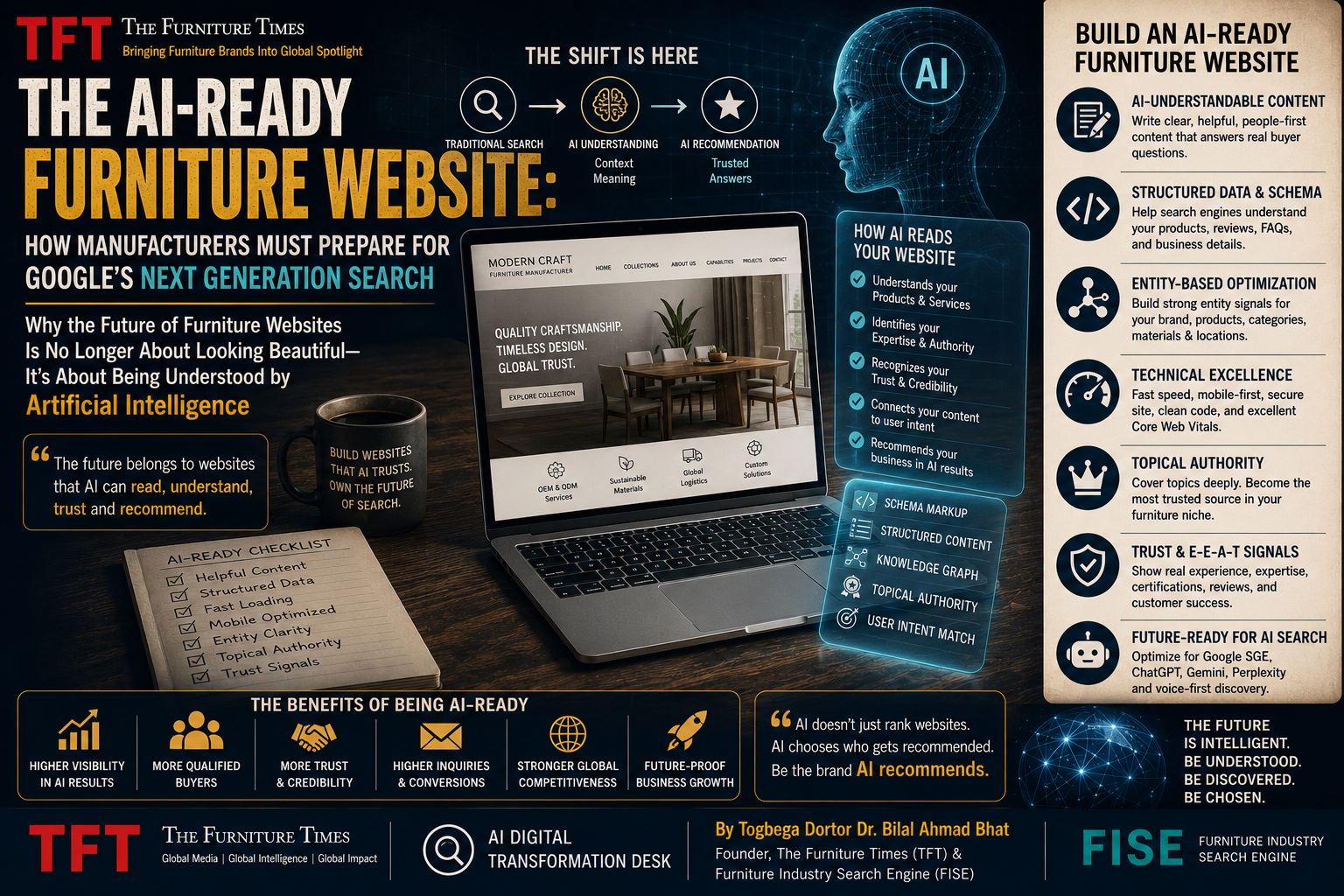
The AI-Ready Furniture Website: How Manufacturers Must Prepare for Google’s Next Generation Search
Why the Future of Furniture Websites Is No Longer About Looking Beautiful—It’s About Being Understood by Artificial Intelligence
AI Digital Transformation Desk
By Togbega Dortor Dr. Bilal Ahmad Bhat
Founder, The Furniture Times (TFT) & Furniture Industry Search Engine (FISE)
Executive Summary
For nearly three decades, websites have served as the digital storefronts of furniture businesses.
Companies invested heavily in:
Beautiful designs.
Large banners.
Animations.
Product galleries.
Corporate videos.
Modern layouts.
These elements remain important.
But they are no longer enough.
Google is changing.
Artificial Intelligence is changing.
Customer behaviour is changing.
Search is evolving from finding websites to finding answers.
The next generation of search engines and AI assistants no longer evaluate websites only by appearance.
They evaluate:
Structure.
Meaning.
Authority.
Trust.
Relationships between topics.
Entity recognition.
Machine-readable data.
Context.
According to The Furniture Times (TFT), the next competitive advantage will belong to businesses with AI-ready websites.
A website must not only impress human visitors.
It must also communicate effectively with Artificial Intelligence.
The future belongs to businesses that build websites AI can understand, trust and recommend.
Websites Are Entering a New Era
Traditional websites were built for humans.
Future websites must serve both:
People.
Artificial Intelligence.
This represents one of the biggest changes in digital business.
Google increasingly uses AI.
ChatGPT.
Voice assistants.
Visual search.
AI procurement systems.
Knowledge graphs.
Semantic search.
Every system requires structured information.
What Is an AI-Ready Website?
An AI-ready website is designed so machines can understand:
Who you are.
What you manufacture.
Where you operate.
Which industries you serve.
Your expertise.
Your products.
Your services.
Your reputation.
Your relationships.
Your authority.
AI no longer reads only words.
It understands meaning.
Structured Data Is Becoming Essential
Structured data helps search engines understand website content.
Instead of guessing…
Google receives organised information.
Examples include:
Business details.
Products.
Reviews.
FAQs.
Events.
Articles.
Videos.
Locations.
People.
Structured data improves visibility.
It also prepares websites for AI-generated answers.
Schema Markup Is the Website’s Digital Language
Schema markup is a standard vocabulary that explains content to search engines.
Furniture businesses can implement schema for:
Organization.
Local Business.
Products.
Articles.
Reviews.
Events.
Videos.
FAQ.
Images.
Job postings.
Services.
Schema helps machines interpret information correctly.
AI-Readable Content Replaces Keyword Stuffing
Old SEO focused on repeating keywords.
Modern AI values:
Natural language.
Expertise.
Clear explanations.
Original insights.
Customer-focused writing.
Businesses should answer real questions rather than forcing keywords into pages.
Content should educate first.
Optimise second.
Knowledge Graph Is Becoming the New Business Identity
Google increasingly connects businesses through its Knowledge Graph.
It understands relationships between:
Companies.
Products.
Founders.
Industries.
Countries.
Awards.
Publications.
Associations.
The stronger your digital identity…
The easier it becomes for AI to understand your business.
Entity SEO Is the Future of Search
Traditional SEO focused on keywords.
Entity SEO focuses on identities.
Examples include:
Furniture manufacturers.
Furniture designers.
Kitchen cabinets.
Malaysia.
Muar.
Hospitality furniture.
Google increasingly understands entities rather than isolated keywords.
Businesses should become recognised entities.
Not simply websites.
Semantic Search Understands Meaning
Customers no longer search exactly the same way.
Examples:
Best hotel furniture company
Luxury hospitality furniture supplier
Commercial furniture manufacturer
Hotel furniture exporter
These phrases express similar intent.
Semantic search understands relationships between concepts.
Websites should cover complete topics rather than isolated keywords.
Core Web Vitals Still Matter
A beautiful website is useless if it performs poorly.
Google measures:
Loading speed.
Visual stability.
Interactivity.
Mobile usability.
Fast websites create:
Better rankings.
Better customer experiences.
Higher conversions.
Performance remains a critical ranking factor.
Future Website Architecture
The websites of tomorrow will look different.
Instead of hundreds of disconnected pages…
They will organise information into knowledge hubs.
Example:
Outdoor Furniture
↓
Materials
↓
Maintenance
↓
Buying Guides
↓
Projects
↓
Case Studies
↓
FAQs
↓
Videos
↓
Related Products
Everything becomes connected.
Every Product Needs Complete Information
Future product pages require:
Specifications.
Dimensions.
Materials.
Downloads.
Images.
Videos.
Warranty.
Care instructions.
FAQs.
Customer reviews.
Structured data.
Products become information assets.
AI Prefers Expert Content
Artificial Intelligence increasingly favours businesses demonstrating:
Experience.
Expertise.
Authority.
Trustworthiness.
Companies should publish:
Industry reports.
Buying guides.
Educational articles.
Market analysis.
Research.
Case studies.
Knowledge creates discoverability.
Images Must Become Intelligent
Furniture companies invest heavily in photography.
Yet many images remain invisible to search engines.
Future optimisation includes:
Descriptive filenames.
Alternative text.
Captions.
Image schema.
Compression.
Contextual placement.
Visual search depends upon image quality and metadata.
Video Is Becoming Searchable
Google increasingly indexes:
Factory tours.
Installation videos.
Product demonstrations.
Customer testimonials.
Educational webinars.
Video content improves:
Engagement.
Authority.
Search visibility.
AI understanding.
Voice Search Requires Conversational Content
Customers increasingly ask:
“Who manufactures hotel furniture in Malaysia?”
“What is the best outdoor furniture for tropical climates?”
Content should answer questions naturally.
Voice search rewards conversational language.
AI Procurement Needs Better Websites
Future procurement systems will analyse:
Manufacturing capabilities.
Certifications.
Delivery capacity.
Export markets.
Quality standards.
Sustainability.
Product categories.
Businesses with structured information become easier to evaluate.
Furniture Industry Search Engine (FISE): Building AI-Ready Industry Infrastructure
General search engines serve every industry.
Furniture requires specialised intelligence.
Furniture Industry Search Engine (FISE) is envisioned as an AI-ready knowledge platform where manufacturers, retailers, suppliers, designers, logistics providers and service companies can present structured, verified and searchable information.
FISE aims to support:
AI supplier discovery.
Structured product data.
Industry knowledge.
Verified business profiles.
Future procurement systems.
One connected furniture knowledge ecosystem.
The Future Website Checklist
Every furniture business should prepare by:
✓ Implementing structured data.
✓ Using schema markup.
✓ Publishing expert content.
✓ Improving Core Web Vitals.
✓ Building knowledge hubs.
✓ Optimising images.
✓ Creating educational videos.
✓ Strengthening reviews.
✓ Building entity authority.
✓ Becoming AI-readable.
✓ Publishing regularly.
✓ Connecting with trusted industry platforms.
CEO Perspective
According to Togbega Dortor Dr. Bilal Ahmad Bhat, Founder of The Furniture Times (TFT) and Furniture Industry Search Engine (FISE):
“The next generation of websites will not compete only for human attention. They will compete for Artificial Intelligence’s understanding. Businesses that organise knowledge clearly will become the businesses AI recommends most confidently.”
He continues:
“For years, companies focused on designing attractive websites. That remains important, but the future belongs to websites that communicate clearly with both people and machines. AI-ready businesses will become more discoverable, more trusted and more competitive.”
He adds:
“Furniture Industry Search Engine (FISE) is part of this long-term vision. It is designed not simply to help businesses become searchable, but to help them become structured, connected and AI-ready within the global furniture ecosystem.”
TFT & FISE Analysis
The evolution of websites follows four stages.
Website 1.0
Digital brochure.
↓
Website 2.0
Search Engine Optimisation.
↓
Website 3.0
Customer experience.
↓
Website 4.0
Artificial Intelligence readiness.
Structured knowledge.
Entity recognition.
Semantic understanding.
Machine-readable content.
The future belongs to AI-ready websites.
Final Verdict
The furniture industry’s digital future will not be built by the most beautiful websites.
It will be built by the most intelligent websites.
Businesses that organise information clearly…
Publish expert knowledge…
Implement structured data…
Strengthen entity authority…
Improve website performance…
And become understandable to Artificial Intelligence…
Will dominate the next generation of search.
Google is evolving.
Artificial Intelligence is evolving.
Customer expectations are evolving.
Furniture businesses must evolve as well.
Because by 2035…
Customers may no longer search hundreds of websites.
Artificial Intelligence will recommend only a few.
The businesses prepared today will become tomorrow’s trusted digital leaders.
By Togbega Dortor Dr. Bilal Ahmad Bhat
Founder, The Furniture Times (TFT) & Furniture Industry Search Engine (FISE)
AI Digital Transformation Desk | July 2026
“TFT tells their story. FISE helps the world find them.”
The furniture industry ecosystem is a $1 Trillion Dollar Industry.