The Minimum Viable Marketing Budget Every SME Should Protect
A practical framework covering local search, customer retention, product information, reviews, news visibility and high-intent advertising
By The Furniture Times (TFT) Editorial Desk | SME Growth | Furniture Marketing | Search Visibility | Customer Retention | Digital Reputation | Business Intelligence
When business slows, marketing is often one of the first expenses small and medium-sized enterprises cut.
Advertising campaigns are paused. Website improvements are postponed. Customer databases are neglected. News and public-relations activity stops. Review requests disappear. Product pages become outdated. Social channels fall silent.
These actions may reduce expenditure immediately, but they can also weaken the business’s ability to generate tomorrow’s enquiries.
A company cannot expect continuous discovery while investing nothing in being discovered.
This does not mean an SME should spend recklessly or preserve every unsuccessful campaign. Wasteful advertising should be stopped. Unmeasured subscriptions should be reviewed. Poor agencies should be challenged. Campaigns producing unqualified leads should be redesigned.
However, every SME should protect a minimum viable marketing budget: the smallest disciplined investment needed to keep the business searchable, credible, responsive and commercially active.
The purpose is not to appear everywhere.
It is to ensure that when a high-intent customer needs the product or service, the business can still be:
- Found
- Understood
- Evaluated
- Trusted
- Contacted
- Remembered
The minimum viable marketing budget is not the amount required to dominate the market. It is the amount required to avoid disappearing from it.
What is a minimum viable marketing budget?
A minimum viable marketing budget, or MVMB, is the protected level of investment required to maintain the core systems that generate and convert demand.
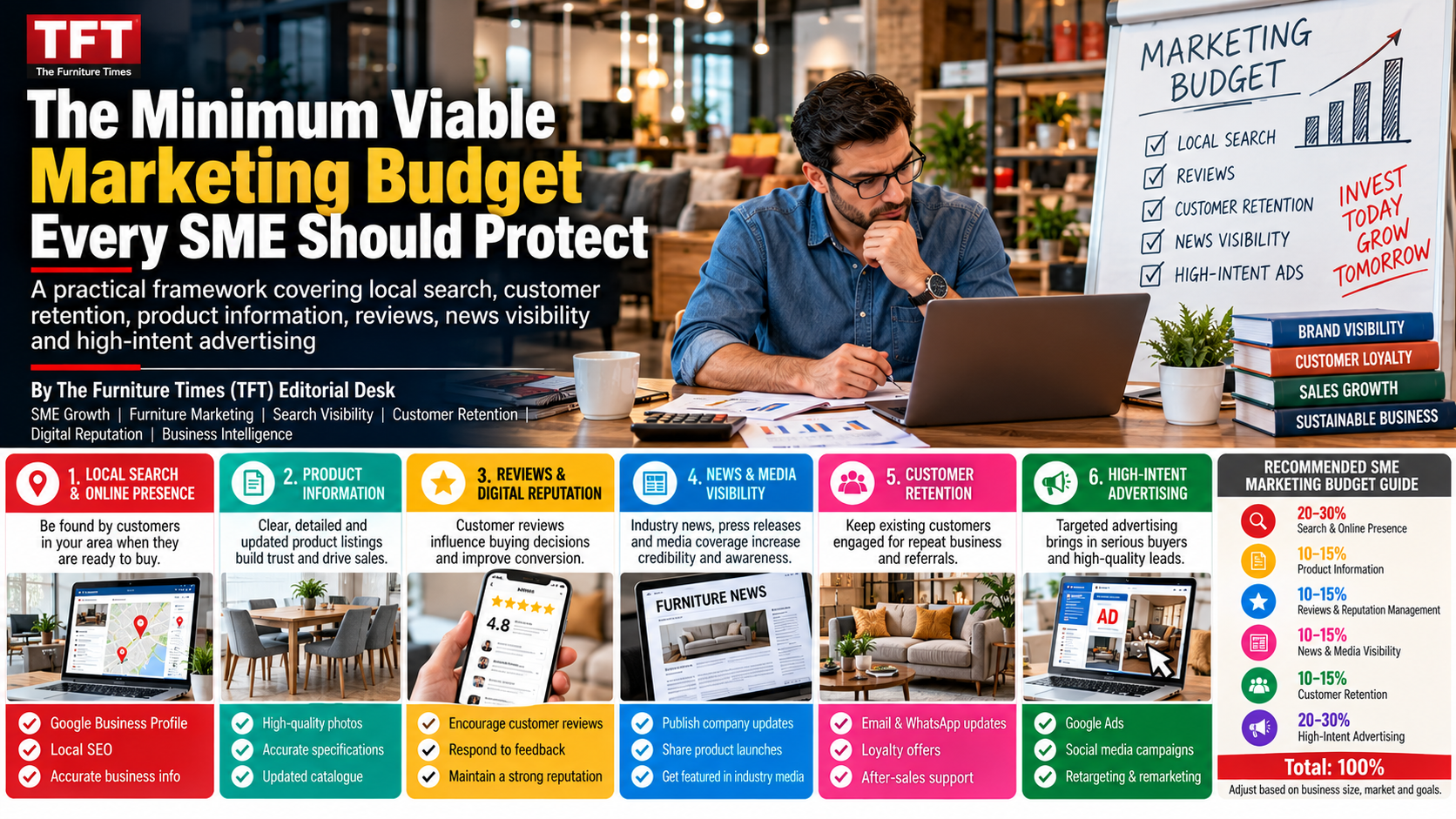
It should support six essential areas:
- Local and organic search visibility
- Customer retention and reactivation
- Accurate product and service information
- Reviews and reputation
- News, content and authority building
- High-intent advertising
If one layer is missing, the others become less effective.
Advertising a poorly explained product wastes traffic. Strong product information without search visibility remains unseen. Excellent service without reviews leaves prospective customers uncertain. Publishing news without a clear conversion path creates attention but not enquiries.
The budget must therefore protect the complete customer-discovery journey.
Marketing is not one expense
Many SMEs treat marketing as one line in the accounts. In practice, it contains several distinct investments.
A practical marketing budget may cover:
- Website hosting and maintenance
- Product-page development
- Search-engine optimisation
- Business-profile management
- Photography and video
- Copywriting
- Email and messaging systems
- Customer database management
- Review acquisition and monitoring
- News and media publication
- Directory and industry-platform listings
- Search advertising
- Retargeting
- Marketplace fees
- Analytics and call tracking
- Design
- Marketing staff or agency support
Lumping these activities together makes it difficult to know what should be protected and what can be reduced.
The objective is not to defend every marketing cost. It is to identify which activities keep the commercial engine running.
There is no universal percentage
Marketing budgets should not be set by blindly copying a generic percentage of revenue.
A young business trying to build market awareness may need to invest more than an established company with strong repeat demand. A local service provider may depend heavily on maps and search ads, while a furniture manufacturer may require catalogues, trade outreach and specification content.
Budget requirements vary according to:
- Business age
- Gross margin
- Market competition
- Geographic coverage
- Average order value
- Customer lifetime value
- Sales cycle
- Repeat-purchase frequency
- Brand awareness
- Digital maturity
- Growth objectives
- Product complexity
- Export ambitions
- Business-to-business or consumer focus
- Existing marketing assets
Percentage-of-revenue planning can provide a starting point, but the final budget must be connected to commercial reality.
The better question is:
What is the minimum investment required to maintain a reliable flow of qualified opportunities?
The seven-budget-envelope framework
An SME can divide its minimum viable marketing budget into seven protected envelopes.
| Budget envelope | Suggested share of protected budget | Primary purpose |
|---|---|---|
| Local and organic search | 20% | Help customers find the business |
| Product and service information | 20% | Help customers understand the offer |
| Customer retention and reactivation | 15% | Generate more value from existing relationships |
| Reviews and reputation | 10% | Reduce buyer uncertainty |
| News and authority building | 10% | Build visibility and credibility |
| High-intent advertising | 20% | Capture active demand |
| Measurement and optimisation | 5% | Identify what produces results |
| Total | 100% | Maintain the marketing foundation |
These allocations are a planning framework, not a rigid formula.
A local furniture retailer may allocate more to search and advertising. A custom manufacturer may invest more in technical product information and case studies. A business with thousands of past customers may benefit from greater retention spending.
What matters is that none of the essential functions disappears completely.
1. Protect local and organic search visibility
Customers often begin with a search rather than a brand name.
They may search for:
- Furniture store near me
- Outdoor furniture Malaysia
- Office furniture supplier
- Hotel furniture manufacturer
- Sofa repair near me
- Custom dining table
- Restaurant furniture supplier
- Garden furniture showroom
- Furniture delivery in my city
- Commercial parasol supplier
- Bedroom furniture manufacturer
- Furniture wholesaler
If the SME does not appear, customers may assume it does not exist, is inactive or is less credible than visible competitors.
The minimum local-search investment should cover
- Accurate business name, address and telephone number
- Updated opening hours
- Correct business categories
- Website links
- Maps visibility
- Product and service descriptions
- Current photographs
- Review responses
- Location pages
- Enquiry buttons
- Mobile usability
- Basic technical website health
- Monitoring of incorrect or duplicate listings
For furniture SMEs
Local search should explain more than the location.
A customer should be able to understand:
- What furniture categories are available
- Whether the business manufactures, imports or retails
- Whether products are residential or commercial
- Delivery areas
- Installation availability
- Customisation options
- Showroom hours
- Contact methods
- Project capabilities
- Warranty and after-sales support
A business-profile listing with a name and telephone number is not a complete search presence.
2. Protect product and service information
Product information is one of the highest-value marketing assets an SME can create.
A paid advertisement stops working when spending stops. A strong product page, buying guide, project profile or catalogue can continue supporting sales for months or years.
Every important product page should answer:
- What is the product?
- Who is it for?
- Where can it be used?
- What are its dimensions?
- What materials are used?
- What colours and finishes are available?
- Is customisation possible?
- Is assembly required?
- What is the lead time?
- Is delivery available?
- What maintenance is required?
- What warranty applies?
- How can the customer request a quotation?
Minimum information for furniture products
- Product name
- Product code
- Category
- Multiple clear images
- Dimensions
- Materials
- Finish
- Colour options
- Weight or load information where relevant
- Indoor or outdoor suitability
- Residential or commercial suitability
- Assembly details
- Care instructions
- Warranty
- Availability
- Delivery coverage
- Enquiry or purchasing method
Weak product information forces customers to contact the business for basic answers. Many will not.
They will simply choose a competitor whose product is easier to evaluate.
Product information reduces advertising waste
Suppose an SME pays for 1,000 website visits.
If the product page contains:
- One low-quality photograph
- No dimensions
- No material information
- No delivery details
- No price guidance
- No clear enquiry button
the advertisement may generate traffic without generating confidence.
The problem is not necessarily the advertisement.
The destination failed.
Before increasing advertising expenditure, the company should verify that its website can convert the traffic it already receives.
Every paid campaign should direct customers to a page that closely matches the advertisement.
An ad for outdoor dining sets should not send visitors to the website homepage and expect them to search through the entire catalogue.
3. Protect customer retention and reactivation
Existing customers are among the most valuable assets an SME possesses.
They already know the business. The company may have already paid to acquire them. They may be more likely to:
- Buy again
- Refer others
- Purchase additional categories
- Leave reviews
- Respond to new-product announcements
- Consider upgrades
- Request maintenance or replacement parts
Yet many SMEs spend almost their entire marketing budget attracting strangers while neglecting previous buyers.
A minimum retention system should include
- A clean customer database
- Purchase history
- Permission-based email or messaging
- Post-purchase follow-up
- Review requests
- Warranty communication
- Maintenance reminders
- New-product announcements
- Relevant seasonal offers
- Replenishment or replacement reminders
- Referral invitations
- Customer-service recovery
Furniture-specific retention opportunities
Furniture has a long replacement cycle, but that does not eliminate repeat business.
A customer who bought a sofa may later need:
- A dining set
- An outdoor collection
- A bed
- An office desk
- A rug
- Storage furniture
- Replacement cushions
- Furniture care
- Repair
- Reupholstery
- Furniture for another property
Business customers may require:
- Additional units
- New branches
- Replacement parts
- Refurbishment
- Maintenance
- Staff expansion
- Project upgrades
Retention does not mean sending the same discount to every previous customer. It means maintaining a useful relationship.
A basic customer-retention schedule
| Customer stage | Recommended communication |
|---|---|
| Immediately after purchase | Order confirmation and expectations |
| Before delivery | Delivery date, preparation and contact details |
| After delivery | Satisfaction check and care guidance |
| 7–14 days later | Review request |
| 30–90 days later | Relevant care or usage advice |
| Seasonal interval | New products or useful category information |
| Warranty milestone | Warranty and maintenance reminder |
| Appropriate repurchase window | Upgrade, replacement or related-product message |
The timing should match the product and customer relationship. Excessive messaging can damage trust.
4. Protect reviews and reputation
Reviews influence customer decisions because they provide information the business cannot credibly provide about itself.
A company can claim:
- Excellent quality
- Fast delivery
- Professional service
- Reliable warranty support
A customer review can show whether those promises were experienced.
Reviews are especially important for furniture because buyers worry about:
- Comfort
- Durability
- Finish quality
- Delivery damage
- Assembly
- Product accuracy
- Delays
- Warranty response
- After-sales service
The minimum review budget should support
- A review-request process
- Staff training
- Review monitoring
- Timely responses
- Complaint escalation
- Customer-experience analysis
- Integration of verified reviews into product pages
- Presence on relevant review platforms
The budget does not have to fund incentives for positive reviews. It should fund the systems required to ask, listen and respond.
Reviews should never be purchased, fabricated or manipulated.
Reviews are operational intelligence
Review management is not only a reputation activity.
Customer feedback can reveal:
- Weak packaging
- Recurring delivery delays
- Confusing assembly instructions
- Product-description errors
- Inconsistent finish
- Poor sales follow-up
- Common component failures
- Missing warranty communication
- Excellent employees
- High-performing products
A business that analyses reviews can improve products and operations.
A business that merely chases star ratings misses the larger value.
5. Protect news and authority building
Many SMEs publish only advertisements.
Every communication says:
- Buy now
- Call us
- Limited offer
- Sale
- Discount
- New stock
This may produce transactions, but it does not create authority.
News and editorial content can establish:
- Industry expertise
- Business credibility
- Product knowledge
- Founder visibility
- Manufacturing capability
- Project experience
- Innovation
- Community contribution
- Market relevance
Newsworthy SME subjects include
- New product launches
- Factory expansion
- Showroom openings
- Export milestones
- Hotel or office projects
- Sustainability initiatives
- New machinery
- Certifications
- Awards
- Strategic partnerships
- Design collaborations
- Apprenticeship programmes
- Community projects
- Leadership appointments
- Market analysis
- Research and surveys
News gives customers, suppliers, distributors, journalists, search engines and AI systems more context about the company.
Why news matters for small businesses
Large companies already possess visibility through:
- Established brand recognition
- Distribution networks
- Investor coverage
- Media relationships
- Advertising budgets
- Search demand
SMEs often possess valuable expertise but remain digitally silent.
If the company does not publish its achievements, capabilities and insights, external audiences may never discover them.
News activity can support:
- Search visibility
- Brand recall
- Business development
- Recruitment
- Supplier confidence
- Investor discussions
- Dealer acquisition
- Export enquiries
- AI discovery
- Industry recognition
Public relations should not replace sales activity, but it can strengthen the credibility surrounding every sales conversation.
Media visibility must be credible
A press release should contain a real story.
It should clearly identify:
- What happened
- Why it matters
- Who is involved
- Where it occurred
- When it occurred
- What evidence supports it
- How the company can be contacted
Avoid exaggerated claims such as:
- World’s best
- Number one
- Revolutionary
- Unmatched
- Guaranteed success
- Industry-leading
unless they can be substantiated.
Credibility builds authority more effectively than promotional exaggeration.
6. Protect high-intent advertising
During a budget reduction, SMEs should prioritise advertising that reaches customers with immediate or clearly expressed interest.
High-intent demand may include searches such as:
- Buy outdoor furniture Kuala Lumpur
- Office chairs bulk supplier
- Hotel furniture quotation
- Custom wardrobe manufacturer
- Commercial dining chairs
- Furniture repair near me
- Ready-stock sofa delivery
- Resort furniture supplier Malaysia
These searches indicate stronger commercial intent than broad interest-based exposure.
High-intent advertising may include
- Search advertising
- Maps-based campaigns
- Shopping or product ads
- Marketplace sponsored listings
- Retargeting engaged visitors
- Lead-generation campaigns with clear qualification
- Industry-directory promotion
- Trade-platform visibility
During difficult periods, the company may reduce broad awareness campaigns while protecting the channels most closely connected to enquiries and sales.
That does not mean brand awareness has no value. It means the minimum viable budget should first prevent active demand from going to competitors unnoticed.
Broad advertising versus high-intent advertising
| Broad-reach activity | High-intent activity |
|---|---|
| Introduces the brand | Captures existing demand |
| Reaches larger audiences | Reaches narrower qualified audiences |
| May have a longer payback period | May generate nearer-term enquiries |
| Useful for market development | Useful for sales-pipeline protection |
| Harder to attribute directly | Often easier to track |
| Important for long-term growth | Essential for a minimum viable system |
A healthy full marketing programme uses both.
A minimum survival-level programme may place more weight on high-intent activity while maintaining a modest foundation of brand communication.
7. Protect measurement and optimisation
A marketing budget without measurement can become guesswork.
Every SME should maintain a basic system for understanding:
- Where enquiries originate
- Which campaigns produce qualified leads
- Which products attract demand
- What customers search for
- Which landing pages convert
- How many calls are answered
- How quickly enquiries receive replies
- How much each lead costs
- How many leads become sales
- How much profit those sales generate
Minimum measurement tools
- Website analytics
- Search-performance monitoring
- Advertising conversion tracking
- Lead-source fields
- Call tracking where appropriate
- Customer relationship management
- Campaign codes
- Monthly marketing dashboard
- Sales and gross-profit reconciliation
Perfect attribution is rarely possible. Useful attribution is.
An SME does not need an expensive analytics department. It needs sufficient evidence to distinguish productive activity from waste.
Three minimum-budget models
The following models are illustrative planning frameworks. Actual amounts should reflect local costs, business size, competition, margins and growth targets.
Model A: Microbusiness foundation
Suitable for a small local company with limited resources and owner-led marketing.
| Activity | Monthly allocation |
|---|---|
| Local search and website maintenance | 25% |
| Product information and content | 20% |
| Customer retention | 15% |
| Review management | 10% |
| News and authority | 10% |
| High-intent advertising | 15% |
| Measurement | 5% |
The owner may perform some work internally, but time must still be budgeted.
Model B: Growth-focused SME
Suitable for a retailer, manufacturer or service business seeking predictable lead generation.
| Activity | Monthly allocation |
|---|---|
| Local and organic search | 20% |
| Product information | 20% |
| Customer retention | 15% |
| Reviews | 10% |
| News and authority | 10% |
| High-intent advertising | 20% |
| Measurement | 5% |
Model C: B2B manufacturer or project supplier
Suitable for companies with longer sales cycles and fewer, higher-value orders.
| Activity | Monthly allocation |
|---|---|
| Search and industry discoverability | 20% |
| Technical product information | 25% |
| Customer and dealer retention | 15% |
| Reviews, case studies and references | 10% |
| News and thought leadership | 15% |
| High-intent lead generation | 10% |
| Measurement | 5% |
The B2B company may spend less on direct-response advertising and more on technical credibility.
A practical budget-setting formula
An SME can construct its minimum budget from the bottom up.
Step 1: Calculate essential fixed marketing infrastructure
Include:
- Website
- Hosting
- Maintenance
- Analytics
- Business-profile management
- Customer database
- Email or messaging system
- Review monitoring
Step 2: Add minimum monthly content production
Include:
- Product updates
- Photography
- Product pages
- Buying guides
- Case studies
- News
- Customer communications
Step 3: Add demand-capture spending
Estimate the minimum amount required to remain visible for the company’s most commercially important searches and platforms.
Step 4: Add optimisation capacity
Reserve time or money to analyse performance and improve weak areas.
A simplified formula is:
MVMB = Essential infrastructure + Minimum content + Customer retention + Reputation + Demand capture + Measurement
The result should then be tested against:
- Gross margin
- Cash flow
- Revenue objectives
- Sales capacity
- Lead-handling capacity
- Operational capacity
The company should not generate more demand than it can fulfil properly.
Connect the budget to revenue capacity
A business should understand how many profitable orders are required to recover its marketing investment.
Assume:
- Monthly protected marketing budget: $3,000
- Average gross profit per order: $600
- Marketing contribution required from new orders: $3,000
The company needs five incremental orders to recover the budget at the gross-profit level:\[ \$3,000 \div \$600 = 5 \]
But this calculation must be refined for:
- Sales commissions
- Delivery
- Installation
- Returns
- payment processing
- Agency costs
- Warranty exposure
- Repeat customer value
The objective is not to demand that every individual marketing activity generate an immediate sale. Some activities support visibility, trust and conversion across multiple channels.
Nevertheless, the total programme must remain commercially responsible.
Why “zero marketing” is not a neutral position
Stopping marketing does not freeze the business in place.
While an SME remains silent:
- Competitors continue publishing
- Search rankings change
- Reviews accumulate elsewhere
- Customer databases become outdated
- Website information ages
- Advertising platforms lose campaign history
- Brand recall weakens
- New buyers enter the market without encountering the company
- AI systems gather information from more active sources
- Sales teams receive fewer inbound opportunities
The company does not remain where it was. It can lose ground.
Restarting later may require greater expenditure because the business must rebuild:
- Visibility
- Traffic
- customer attention
- Campaign data
- Content momentum
- Trust
- Search presence
This is the recovery debt created by prolonged invisibility.
What to cut before cutting the foundation
When cost reduction is necessary, begin by reviewing:
- Duplicate software
- Unused subscriptions
- Unqualified lead sources
- Vanity sponsorships
- Poorly targeted advertising
- Low-quality directory listings
- Repetitive content
- Agencies without measurable deliverables
- Channels not connected to the target market
- Advertising directed to weak landing pages
- Broad campaigns with no strategic purpose
- Discounts that destroy margin
- Content produced without distribution
Protect:
- Website accessibility
- Accurate business information
- Core product pages
- Customer follow-up
- Review responses
- High-intent search presence
- Measurement
- Essential news and credibility activity
Cut waste, not visibility.
The minimum viable monthly marketing calendar
A disciplined SME can maintain momentum through a simple recurring schedule.
Every week
- Update important business information
- Respond to reviews
- Follow up on enquiries
- Contact appropriate previous customers
- Monitor advertising
- Publish at least one useful update
- Check stock, availability and lead times
Every month
- Improve priority product pages
- Publish one substantial news or educational article
- Request reviews from recent customers
- Analyse lead sources
- Review advertising terms
- Update photographs or projects
- Audit unanswered enquiries
- Compare revenue, gross profit and marketing costs
Every quarter
- Review brand positioning
- Audit local-search visibility
- Clean the customer database
- Refresh major product categories
- Publish a case study
- Assess competitors
- Review customer complaints
- Reallocate the budget based on evidence
Consistency is more valuable than occasional bursts of activity followed by silence.
A minimum viable marketing scorecard
An SME should be able to answer these questions every month:
| Area | Core question |
|---|---|
| Search | Can high-intent customers find us? |
| Product information | Can they understand what we sell? |
| Trust | Can they verify our reputation? |
| Retention | Are we communicating with existing customers? |
| Authority | Are we publishing useful and credible information? |
| Advertising | Are we capturing active demand? |
| Conversion | Is it easy to enquire or purchase? |
| Measurement | Do we know what produces qualified business? |
| Profitability | Does marketing contribute to profitable growth? |
If several answers are “no,” the business may not have a functioning marketing system—even if it posts frequently on social media.
Special framework for furniture SMEs
Furniture manufacturers, retailers, suppliers, installers, designers and service providers should protect the following essentials.
Manufacturer
- Searchable company profile
- Technical catalogue
- Materials and capacity information
- Factory photographs
- Certifications
- Export markets
- Minimum order quantities
- Customisation capability
- Case studies
- RFQ process
- Industry news
Retailer
- Accurate local listing
- Product availability
- Product pages
- Showroom information
- Delivery areas
- Customer reviews
- High-intent ads
- Retention campaigns
- New-arrival and clearance communication
Hospitality and project supplier
- Project portfolio
- Technical specifications
- Commercial-grade claims
- Lead times
- Installation capacity
- Warranty support
- Client references
- Case studies
- Tender and quotation process
- Industry visibility
Repairer or restorer
- Local search
- Before-and-after examples
- Service-area information
- Repair categories
- Transparent enquiry process
- Reviews
- Turnaround expectations
- Care advice
Each business model needs a different mix, but every one needs visibility, information and trust.
The role of TFT, FISE and FurniReviewology
The furniture industry ecosystem is a $1 trillion industry ecosystem, but much of it remains digitally fragmented.
Manufacturers, suppliers, retailers, installers, designers, artisans, repairers and project specialists may possess genuine expertise while remaining difficult to discover.
A stronger visibility infrastructure should connect three layers:
- The Furniture Times (TFT) helps furniture businesses tell their stories through news, insight and industry visibility.
- Furniture Industry Search Engine (FISE) helps buyers search for and discover relevant furniture companies, products and capabilities.
- FurniReviewology helps the market assess experience, reputation and trust.
TFT tells their story.
FISE helps the world find them.
FurniReviewology helps the world trust them.
Marketing works best when discovery, information and credibility reinforce one another.
The TFT conclusion
Every SME should establish a protected marketing floor.
The amount will differ, but the essential functions remain consistent:
- Maintain local and organic search visibility.
- Keep product and service information accurate.
- Communicate with existing customers.
- Request, monitor and respond to reviews.
- Publish credible news and useful content.
- Capture high-intent demand.
- Measure what produces qualified and profitable business.
A minimum viable marketing budget does not guarantee growth. It preserves the business’s ability to compete for growth.
When conditions become difficult, the solution is not to continue every campaign regardless of performance. It is to distinguish marketing infrastructure from marketing waste.
Pause what does not work.
Improve what is unclear.
Measure what matters.
But protect the systems that allow customers to find, understand and trust the business.
If you are not searchable, you do not exist.
And if customers cannot verify your value, visibility alone will not convert them.
The SME that protects its discovery, credibility and customer relationships during difficult periods is better positioned to lead when demand returns.

Related Posts
Furniture Store Marketing Benchmarks 2026
Google Ads or SEO: What Is the Difference