Google Ads or SEO: What Is the Difference
And Which Strategy Should Furniture Businesses Choose in 2026?
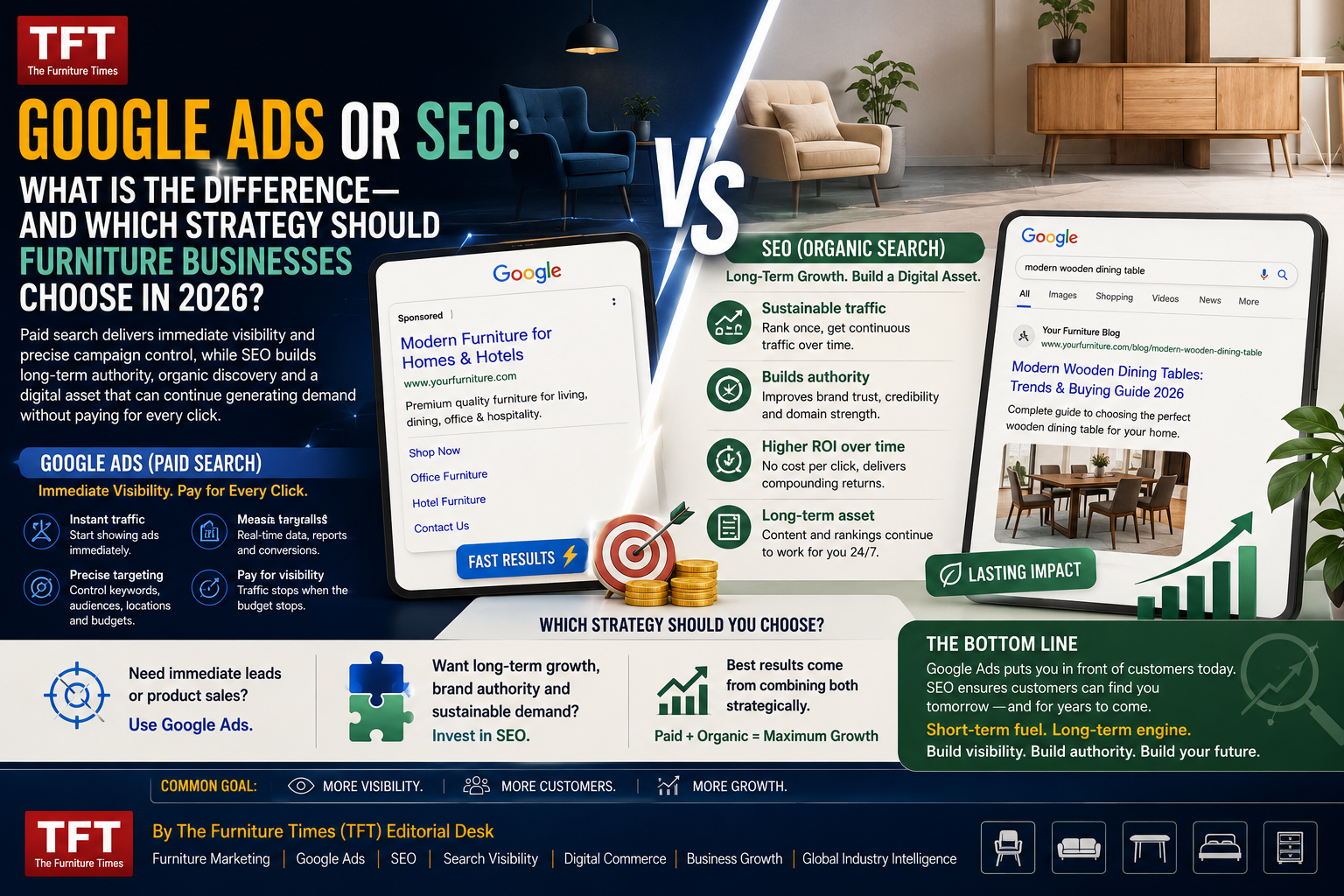
Paid search delivers immediate visibility and precise campaign control, while SEO builds long-term authority, organic discovery and a digital asset that can continue generating demand without paying for every click
By The Furniture Times (TFT) Editorial Desk | Furniture Marketing | Google Ads | SEO | Search Visibility | Digital Commerce | Business Growth | Global Industry Intelligence
One of the most common questions asked by business owners is deceptively simple:
Should we invest in Google Ads or SEO?
The question becomes especially urgent when sales weaken, a company launches a new website, competitors begin appearing more prominently online or management wants faster enquiries.
Google Ads and search engine optimization both help businesses become visible through Google, but they work in fundamentally different ways.
Google Ads purchases visibility through paid placements. Search engine optimization earns organic visibility by improving a website’s relevance, usefulness, technical accessibility and authority.
A business using Google Ads can potentially begin receiving traffic soon after an approved campaign goes live. A company using SEO may need months of consistent work before significant organic visibility develops.
But speed is only one difference.
Google Ads and SEO have different:
- Cost models.
- Timelines.
- Control mechanisms.
- Targeting capabilities.
- Risk profiles.
- Measurement systems.
- Content requirements.
- Long-term value.
- Dependency levels.
The correct question is therefore not, “Which one is always better?”
It is:
Which channel is appropriate for this business objective, customer journey, budget, market and time horizon?
For many businesses—especially furniture manufacturers, retailers, suppliers and service providers—the strongest strategy is not Google Ads or SEO. It is a disciplined combination of both.
The original discussion was prompted by the WOW Search comparison of Google Ads and SEO. This report expands the subject for the furniture industry and the wider business ecosystem.
Google Ads and SEO at a glance
| Strategic question | Google Ads | SEO |
|---|---|---|
| How visibility is gained | Businesses pay to participate in advertising auctions | Pages earn organic visibility through relevance, quality, authority and technical accessibility |
| Speed | Campaigns can generate visibility quickly after approval | Results normally require sustained work and time |
| Cost structure | Advertiser pays for clicks, impressions, conversions or campaign outcomes, depending on format | No payment to Google for an organic click, but strategy, content, technology and expertise still cost money |
| Position control | Greater control over campaigns, bids, locations, timing and advertisements | No guaranteed organic position; rankings depend on search systems and competition |
| Duration | Traffic generally falls when campaigns stop | Strong pages may continue receiving traffic, although rankings require maintenance |
| Testing | Fast testing of offers, keywords and landing pages | Slower feedback cycle but valuable for long-term market intelligence |
| Best suited to | Immediate enquiries, launches, promotions and controlled campaigns | Sustainable discovery, authority, education and long-term demand |
| Primary dependency | Ongoing advertising budget and campaign efficiency | Website quality, content, authority, technical health and continuing relevance |
| Ownership value | Campaign data is valuable, but visibility is rented | Content, website architecture and authority become business assets |
| Combined role | Generates immediate attention | Builds the foundation that reduces long-term dependence on paid traffic |
What is Google Ads?
Google Ads is Google’s paid advertising platform.
Businesses can use it to appear in paid positions when potential customers search for relevant products or services.
A furniture company might advertise against searches such as:
- Furniture store near me.
- Outdoor furniture Malaysia.
- Hotel furniture manufacturer.
- Office chairs Delhi.
- Custom wardrobe company.
- Mattress shop nearby.
- Commercial furniture supplier.
- Restaurant furniture manufacturer.
- Furniture hardware distributor.
- Sofa sale this weekend.
In a standard pay-per-click search campaign, the advertiser generally pays when someone clicks the advertisement.
However, Google Ads includes more than text advertisements in search results. Depending on availability, account setup and business objectives, campaigns may include:
- Search advertisements.
- Shopping advertisements.
- Display campaigns.
- Video advertising.
- Performance Max campaigns.
- App campaigns.
- Remarketing.
- Local and location-supported formats.
Google explains that paid search allows businesses to bid for opportunities to display advertisements alongside relevant searches, while SEO concerns unpaid organic visibility. Paid advertising does not purchase an improvement in organic ranking. Google’s official SEO and PPC explainer
What is SEO?
SEO—search engine optimization—is the process of improving a website so that search engines can access, understand and present its content for relevant searches.
SEO can include:
- Keyword and market research.
- Website architecture.
- Product-category organization.
- Technical performance.
- Page speed.
- Mobile usability.
- Helpful content.
- Product specifications.
- Local business information.
- Internal linking.
- Structured data.
- Image optimization.
- Backlinks.
- News coverage.
- Brand mentions.
- Customer reviews.
- Website security.
- Search-intent alignment.
SEO is sometimes incorrectly described as free traffic.
A business does not pay Google for each organic click, but successful SEO still requires investment in:
- Strategy.
- Research.
- Writing.
- Design.
- Photography.
- Development.
- Technical improvements.
- Digital public relations.
- Analytics.
- Content maintenance.
SEO is not free. It operates through a different cost model.
The most important difference: renting visibility versus building an asset
Google Ads provides rented visibility.
As long as the campaign has sufficient budget, meets platform requirements and performs effectively in the auction, the business can remain visible.
When the advertising budget stops, paid traffic usually declines rapidly.
SEO builds owned digital assets.
Those assets can include:
- Category pages.
- Product guides.
- Buying guides.
- Case studies.
- Technical resources.
- News articles.
- Local pages.
- Images.
- Video content.
- Internal links.
- Search authority.
- Brand recognition.
A well-built guide to selecting hotel pool furniture may continue attracting relevant visitors long after publication. A paid advertisement for the same topic generally stops generating traffic when spending ends.
This does not make SEO automatically superior. Renting visibility can be extremely valuable when speed, control and timing matter.
The two approaches solve different business problems.
Google Ads delivers speed
One of the strongest benefits of Google Ads is the ability to begin testing demand quickly.
A company can potentially launch a campaign for:
- A new showroom.
- A furniture sale.
- An exhibition.
- A new collection.
- Immediate stock.
- A local service.
- A dealer-recruitment programme.
- A hospitality product.
- A seasonal outdoor range.
If the campaign is properly structured, the business can begin learning:
- Which searches attract clicks.
- Which locations generate enquiries.
- Which advertisements perform better.
- Which landing pages convert.
- What times produce stronger results.
- Which devices customers use.
- How much a lead costs.
This rapid feedback is valuable for new businesses and product launches.
SEO cannot normally provide the same speed because search engines need time to discover, assess and rank new content—and the site must compete with businesses that may have built authority for years.
SEO builds cumulative visibility
SEO is slower because it develops through accumulation.
A company publishes product pages, improves technical performance, earns relevant mentions, creates helpful resources and strengthens authority over time.
Each strong asset can support other assets.
For example:
- A manufacturer publishes a detailed guide to hotel furniture procurement.
- An industry publication references the guide.
- The link strengthens the website’s authority.
- Search engines discover more pages.
- Architects find the guide.
- Visitors explore the company’s project portfolio.
- The business receives enquiries.
- Search behaviour reveals new topics.
- The company publishes additional resources.
- Authority compounds.
This cumulative effect is one of SEO’s most important advantages.
Google Ads offers stronger short-term control
Advertisers can control many campaign settings, including:
- Daily budgets.
- Geographic targeting.
- Campaign schedules.
- Devices.
- Search themes or keywords.
- Negative keywords.
- Landing pages.
- Advertising messages.
- Conversion objectives.
- Audience signals.
- Bid strategies.
This makes Google Ads useful when a business needs to promote a particular offer to a defined audience.
A furniture retailer could advertise a warehouse clearance within a specific delivery radius. A hotel furniture manufacturer could target markets where it has sales representatives. A mattress company could promote immediate delivery in selected cities.
SEO does not offer this level of direct control.
A business can optimize content, but it cannot buy or guarantee an organic ranking.
Keyword control is changing under AI-powered advertising
Google Ads historically depended heavily on manually selected keywords. Keywords remain important, but Google’s systems increasingly use AI and contextual signals to interpret search intent.
Google’s keyword-matching system includes:
- Broad match.
- Phrase match.
- Exact match.
- Negative keywords.
Broad match can reach a wider range of related searches. Phrase and exact match provide progressively tighter steering, although the system considers meaning and intent rather than only identical words. Google Ads keyword-matching guidance
In 2026, Google is also expanding AI Max for Search campaigns. The company has announced upgrades involving AI-supported search-term matching, text customization and final-URL expansion, with automatic transitions beginning for some eligible legacy settings. Google AI Max update
This development increases the importance of:
- Accurate website content.
- Well-structured landing pages.
- Clear brand controls.
- Strong conversion tracking.
- Good exclusions.
- Human oversight.
Automation does not remove the need for strategy. It makes accurate business data and clear objectives more important.
The website affects both strategies
Businesses sometimes assume that Google Ads can compensate for a poor website.
It cannot.
Advertising may generate clicks, but visitors can still leave if the landing page is:
- Slow.
- Confusing.
- Outdated.
- Incomplete.
- Untrustworthy.
- Difficult to use on mobile.
- Missing prices or enquiry routes.
- Inconsistent with the advertisement.
- Unsupported by reviews or evidence.
The same website weaknesses can damage SEO.
A strong website supports both paid and organic performance.
It should answer:
- What does the company sell?
- Who is the product for?
- Where is the business located?
- Which areas does it serve?
- What makes the offer different?
- How much does it cost—or how can customers request a quote?
- What are the dimensions and materials?
- What delivery options exist?
- Is the company credible?
- What should the visitor do next?
Google Ads works well for immediate commercial intent
Paid search can be particularly effective for queries suggesting that a customer may be close to buying.
Examples include:
- Buy outdoor dining set.
- Office chair supplier near me.
- Hotel furniture quotation.
- Mattress same-day delivery.
- Furniture clearance sale.
- Custom kitchen quotation.
- Restaurant chairs wholesale.
- Furniture repair service.
- Commercial parasol supplier.
The customer is not merely researching a topic. The search suggests a potential action.
Businesses can create campaigns and landing pages aligned with that intention.
However, high-intent searches are often competitive. The cost per click can rise when many advertisers bid for the same audience.
SEO captures the complete customer journey
Not every valuable search leads immediately to a purchase.
Customers may begin with questions such as:
- What is the best outdoor furniture for a tropical climate?
- How long should a commercial sofa last?
- What is the difference between teak and aluminium furniture?
- How should a hotel select poolside furniture?
- What does BIS certification mean for furniture?
- How much space is required around a dining table?
- How do I choose furniture for a small apartment?
These searches represent early-stage research.
SEO allows a company to become useful before the customer is ready to buy.
A retailer that answers the customer’s questions can build familiarity and trust throughout the journey.
Google Ads can test demand before a major investment
Paid campaigns can help businesses test:
- New product categories.
- New locations.
- New price points.
- New offers.
- New customer segments.
- New markets.
- New terminology.
Suppose a furniture manufacturer is considering entering hotel furniture.
Before building a large content library, it could run targeted advertising to relevant landing pages and observe:
- Search volume.
- Enquiry quality.
- Geographic interest.
- Product interest.
- Cost per lead.
- Common customer questions.
The findings can then inform SEO and content strategy.
In this way, Google Ads becomes a market-research tool as well as a lead-generation channel.
SEO can lower paid dependency over time
A business relying entirely on paid advertising faces a structural risk.
Every month begins with a need to purchase traffic again.
If click costs rise, competition increases or the budget is reduced, enquiries may decline immediately.
SEO can diversify demand by creating organic traffic.
The objective should not necessarily be to eliminate advertising. It should be to avoid dependence on only one channel.
A balanced company can receive enquiries from:
- Organic search.
- Google Ads.
- Direct traffic.
- News coverage.
- Email.
- Reviews.
- Social media.
- Referrals.
- Business listings.
- Trade exhibitions.
- Furniture Industry Search Engine.
The more diversified the demand infrastructure, the more resilient the business becomes.
SEO does not produce permanent guaranteed rankings
SEO is sometimes presented as a one-time investment that generates free traffic forever.
That is misleading.
Organic visibility can change because of:
- Competitor activity.
- Algorithm updates.
- Search-interface changes.
- Technical problems.
- Outdated information.
- Lost backlinks.
- Poor user experience.
- New search behaviour.
- AI-generated answers.
- Market changes.
SEO assets can continue creating value, but they require maintenance.
Businesses should update:
- Product availability.
- Pricing information.
- Standards.
- Market data.
- Images.
- Contact details.
- Delivery regions.
- Case studies.
- Internal links.
- Technical performance.
SEO is a long-term asset, not a permanently fixed position.
Google Ads does not automatically create profitable sales
Traffic is not the same as profit.
A campaign can generate many clicks and still fail commercially.
Possible reasons include:
- Wrong targeting.
- Weak landing pages.
- Expensive keywords.
- Poor sales follow-up.
- Uncompetitive pricing.
- Irrelevant searches.
- Low-quality products.
- Incorrect conversion tracking.
- Delivery limitations.
- Slow response times.
- Margin too low to support the lead cost.
Businesses must track the complete path:
- Advertising impression.
- Click.
- Website visit.
- Enquiry.
- Qualified lead.
- Quotation.
- Sale.
- Gross profit.
- Delivery and service cost.
- Repeat business.
The meaningful outcome is not the cheapest click. It is profitable customer acquisition.
SEO traffic can also be commercially weak
Organic traffic is not automatically valuable.
A company may rank for popular topics that attract:
- Students.
- Job seekers.
- Do-it-yourself researchers.
- People outside the delivery region.
- Customers seeking products it does not sell.
- Visitors with no commercial intent.
SEO performance should therefore be assessed through:
- Relevant traffic.
- Qualified enquiries.
- Product engagement.
- Quote requests.
- Store visits.
- Revenue.
- Assisted conversions.
- Customer lifetime value.
Ranking first for an irrelevant keyword is not a business achievement.
Cost comparison: Google Ads versus SEO
The two channels cannot be compared through a simple monthly fee.
Google Ads costs can include:
- Media budget.
- Campaign management.
- Creative production.
- Landing-page development.
- Conversion tracking.
- Feed management.
- Testing.
- Analytics.
- Call tracking.
SEO costs can include:
- Research.
- Strategy.
- Technical audits.
- Development.
- Content.
- Product data.
- Photography.
- Digital public relations.
- Link earning.
- Local optimization.
- Reporting.
- Maintenance.
Google Ads places more of the cost into buying current attention.
SEO places more of the cost into building assets capable of earning future attention.
Which strategy is better for a new business?
A new business may have:
- No search authority.
- Little content.
- No backlinks.
- Few reviews.
- Limited brand recognition.
SEO should begin immediately, but meaningful organic results may take time.
Google Ads can help the business generate early visibility and test demand while its SEO foundation develops.
A practical approach could be:
- Build a technically sound website.
- Create strong core pages.
- Set up accurate analytics.
- Launch controlled Google Ads campaigns.
- Analyse search terms and enquiries.
- Use the findings to improve pages.
- Publish helpful content.
- Build news and review signals.
- Expand organic visibility.
Ads provide immediate learning. SEO builds long-term strength.
Which strategy is better for an established business?
An established company may already possess:
- Brand recognition.
- Customer reviews.
- Media coverage.
- Website authority.
- Product content.
- Direct traffic.
- Dealer relationships.
SEO may deliver significant value by improving and expanding what already exists.
Google Ads can then be used selectively for:
- New products.
- Competitive categories.
- Geographic expansion.
- Promotions.
- Remarketing.
- High-value searches.
- Seasonal demand.
An established business should avoid paying indefinitely for branded traffic that it could capture organically—unless paid coverage serves a clear defensive or conversion purpose.
Which strategy is better during a promotion?
Google Ads is usually better suited to short-duration offers because a campaign can be activated, modified and stopped according to the promotional calendar.
Examples include:
- Merdeka sale.
- Warehouse clearance.
- Holiday promotion.
- Exhibition campaign.
- New showroom opening.
- Immediate-delivery stock.
- End-of-season outdoor furniture sale.
SEO is less reliable for a promotion lasting only several days because organic rankings may not develop before the event ends.
However, SEO should support permanent sale and location pages so that future promotions do not begin from zero.
Which strategy is better for complex B2B furniture?
B2B furniture purchases can involve long decision cycles.
A hotel furniture order may require:
- Design consultation.
- Samples.
- Specifications.
- Budget approval.
- Mock-ups.
- Compliance.
- Quotations.
- Factory assessment.
- Negotiation.
- Installation planning.
Google Ads can reach decision-makers when they express direct intent. SEO can educate them throughout the research and evaluation process.
A B2B strategy should include both:
- Paid campaigns for active demand.
- Detailed organic content for trust and technical understanding.
The importance of landing pages
Sending every advertisement to the homepage is a common mistake.
The landing page should match the customer’s search.
| Customer search | Better landing page |
|---|---|
| Hotel pool furniture | Commercial poolside furniture page |
| Office chairs Kuala Lumpur | Office-chair category with local service information |
| Custom hotel furniture manufacturer | Hospitality manufacturing capability page |
| Outdoor furniture clearance | Current clearance-stock page |
| Restaurant table supplier | Commercial restaurant-table page |
| Mattress delivery near me | Local mattress delivery and availability page |
A strong landing page can improve paid conversion and organic relevance simultaneously.
SEO and Google Ads can share intelligence
The strongest strategy allows both channels to learn from each other.
Google Ads can inform SEO
Paid-search data can reveal:
- High-converting searches.
- Customer language.
- Geographic demand.
- Stronger offers.
- Common objections.
- Landing-page performance.
SEO can improve advertising
Organic content can provide:
- Better landing pages.
- Stronger website relevance.
- Educational material.
- Brand credibility.
- Improved customer trust.
- Remarketing audiences.
Shared data improves business decisions
Together, the channels can show:
- What customers search.
- What they click.
- What they read.
- What they request.
- What they buy.
A combined strategy for furniture businesses
Phase One: Establish the foundation
- Correct technical website problems.
- Improve mobile experience.
- Create category and location pages.
- Install reliable analytics.
- Define qualified conversions.
- Confirm profit margins and delivery areas.
Phase Two: Launch controlled advertising
- Begin with high-intent categories.
- Use geographic restrictions.
- Create negative keyword lists.
- Match advertisements to landing pages.
- Monitor search terms.
- Track calls and forms.
- Review lead quality.
Phase Three: Build SEO assets
- Publish buying guides.
- Improve product specifications.
- Create case studies.
- Build local pages.
- Secure news coverage.
- Collect customer reviews.
- Strengthen internal linking.
Phase Four: Optimize the balance
- Reduce spending on queries performing strongly organically where appropriate.
- Maintain paid coverage for strategic terms.
- Expand successful categories.
- Remove poor campaigns.
- Update strong organic content.
- Compare cost per qualified sale—not merely cost per click.
What furniture companies should publish for SEO
A furniture business should not create content only around its company name.
Useful topics include:
- Buying guides.
- Material comparisons.
- Furniture dimensions.
- Maintenance.
- Commercial applications.
- Project planning.
- Lifecycle cost.
- Product testing.
- Certifications.
- Delivery guidance.
- Installation.
- Space planning.
- Trends.
- Case studies.
- Common purchasing mistakes.
For example:
- Best outdoor furniture materials for Malaysia.
- How to select chairs for a high-traffic restaurant.
- Hotel furniture procurement checklist.
- Teak versus aluminium outdoor furniture.
- How to evaluate office-chair durability.
- What BIS certification means for furniture buyers.
- How much space is needed for an eight-seat dining table.
Helpful content attracts research traffic and gives sales teams resources to share with customers.
News coverage supports both authority and discovery
SEO is not limited to pages published on the company website.
Credible industry news can help establish:
- Brand identity.
- Leadership.
- Product launches.
- Factory investment.
- Market expansion.
- Exhibition participation.
- Certifications.
- Innovation.
- Sustainability initiatives.
News coverage gives potential customers more evidence when evaluating a business.
It can also help search engines and AI systems understand the company’s relationship to products, locations and industries.
The Furniture Times can provide this editorial visibility for the furniture ecosystem.
Listings strengthen local and category discovery
Many furniture businesses have weak or inconsistent listings.
Business information should remain accurate across:
- Search profiles.
- Maps.
- Directories.
- Industry platforms.
- Social profiles.
- Retail listings.
- Review platforms.
The business name, address, telephone number, website, categories and opening hours should be consistent.
Furniture Industry Search Engine can add a specialized layer by helping buyers find companies according to furniture-specific categories and capabilities.
General search may know that a company sells furniture. FISE can help explain whether it specializes in:
- Hospitality.
- Office furniture.
- Outdoor furniture.
- Components.
- Mattresses.
- Custom manufacturing.
- Installation.
- Repair.
- Wholesale.
- Retail.
Reviews affect both paid and organic conversion
Customers do not evaluate an advertisement or organic listing in isolation.
They may click, then search for reviews.
Positive and detailed customer experiences can strengthen:
- Conversion.
- Brand trust.
- Local visibility.
- Sales confidence.
- Referral demand.
Negative reviews can expose issues involving:
- Delivery.
- Quality.
- Warranty.
- Communication.
- Installation.
- Refunds.
FurniReviewology can help businesses and customers understand these trust signals within the furniture industry.
Common Google Ads mistakes
- Targeting areas the business cannot serve.
- Using broad targeting without monitoring search terms.
- Ignoring negative keywords.
- Sending traffic to the homepage.
- Tracking clicks instead of qualified sales.
- Allowing automated settings to operate without oversight.
- Advertising unavailable products.
- Ignoring mobile calls.
- Using one campaign for unrelated categories.
- Failing to calculate profit after advertising and delivery.
Common SEO mistakes
- Expecting results in several weeks.
- Publishing generic AI content without expertise.
- Repeating keywords unnaturally.
- Creating duplicate city pages.
- Ignoring technical performance.
- Hiding important information inside images.
- Using poor product descriptions.
- Failing to update outdated pages.
- Ignoring local search.
- Measuring only ranking positions.
- Believing backlinks alone can replace a useful website.
SEO in the age of AI search
Search is no longer limited to a list of blue links.
Customers may receive:
- AI-generated overviews.
- Product recommendations.
- Local results.
- Shopping results.
- Videos.
- Images.
- Direct answers.
- Marketplace listings.
SEO must therefore evolve from “ranking a webpage” to building a complete, understandable digital entity.
Businesses need:
- Consistent brand information.
- Structured product data.
- Clear expertise.
- Credible mentions.
- Helpful content.
- Reviews.
- Images.
- Video.
- Accurate locations.
- Documented experience.
The goal is to become a source that search and AI systems can confidently understand and cite.
A decision framework for business owners
Choose a stronger Google Ads emphasis when:
- Leads are needed immediately.
- A promotion has a deadline.
- The business is entering a new market.
- Demand needs to be tested.
- The website is new.
- Geographic targeting is important.
- A specific high-value product is being promoted.
Choose a stronger SEO emphasis when:
- Long-term visibility is the objective.
- The market requires education.
- Paid-click costs are becoming unsustainable.
- The company has expertise worth publishing.
- The buying cycle is long.
- The business wants to build authority.
- Organic competitors are capturing research traffic.
Use both when:
- Immediate demand and sustainable growth are both required.
- The company has sufficient budget and operational capacity.
- Search data can guide content development.
- The business wants diversified lead sources.
- Competition is strong.
- Customer acquisition must improve over time.
The final answer: Google Ads and SEO are not opponents
Google Ads and SEO should not be treated as rival philosophies.
Google Ads is a controlled system for purchasing immediate visibility and collecting rapid market data.
SEO is a long-term system for building relevance, authority, discovery and digital equity.
Paid search can fill the demand pipeline while organic visibility develops. SEO can reduce the company’s dependence on buying every visit. Advertising data can reveal which content should be created. SEO content can improve advertising landing pages and conversion.
The strongest businesses do not choose speed at the expense of sustainability or sustainability at the expense of immediate demand.
They build both.
In the furniture industry, where buying cycles are long, products are expensive and trust matters deeply, a combined strategy is particularly valuable.
The company that appears in an advertisement may win the click.
The company that also has useful content, credible news coverage, complete product information and trusted reviews is more likely to win the customer.
Sources: WOW Search — Google Ads or SEO: What’s the Difference?, Google — SEO vs PPC, Google Ads keyword matching, Google AI Max update
The Furniture Times (TFT) & Furniture Industry Search Engine (FISE)
“TFT tells their story. FISE helps the world find them.”
FurniReviewology helps the world trust them.
The furniture industry ecosystem is a $1 trillion industry ecosystem.
Use Google Ads to capture today’s demand. Use SEO to build tomorrow’s authority. Use both to become visible, searchable and trusted.