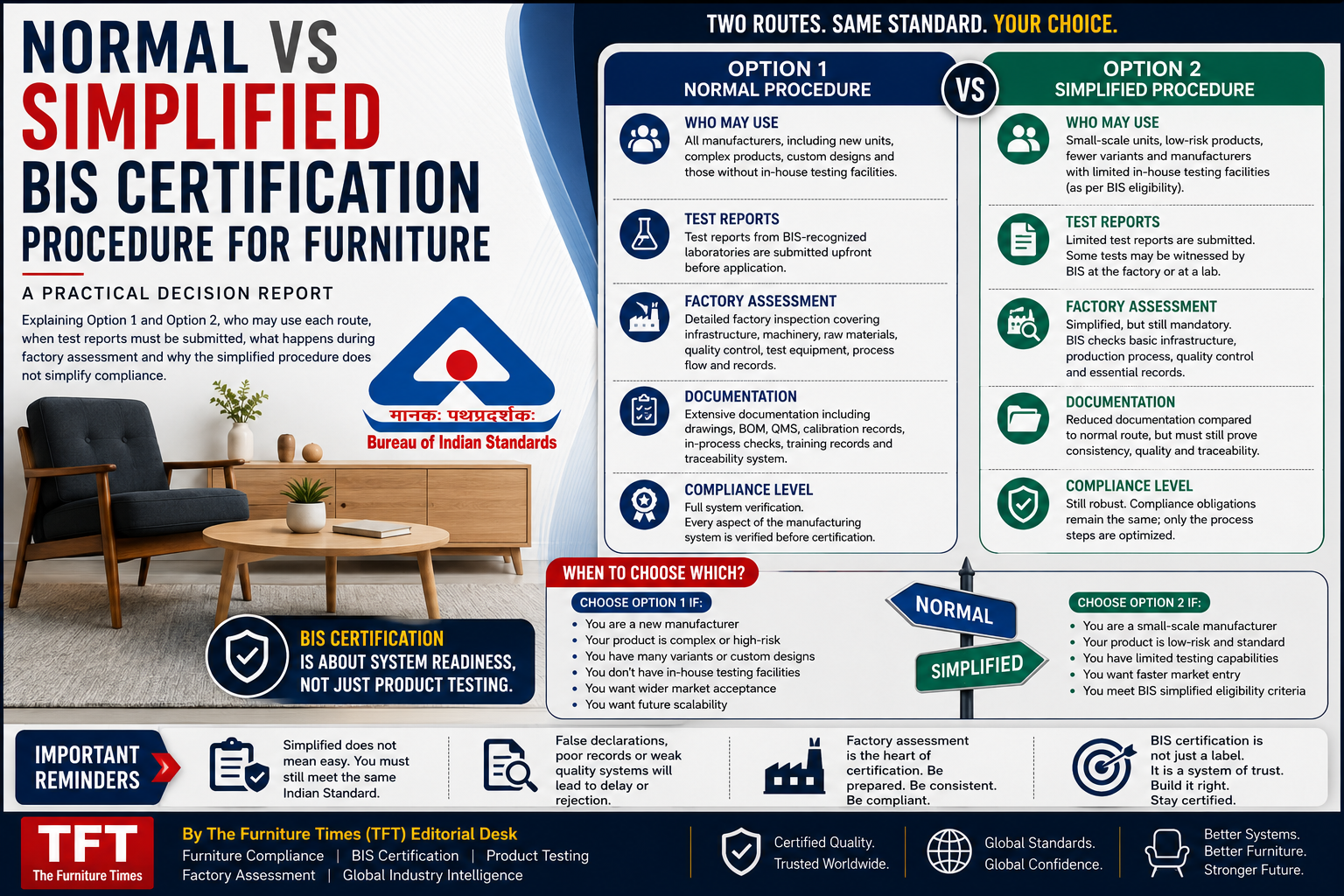
Normal vs Simplified BIS Certification Procedure for Furniture
A practical decision report explaining Option 1 and Option 2, who may use each route, when test reports must be submitted, what happens during factory assessment and why the simplified procedure does not simplify compliance
By The Furniture Times (TFT) Editorial Desk | Furniture Compliance | BIS Certification | Product Testing | Factory Assessment | Global Industry Intelligence
Furniture manufacturers preparing for BIS certification frequently encounter two expressions: the Normal Procedure and the Simplified Procedure.
These names can be misleading.
The simplified procedure does not reduce the technical requirements of the applicable Indian Standard. It does not remove factory assessment. It does not excuse incomplete model declarations, weak quality controls, missing testing arrangements or inaccurate documentation.
Likewise, the normal procedure should not be interpreted as an inferior route. It is a different sequence for establishing product conformity and manufacturing capability.
Under the Bureau of Indian Standards’ current terminology, these routes are generally described as:
- Option 1 — erstwhile Normal Procedure
- Option 2 — erstwhile Simplified Procedure
Both operate under Scheme I of the BIS Conformity Assessment Regulations for the grant of a licence to use or apply the Standard Mark.
The primary difference is not the quality standard.
It is the timing and source of the product test evidence used in the licence decision.
Under Option 1, BIS generally assesses the factory, draws the relevant sample during the visit and waits for satisfactory test results before considering the grant of licence.
Under Option 2, an eligible domestic applicant submits acceptable, conforming third-party test reports with the application. BIS then conducts a factory visit to verify the manufacturing and quality system and draws a verification sample for subsequent review.
The shortest explanation is:
Option 1: BIS visits first, draws the certification sample and grants the licence after satisfactory test evidence is received.
Option 2: The applicant obtains acceptable test evidence first, submits it with the application and then undergoes BIS factory verification.
But manufacturers need to understand much more before choosing—or assuming they can choose—a route.
Comparison at a glance
| Area | Option 1 — Normal | Option 2 — Simplified |
|---|---|---|
| Test report submitted with initial application | Generally not the principal basis for application processing | Conforming report from an acceptable third-party laboratory is required |
| When main product sample is selected | Normally during BIS factory visit | Applicant submits pre-tested sample based on applicable grouping and scope rules |
| Factory visit | Required | Required |
| Manufacturing-capability assessment | Required | Required |
| Quality-control assessment | Required | Required |
| Testing arrangements reviewed | Required | Required |
| BIS sample drawn during factory visit | Yes, for applicable product scope | A verification sample is drawn |
| When licence is normally considered | After satisfactory factory assessment and conformity of the sample drawn under the process | After acceptable pre-submitted report and satisfactory factory verification, subject to applicable conditions |
| Indicative processing expectation | Current BIS guideline states 90 days if satisfactory at the first instance | Current BIS guideline states 30 days if satisfactory at the first instance |
| Available to foreign manufacturers | Yes; foreign applications are processed under Option 1 | No |
| Main advantage | Test sample is selected within BIS’s assessment process | Potentially faster when eligibility, laboratory access and documentation are fully in place |
| Main risk | Longer timeline while official sample testing is completed | Incorrect, incomplete, old or unrepresentative test reports can defeat the time advantage |
The table is a simplified summary. Actual eligibility depends on the latest BIS Grant of Licence guidelines, product-specific manuals, laboratory availability, application history and decisions of the responsible BIS Branch Office.
The language has changed, but the two-route concept remains
The older industry terminology described the routes as “normal” and “simplified.” BIS’s current Grant of Licence framework generally refers to them as Option 1 and Option 2.
The change is useful because “simplified” can create false expectations.
Option 2 may simplify the sequence and reduce processing time by allowing the application to be supported by recent conforming laboratory reports. But it does not simplify:
- The applicable Indian Standard
- Model and variant declaration
- Manufacturing capability
- Factory inspection
- Quality Assurance Plan
- Equipment requirements
- Calibration
- Traceability
- Continuing compliance
- Surveillance after grant
The compliance burden is not removed. Some of it is moved earlier.
An Option 2 applicant must invest more effort before submitting the application because acceptable test evidence must already be available.
Furniture standards covered by the QCO framework
The BIS Scheme I compulsory-certification listing identifies six principal furniture categories within the Furniture Quality Control Order framework:
| Product | Indian Standard |
|---|---|
| Work chairs | IS 17631:2022 |
| General-purpose chairs and stools | IS 17632:2022 |
| Tables and desks | IS 17633:2022 |
| Storage units | IS 17634:2022 |
| Beds | IS 17635:2022 |
| Bunk beds | IS 17636:2022 |
Manufacturers should check the latest official notifications because the Furniture Quality Control Order has been followed by amendments, exemptions and transition-related provisions. Current information should be verified through the official BIS Scheme I compulsory-certification page.
The certification route may also differ by product and circumstances. Manufacturers should not assume that because Option 2 is available for one furniture standard, it is automatically available for every furniture category and applicant.
Option 1: how the normal procedure works
Option 1 is the route in which BIS plays the central role in selecting the sample used to establish conformity for the grant decision.
The process can be understood through the following sequence.
Stage 1: Determine the applicable standard
The manufacturer must identify which Indian Standard applies to the product.
This is not always as simple as selecting the nearest product name. A chair designed for office work may fall under a different standard from a general-purpose dining or visitor chair. A bunk bed presents requirements different from an ordinary bed.
Incorrect classification can invalidate the planning that follows.
Stage 2: Define the proposed scope
The applicant identifies:
- Product category
- Models
- Variants
- Sizes
- Materials
- Construction differences
- Factory location
- Brand or marking information
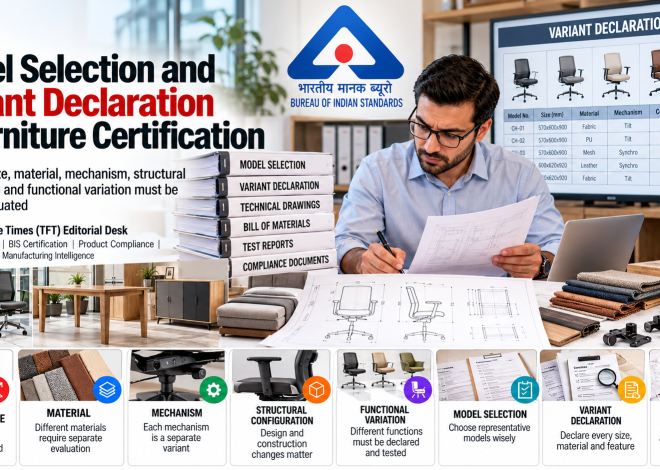
The manufacturer should consult the relevant product manual and grouping guidelines, where available, to determine sample coverage.
Stage 3: Prepare the application and supporting documents
The application should establish the identity of the manufacturer, manufacturing location, product scope and production capability.
Documentation normally includes details such as:
- Manufacturing machinery
- Process flow
- Testing equipment or arrangements
- Quality-control personnel
- Factory layout
- Location plan
- Drawings
- Raw-material information
- Calibration records
- Quality Assurance Plan
- Applicable declarations and undertakings
Stage 4: BIS conducts the factory visit
A BIS certification officer visits the factory to assess:
- Manufacturing infrastructure
- Production process
- Quality controls
- Testing capabilities or arrangements
- Product scope
- Personnel competence
- Documentation
- Traceability
Factory testing may be witnessed for as many requirements as practicable.
If the factory cannot demonstrate the declared process or testing arrangements, the application can be delayed before the external laboratory stage is completed.
Stage 5: BIS draws the sample
Under Option 1, the officer draws samples according to applicable product and grouping requirements. Counter-samples may also be sealed.
The sample should represent normal production—not a special prototype made separately from the controlled manufacturing system.
Stage 6: Sample goes for testing
The drawn sample is sent to the relevant testing laboratory. Testing fees for Option 1 samples are borne by the applicant under the current BIS Grant of Licence guidelines.
Testing time depends on:
- Product category
- Number of models or groups
- Test requirements
- Laboratory capacity
- Sample condition
- Completeness of documentation
- Whether retesting becomes necessary
Furniture testing can involve large samples, purpose-built test rigs and repeated loading cycles, so logistical and laboratory planning matter.
Stage 7: BIS reviews the complete evidence
The licence can be considered after BIS is satisfied with:
- The application documentation
- The factory assessment
- Manufacturing and testing capability
- Product conformity
- Applicable fees and obligations
The current February 2026 BIS Grant of Licence guideline states that an Option 1 case is expected to be completed within approximately 90 days, provided the documents, factory assessment and product conformity are satisfactory at the first instance. Actual time can be longer when there are queries, repeat inspections, testing delays or nonconformities. BIS Grant of Licence Guidelines, February 2026
When Option 1 may be required
Option 1 is not merely a route chosen by applicants who prefer not to obtain a test report in advance. In some circumstances it is mandatory or more appropriate.
Examples include:
Foreign manufacturers
The current BIS Grant of Licence guidelines state that applications from foreign manufacturers are processed under Option 1.
Foreign applicants must therefore plan for factory inspection and BIS-controlled conformity assessment rather than assuming that an overseas laboratory report will unlock Option 2.
Products assigned exclusively to Option 1
BIS maintains product categorization within its Grant of Licence guidelines. Some products are processed exclusively through Option 1.
Lack of an acceptable third-party laboratory
Option 2 depends on the availability of an acceptable laboratory for the applicable Indian Standard and product variety. Where suitable third-party testing capacity is unavailable, suspended or unable to test the required variety, the responsible Branch Office may process the case under Option 1.
Previous licence failure
If a previous licence for the same product and premises was cancelled, expired or surrendered in circumstances involving sample nonconformity, Option 2 may not be available. The fresh application may have to proceed through Option 1 with corrective-action evidence.
All-India first cases
The latest guidelines state that an All-India first application is normally considered under Option 1, although Option 2 may be considered in certain circumstances where recognized third-party laboratory availability is established.
Factory-testing route
Some large or difficult-to-transport products may be considered through witnessed factory testing or declared testing arrangements when allowed. Furniture’s bulk and test-rig requirements make this an area that applicants should discuss with BIS rather than assume.
Advantages of Option 1
Option 1 offers several practical advantages.
BIS controls sample selection
Because the sample is selected during the BIS visit, there is less uncertainty over whether the submitted test sample was representative or correctly selected.
Suitable for applicants without pre-application test evidence
A manufacturer can begin the formal process without first relying on a complete Option 2 test-report package.
Appropriate for foreign manufacturers
It provides the defined route for overseas factories seeking BIS certification.
Useful when product scope is complex
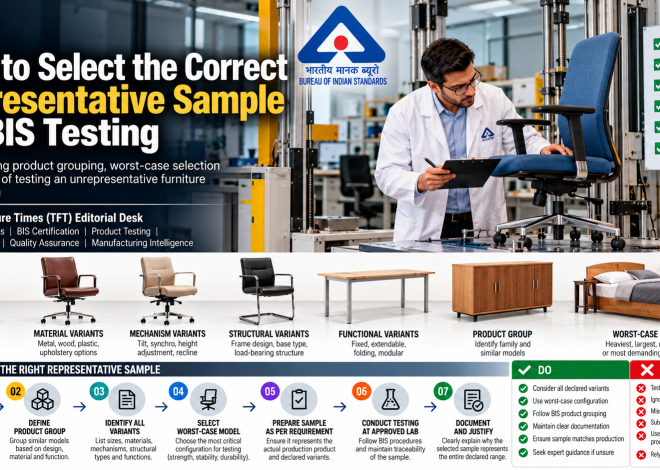
Where grouping, variants or sample selection are uncertain, BIS involvement in drawing the sample may reduce the risk of testing an unsuitable representation—although manufacturers should still resolve scope questions early.
Risks and disadvantages of Option 1
Longer processing time
The grant decision generally waits for testing of the sample drawn during the factory assessment.
Laboratory delays occur after the inspection
If the laboratory has limited capacity or the product requires lengthy tests, the entire application remains open longer.
A failed sample can require significant rework
If the drawn product fails, the factory may need root-cause analysis, corrective action, new production, reinspection or retesting.
Commercial schedules may be affected
Manufacturers should not promise supply dates based on the minimum processing estimate.
Option 2: how the simplified procedure works
Option 2 changes the sequence by requiring the applicant to establish product conformity before submitting the licence application.
It is faster only when the manufacturer prepares correctly.
Stage 1: Confirm eligibility
Before commissioning tests, the manufacturer should confirm:
- The product is currently eligible for Option 2
- The applicant is a domestic manufacturer
- An acceptable laboratory is available
- The proposed variety can be tested by that laboratory
- No previous licence-performance issue excludes Option 2
- The selected sample covers the intended scope
This step is critical.
Spending money on testing does not create eligibility.
Stage 2: Register in the BIS IT system
The February 2026 guideline states that an Option 2 applicant should first register in the BIS IT system and obtain the required unique code.
That code is provided to the third-party laboratory when the product sample is submitted. The related receipt is uploaded through the IT process.
Manufacturers should not independently send samples for certification-purpose testing without first checking the required BIS procedure and laboratory instructions.
Stage 3: Select representative samples
Samples must be selected according to:
- The relevant Indian Standard
- The product manual
- Grouping guidelines, where available
- Models and variants proposed for the licence
A passing report for the wrong configuration may be commercially useless.
For example, a test on one table construction may not automatically cover another table using a different extension mechanism, frame material or structural arrangement.
Stage 4: Obtain reports from an acceptable laboratory
BIS states that reports used for Option 2 should be issued by laboratories within the categories accepted under the Grant of Licence guidelines, including BIS-established, maintained, recognized or otherwise appropriately empanelled laboratories for the product.
The applicant must verify that the laboratory is authorized for:
- The correct Indian Standard
- The relevant product
- The necessary test requirements
- The sample variety involved
An accredited laboratory is not automatically acceptable for every BIS certification purpose.
Stage 5: Check the age of the reports
Under the February 2026 guideline, an Option 2 product test report should generally not be more than 90 days old, counted from the date of issue to the date the application reaches the BIS Branch Office.
Where multiple reports cover one product:
- The latest product report should not be more than 90 days old.
- The oldest product report should not be more than 180 days old.
The official BIS FAQs also emphasize that reports used for Option 2 should generally not be older than 90 days. BIS Product Certification FAQs
This creates a planning challenge. If the manufacturer obtains the report but then spends months correcting the application, the report may become too old.
Documentation and factory preparation should therefore proceed in parallel with testing.
Stage 6: Submit the application
The applicant submits:
- The Option 2 test evidence
- Product and raw-material evidence where required
- Factory details
- Manufacturing-process information
- Testing arrangements
- Drawings
- Model and variant scope
- Quality-control documents
- Undertakings
- Required fees and declarations
The responsibility for ensuring that reports are complete and conforming rests with the applicant.
Stage 7: BIS conducts the factory visit
This is the stage many applicants misunderstand.
Option 2 does not eliminate the factory visit.
BIS visits the manufacturing unit to assess:
- Manufacturing infrastructure
- Production process
- Quality control
- Testing capabilities or arrangements
- Product identity
- Calibration
- Personnel
- Documentation
- Traceability
- Proposed Quality Assurance Plan
The officer may witness factory testing and examine whether the pre-submitted test sample genuinely represents normal factory production.
Stage 8: BIS draws a verification sample
Under Option 2, BIS draws a verification sample during the factory visit. The current guidelines specify a more limited review-oriented sample approach than Option 1, subject to the applicable Scheme of Inspection and Testing.
The verification sample is sent for third-party testing and its report is reviewed after the licence decision in accordance with the procedure.
This is important: the pre-submitted report does not give the manufacturer permanent protection from later sample failure.
Stage 9: Grant and post-grant review
The current BIS guideline states that Option 2 is expected to be completed within approximately 30 days when the application, factory assessment and evidence are satisfactory at the first instance.
However, if the verification sample drawn during the factory visit later fails, immediate suspension and corrective-action measures may follow.
The applicant must therefore treat the verification sample as a serious continuing conformity test—not an administrative formality.
Why Option 2 can be faster
Option 2 reduces the time between factory verification and the licence decision because acceptable conformity evidence is already available.
Under Option 1, the process usually pauses while the BIS-drawn certification sample is tested.
Under Option 2, that principal testing stage takes place before the application.
The procedure is therefore faster because work has been completed in advance—not because the work has disappeared.
Option 2 is front-loaded compliance
A useful way to understand the difference is through workload timing.
Option 1 workload
- Application preparation
- Factory assessment
- BIS sample drawing
- Laboratory testing
- Conformity review
- Licence decision
Option 2 workload
- Eligibility verification
- Sample planning
- Laboratory selection
- Pre-application testing
- Report review
- Application preparation
- Factory verification
- Verification sample
- Licence decision and post-grant review
Option 2 places more technical and financial responsibility on the manufacturer before the formal application is processed.
A well-prepared applicant can benefit from a faster decision. An unprepared applicant may lose time and money by testing the wrong sample or allowing reports to expire.
Option 2 does not mean self-certification
Another misconception is that submitting a passing laboratory report converts the process into self-certification.
It does not.
The report is independent product evidence considered by BIS. BIS still controls the licensing decision, conducts the factory visit, reviews the manufacturing system and draws a verification sample.
The manufacturer cannot use the Standard Mark merely because an external laboratory issued a passing report.
The Standard Mark can be used only after BIS grants the relevant licence and only within the approved scope and conditions.
Documentation requirements: what both options share
The two routes differ in test-evidence sequence, but their core factory-documentation expectations substantially overlap.
Applicants should prepare the following areas carefully.
Manufacturer identity
- Legal name
- Factory address
- Ownership or constitution details
- Authorized signatory
- Brand relationships
- Contact information
Separate applications are required for different Indian Standards and for products manufactured at different factory locations. BIS’s official FAQs specifically state that one application cannot cover different products and standards merely because they share a factory, nor can one application automatically cover the same product across multiple factories.
Product scope
- Product name
- Indian Standard
- Model codes
- Variant descriptions
- Sizes
- Materials
- Construction differences
- Brand names
Technical documents
- Product drawings
- Component drawings where relevant
- Bills of materials
- Specifications
- Photographs
- Revision status
- Grouping or sample-selection logic
Manufacturing details
- Process flow
- Machinery list
- Plant layout
- Manufacturing stages
- Subcontracted processes
- Production capacity
Quality controls
- Incoming inspection
- In-process controls
- Final inspection
- Testing frequencies
- Batch definition
- Quality Assurance Plan
- Nonconforming-product control
Testing arrangements
- Equipment list
- Range and accuracy
- Calibration certificates
- Testing personnel
- External laboratory arrangements
- Subcontracting declarations
Raw-material evidence
Where the product standard makes conformity of a raw material mandatory, the latest guidelines describe an evidence hierarchy that may include ISI-marked material, reports from acceptable laboratories, manufacturers’ certificates, NABL-accredited reports or factory reports under specified circumstances.
The obligation to ensure raw-material and component conformity remains with the applicant.
Documentation unique or especially important to Option 2
Option 2 requires additional focus on:
- The pre-application product test report
- Laboratory eligibility
- BIS registration code supplied to the laboratory
- Proof or receipt of sample submission
- Report issue dates
- Complete coverage of test requirements
- Relationship between the tested sample and proposed scope
- Option 2 undertaking
- Raw-material reports where mandatory
A report should be reviewed clause by clause before filing.
Manufacturers should confirm:
- The applicant’s name is correct.
- The manufacturing address is correct.
- The model designation matches the application.
- The sample description is accurate.
- The Indian Standard and version are correct.
- All required tests are covered or justified.
- Every result is conforming.
- Photographs correspond to the sample.
- The report remains within the permitted age.
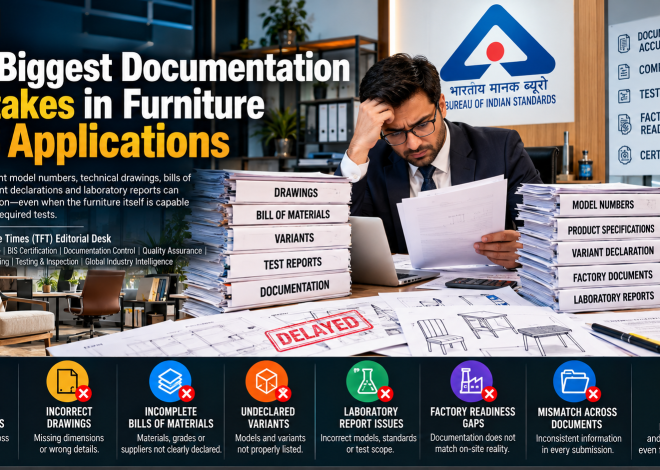
A spelling discrepancy may appear minor, but multiple inconsistencies can make it difficult to prove that the report belongs to the product, factory and applicant seeking certification.
Testing arrangements after the licence is granted
The route used for grant does not determine whether the manufacturer can ignore future testing.
After certification, the licensee must implement the applicable Scheme of Inspection and Testing or the Quality Assurance Plan agreed with BIS.
The product manual may distinguish between:
- Tests required in-house
- Tests that may be subcontracted
- Routine checks
- Periodic tests
- Batch- or control-unit requirements
Manufacturers should review these obligations before applying.
A company may be able to obtain an Option 2 report from an external laboratory yet remain unprepared to maintain the required operational testing after the licence is granted.
The grant route and ongoing testing system are related but separate questions.
Factory assessment: the obligation is broadly common
Regardless of route, BIS needs to verify that the factory can maintain product conformity.
During the visit, the officer may examine:
- Machinery and infrastructure
- Raw-material storage
- Production areas
- Finished-goods storage
- Laboratory or declared test arrangements
- Quality-control personnel
- Calibration certificates
- Raw-material certificates
- Product drawings
- Plant and location plans
- Quality Assurance Plan
- Previous corrective actions where applicable
BIS may witness tests at the manufacturer’s site or at declared testing arrangements.
If factory testing reveals a nonconformity, sample drawing and further processing may be affected.
A passing Option 2 report cannot rescue a factory that fails to demonstrate real manufacturing and quality capability.
The verification-sample risk under Option 2
Option 2 applicants must understand the risk attached to the verification sample.
The licence may be granted based on the pre-submitted conforming report and satisfactory factory assessment, while the sample drawn during the visit proceeds for review testing.
If that verification sample is nonconforming, BIS’s current guidelines provide for immediate suspension, corrective action and further review.
This creates a powerful compliance lesson:
The sample submitted before the application and the product manufactured during the BIS visit must be equivalent in all conformity-relevant respects.
Differences may arise through:
- Material substitution
- Different component supplier
- Changed board thickness
- Hardware variation
- Manufacturing inconsistency
- Uncontrolled dimensions
- Special preparation of the original sample
- Weak routine quality control
Option 2 is therefore appropriate only when the factory has stable production—not merely the ability to build one passing sample.
Eligibility decision tree for furniture manufacturers
Before selecting a route, ask the following questions.
Question 1: Is the factory outside India?
If yes, Option 2 is not available under the current guidelines. The application proceeds under Option 1 through the relevant Foreign Manufacturers Certification Scheme process.
Question 2: Is the furniture product currently eligible for Option 2?
Check the latest BIS Grant of Licence annexure, product-specific information and online portal. Do not rely on an old list.
Question 3: Is an acceptable laboratory available for the standard and product variety?
If not, the Branch Office may need to process the case under Option 1 or another permitted testing arrangement.
Question 4: Was a previous licence affected by sample nonconformity?
If yes, Option 2 may be unavailable, and corrective-action evidence may be required under Option 1.
Question 5: Is the product an All-India first application?
It will normally be considered under Option 1, subject to the limited circumstances described in current BIS guidelines.
Question 6: Is the product scope stable?
If models, components or drawings are still changing, pre-application testing may be premature.
Question 7: Can the factory maintain the tested construction?
If normal production cannot reproduce the sample reliably, Option 2 creates a serious verification-sample risk.
Question 8: Can the application be submitted before reports become too old?
If not, the company may need new testing.
Which route should a furniture manufacturer prefer?
There is no universal answer.
Option 1 may be more appropriate when:
- The applicant is a foreign manufacturer.
- Option 2 is not available for the product.
- No acceptable external laboratory is available.
- The company has a prior nonconformity history affecting eligibility.
- Sample-selection or grouping requires closer BIS involvement.
- The company cannot complete valid testing before applying.
- The product is an All-India first case.
Option 2 may be attractive when:
- The applicant is a qualifying domestic manufacturer.
- The product is eligible.
- An acceptable laboratory has full testing capability.
- Models and variants are finalized.
- Drawings and bills of materials are controlled.
- The factory can reproduce the tested sample.
- Documents can be filed while reports remain valid.
- A faster processing sequence has genuine commercial value.
Manufacturers should not choose Option 2 merely because they are facing an urgent sales deadline.
Urgency cannot compensate for weak preparation.
Comparative timeline
Option 1
Week 1 onward: Application review and query resolution
Next stage: Factory assessment
Next stage: BIS sample drawing and dispatch
Next stage: Laboratory testing
Next stage: Review, fees and grant decision
The official expectation is approximately 90 days when everything is satisfactory at the first attempt. The BIS FAQ notes that actual average processing under Option 1 can extend to around four months.
Option 2
Before application: Registration, sample selection and testing
Application stage: Submission of conforming, recent reports
Next stage: Factory verification
Next stage: Verification-sample dispatch
Next stage: Grant decision and post-grant report review
The official expectation is approximately 30 days after receipt of a complete application when conformity and factory assessment are satisfactory at the first attempt.
The hidden time is the period before application used for product finalization and laboratory testing.
Option 2 is not necessarily shorter from the day a company first begins preparing. It is generally shorter from the date a complete, test-supported application is submitted.
Cost differences
Both procedures may involve:
- Application fees
- Inspection charges
- Licence fees
- Marking fees
- Testing expenses
- Sample production
- Transport
- Consultancy or preparation costs
- Calibration
- Test equipment
- Corrective action
Under the February 2026 guidelines:
- Option 1 sample-testing charges are borne by the applicant.
- The Option 2 verification-sample testing fee is treated as subsumed within the applicable annual minimum marking fee under the stated procedure.
However, the applicant still bears the cost of obtaining the pre-application Option 2 test reports.
The cheapest route is not automatically the best route. A failed, expired or incorrectly scoped test report can make Option 2 more expensive than a carefully planned Option 1 application.
Common Option 1 mistakes
- Submitting an application before the factory is operational
- Offering a prototype instead of normal production
- Incomplete testing equipment
- Uncalibrated equipment
- Unclear model and variant scope
- Failure during witnessed factory testing
- Poor raw-material documentation
- Long delays in dispatching the drawn sample
- Failure to answer BIS queries quickly
Common Option 2 mistakes
- Assuming every furniture product is eligible
- Testing before registering through the required system
- Using a laboratory not accepted for the product
- Testing the wrong model
- Submitting a partial report without acceptable justification
- Allowing the report to exceed the age limit
- Changing construction after testing
- Submitting a report with the wrong factory address
- Preparing a special sample that routine production cannot reproduce
- Treating the factory visit as a formality
The best preparation strategy
Furniture manufacturers should follow a route-neutral preparation system before deciding between Option 1 and Option 2.
Step 1: Freeze the product
Finalize the model, construction, materials, components and drawings.
Step 2: Map the standard
Identify every applicable requirement and test.
Step 3: Define the certification family
Create a variant matrix explaining which models are covered and why.
Step 4: Audit the factory
Review machinery, process controls, personnel, test facilities, calibration and records.
Step 5: Conduct internal pre-testing
Identify product weaknesses before the certification sample is produced.
Step 6: Verify route eligibility
Check the latest BIS procedure, product listing, laboratory availability and applicant status.
Step 7: Build the document package
Ensure that all technical and legal documents are consistent.
Step 8: Select the route
Choose—or confirm with BIS—the route supported by the product, factory and current rules.
Do not confuse speed with readiness
Option 2 can accelerate a strong application.
It cannot repair a weak one.
A manufacturer with controlled production, accurate drawings, stable materials, reliable testing and complete documentation can benefit from front-loaded test evidence.
A manufacturer with uncontrolled variants, inconsistent components and incomplete quality records may simply reach failure faster.
Option 1 provides more time during the formal sequence, but it also exposes problems when BIS draws and tests the sample.
Neither procedure hides a weak factory.
FurniReviewology and post-certification performance
BIS certification and customer reviews evaluate different dimensions of trust.
Certification provides evidence that products within the licensed scope are manufactured under a conformity-assessment system connected with the relevant Indian Standard.
Customer and trade reviews reveal what happens after the product enters real use.
FurniReviewology can help identify recurring patterns relating to:
- Structural performance
- Mechanism reliability
- Material accuracy
- Delivery damage
- Installation quality
- Warranty support
- Complaint resolution
A certified product can still produce dissatisfaction through delivery, installation or service failures. Conversely, positive reviews do not replace mandatory certification where the law requires it.
The complete trust framework is:
BIS supports conformity.
FISE supports discoverability.
FurniReviewology supports experience-based trust.
TFT supports industry understanding and visibility.
Final conclusion
The normal and simplified procedures are not two different standards of quality.
They are two different routes for establishing conformity and factory capability.
Under Option 1, BIS generally visits the factory, draws the sample and awaits satisfactory test evidence before granting the licence.
Under Option 2, an eligible domestic manufacturer submits acceptable recent conformity reports with the application, undergoes factory verification and provides a verification sample for subsequent review.
Both require:
- Correct product classification
- Accurate model scope
- Manufacturing capability
- Quality control
- Testing arrangements
- Factory assessment
- Documentation
- Traceability
- Continuing compliance
The correct route is the one that matches the product, applicant, laboratory situation, compliance history and latest BIS requirements.
Manufacturers should stop asking:
“Which route is easier?”
They should ask:
“Which route are we eligible for, and can our factory support it without gaps?”
That question leads to better planning, fewer delays and a more defensible BIS application.
Regulatory note
This article is for general industry education and does not constitute legal or certification advice. BIS rules, Quality Control Orders, product lists, laboratory status, implementation dates and grant procedures can change.
Applicants should confirm current requirements through the BIS Product Certification Process, the latest Grant of Licence Guidelines, relevant product manuals, ManakOnline and the responsible BIS Branch Office.
The Furniture Times (TFT) & Furniture Industry Search Engine (FISE)
“TFT tells their story. FISE helps the world find them.”
FurniReviewology helps the world trust them.
The furniture industry ecosystem is a $1 trillion industry ecosystem.
May simplify the sequence—but only complete preparation simplifies the certification journey.