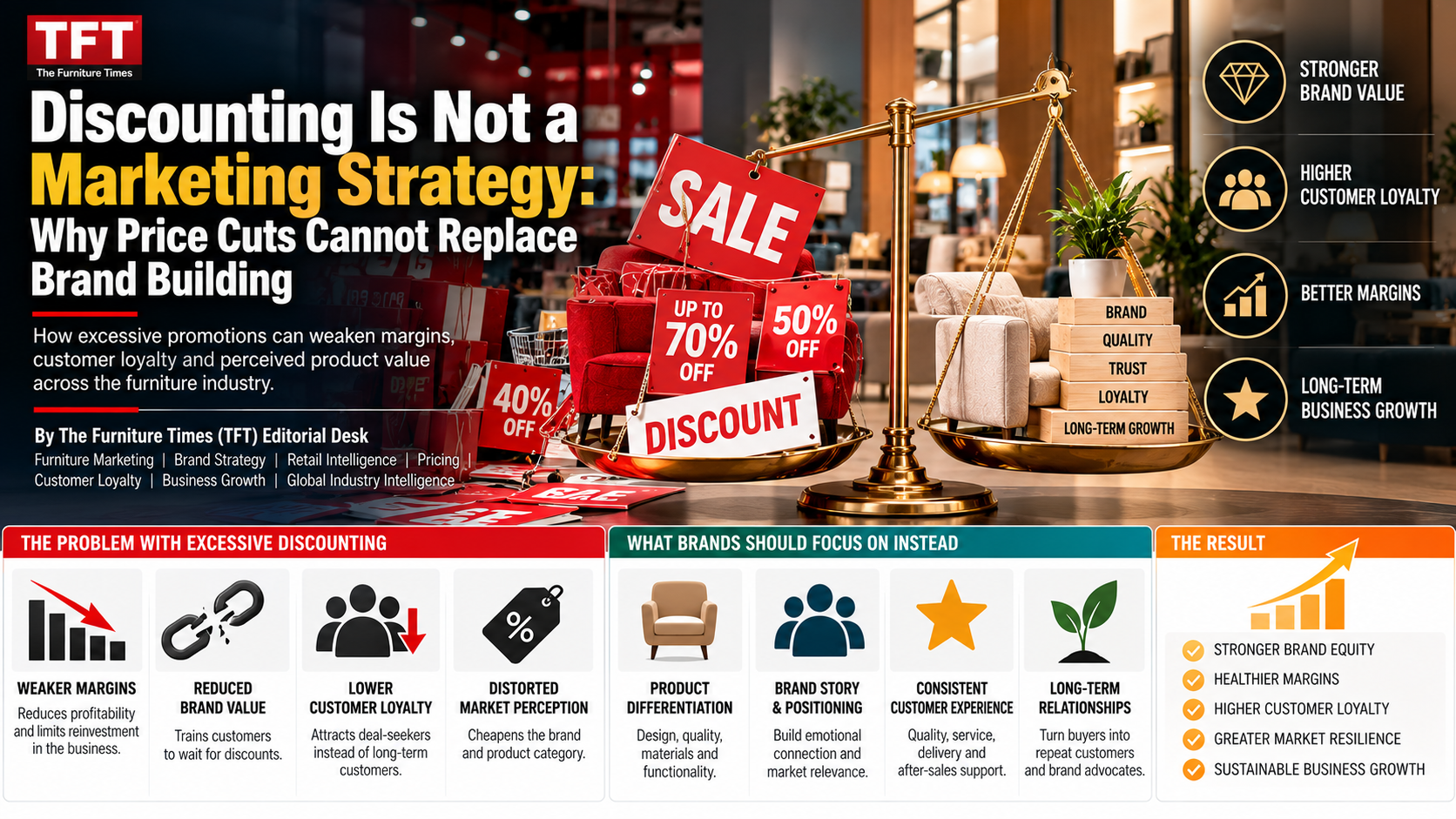
Discounting Is Not a Marketing Strategy: Why Price Cuts Cannot Replace Brand Building
How excessive promotions can weaken margins, customer loyalty and perceived product value across the furniture industry
By The Furniture Times (TFT) Editorial Desk | Furniture Marketing | Brand Strategy | Retail Intelligence | Pricing | Customer Loyalty | Business Growth | Global Industry Intelligence
Discounting can generate attention. It can move ageing inventory, encourage first-time purchases, support a seasonal campaign and help a furniture retailer convert customers who are already close to making a decision.
But discounting alone is not a marketing strategy.
When a furniture business depends continuously on “sale,” “clearance,” “limited-time offer” and “up to 70% off” messages, the discount stops feeling exceptional. It becomes the brand’s normal identity.
Customers begin to ask:
- Why should I buy today if another sale will begin next week?
- Was the original price ever genuine?
- Is the product worth its listed price?
- Is the company struggling to sell?
- Is the quality lower than advertised?
- Can I negotiate an even lower price?
- Should I wait for a larger discount?
This is the hidden cost of excessive promotion.
A short-term increase in transactions can create a long-term decline in pricing power, perceived quality, customer trust and profitability. The company may sell more units while earning less money, attracting less loyal customers and weakening the very brand it needs for sustainable growth.
Furniture businesses cannot build enduring market positions by teaching customers to wait for discounts.
A price cut may create a transaction. Brand value creates preference.
The difference matters.
Discounting is a pricing action—not a complete strategy
A marketing strategy defines:
- Who the business serves
- What customer problem it solves
- Why its offer is different
- How it creates value
- How it communicates that value
- Where customers can discover it
- Why buyers should trust it
- How it earns repeat business
- How it protects its market position
A discount answers only one question:
How much less will the customer pay?
That may help close a sale, but it does not explain:
- Why the product is worth buying
- Why the brand deserves attention
- Why its materials are better
- Why its construction is more dependable
- Why its service is more reliable
- Why the customer should return
- Why the business should be recommended
A brand without a clear value proposition can easily become trapped in price competition.
Once customers see little meaningful difference between two furniture businesses, price becomes the deciding factor. When price becomes the primary differentiator, the cheapest competitor gains an advantage—even if it offers weaker products or service.
The solution is not always a deeper discount. The solution is greater differentiation.
The furniture industry is especially vulnerable to discount addiction
Furniture is highly exposed to promotional pressure because it combines:
- Large physical inventories
- High warehousing costs
- Seasonal collections
- Changing design trends
- Slow-moving product categories
- Expensive showroom space
- Cash-flow requirements
- Online price comparison
- Aggressive marketplace competition
- Long replacement cycles
- High customer-acquisition costs
A sofa that remains unsold occupies valuable space. A discontinued dining collection ties up capital. Outdoor furniture may become harder to sell after the main season. A mattress or bedroom set may face intense price competition from local and online sellers.
Discounting can therefore become operationally attractive.
The problem begins when a temporary inventory-management tool becomes the company’s permanent customer-acquisition model.
A furniture business may start with one clearance campaign. Strong initial traffic encourages another promotion. Soon, almost every advertisement becomes price-led:
- Weekend sale
- Holiday sale
- Anniversary sale
- Warehouse sale
- Festival sale
- Month-end sale
- New-arrival sale
- Moving sale
- Online-exclusive sale
- Manager’s special
- Member discount
- Clearance extension
- Final clearance extension
When promotions never end, urgency disappears.
The customer learns that the sale price is the real price.
The margin damage is larger than many businesses realise
A discount comes directly out of gross margin unless it is offset by lower costs, supplier funding, higher basket value or significant operational efficiencies.
Consider a product with:
- Selling price: $1,000
- Product and direct costs: $600
- Gross profit: $400
- Gross margin: 40%
If the retailer offers a 20% discount, the selling price becomes $800.
Assuming the cost remains $600:
- New gross profit: $200
- Gross profit reduction: 50%
The selling price fell by only 20%, but gross profit fell by half.
To generate the same $400 gross profit previously earned from one unit, the retailer must now sell two units—before considering additional delivery, sales commission, payment-processing, advertising, assembly or after-sales expenses.
| Scenario | Selling price | Direct cost | Gross profit per unit | Units required to earn $400 |
|---|---|---|---|---|
| Full price | $1,000 | $600 | $400 | 1 |
| 10% discount | $900 | $600 | $300 | 1.34 |
| 20% discount | $800 | $600 | $200 | 2 |
| 30% discount | $700 | $600 | $100 | 4 |
| 40% discount | $600 | $600 | $0 | No gross profit |
This simplified example illustrates why sales volume alone can be misleading.
A business can report:
- More customers
- More invoices
- More items sold
- Higher website traffic
- Greater showroom activity
—and still be financially weaker.
The correct question is not only, “How much did we sell?”
It is:
How much profitable revenue did the campaign create after all associated costs?
Volume does not automatically compensate for lower margins
Managers frequently justify discounting with the assumption that additional sales volume will offset reduced profit per unit.
Sometimes it can. Often it does not.
Higher sales volume may also create higher:
- Delivery costs
- Installation workloads
- Payment-processing fees
- Sales commissions
- Damage claims
- Customer-service demand
- Return and replacement costs
- Assembly pressure
- Overtime expenses
- Warranty exposure
Discount campaigns can also attract customers who expect premium service despite paying a reduced price.
If the company’s operational systems are not prepared for the increase, the campaign may cause:
- Delivery delays
- Product damage
- Installation mistakes
- Stock inaccuracies
- Poor communication
- Negative reviews
- Refund requests
- Customer dissatisfaction
The business may generate more transactions while weakening its reputation.
Constant sales train customers not to buy
Customers learn from repeated brand behaviour.
If a furniture retailer discounts every month, buyers notice the pattern. Instead of creating urgency, the promotion creates postponement.
A customer considering a dining set may think:
I will wait. There is always another sale.
This behaviour can produce a damaging cycle:
- Customers delay full-price purchases.
- Normal-period sales decline.
- The retailer launches another promotion.
- Customers receive confirmation that waiting was correct.
- Full-price demand weakens further.
- The business becomes increasingly dependent on discounts.
The brand has unintentionally trained its market to resist regular prices.
This is the opposite of loyalty.
True loyalty means the customer prefers the brand because of its value, trust, experience or identity. Discount dependency means the customer remains interested only while the price is reduced.
Discount-driven customers may not be loyal customers
Not every customer acquired during a promotion is unprofitable or disloyal. Discounts can introduce buyers to a brand and lead to valuable long-term relationships.
However, excessive discounting disproportionately attracts price-sensitive shoppers who may switch immediately when another seller makes a cheaper offer.
Their loyalty often belongs to the promotion rather than the business.
A discount-dependent customer may:
- Compare every purchase primarily on price
- Negotiate beyond the advertised offer
- Delay purchasing until another campaign
- Expect free delivery and installation
- Seek additional gifts or accessories
- Switch brands for a small price difference
- Perceive regular prices as unfair
- Complain if a later discount is larger
- Provide little repeat business without incentives
This does not mean price-conscious customers are undesirable. Every market includes customers with different budgets.
The danger is building an entire customer-acquisition model around buyers who will not remain once the promotion ends.
Excessive discounts can weaken perceived quality
Price is not merely a number. It is also a signal.
Customers often use price to infer:
- Product quality
- Material value
- Craftsmanship
- Durability
- Brand position
- Service quality
- Exclusivity
- Reliability
Furniture purchases can be difficult to evaluate before use. A customer may not fully understand timber grades, foam density, joint construction, hardware quality, coating durability or structural engineering.
When product information is incomplete, price becomes one of the cues used to judge value.
A premium sofa permanently offered at half price creates uncertainty:
- Was the original price inflated?
- Is the sofa really premium?
- Is the stock defective or outdated?
- Is the company clearing inventory because of a problem?
- Will after-sales support remain available?
- Is the retailer about to close?
A discount does not automatically communicate poor quality, but constant deep discounting can create suspicion.
The “false original price” problem
Retailers sometimes advertise dramatic reductions against reference prices that customers rarely, if ever, pay.
This may create impressive-looking messages:
- “Was $5,000—Now $2,499”
- “70% off”
- “Massive savings”
- “Final clearance”
But when the same product remains on promotion for months, customers may conclude that the higher price was never meaningful.
This harms trust.
It can also create consumer-protection and advertising-compliance concerns depending on the jurisdiction, particularly where businesses make misleading price comparisons, create artificial urgency or use reference prices without a genuine selling history.
Furniture businesses should ensure that:
- Original prices are genuine
- Promotional periods are clearly defined
- Conditions are disclosed
- “Up to” discounts are not misleading
- Stock limitations are accurate
- Savings claims can be substantiated
- Countdown timers reflect real deadlines
- Clearance descriptions are truthful
A promotion should reduce the price—not the credibility of the company.
Endless urgency destroys urgency
Urgency works only when the deadline is real.
A customer will stop responding if the business repeatedly announces:
- Final day
- Last chance
- Ending tonight
- Clearance ends Sunday
- Sale extended by popular demand
- Final extension
- One more weekend
When every day is the final day, no day is the final day.
Artificial urgency may produce short-term clicks, but it erodes customer confidence. Buyers begin to treat every promotional message as background noise.
A credible campaign should have:
- A clear start date
- A genuine end date
- Defined products
- Accurate stock conditions
- Transparent exclusions
- Consistent pricing
- A real commercial reason
Scarcity should be factual, not manufactured.
Promotion frequency can dilute brand identity
A furniture brand should stand for something memorable.
It may be known for:
- Exceptional comfort
- Outdoor durability
- Local craftsmanship
- Sustainable materials
- Modular living
- Small-space design
- Hospitality expertise
- Fast delivery
- Customisation
- Premium after-sales service
- Timeless design
- Accessible luxury
- Commercial-grade performance
But when every advertisement communicates only a price reduction, these distinctions disappear.
The market begins to remember the business as:
“The furniture company that is always on sale.”
That may generate bargain traffic, but it does not necessarily build preference, trust or prestige.
The company’s craftsmanship, service, expertise and product story become invisible behind the discount percentage.
Brand building creates reasons to choose beyond price
A strong brand reduces the need to win every transaction through discounting.
Brand building includes:
- A clear market position
- Consistent visual identity
- Recognisable product design
- Reliable product quality
- Honest communication
- Useful educational content
- Visible customer reviews
- Strong product documentation
- Memorable showroom experience
- Dependable delivery
- Responsive after-sales support
- Meaningful guarantees
- Credible media coverage
- Transparent company information
- Consistent digital presence
A strong furniture brand answers the customer’s deeper questions:
- Will this product last?
- Will it fit my space?
- Can I trust the dimensions?
- Is the seating comfortable?
- Will delivery arrive on time?
- Who will help if something breaks?
- Can I obtain replacement parts?
- Is the warranty meaningful?
- Do other customers recommend the company?
- Will this purchase still feel worthwhile in five years?
Price remains important, but it becomes one part of a larger decision.
Furniture businesses must sell value—not only products
Value is not identical to low price.
Value is the relationship between what the customer receives and what the customer gives.
A customer may consider a higher-priced furniture product better value when it offers:
- Longer lifespan
- Better materials
- Greater comfort
- Stronger construction
- Safer performance
- Easier maintenance
- Better warranty
- Professional delivery
- Correct installation
- Replaceable components
- Reliable after-sales service
- Better resale potential
- Lower lifecycle cost
A $400 chair that must be replaced every year may provide less value than a $700 chair that performs reliably for several years.
Furniture marketing should help customers understand this difference.
Without education, the buyer sees only the upfront price.
The role of product storytelling
Furniture contains many invisible value factors.
A customer may not see:
- Reinforced joints
- Higher-density foam
- Kiln-dried timber
- Thicker aluminium sections
- UV-resistant materials
- Corrosion-resistant fasteners
- Commercial-grade fabrics
- Replaceable hardware
- Load testing
- Quality-control inspections
- Responsible material sourcing
These advantages must be communicated.
Product storytelling can explain:
- Why the material was selected
- How the product was engineered
- Where it was manufactured
- Who designed or crafted it
- What environment it is suitable for
- How it should be maintained
- What tests it has undergone
- What warranty support is available
- How it performs over time
- How it differs from cheaper alternatives
When customers understand the product, they are less likely to evaluate it on price alone.
Reviews are more powerful than repeated discounts
A discount tells buyers that the product costs less.
A detailed review can tell them:
- Whether the furniture is comfortable
- Whether delivery was punctual
- Whether assembly was professional
- Whether the finish remained durable
- Whether the dimensions were accurate
- Whether the company responded to problems
- Whether the product delivered value over time
Reviews reduce perceived risk.
For high-consideration purchases such as sofas, dining sets, beds, office furniture and outdoor collections, reducing risk can be more powerful than reducing price.
Furniture companies should build review strategies across credible channels, including:
- Google Business Profiles
- Marketplaces
- Retail platforms
- Social channels
- Independent industry-review platforms
- FurniReviewology
- Verified post-purchase feedback systems
The purpose is not merely to collect five-star ratings. It is to create credible evidence of quality, service and accountability.
Better alternatives to indiscriminate discounting
Furniture companies do not have to choose between full price and no sales.
There are more strategic ways to create customer value.
1. Product bundles
Instead of cutting the price of every item, combine complementary products:
- Dining table with chairs
- Bed with bedside tables
- Sofa with coffee table
- Outdoor table with parasol
- Desk with ergonomic chair
- Mattress with bedframe
- Wardrobe with installation
Bundles can increase order value while giving customers a meaningful benefit.
2. Value-added services
Offer benefits that protect product price:
- Free design consultation
- Space planning
- Assembly
- Installation
- Delivery within a defined area
- Old-furniture removal
- Extended warranty
- Maintenance inspection
- Fabric-protection service
- Priority delivery
The customer receives more value without the business reducing the product’s perceived worth.
3. Financing
Monthly payment options can improve affordability without damaging the headline price.
Financing must be transparent, but it can address the customer’s cash-flow concern more effectively than a permanent discount.
4. Loyalty benefits
Reward repeat customers through:
- Member pricing
- Early access
- Service upgrades
- Maintenance benefits
- Referral rewards
- Exclusive products
- Priority support
A loyalty programme should encourage long-term relationships, not distribute indiscriminate coupons.
5. Targeted promotions
Offer incentives to defined segments rather than discounting the entire catalogue:
- First-time buyers
- Existing customers
- Trade professionals
- Hospitality clients
- Property managers
- Designers
- Bulk purchasers
- Members
6. Genuine clearance
Use discounts to remove:
- Discontinued stock
- Display pieces
- Returned but inspected items
- Packaging-damaged products
- Seasonal inventory
- Excess components
- One-off samples
Clearly explain why the price has been reduced.
7. Entry-level products
Create a properly designed, lower-priced range rather than repeatedly discounting premium products.
An entry-level line can protect the premium brand while serving budget-conscious customers.
8. Limited product promotions
Discount selected products strategically instead of reducing the entire assortment.
A promotional product can attract traffic while related products remain at full price.
9. Trade-in programmes
Trade-ins can create customer value, encourage circularity and reduce direct pressure on list prices.
10. Furniture-as-a-service
For suitable commercial customers, leasing or subscription models can shift the conversation from purchase price to monthly operational value.
When discounting is strategically justified
Discounting is not inherently harmful.
It can be useful when the objective is specific, measurable and time-bound.
Appropriate uses may include:
- Clearing discontinued inventory
- Selling seasonal stock
- Launching a new location
- Introducing a new product
- Stimulating demand during a defined slow period
- Rewarding loyal customers
- Securing a commercially viable bulk order
- Supporting supplier-funded promotions
- Disposing of showroom samples
- Recovering cash from ageing stock
- Promoting a carefully selected loss leader
- Responding to temporary market disruption
The key is to know:
- Why the discount is being offered
- Which customers it targets
- Which products are included
- How it affects margin
- What behaviour it is intended to create
- How success will be measured
- When the campaign will end
A strategic discount has a job.
A habitual discount merely fills the absence of strategy.
What every promotion should measure
Furniture businesses should assess more than total sales.
| Metric | Why it matters |
|---|---|
| Gross profit | Shows whether the campaign generated profitable revenue |
| Contribution margin | Accounts for variable costs beyond product cost |
| Average order value | Indicates whether customers bought more or merely paid less |
| Units per transaction | Measures bundle or cross-selling performance |
| New-customer acquisition cost | Shows what it cost to attract each buyer |
| Repeat purchase rate | Reveals whether promotional customers return |
| Full-price conversion rate | Indicates whether the brand can sell without incentives |
| Stock ageing | Shows whether the intended inventory was cleared |
| Delivery and installation cost | Identifies operational burden |
| Return and cancellation rate | Reveals quality or expectation problems |
| Warranty and complaint rate | Measures downstream campaign cost |
| Review sentiment | Shows whether increased volume harmed customer experience |
| Discount dependency | Tracks how much revenue occurs only under promotion |
| Customer lifetime value | Determines whether acquired customers remain commercially valuable |
A campaign that increases revenue but destroys contribution margin should not automatically be celebrated as successful.
The discount-authority problem
In many furniture businesses, too many employees can authorise discounts.
Sales representatives may reduce prices to:
- Close the transaction quickly
- Meet personal targets
- Avoid difficult value discussions
- Match an unverified competitor
- Satisfy a demanding customer
- Clear an old quotation
- Prevent a buyer from leaving the showroom
Over time, customers learn that listed prices are negotiable.
The business should establish:
- Discount approval levels
- Minimum margin thresholds
- Product-specific limits
- Documented reasons
- Manager authorisation
- Quote-expiry rules
- Trade-customer policies
- Salesperson performance measures based on profit—not only revenue
Sales teams should be trained to defend value before offering a concession.
Stop rewarding salespeople only for turnover
If commissions and targets are based solely on revenue, salespeople may be encouraged to close heavily discounted orders.
This can produce high turnover and weak profitability.
A better performance system can consider:
- Gross profit
- Contribution margin
- Average discount
- Order quality
- Customer satisfaction
- Repeat business
- Return rate
- Payment collection
- Cross-selling
- Warranty claims
The goal is not merely to sell more furniture.
It is to sell profitably, responsibly and in a way that strengthens the customer relationship.
How to reduce an established discount dependency
A business that has trained customers to wait for sales cannot usually return to full-price selling overnight.
The transition must be managed.
Step 1: Audit promotional history
Review:
- Discount frequency
- Average discount depth
- Products most often reduced
- Campaign profitability
- Customer response
- Competitor activity
- Margin erosion
- Coupon usage
- Full-price sales performance
Step 2: Identify genuine price-value gaps
Some products may simply be overpriced relative to quality or market expectations.
In that case, the answer may be a transparent price correction—not endless temporary discounts.
Step 3: Clarify brand position
Decide what the business wants to be known for beyond price.
Step 4: Strengthen product information
Improve:
- Specifications
- Dimensions
- Materials
- Lifestyle photography
- Videos
- Care instructions
- Warranty information
- Comparisons
- Reviews
- Delivery details
Step 5: Improve the offer
Add services, guarantees, bundles and expertise that justify the price.
Step 6: Reduce promotion frequency
Fewer campaigns can make each campaign more credible.
Step 7: Replace blanket discounts
Use targeted offers, genuine clearance and product-specific incentives.
Step 8: Train the sales team
Teach salespeople to explain value, lifecycle cost and product differences.
Step 9: Measure full-price conversion
Track whether customers are gradually accepting regular pricing.
Step 10: Communicate consistently
Brand recovery requires repetition. Customers must repeatedly see quality, expertise, reliability and value—not only discounts.
A stronger marketing content mix
A furniture brand’s communication should not consist entirely of sale advertisements.
A healthier content mix can include:
- Product education
- Material guides
- Buying advice
- Room-planning ideas
- Care and maintenance
- Factory stories
- Designer interviews
- Customer projects
- Hospitality installations
- Before-and-after transformations
- Product testing
- Sustainability information
- Warranty explanations
- Delivery and installation expertise
- Customer reviews
- New collections
- Genuine promotions
Promotional posts may remain part of the mix, but they should not dominate it.
The audience should understand what the company knows, what it stands for and why its products deserve consideration.
Brand building is particularly important during a slowdown
When demand weakens, many businesses reduce advertising and rely more heavily on discounts.
That can create two problems:
- The business becomes less visible.
- The remaining visibility focuses almost entirely on lower prices.
Competitors that continue publishing, communicating and demonstrating expertise can gain a stronger share of attention.
During a slowdown, furniture companies should control costs carefully—but disappearing from the market can create a future recovery problem.
Brand building supports:
- Customer recall
- Search visibility
- Dealer confidence
- Supplier confidence
- Media recognition
- Qualified enquiries
- Long-term pricing power
- Recovery readiness
Discounts can stimulate immediate demand. Visibility keeps the future pipeline alive.
Search visibility is part of brand strength
A furniture business cannot rely only on social-media promotions.
Potential buyers increasingly search for:
- Furniture suppliers by location
- Product categories
- Commercial furniture specialists
- Hotel and resort furniture
- Outdoor furniture
- Office furniture
- Manufacturers
- Custom furniture
- Reviews
- Delivery experiences
- Warranty information
- Brand comparisons
A company should maintain consistent, searchable information across:
- Its website
- Search engines
- Maps
- Business directories
- Industry media
- Furniture platforms
- Review platforms
- Product catalogues
- Social profiles
- AI-driven discovery systems
Price can attract a click. Searchable authority helps create trust before that click occurs.
This is where media visibility through The Furniture Times, structured industry discovery through the Furniture Industry Search Engine and customer-experience evidence through FurniReviewology can support a more complete furniture-business identity.
The difference between a discount brand and a value brand
| Discount-dependent brand | Value-led brand |
|---|---|
| Leads mainly with price | Leads with customer benefit |
| Runs nearly continuous promotions | Uses planned, limited campaigns |
| Trains customers to wait | Gives customers reasons to act |
| Attracts highly price-sensitive traffic | Attracts customers aligned with the offer |
| Struggles to defend margins | Protects pricing through differentiation |
| Makes products appear interchangeable | Explains meaningful product distinctions |
| Measures sales volume | Measures profitable customer value |
| Relies on urgency claims | Builds trust and preference |
| Competes with every cheaper seller | Competes within a defined position |
| Creates transactions | Builds relationships |
The objective is not to eliminate every discount.
It is to prevent discounts from becoming the only reason customers buy.
The TFT perspective: build value before reducing price
Furniture businesses operate in a competitive global industry where customers can compare thousands of products within minutes.
Price pressure will not disappear.
But the businesses most capable of protecting their margins will be those that clearly communicate:
- What they make
- Who they serve
- What makes their products different
- How their products perform
- Why their service is dependable
- What customers say about them
- What happens after the sale
- Why their price represents value
The furniture industry must move beyond the belief that every slow month requires another larger discount.
Sometimes the problem is not the price.
The problem may be:
- Weak visibility
- Poor product presentation
- Incomplete information
- Unclear positioning
- Limited trust
- Weak sales training
- Negative reviews
- Poor follow-up
- An inconvenient buying process
- Failure to communicate value
Cutting the price does not repair these weaknesses. It merely hides them temporarily.
If customers understand only the discount, the business has not explained the value.
The strongest brands do not refuse every promotion. They use promotions deliberately while continuing to invest in product quality, customer experience, discoverability, reputation and long-term differentiation.
A discount has an expiry date.
A trusted brand continues creating value after the sale has ended.