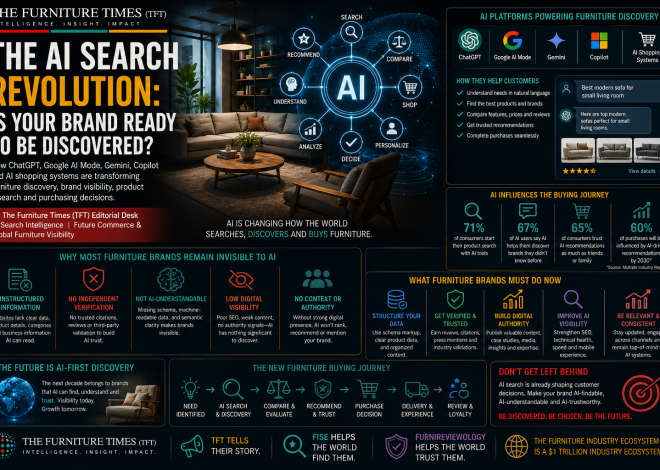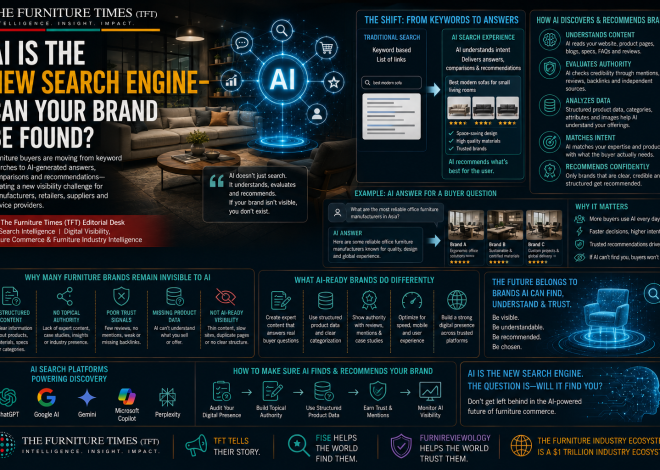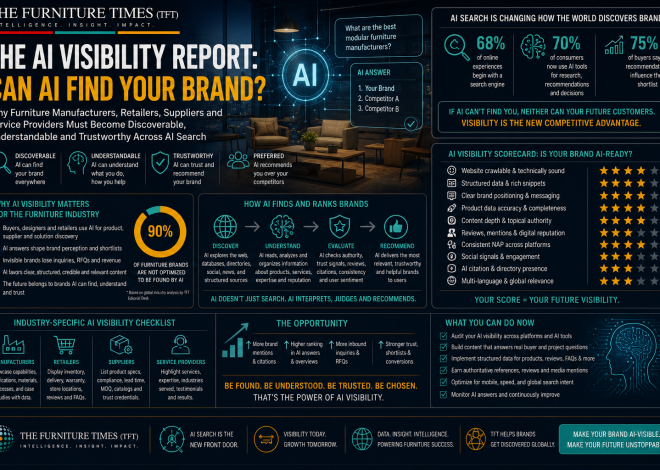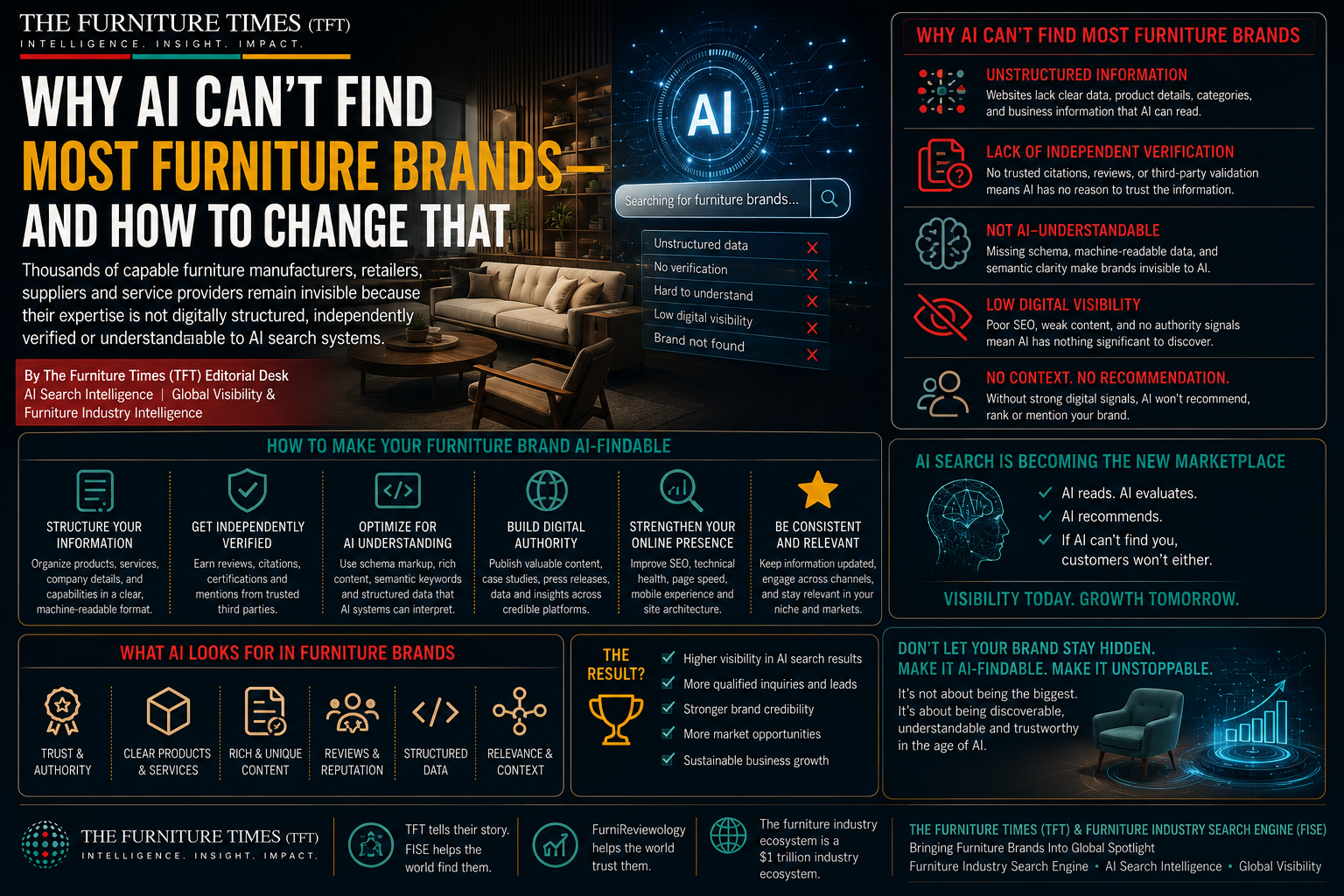
Why AI Can’t Find Most Furniture Brands—and How to Change That
Thousands of capable furniture manufacturers, retailers, suppliers and service providers remain invisible because their expertise is not digitally structured, independently verified or understandable to AI search systems
By The Furniture Times (TFT) Editorial Desk | AI Search Intelligence | Global Visibility & Furniture Industry Intelligence
The global furniture industry has a serious visibility problem.
Thousands of companies manufacture quality sofas, tables, beds, cabinets, office systems, hotel furniture, outdoor collections, hardware, machinery, upholstery materials and interior products. Many have decades of experience, skilled workers, modern factories and successful projects.
Yet when buyers ask ChatGPT, Google AI Mode, Gemini, Copilot or other AI-powered platforms to recommend relevant furniture companies, only a small group of recognizable brands often appears.
Most of the industry remains missing.
This does not necessarily mean that the invisible companies are less capable. It frequently means that their capabilities have not been published in a form that search engines and artificial-intelligence systems can reliably discover, understand and verify.
A manufacturer may operate a 100,000-square-foot factory but have only a five-page website. A retailer may stock thousands of products but upload them only to Instagram. A component supplier may have 30 years of engineering experience but provide no detailed product specifications online.
These businesses exist in the physical economy, but their digital identities are incomplete.
AI cannot responsibly recommend what it cannot find, understand or validate.
Furniture Discovery Is Moving From Search Results to AI Answers
Traditional internet searches normally return a list of links. Users compare titles, open websites and conduct their own research.
AI-powered discovery works differently.
A buyer can now ask a detailed question:
“Which Malaysian manufacturers can supply weather-resistant outdoor furniture for a luxury resort, offer customization and manage international delivery?”
Instead of returning only ten links, an AI platform may interpret the buyer’s requirements, research accessible information and provide a summarized answer containing a limited number of companies.
The AI system may evaluate:
- Product specialization
- Geographic location
- Materials
- Manufacturing capability
- Certifications
- Project experience
- Delivery reach
- Reviews
- Independent media coverage
- Website quality and information consistency
If a furniture company does not provide these facts clearly, it may never enter the AI-generated shortlist.
The new commercial challenge is therefore larger than ranking on Google. It is about becoming part of the answer.
What “AI Can’t Find Your Brand” Actually Means
AI invisibility can take several forms.
| AI visibility condition | What happens |
|---|---|
| Completely absent | The AI system provides no meaningful information about the company. |
| Name-only recognition | The brand is recognized, but its products and capabilities remain unclear. |
| Category confusion | The business is incorrectly classified as a retailer, manufacturer, designer or unrelated company. |
| Outdated visibility | Old addresses, discontinued products or former contact details are repeated. |
| Weak recommendation visibility | The company is understood but rarely appears for non-branded buyer questions. |
| Unverified visibility | AI finds company claims but lacks independent evidence to support them. |
| Negative or misleading visibility | Complaints, outdated information or incorrect third-party descriptions dominate the answer. |
A brand can therefore be technically “found” while remaining commercially invisible.
The objective is not merely to make AI recognize the company’s name. The objective is to ensure that AI understands the business accurately and considers it relevant when customers ask category-level questions.
Research Shows That Brand Visibility Extends Beyond the Company Website
A 2025 Ahrefs study examined approximately 75,000 brands and their visibility in Google AI Overviews. The analysis found that 26% of the brands studied had no AI Overview mentions.
Branded web mentions had the strongest reported correlation with AI visibility among the factors examined. Their correlation was significantly stronger than the correlation associated with raw backlink volume.
Ahrefs correctly emphasized that correlation does not prove causation. Nevertheless, the finding points toward an important change: AI visibility depends on how consistently a brand is discussed across the wider web, not only on what it says about itself.
The company website remains essential, but AI systems may also encounter:
- News publications
- Business directories
- Industry search platforms
- Association websites
- Exhibition listings
- Distributor pages
- Customer reviews
- YouTube videos
- Social platforms
- Marketplace listings
- Project references
- Government and certification databases
A company’s identity is assembled from this wider information environment.
If these sources contain little information—or contradict each other—AI systems may ignore or misrepresent the brand.
Why Furniture Brands Are Especially Vulnerable
Furniture is one of the world’s most fragmented industries.
The ecosystem includes:
- Large multinational brands
- Family-owned manufacturers
- Independent workshops
- Regional retailers
- Upholstery companies
- Hardware and fittings suppliers
- Timber and panel producers
- Interior designers
- Furniture machinery companies
- Hospitality and contract specialists
- Repair and restoration businesses
- Logistics and installation providers
- E-commerce platforms
- Designers and craftspeople
Many of these businesses were established before digital visibility became commercially essential.
Their growth historically depended on:
- Personal relationships
- Agents and distributors
- Furniture exhibitions
- Printed catalogues
- Retail showrooms
- Telephone communication
- Local reputation
- Repeat customers
- Word-of-mouth referrals
These channels remain valuable, but they do not automatically create a structured digital identity.
AI search requires explicit, accessible and verifiable information. It cannot reliably infer a company’s production capability from a few photographs or a business card exchanged at an exhibition.
Reason 1: The Website Does Not Explain the Business Clearly
Many furniture websites look attractive but communicate very little.
The homepage might say:
- “Quality without compromise.”
- “Innovative furniture solutions.”
- “Designed for modern living.”
- “Your trusted furniture partner.”
These phrases sound positive, but they do not explain what the company actually does.
AI systems need factual clarity:
- Is the company a manufacturer, retailer, wholesaler or design studio?
- Where is it located?
- What furniture categories does it supply?
- Does it serve consumers or commercial buyers?
- Does it export?
- Can it customize products?
- What materials does it use?
- What are its minimum-order quantities?
- Which countries does it serve?
- What certifications does it hold?
A brand that does not answer these questions forces AI systems to guess. Responsible systems may avoid mentioning the company instead.
How to change it
Create a complete company profile page containing:
- Official brand name
- Legal company name
- Headquarters and factory locations
- Year established
- Business model
- Product categories
- Materials and capabilities
- Customer segments
- Export territories
- Certifications
- Warranty information
- Contact details
- Last-updated date
Clarity is more valuable than vague marketing language.
Reason 2: Important Information Is Locked Inside Images and PDFs
Furniture companies frequently upload product catalogues as PDF files and present their collections through image galleries.
These formats can be helpful to human buyers, but they should not be the only sources of information.
A PDF catalogue may contain hundreds of products without creating an independent searchable page for any of them. A photograph may display a beautiful sofa while providing no information about its frame, foam, fabric, dimensions or intended application.
Text embedded inside promotional graphics can also be difficult to process consistently.
How to change it
Keep downloadable catalogues, but support them with searchable HTML pages.
Every important category should have its own page, and priority products should include:
- Product name
- Model number
- Category
- Description
- Dimensions
- Materials
- Finishes
- Intended use
- Indoor or outdoor suitability
- Customization options
- Warranty
- Availability
- Delivery areas
- Care instructions
This allows search engines, AI systems and customers to understand the product without interpreting an image.
Reason 3: The Website Is Blocking Search and AI Crawlers
A company can publish excellent content and remain invisible if technical settings prevent machines from accessing it.
Possible problems include:
- Search crawlers blocked in
robots.txt - Important pages marked
noindex - Firewall rules rejecting legitimate crawlers
- Pages hidden behind login screens
- Broken internal links
- Missing XML sitemaps
- Server errors
- Slow or unstable hosting
- Content rendered incorrectly
- Mobile pages that do not function
- Product information loaded in inaccessible scripts
OpenAI explains that OAI-SearchBot is used to surface websites in ChatGPT search. Websites that opt out of this search crawler will not be shown as cited sources in ChatGPT search answers, although navigational mentions may still occur. OpenAI’s crawler documentation provides the relevant user-agent and access information.
Google similarly advises site owners to ensure that public content is crawlable and indexable for its generative search features. Google’s official AI optimization guidance confirms that publicly accessible content remains fundamental.
How to change it
Ask a qualified technical professional to audit:
robots.txt- Meta robots directives
- Server response codes
- XML sitemaps
- Canonical tags
- Firewall and CDN settings
- Mobile rendering
- Internal navigation
- Page speed
- Google Search Console
- Bing Webmaster Tools
- OpenAI search-crawler access
Do not remove security protections indiscriminately. The objective is to allow access to intended public content, not private business data.
Reason 4: The Brand Name Is Inconsistent
A furniture company may use:
- One name on its website
- Another name on invoices
- An abbreviation on social media
- A former name in directories
- A product brand at exhibitions
- A legal company name in government records
This can confuse search engines and AI systems, especially when the name is common or shared with unrelated businesses.
For example, “Modern Living” could refer to a furniture retailer, property company, magazine or interior-design service. Without consistent context, AI may merge or confuse those identities.
How to change it
Create an official brand-identity record containing:
- Primary brand name
- Legal business name
- Accepted abbreviation
- Former names
- Official domain
- Address
- Telephone number
- Company registration information where appropriate
- Brand description
- Logo
- Social-media profiles
- Product categories
Use the information consistently across the website, directory listings, exhibition profiles, press releases and social accounts.
Reason 5: The Company Has No Clear Product Category Authority
A furniture company may publish dozens of unrelated products without establishing expertise in any category.
AI recommendation questions are often highly specific:
- Best hotel headboard manufacturers
- Custom office workstation suppliers
- Outdoor teak furniture exporters
- Soft-close hinge manufacturers
- School furniture suppliers
- Luxury wardrobe specialists
- Restaurant seating manufacturers
A generic “Products” page does not demonstrate category authority.
How to change it
Create detailed category hubs explaining:
- What the company manufactures
- Available product types
- Materials
- Production processes
- Customization options
- Quality standards
- Applications
- Typical customers
- Relevant projects
- Frequently asked questions
A category page should educate, not merely display products.
Reason 6: There Is No Independent Evidence
A company’s website is a self-controlled source. It can claim to be reliable, sustainable, innovative or internationally recognized.
AI systems become more confident when independent sources support those claims.
Evidence can come from:
- Credible news coverage
- Industry publications
- Verified directories
- Government databases
- Trade associations
- Exhibition organizers
- Certification organizations
- Project partners
- Distributors
- Authentic customer reviews
- Academic or technical collaborations
How to change it
Build a legitimate public-relations and industry-participation strategy.
Furniture companies should publish news when they:
- Open or expand a factory
- Launch a product collection
- Receive a valid certification
- Participate in an exhibition
- Enter a new market
- Complete a major project
- Introduce sustainable materials
- Develop new technology
- Win a credible award
- Form an important partnership
The objective is not promotional noise. It is to create an accurate public record.
Reason 7: The Brand Has No Reviews—or the Reviews Are Untrustworthy
Reviews help customers and AI systems understand real-world experiences.
Furniture reviews can reveal:
- Product quality
- Comfort
- Finish consistency
- Delivery performance
- Assembly experience
- Customer support
- Warranty handling
- Durability
- Accuracy of descriptions
A business with no reviews may be difficult to assess. A business with hundreds of repetitive, suspicious reviews may appear manipulative.
How to change it
Ask genuine customers for honest, detailed feedback. Do not purchase or fabricate reviews.
Respond professionally to criticism. A negative review with a responsible company response can demonstrate accountability more effectively than a page containing only generic praise.
FurniReviewology can support this trust layer by helping the furniture ecosystem build more relevant and transparent review information.
Reason 8: Product Data Is Incomplete or Outdated
AI-assisted product discovery depends on data quality.
A product page that lacks price, availability, dimensions, materials or delivery information may be difficult to recommend confidently.
Outdated product information creates greater risk. AI systems may cite a discontinued collection, an expired warranty or an unavailable service.
How to change it
Maintain a central product-information system containing:
- Product identifiers
- Current names
- Descriptions
- Specifications
- Materials
- Dimensions
- Variants
- Images
- Availability
- Price or quotation status
- Warranty
- Delivery regions
- Updated dates
The same information should feed the website, catalogues, marketplaces and sales channels.
Reason 9: There Is No Structured Data
Structured data provides machine-readable information about pages and entities.
Relevant schema types for furniture businesses can include:
- Organization
- LocalBusiness
- Product
- Offer
- Article
- BreadcrumbList
- Person
- Event
- JobPosting
- VideoObject
Structured data does not guarantee inclusion in an AI answer. Google also states that there is no special AI-only schema required for AI Overviews or AI Mode.
However, valid structured data helps machines interpret organizations, products and relationships. Google’s structured-data documentation explains how markup can support richer search eligibility.
How to change it
Add only accurate, relevant markup that matches visible page content. Test it using recognized validation tools.
Do not use structured data to insert hidden claims, fake ratings or unavailable products.
Reason 10: The Website Publishes Generic Content
The rapid availability of content-generation tools has led to an increase in generic articles.
Many websites now publish repetitive posts such as:
- Top Furniture Trends
- Benefits of Quality Furniture
- How to Choose a Sofa
- Why Furniture Matters
These topics can be useful, but only when they contain original expertise.
AI systems and customers gain little value from articles that repeat general information without evidence, examples, experience or a distinct viewpoint.
How to change it
Publish content that only the company is qualified to create:
- How the factory tests furniture joints
- Why a particular foam density is used
- Lessons from delivering 500 hotel rooms
- How coastal climates affect outdoor furniture
- Common causes of furniture warranty claims
- How packaging reduced transport damage
- How a custom product was engineered
- Material comparisons based on actual production
- Maintenance guidance for specific finishes
- Detailed project case studies
Original operational knowledge is difficult for competitors to imitate.
Reason 11: The Brand Depends Entirely on Social Media
Instagram, Facebook, TikTok, YouTube and messaging applications can generate valuable engagement. They should not replace an official website and searchable company profile.
Social platforms control account access, algorithms and content distribution. Posts can disappear quickly from visibility, and important information may become fragmented across years of uploads.
AI systems may not access or interpret every social platform equally.
How to change it
Use social media to distribute and demonstrate expertise, but maintain the official website as the primary factual source.
Every important social post should point toward a durable destination:
- Product page
- Company profile
- Case study
- News article
- Contact page
- Business listing
- Technical guide
The company should own its core digital identity.
Reason 12: The Brand Is Missing From Industry-Specific Discovery Platforms
General search engines index the entire web. They may not understand the detailed structure of the furniture ecosystem.
A furniture buyer may need to distinguish between:
- Manufacturer and retailer
- Indoor and outdoor specialist
- Residential and commercial supplier
- Component maker and finished-furniture producer
- OEM and proprietary brand
- Local business and exporter
Generic directories often use broad categories that fail to capture these distinctions.
How to change it
Create complete profiles on reputable, relevant platforms.
Furniture Industry Search Engine (FISE) can help organize the sector around furniture-specific categories, locations, capabilities and business types.
A strong industry listing should include:
- Company name
- Business classification
- Product categories
- Geographic coverage
- Factory or showroom location
- Website
- Contact details
- Certifications
- Catalogue
- Images
- News and project references
- Review information
Searchable industry infrastructure gives AI systems and buyers another structured source for understanding the company.
Reason 13: Marketing, Sales and Operations Tell Different Stories
Marketing may describe the company as a luxury brand. Sales may promote low prices. Operations may specialize in contract manufacturing. Social media may focus on residential consumers.
AI systems encounter all these messages and may produce a confused description.
A 2026 Semrush survey of 481 US marketers, business owners and search professionals found that only 22% reported having a fully integrated AI-search and SEO strategy. Thirty percent said AI had described their brands inaccurately, while 29% experienced unclear or generic positioning.
The survey is not specific to furniture, but its findings are highly relevant to an industry where manufacturers often serve several channels.
How to change it
Create one approved positioning framework covering:
- Who the company is
- What it does
- Who it serves
- Where it operates
- What differentiates it
- Which claims can be verified
- Which categories are priorities
Every department and external agency should use the same factual foundation.
Reason 14: Nobody Measures AI Visibility
Many furniture companies do not know whether they appear in AI-generated answers because they never test it.
Others ask one question once and treat the result as permanent.
AI answers can vary by:
- Platform
- Prompt wording
- Location
- Language
- Date
- Available web sources
- Search context
- Model or system update
A single response is not a complete audit.
How to change it
Develop a prompt-testing library containing branded, category, commercial and comparison questions.
Track:
- Brand mention rate
- Citation rate
- Accuracy
- Recommendation frequency
- Competitors mentioned
- Sentiment
- Source domains
- Product-category visibility
- Geographic visibility
- AI referral traffic
Google introduced dedicated Search Console reporting in June 2026 for impressions in generative AI experiences, including AI Overviews and AI Mode. This development demonstrates that generative-search visibility is becoming measurable rather than purely theoretical.
The Furniture AI Visibility Framework
A furniture company can evaluate its readiness across eight areas.
| Assessment category | Weight |
|---|---|
| Technical accessibility | 15 points |
| Brand identity and entity consistency | 15 points |
| Product and category information | 15 points |
| Original expertise and useful content | 15 points |
| Independent authority and media coverage | 15 points |
| Structured data and product feeds | 10 points |
| Reviews and trust evidence | 10 points |
| Measurement and governance | 5 points |
| Total | 100 points |
Suggested interpretation
| Score | AI visibility position |
|---|---|
| 0–20 | Functionally invisible |
| 21–40 | Discoverable but poorly understood |
| 41–60 | Partially established |
| 61–80 | Strong foundation |
| 81–100 | Highly prepared and actively managed |
This is a TFT editorial framework, not an official platform score. It is intended for internal diagnosis and strategic planning.
A Practical AI Brand Test
Furniture companies should test questions that reflect how customers actually search.
Branded questions
- What does [Brand Name] manufacture?
- Where is [Brand Name] located?
- Is [Brand Name] a manufacturer or retailer?
- What products does [Brand Name] specialize in?
- Does [Brand Name] export internationally?
- What reviews are available for [Brand Name]?
Category questions
- Who manufactures outdoor furniture in Malaysia?
- Which companies supply hotel furniture in Southeast Asia?
- What are reliable office-furniture manufacturers in India?
- Which brands produce sustainable bedroom furniture?
- Who supplies furniture hardware for cabinet manufacturers?
Capability questions
- Which furniture factories accept OEM orders?
- Which suppliers provide customized finishes?
- Who can manufacture weather-resistant resort furniture?
- Which furniture companies offer installation services?
- Which brands provide documented warranties?
Comparison questions
- How does [Brand] compare with [Competitor]?
- Which company is better suited to hospitality projects?
- Which supplier offers the strongest product documentation?
- What are the advantages and limitations of each company?
Record every result with its date, platform, prompt and sources.
A 90-Day Plan to Improve AI Visibility
Days 1–30: Build the foundation
- Audit crawler access and indexing.
- Correct broken pages and server errors.
- Create a complete company profile.
- Standardize the brand name and contact information.
- Identify priority product categories.
- Create an XML sitemap.
- Verify search-console accounts.
- Document incorrect online information.
- Establish baseline AI visibility tests.
Days 31–60: Publish the evidence
- Build detailed category pages.
- Upgrade priority product pages.
- Publish two or three original case studies.
- Create certification and warranty pages.
- Add appropriate structured data.
- Improve image names and alternative text.
- Publish an authoritative company news article.
- Create or improve verified industry listings.
- Begin collecting authentic reviews.
Days 61–90: Expand authority
- Seek credible media coverage.
- Publish an expert technical guide.
- Add video demonstrations with accurate titles and descriptions.
- Update exhibition and association profiles.
- Correct outdated third-party information.
- Compare AI visibility against competitors.
- Track citations and referral traffic.
- Develop a quarterly visibility calendar.
- Assign responsibility for ongoing monitoring.
The first 90 days will not guarantee AI recommendations, but they can replace confusion with a measurable and sustainable visibility foundation.
What Furniture Brands Should Not Do
Companies should avoid manipulative shortcuts, including:
- Fake reviews
- Fabricated awards
- False certifications
- Mass-produced press-release spam
- Hidden text
- Misleading structured data
- Thousands of shallow AI-generated pages
- Copying competitors’ content
- Purchasing irrelevant links or mentions
- Claiming factory capabilities that do not exist
- Creating fake comparison websites
- Publishing unverified market statistics
These actions can damage customer trust and create long-term reputational risk.
AI visibility must be built on real capability and verifiable information.
SMEs Can Compete With Larger Brands
Large companies possess stronger marketing budgets, but smaller furniture businesses often hold something equally valuable: specific expertise.
An SME may know more about:
- Teak behavior in tropical weather
- Reupholstering heritage furniture
- Manufacturing custom hotel headboards
- Producing small-batch cabinet hardware
- Designing furniture for limited spaces
- Packaging fragile stone tables
- Restoring antique wooden furniture
- Serving a specialized regional market
When this expertise is published clearly and supported by evidence, smaller companies can become relevant for highly specific AI queries.
The goal is not to compete for every furniture-related question. It is to become one of the most useful and credible answers within the company’s genuine area of expertise.
The Role of TFT, FISE and FurniReviewology
The AI visibility challenge requires three connected layers.
The Furniture Times (TFT) documents the stories, companies, innovations, challenges and achievements shaping the furniture ecosystem.
Furniture Industry Search Engine (FISE) helps organize and surface manufacturers, retailers, suppliers and service providers through industry-specific discovery.
FurniReviewology supports trust by helping buyers evaluate experiences, reputation and credibility.
Together, these platforms can address a critical structural problem: capable companies remain invisible because their stories are untold, their profiles are unstructured and their trust signals are difficult to verify.
TFT tells their story.
FISE helps the world find them.
FurniReviewology helps the world trust them.
Final Analysis: AI Invisibility Is Usually an Information Failure
Most furniture brands are not absent from AI because they lack value.
They are absent because their value has not been translated into structured, accessible and credible digital evidence.
Their factories are real, but their factory capabilities are undocumented.
Their products are real, but their specifications are missing.
Their projects are real, but their case studies were never published.
Their experience is real, but independent sources do not mention it.
Their customers are real, but their reviews are unavailable.
Their expertise is real, but it remains inside the minds of employees.
AI systems cannot visit every factory, walk through every showroom or speak with every craftsperson. They evaluate the information that can be accessed and connected.
The solution is not to manipulate AI.
The solution is to make the truth about the business easier to discover, understand and verify.
Furniture companies that begin this work now can build an advantage before AI-driven discovery becomes even more influential. Those that continue relying only on physical reputation, exhibitions, social posts or private networks may find themselves excluded from customer shortlists they never knew existed.
The future question is no longer simply:
“Can customers find our website?”
It is:
“When buyers ask AI who can meet their needs, does our brand become part of the answer?”
For most furniture companies, the answer is still no.
But that can be changed.
Editorial note: AI-generated responses are dynamic. Visibility varies by platform, prompt, location, date and available sources. No SEO, AEO or GEO activity can guarantee a mention, citation or recommendation. Research findings cited in this article identify correlations and reported experiences, not universal ranking factors.
Reference sources: OpenAI crawler documentation, Google’s generative AI optimization guidance, Google’s AI search guidance, Google structured-data documentation, Ahrefs’ 75,000-brand analysis, and Semrush’s 2026 operational study.
The Furniture Times (TFT) & Furniture Industry Search Engine (FISE)
“TFT tells their story. FISE helps the world find them.”
FurniReviewology helps the world trust them.
The furniture industry ecosystem is a $1 trillion industry ecosystem.