
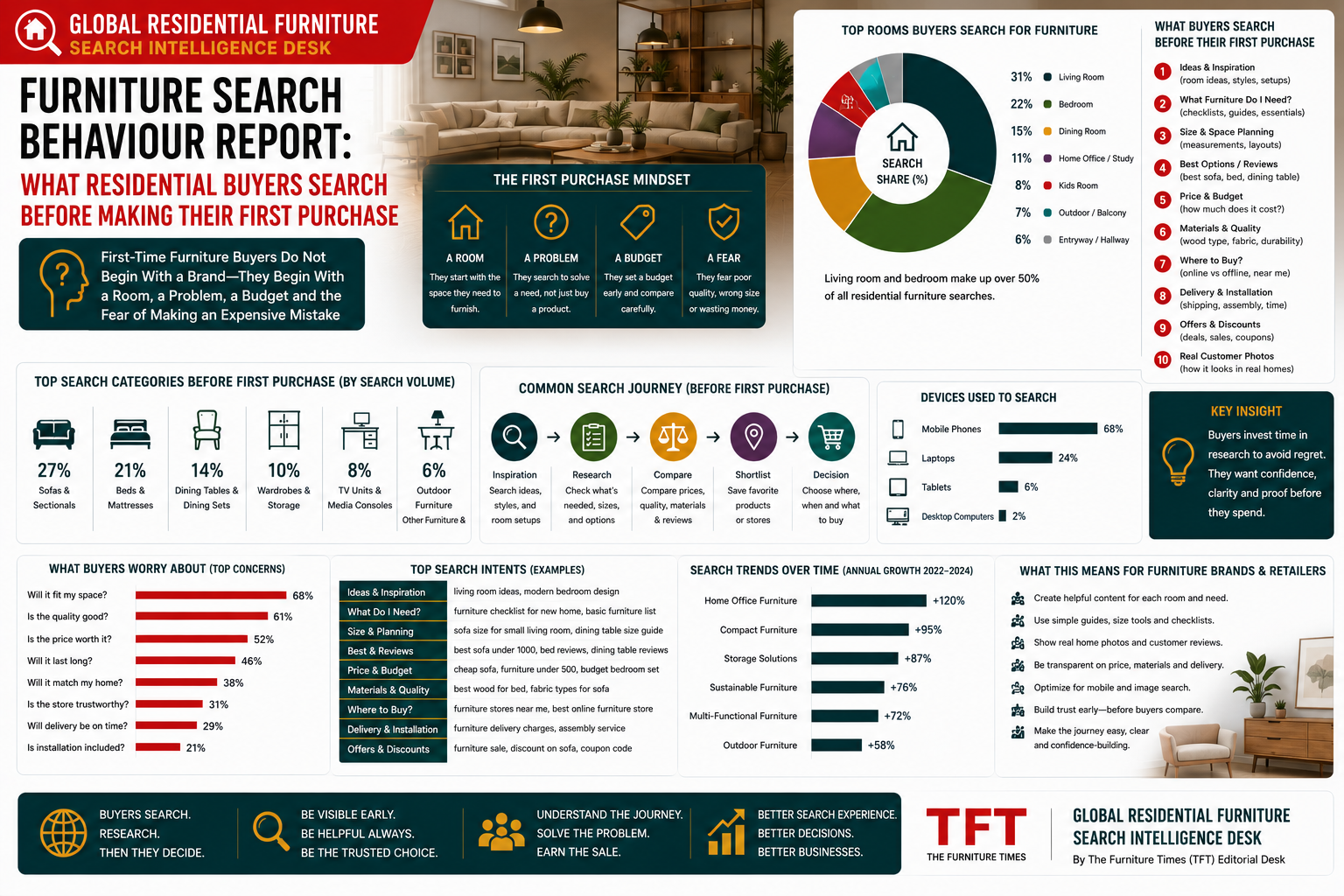
Furniture Search Behaviour Report: What Residential Buyers Search Before Making Their First Purchase
First-Time Furniture Buyers Do Not Begin With a Brand—They Begin With a Room, a Problem, a Budget and the Fear of Making an Expensive Mistake
Global Residential Furniture Search Intelligence Desk
By The Furniture Times (TFT) Editorial Desk
The first significant furniture purchase is an important moment in a consumer’s life.
It may happen when someone moves away from their family home, enters university, rents a first apartment, gets married, purchases a property, starts a family or establishes a permanent home office.
Before this moment, the buyer may have used furniture selected by parents, provided by a landlord, inherited from relatives or purchased temporarily at the lowest possible price.
The first independent purchase is different.
For the first time, the customer must decide:
- What furniture is genuinely necessary
- How much money to allocate
- Which dimensions will fit
- Which materials are reliable
- Which style reflects their identity
- Whether to buy online or in a showroom
- Whether reviews can be trusted
- What delivery and assembly will cost
- Whether the product can move to another home
- What will happen if the furniture fails
Furniture belongs to a high-consideration shopping category. It usually involves substantial research because products are expensive, physically large, used for extended periods and difficult to return. Research into high-consideration e-commerce queries describes these shopping missions as decisions involving significant research and careful evaluation rather than quick, routine purchases.
The first-time buyer feels this risk especially strongly.
Experienced furniture buyers may already understand sofa dimensions, timber terminology, fabric performance and delivery requirements. First-time buyers are still learning the language of furniture.
Their searches frequently begin with basic questions:
- What furniture do I need first?
- How much should I spend on a sofa?
- Is engineered wood good?
- Which mattress should I choose?
- How do I measure a room?
- Can this furniture fit through my doorway?
- Is assembly included?
- How long should furniture last?
This report examines the search behaviour behind that first purchase and explains how manufacturers, retailers and digital platforms can respond.
What Counts as a First Furniture Purchase?
A first furniture purchase does not necessarily mean the first chair, desk or mattress someone has ever bought.
It usually means the first occasion on which the customer independently manages a meaningful furniture decision involving several of the following:
- A personal budget
- Room measurement
- Product comparison
- Material evaluation
- Delivery planning
- Household approval
- Financing
- Long-term use
- Warranty consideration
The trigger may be a first rented room, first apartment, first marital home or first purchased property.
Homeownership is not required.
In fact, high housing costs mean many younger adults remain renters for longer periods. In the United States, first-time buyers accounted for only 24% of primary-residence purchases in one recent annual assessment, compared with a historical average of about 40%. NAR attributed part of this decline to affordability, mortgage rates and limited housing inventory.
The median down payment among US first-time buyers reached 10% in 2025, its highest level in more than three decades, further illustrating the financial pressure that can reduce the amount available for furnishing immediately after purchasing a home.
These figures are specific to the United States, but the underlying commercial lesson applies more broadly:
A first-time furniture buyer may need several products while having very limited cash remaining after rent, deposits, moving, renovation or property expenses.
The First Search Is Usually About a Problem, Not a Product
Furniture companies organise their businesses by product category:
First-time buyers often think differently.
They begin with a practical problem:
- My room is empty.
- I have nowhere to store clothes.
- I need somewhere to sleep.
- My apartment is very small.
- I cannot afford everything at once.
- I need furniture before moving day.
- I need a workspace inside my bedroom.
- I do not know what furniture matches.
Their early searches may therefore look like:
- Furniture needed for first apartment
- What furniture should I buy first?
- First-home furniture checklist
- How to furnish an apartment on a budget
- Essential furniture for newly married couple
- Furniture for a small rented room
- What to buy before moving into a new home
- Cheapest way to furnish an apartment
- Furniture package for first home
At this stage, the buyer is not asking for a particular sofa brand.
The buyer is trying to create a plan.
Furniture retailers that provide room checklists, starter packages and budget guides can enter the customer journey before individual product preferences are fixed.
The First-Time Buyer’s Search Journey
The first residential furniture purchase usually moves through eight overlapping search stages.
Stage 1: Need Recognition
The buyer identifies the empty room, missing product or household problem.
Stage 2: Priority Planning
The buyer decides which pieces are essential and which can wait.
Stage 3: Budget Formation
The buyer researches typical prices, payment options and package costs.
Stage 4: Product Education
The buyer learns about dimensions, materials, quality and terminology.
Stage 5: Discovery
Search engines, AI assistants, marketplaces, social platforms and local listings reveal possible brands and products.
Stage 6: Comparison
The buyer compares price, reviews, size, materials, delivery and warranties.
Stage 7: Verification
The buyer visits showrooms, requests samples, checks measurements or contacts the seller.
Stage 8: Purchase-Risk Reduction
The buyer confirms stock, delivery, assembly, returns and after-sales support.
This journey is rarely linear.
A buyer may select a sofa, discover that it is too large, return to measuring guides, ask an AI assistant for alternatives and then visit another showroom.
What Buyers Search First: The Essential Furniture List
Most first-time residential buyers cannot purchase everything at once.
They prioritise products according to immediate survival, household function and available money.
Priority One: A Bed and Mattress
Sleeping furniture is commonly treated as essential because the household cannot function comfortably without it.
Typical searches include:
- Best mattress for first apartment
- Affordable mattress that lasts
- Bed frame or mattress first
- Mattress firmness guide
- Bed size for small bedroom
- Storage bed for apartment
- Mattress with trial period
- Best mattress under my budget
The customer is not only comparing price.
The buyer is trying to understand firmness, support, size, warranty, delivery and whether the mattress can be tested or returned.
Priority Two: Clothing and General Storage
A buyer moving into an unfurnished property quickly discovers the importance of storage.
Searches include:
- Affordable wardrobe for small room
- Wardrobe with maximum storage
- Clothes storage without built-in wardrobe
- Flat-pack wardrobe for apartment
- Wardrobe that is easy to move
- Sliding-door wardrobe for small bedroom
- Storage cabinet for rented home
Storage products appeal strongly to first-time buyers because they convert an empty room into an organised living environment.
Priority Three: Seating
The first seating purchase may be a small sofa, loveseat, armchair or multipurpose bench.
Searches include:
- First sofa buying guide
- Affordable sofa for apartment
- Small sofa for two people
- Sofa that fits through narrow door
- Best sofa fabric for daily use
- Sofa bed for guests
- Easy-clean sofa for small family
- How much should a good sofa cost?
Priority Four: Dining or Multipurpose Table
In compact homes, the first table may serve as:
- Dining surface
- Work desk
- Study area
- Food-preparation area
- Social space
Searches include:
- Small dining table for apartment
- Table for dining and working
- Foldable dining table
- Four-seat table dimensions
- Round or rectangular table for small room
- Extendable table for first home
Priority Five: A Desk and Chair
Students, remote workers, freelancers and creators may place a desk ahead of dining or living-room furniture.
Searches include:
- Affordable home-office setup
- Desk for bedroom
- Small desk with storage
- Ergonomic chair under budget
- Desk that can be folded away
- Work-from-home furniture for apartment
First-Time Buyers Search by Budget
Budget is one of the strongest signals of first-purchase intent.
The customer may not know the brand, material or style, but usually knows the approximate amount available.
Typical budget searches include:
- Sofa under RM1,500
- Bedroom set under my budget
- Affordable furniture package
- Best mattress at a reasonable price
- Furniture with monthly instalments
- First-home furniture sale
- Cheap furniture with delivery
- Furniture bundle for apartment
- Buy now, pay later furniture
- Furniture clearance near me
Price-focused searches do not necessarily mean the buyer wants the cheapest possible product.
They often mean the customer is trying to control the total cost of establishing a household.
A buyer may choose a better mattress and delay buying a television unit. Another may purchase a durable sofa but use a temporary dining table.
Retailers can support this behaviour by presenting:
- Essential, recommended and optional products
- Good, better and best quality levels
- Complete room-package prices
- Transparent delivery fees
- Instalment calculations
- Products available immediately
The Hidden Cost Search
First-time buyers often begin with the product price and later discover additional expenses.
These may include:
- Delivery
- Staircase or lift charges
- Assembly
- Installation
- Removal of packaging
- Disposal of old furniture
- Fabric upgrades
- Custom dimensions
- Extended warranties
- Delayed-delivery fees
- Return shipping
This creates searches such as:
- Does furniture delivery include assembly?
- How much is sofa delivery?
- Is wardrobe installation included?
- Furniture store with free delivery
- Cost to carry sofa upstairs
- Can old furniture be removed?
- Furniture return delivery charges
Unexpected charges can create immediate distrust.
The retailer that publishes the full delivered cost can appear more expensive initially but more trustworthy overall.
Buyers Search for the Right Size Before They Understand Design
One of the greatest fears surrounding a first furniture purchase is incorrect fit.
The customer may worry that:
- The sofa is too large for the room
- The table leaves insufficient walking space
- The wardrobe blocks a door
- The bed overwhelms the bedroom
- The product cannot fit through the entrance
- The item cannot be carried up the stairs
- The product does not fit inside the lift
Searches include:
- How to measure room for furniture
- Standard sofa dimensions
- Dining table size for four people
- Queen bed size in centimetres
- Wardrobe depth
- How much space around dining table
- Will sofa fit through doorway?
- Furniture size for studio apartment
- How to measure staircase for delivery
This is an area where furniture websites frequently fail.
A product may list total width but omit:
- Seat depth
- Arm width
- Diagonal depth
- Packaged dimensions
- Leg removal
- Module dimensions
- Required assembly clearance
The first-time buyer needs a measuring guide written in ordinary language, supported by diagrams or video.
Smaller Homes Increase the Importance of Search Accuracy
Many buyers are willing to consider smaller homes because of affordability pressure. A US home-buyer survey reported that 35% of respondents were willing to purchase a smaller house, with dining rooms and home offices among the spaces buyers were most willing to reduce. Although geographically specific, the finding illustrates the growing importance of multifunctional and space-conscious furniture.
First-time buyers living in smaller properties search for:
- Furniture for studio apartment
- Sofa bed with storage
- Extendable dining table
- Wall-mounted desk
- Narrow shoe cabinet
- Storage bed
- Stackable chairs
- Nesting coffee tables
- Modular wardrobe
- Furniture for one-bedroom apartment
These searches combine product intent with a space constraint.
A retailer targeting first-time buyers should therefore optimise around complete phrases such as:
“small sofa for studio apartment”
rather than relying only on:
“sofa.”
Material Education Is a Major Search Stage
Many first-time buyers do not yet understand furniture material terminology.
They encounter labels such as:
- Solid wood
- Hardwood
- Veneer
- MDF
- Particleboard
- Plywood
- Laminate
- Melamine
- PU leather
- Genuine leather
- Performance fabric
- Powder-coated steel
- Aluminium
- Tempered glass
The customer then searches:
- Solid wood vs engineered wood
- Is MDF furniture durable?
- Plywood vs particleboard wardrobe
- Is veneer real wood?
- Best sofa material for daily use
- Fabric or leather sofa
- Is aluminium furniture good?
- Which furniture material lasts longest?
- Best wardrobe material for humidity
- Is tempered glass safe for dining table?
These searches reveal uncertainty, not necessarily opposition to a material.
A customer may be willing to buy engineered wood if the retailer clearly explains where it is used, how it performs and how it should be maintained.
Material secrecy encourages suspicion.
Material education creates informed customers whose expectations are more likely to match the product.
Buyers Search for Durability Because They Fear Wasting Money
First-time furniture buyers may have limited budgets, making premature failure especially damaging.
They want reassurance that the purchase will not need to be repeated quickly.
Searches include:
- How long should a sofa last?
- Furniture that does not break easily
- Best bed frame for long-term use
- Sofa that will not sag
- Strong wardrobe for moving
- Durable dining chairs
- Best furniture for children and pets
- Furniture warranty worth it?
- How to identify good-quality furniture
The customer looks for signals such as:
- Frame construction
- Board thickness
- Joinery
- Weight capacity
- Foam density
- Fabric abrasion performance
- Hardware brand
- Warranty length
- Replacement parts
- Customer reviews
Furniture companies should explain quality through visible evidence rather than simply saying “premium” or “high quality.”
Buyers Search Reviews to Validate the Brand Promise
Online furniture purchasing behaviour is shaped by the category’s unusual combination of large product size, relatively high transaction value and the importance of physical experience. Academic research on online furniture purchasing highlights these factors as central challenges for furniture e-commerce.
Because first-time buyers lack personal experience, they depend heavily on other customers.
They search for:
- Furniture brand reviews
- Sofa model review
- Is this furniture company reliable?
- Furniture delivery complaints
- Mattress review after one year
- Wardrobe assembly review
- Furniture warranty experience
- Real customer furniture photos
The most valuable reviews are often not the shortest or most enthusiastic.
Customers look for evidence concerning:
- Product condition on arrival
- Accuracy of colour
- Comfort after several months
- Cushion performance
- Drawer and door alignment
- Delivery punctuality
- Assembly difficulty
- Customer-service response
- Warranty handling
Brands should encourage customers to provide detailed, honest reviews rather than generic praise.
Buyers Search for Real Images
Highly polished images create desire, but first-time buyers also want realism.
They search or inspect:
- Customer photographs
- Unedited room images
- Product videos
- Showroom walkthroughs
- Close-up material images
- Assembly videos
- Before-and-after installations
The buyer wants to know:
- Is the colour accurate?
- Does the sofa look smaller in a real room?
- Is the fabric texture attractive?
- Does the cabinet look inexpensive up close?
- Is the table stable?
- Does the product match the advertised photograph?
Furniture brands should show products in:
- Large and small rooms
- Natural and artificial light
- Multiple angles
- Realistic household settings
- Different available finishes
Search Often Moves Between Online and Offline Channels
Digital research has influenced furniture shopping for many years. Earlier Google research found that furniture shoppers used online resources for research while continuing to rely on physical stores for inspection and purchase. Although the studies are historical and should not be treated as current global market measurements, they established the enduring importance of digital research in furniture’s path to purchase.
The modern first-time buyer may follow this route:
- Search for furniture checklists.
- Save room ideas.
- Compare prices online.
- Read material guides.
- Visit a showroom.
- Photograph several products.
- Search those products again.
- Compare reviews.
- Ask an AI assistant for an opinion.
- Return to the retailer and purchase.
The final sale may happen in a showroom, but digital search may have shaped almost every stage.
Retailers should avoid treating online and offline customers as separate groups.
Buyers Search Locally When They Need Confidence
First-time buyers may prefer nearby businesses because local availability appears to reduce risk.
Typical searches include:
- Furniture shop near me
- Sofa showroom nearby
- Affordable furniture store in Kuala Lumpur
- Bedroom furniture Shah Alam
- Custom wardrobe manufacturer near me
- Mattress store open today
- Furniture delivery in my area
Local searches often indicate strong purchase intent.
The customer may be ready to:
- Visit
- Call
- Request directions
- Check inventory
- Ask about delivery
- Complete the purchase
Accurate business hours, photographs, addresses, showroom details and contact information are therefore essential.
Google’s Local Business structured-data documentation explains that businesses can provide information such as operating hours and other administrative details to help Google understand and display relevant business information.
Mobile Search Supports the Entire First-Purchase Journey
First-time buyers commonly research furniture while:
- Standing inside an empty room
- Visiting a showroom
- Comparing products with a partner
- Measuring a doorway
- Travelling between stores
- Speaking with a salesperson
The smartphone becomes a portable furniture adviser.
The customer may use it to:
- Check dimensions
- Compare prices
- Read reviews
- Photograph products
- Save screenshots
- Ask family members
- Calculate room layout
- Contact the retailer
- View directions
Historical Google research found that consumers who conducted more online research could also produce higher in-store basket values, reinforcing the principle that digital research does not necessarily reduce physical retail purchases.
A furniture website that is difficult to use on mobile can lose the customer at the exact moment when buying intent is highest.
AI Search Is Becoming a First-Time Buyer’s Teacher
First-time buyers often do not know the correct search terms.
This makes conversational AI particularly useful.
Instead of entering several disconnected queries, the customer can explain the complete situation:
I am moving into a small one-bedroom apartment. I need a bed, sofa, dining table and storage, but I have a limited budget. What should I buy first?
The AI can help organise:
- Purchase priorities
- Approximate dimensions
- Material questions
- Budget allocation
- Product comparisons
- Questions for the retailer
The customer may then ask:
- Is MDF acceptable for a wardrobe?
- Should I buy a sofa bed?
- How much walking space should I leave?
- Which fabric is easiest to clean?
- What information should I check in the warranty?
AI reduces the knowledge barrier for inexperienced buyers.
However, it can only recommend accurately when furniture companies publish detailed and consistent product information.
Search Is Becoming Conversational
Traditional searches are short:
- Affordable sofa
- Small dining table
- Wardrobe Malaysia
Conversational searches are more detailed:
- Find a compact sofa with washable fabric for a rented apartment that can fit through a narrow doorway.
- Compare plywood and MDF wardrobes for a humid climate.
- What size dining table should I buy for four people in a small apartment?
- Which bed frame is easiest to dismantle when moving?
This creates an advantage for businesses that publish specific answers.
A small specialist retailer may become more relevant than a large general seller when its content precisely matches the customer’s situation.
First-Time Buyers Search for Help Comparing Options
Furniture comparison is cognitively demanding because products may differ in several ways simultaneously:
- Price
- Dimensions
- Material
- Style
- Delivery
- Warranty
- Reviews
- Availability
- Assembly
High-consideration search research suggests that users engage strongly with informational elements that help them evaluate complex purchasing decisions.
Useful comparison content includes:
- Solid wood vs engineered wood
- Sofa bed vs normal sofa
- Round vs rectangular dining table
- Fabric vs leather
- Sliding vs hinged wardrobe doors
- Queen vs king bed
- Ready-made vs custom furniture
- Online vs showroom purchase
- Flat-pack vs fully assembled furniture
The best comparison guides do not force every customer toward one answer.
They explain which option suits which household.
Buyers Search for Delivery Before Completing the Purchase
Delivery uncertainty can stop a first-time purchase even after the product has been selected.
Searches include:
- How long does furniture delivery take?
- Furniture available immediately
- Same-week sofa delivery
- Can furniture be delivered before moving day?
- Does the delivery team assemble furniture?
- What happens if furniture arrives damaged?
- Can I choose a delivery date?
- Will the sofa fit inside the lift?
The customer needs to coordinate furniture with:
- Property access
- Landlord rules
- Building management
- Lift bookings
- Renovation work
- Moving dates
- Work schedules
Furniture companies should make delivery information visible before checkout, not after payment.
Buyers Search Returns and Warranties Because Furniture Is Difficult to Undo
A first-time buyer may be comfortable ordering clothing online because returns are relatively manageable.
Furniture is different.
Returning a sofa, bed or dining table can require:
- Repacking
- Heavy lifting
- Collection scheduling
- Additional fees
- Waiting for inspection
- Replacement delays
The customer searches:
- Can furniture be returned after assembly?
- Sofa return policy
- Mattress trial conditions
- Furniture warranty coverage
- Who pays return delivery?
- What if the colour is different?
- What if furniture arrives damaged?
- Does warranty cover sofa sagging?
Google recommends providing structured and accessible e-commerce information, including product details and merchant return policies, to help its systems understand retail content more accurately.
For buyers, however, the most important requirement remains simple language.
The customer should understand the policy without needing legal expertise.
Product Variants Create Search and Decision Complexity
Furniture frequently comes in different:
- Sizes
- Colours
- Materials
- Fabrics
- Configurations
- Leg finishes
- Orientations
A customer may find the correct sofa design but the wrong size or fabric.
Retailers should clearly connect variants so buyers can move between them without restarting the search.
Google’s product-variant guidance specifically recognises furniture as a category in which related products may vary by size, colour, material or pattern. It recommends structured information that helps search systems understand the relationship between a parent product and its variants.
For first-time buyers, this also improves comparison:
- Which size fits?
- Which fabric costs more?
- Which colour is available now?
- Does the warranty remain the same?
- Does changing the material change maintenance requirements?
The First-Time Buyer’s Most Common Search Categories
Category 1: Planning
- What furniture do I need first?
- First-apartment furniture checklist
- Furniture budget for new home
- How to furnish room by room
Category 2: Dimensions
- How to measure for sofa
- Standard bed sizes
- Dining table size guide
- Wardrobe depth guide
Category 3: Materials
- Solid wood vs MDF
- Best sofa fabric
- Durable furniture materials
- Furniture for humid climate
Category 4: Quality
- How to recognise a good sofa
- How long should furniture last?
- Strong bed-frame construction
- Furniture warranty guide
Category 5: Price
- Affordable furniture near me
- Furniture package price
- Sofa under budget
- Furniture instalment plan
Category 6: Trust
- Best furniture brands
- Furniture company reviews
- Reliable furniture store
- Real product photographs
Category 7: Delivery
- Furniture delivery time
- Furniture assembly included
- Sofa delivery upstairs
- Furniture available immediately
Category 8: Maintenance
- Easy-clean sofa
- How to maintain wooden furniture
- Washable sofa covers
- Scratch-resistant dining table
Search Behaviour Differs by First-Purchase Trigger
Moving Into a First Rental
The customer searches for:
- Affordability
- Portability
- Compact dimensions
- Fast delivery
- Easy assembly
- Resale value
Buying a First Home
The customer searches for:
- Durability
- Coordinated room packages
- Better materials
- Financing
- Custom storage
- Long-term warranties
Marriage or Partnership
The customer may search for:
- Complete bedroom sets
- Dining furniture
- Sofas
- Shared storage
- Furniture packages
- Delivery before a specific date
First Child
Searches shift toward:
- Easy-clean materials
- Rounded edges
- Storage
- Family-sized sofas
- Child-safe furniture
- Durable dining furniture
First Remote-Work Setup
Searches include:
- Ergonomic chairs
- Compact desks
- Cable management
- Bedroom workstations
- Foldable furniture
Regional Differences in First-Purchase Search
Asia-Pacific
Searches may emphasise:
- Apartment dimensions
- Mobile marketplaces
- Instalments
- Custom carpentry
- Local delivery
- Humidity-resistant materials
- Marriage furniture packages
North America
Buyers often search:
- Reviews
- Delivery
- Trial periods
- Financing
- Room planning
- Assembly
- Return policies
Europe
Searches may place stronger emphasis on:
- Compact living
- Certified materials
- Product durability
- Repairability
- Delivery access
- Energy and environmental considerations
Middle East
Demand may include:
- Complete furnishing packages
- Luxury and imported furniture
- Custom dimensions
- Apartment and villa furniture
- Rapid project delivery
- Marriage-related furnishing
Africa
First-purchase behaviour may emphasise:
- Affordability
- Local manufacturing
- Durability
- Instalments
- Repairability
- Basic household packages
Latin America
Searches may be influenced by:
- Payment plans
- Local marketplaces
- Social-media sellers
- Delivery
- Custom manufacturing
- Price comparison
Global furniture brands must localise vocabulary, currencies, room sizes, payment systems and material guidance.
Why First-Time Buyers Abandon Their Search
A buyer may want the product but stop because the retailer creates too much uncertainty.
Major causes include:
- Missing prices
- Missing dimensions
- Unclear materials
- Weak product photographs
- No customer reviews
- Hidden delivery costs
- Unclear stock status
- Slow responses
- Complex financing
- Confusing variants
- Weak warranty information
- No local contact details
Furniture websites should treat every unanswered question as a potential lost sale.
What a First-Time Buyer Needs From a Product Page
A first-purchase product page should function like a patient sales adviser.
It should include:
Product Identity
- Clear, descriptive product name
- Room and product category
- Intended household or use
Dimensions
- Overall width, depth and height
- Functional dimensions
- Packaged dimensions
- Doorway or access considerations
Materials
- Frame
- Surface
- Upholstery
- Foam
- Hardware
- Finish
Practical Use
- Seating capacity
- Storage capacity
- Weight limit where relevant
- Assembly requirements
- Cleaning instructions
- Climate suitability
Commercial Information
- Price
- Available variants
- Stock or lead time
- Delivery region
- Assembly cost
- Return conditions
- Warranty
- Replacement parts
Product structured data can help Google interpret price, availability, reviews and variations, while Google Merchant Center can provide additional product information for search and image-shopping experiences.
Content Furniture Retailers Should Publish
To attract and convert first-time buyers, businesses should create:
- First-home furniture checklist
- First-apartment furniture budget guide
- Room-measuring guide
- Sofa-size guide
- Bed and mattress guide
- Dining-table capacity guide
- Solid wood vs engineered wood guide
- Sofa-fabric comparison
- Furniture-delivery preparation guide
- Furniture warranty guide
- Small-space furniture guide
- Renter-friendly furniture guide
- Furniture financing guide
- Room-by-room purchase priority guide
- Furniture maintenance guide
These resources should connect directly to relevant products.
Educational content should not become an isolated blog library that never helps customers purchase.
Strategic Recommendations for Furniture Brands
Furniture manufacturers and retailers should:
- Create a dedicated first-home or first-apartment section.
- Organise products by room, budget and property size.
- Offer starter packages with flexible substitutions.
- Publish transparent delivered prices.
- Provide exact and packaged dimensions.
- Create measuring videos and diagrams.
- Explain furniture materials in ordinary language.
- Show real customer photographs.
- Publish detailed delivery and assembly information.
- Explain warranty coverage with examples.
- Offer filters for small spaces and renters.
- Provide responsible instalment options.
- Display stock and realistic lead times.
- Offer samples for important finishes and fabrics.
- Build search content around complete customer questions.
- Optimise local showroom and business information.
- Structure product variants clearly.
- Collect long-term customer reviews.
- Provide replacement components.
- Prepare product information for conversational and AI search.
The First Sale Can Become a Lifetime Customer Relationship
A first-time furniture buyer may purchase only a mattress, wardrobe or small sofa today.
Over the following years, that customer may need:
- Dining furniture
- A larger bed
- Children’s furniture
- Home-office furniture
- Outdoor furniture
- Replacement seating
- Kitchen cabinets
- Furniture for another property
- Commercial furniture for a business
The first purchase is therefore not merely a small transaction.
It is the beginning of a customer lifecycle.
The retailer that provides honest education and dependable service during the buyer’s most uncertain stage can become the first brand the customer remembers during every future household transition.
First-Time Buyers Search for Confidence
The first-purchase journey begins with uncertainty.
The buyer may not understand dimensions, materials, construction or delivery.
Every search is an attempt to reduce that uncertainty.
The customer searches for a checklist because they do not know what to buy first.
They search for dimensions because they fear the product will not fit.
They search for materials because they fear poor quality.
They search for reviews because they do not yet trust the brand.
They search for delivery because they fear disruption.
They search for warranties because they fear being abandoned after payment.
The company that understands these fears can create a more supportive buying experience.
It does not pressure the customer to decide quickly.
It helps the customer make the correct decision confidently.
Search Is the First Conversation Between the Buyer and the Brand
Before speaking with a salesperson, the customer is already asking questions.
The website, product listing, review profile, video and search result are answering on behalf of the company.
When those answers are accurate, complete and easy to understand, the customer moves closer to purchase.
When they are vague, inconsistent or missing, the customer continues searching elsewhere.
The first-time residential buyer is not simply searching for furniture.
They are searching for:
- Guidance
- Affordability
- Suitability
- Trust
- Reassurance
- A lower risk of regret
The brands that provide these benefits will earn more than the first sale.
They can earn the beginning of a long-term relationship.
The first furniture purchase is won by the company that makes an inexperienced buyer feel informed, respected and confident enough to create a home.
