
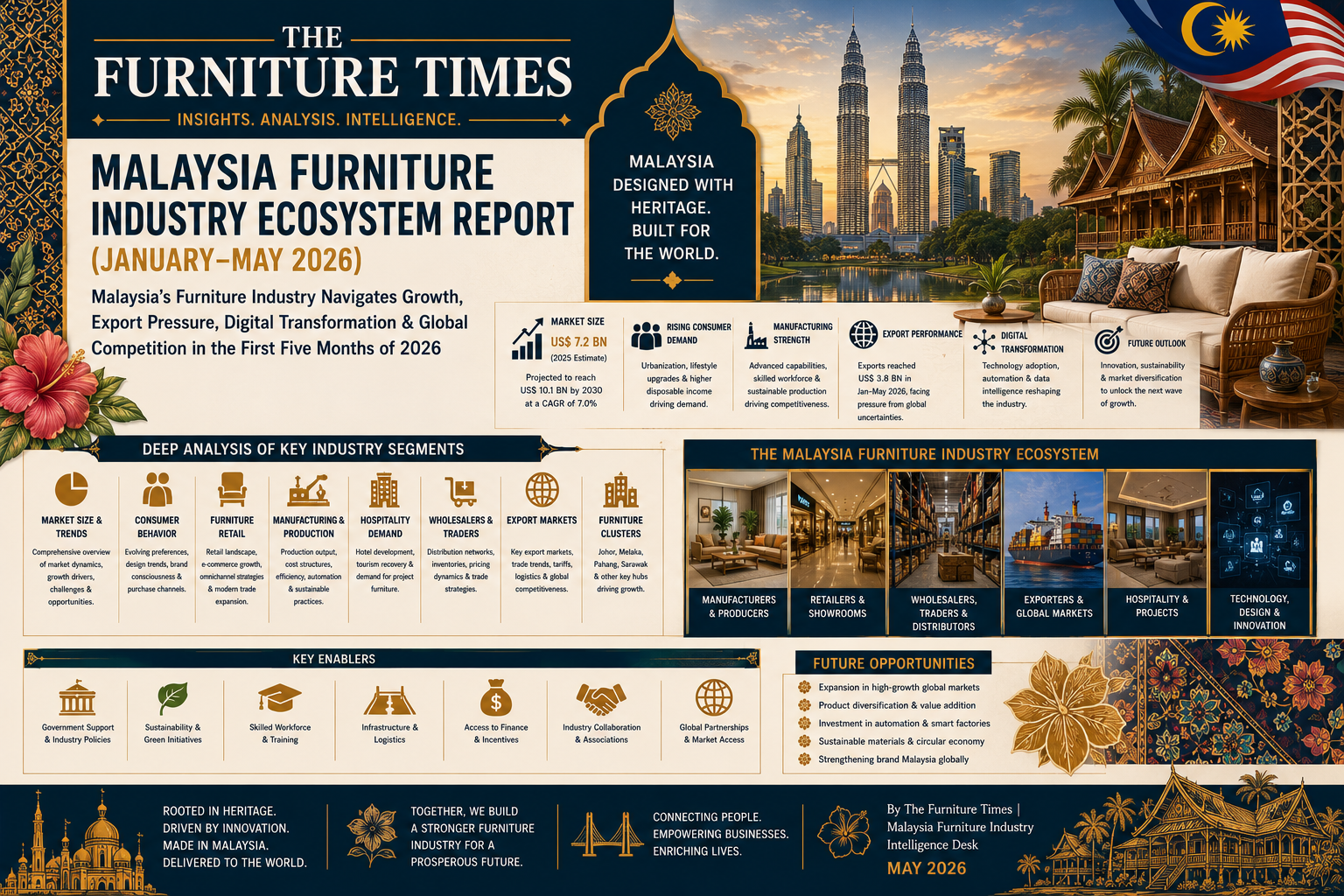
Malaysia’s Furniture Industry Navigates Growth, Export Pressure, Digital Transformation & Global Competition in the First Five Months of 2026
Malaysia Furniture Industry Ecosystem Report (January–May 2026)
Deep Analysis of Market Size, Consumer Behavior, Furniture Manufacturing, Retail, Hospitality Demand, Wholesalers, Export Markets, Furniture Clusters, Technology & Future Opportunities
By The Furniture Times | Malaysia Furniture Industry Intelligence Desk | June 2026
Malaysia’s furniture industry entered 2026 facing one of the most complex business environments in recent years.
Between January and May 2026, the industry experienced a combination of:
export opportunities
rising operational costs
changing consumer behavior
digital transformation
manufacturing modernization
increasing global competition
Despite global uncertainty, Malaysia remains one of Southeast Asia’s most important furniture manufacturing and export ecosystems, supported by strong industrial clusters, export infrastructure, woodworking expertise, and decades of manufacturing experience. Malaysia continues to be recognized as a strategic furniture production hub within ASEAN and global supply chains.
The industry is not only manufacturing furniture.
It is increasingly managing:
global competition, digital visibility, sustainability, and industrial transformation.
January–May 2026 Industry Overview
The first five months of 2026 reflected both resilience and caution across the sector.
The industry benefited from:
export demand
hospitality recovery
tourism growth
housing activity
commercial renovation projects
At the same time, manufacturers faced:
labor cost pressure
raw material volatility
freight uncertainty
intensified regional competition
Industry discussions throughout early 2026 highlighted growing concern about structural pressures affecting long-term competitiveness.
Malaysia Remains a Major Furniture Manufacturing Ecosystem
Malaysia continues to hold a strong position within the global furniture industry.
The country is known for:
wooden furniture manufacturing
export-oriented production
rubberwood furniture
bedroom furniture
office furniture
hospitality furniture
Furniture remains one of Malaysia’s most important manufacturing sectors and a major contributor to export earnings.
Malaysia exports furniture to more than 160 countries worldwide, including:
United States
Japan
Australia
Singapore
Europe
Middle East markets
The country’s furniture industry has evolved into a deeply interconnected ecosystem involving:
factories
subcontractors
machinery suppliers
logistics companies
exporters
wholesalers
retailers
Muar Continues Dominating the Industry
One of the most important industry stories remains:
Muar.
Often referred to as:
Malaysia’s Furniture City
Muar remains one of the largest furniture manufacturing clusters in Southeast Asia.
Industry estimates suggest the district contains around 800 factories and contributes roughly 55–60% of Malaysia’s furniture exports. Manufacturers in the region reportedly ship thousands of containers monthly to global markets.
The Muar ecosystem includes:
furniture factories
OEM manufacturers
woodworking workshops
component suppliers
hardware suppliers
logistics operators
This concentration creates one of the strongest furniture manufacturing ecosystems in the region.
Consumer Behavior Is Changing Rapidly
One of the most important developments in 2026 has been changing consumer preferences.
Malaysian consumers increasingly prioritize:
comfort
multifunctionality
space optimization
aesthetics
customization
long-term durability
Industry trend reports indicate growing demand for adaptable furniture designed for hybrid living and multi-purpose spaces.
Consumers increasingly view furniture as:
lifestyle infrastructure.
Home Living Continues Driving Demand
Residential furniture remained one of the strongest-performing categories between January and May 2026.
Demand was particularly strong for:
Living Room Furniture
sofas
recliners
entertainment units
Bedroom Furniture
storage beds
wardrobes
dressing systems
Dining Furniture
compact dining solutions
modern dining sets
Home Office Furniture
ergonomic chairs
workstations
multifunctional desks
Hybrid work culture continues influencing buying decisions.
Interior Design Awareness Is Growing
Consumers are increasingly influenced by:
TikTok
design blogs
interior influencers
Furniture purchasing is becoming:
visually driven.
Malaysian buyers increasingly focus on:
coordinated interiors
modern aesthetics
minimalist concepts
hospitality-inspired living spaces
This trend supports demand for:
custom furniture
interior design services
built-in solutions
E-Commerce Continues Expanding
Digital furniture retail remained one of the strongest growth themes during early 2026.
Industry observers continue highlighting:
online furniture shopping
digital catalogues
virtual sourcing
omnichannel retail
as major market drivers.
Consumers increasingly research products online before making purchasing decisions.
The buying process increasingly follows:
Search → Compare → Visit → Purchase
Retailers Are Adapting
Furniture retailers increasingly combine:
physical showrooms
online platforms
social media marketing
WhatsApp inquiries
digital customer engagement
Traditional retail remains important.
However, retailers increasingly recognize that:
discoverability influences sales.
The future customer often finds products online before visiting a showroom.
Hospitality Furniture Demand Is Growing
Malaysia’s hospitality recovery continues creating strong opportunities.
Growth across:
hotels
resorts
cafés
restaurants
tourism projects
supported increasing demand for:
restaurant furniture
hotel furniture
outdoor furniture
lounge seating
commercial interiors
Hospitality-driven furniture demand remains one of the strongest commercial segments in 2026.
Café Culture Continues Expanding
One major trend across:
Kuala Lumpur
Shah Alam
Petaling Jaya
Penang
Johor Bahru
has been the growth of:
café culture.
New cafés increasingly invest heavily in:
branding
furniture identity
customer experience design
Instagram-friendly interiors
This trend supports:
restaurant furniture manufacturers
custom furniture workshops
commercial interior businesses
Wholesalers Remain Essential
Despite digital growth, wholesalers continue serving as the backbone of distribution.
Wholesale networks continue connecting:
manufacturers
retailers
contractors
hospitality buyers
interior designers
Many furniture traders still depend heavily on wholesale ecosystems for:
inventory movement
sourcing
project fulfillment
The wholesale layer remains deeply important within Malaysia’s furniture economy.
Export Markets Continue Driving the Industry
Malaysia remains heavily export-oriented.
Industry estimates suggest approximately 85% of annual furniture production is exported internationally.
Major export markets include:
United States
Australia
Japan
Singapore
Europe
UAE
Export demand remains critical to the health of the industry.
This makes Malaysia highly connected to:
global economic conditions.
MIFF 2026 Reinforced Industry Confidence
One of the biggest industry events during the first half of 2026 was:
MIFF 2026.
The Malaysian International Furniture Fair continued attracting international buyers and reaffirming Malaysia’s role as an important global sourcing destination.
Industry observers increasingly view MIFF not only as a trade fair but as:
a business platform
a sourcing ecosystem
a strategic export engine
Manufacturers Face Rising Costs
One of the largest concerns across the sector remains:
cost pressure.
Manufacturers continue facing challenges related to:
labor costs
foreign worker dependency
logistics expenses
compliance costs
raw material prices
Industry leaders increasingly warn that maintaining competitiveness requires modernization and efficiency improvements.
Regional Competition Is Intensifying
Malaysia increasingly competes with:
Vietnam
China
Indonesia
India
These markets continue expanding:
production scale
automation
export competitiveness
Industry stakeholders repeatedly highlight the importance of upgrading technology and improving value creation to remain competitive.
Technology Is Becoming More Important
Furniture factories increasingly invest in:
CNC machinery
automation
digital production systems
manufacturing software
productivity tools
The future manufacturing ecosystem increasingly depends on:
efficiency
precision
automation
The industry is gradually moving beyond labor-intensive production models.
Sustainability Is Becoming a Competitive Requirement
Global buyers increasingly expect:
responsible sourcing
environmental compliance
sustainable production
traceability
Malaysia’s timber and furniture sectors continue emphasizing sustainability as part of long-term industry development strategies.
The future export market increasingly rewards:
responsible manufacturers.
Malaysia’s Economy Supports Furniture Demand
Malaysia’s broader economy continues supporting furniture consumption through:
housing activity
infrastructure projects
tourism recovery
commercial investments
Economic forecasts continue projecting national growth, supporting consumer spending and business activity.
This creates long-term demand across:
residential furniture
office furniture
hospitality furniture
commercial interiors
The Rise of the Visibility Economy
One of the most important transformations occurring quietly across the industry is:
digital discoverability.
Manufacturers increasingly compete through:
visibility
searchability
online presence
content ecosystems
AI discoverability
Many excellent furniture companies remain:
unknown
difficult to find
digitally invisible
The future industry increasingly rewards businesses that become:
discoverable.
The Furniture Times Industry Insight
Malaysia’s furniture industry between January and May 2026 revealed a clear reality:
The future industry is no longer defined only by:
factories
machinery
exports
It is increasingly shaped by:
branding
technology
discoverability
sustainability
customer experience
The next generation of winners may not necessarily be the largest manufacturers.
They may become:
the most adaptable
the most innovative
the most visible
the most connected
Final Thought
Malaysia’s furniture industry remains one of Southeast Asia’s most important manufacturing ecosystems.
The first five months of 2026 demonstrated:
resilience
adaptability
export strength
consumer evolution
Yet the industry is entering a more competitive era.
Future growth will increasingly depend on:
Manufacturing Excellence
Digital Transformation
Sustainability
Global Visibility
Innovation
Because the future Malaysian furniture industry is no longer only about producing furniture.
It is increasingly about building an ecosystem capable of competing in a global economy driven by:
discoverability
connectivity
trust
technology
international market intelligence.
And that transformation is already underway.
Supported by insights from MIFF, MIDA, Malaysian industry stakeholders, export market reports, and regional furniture market intelligence.
