
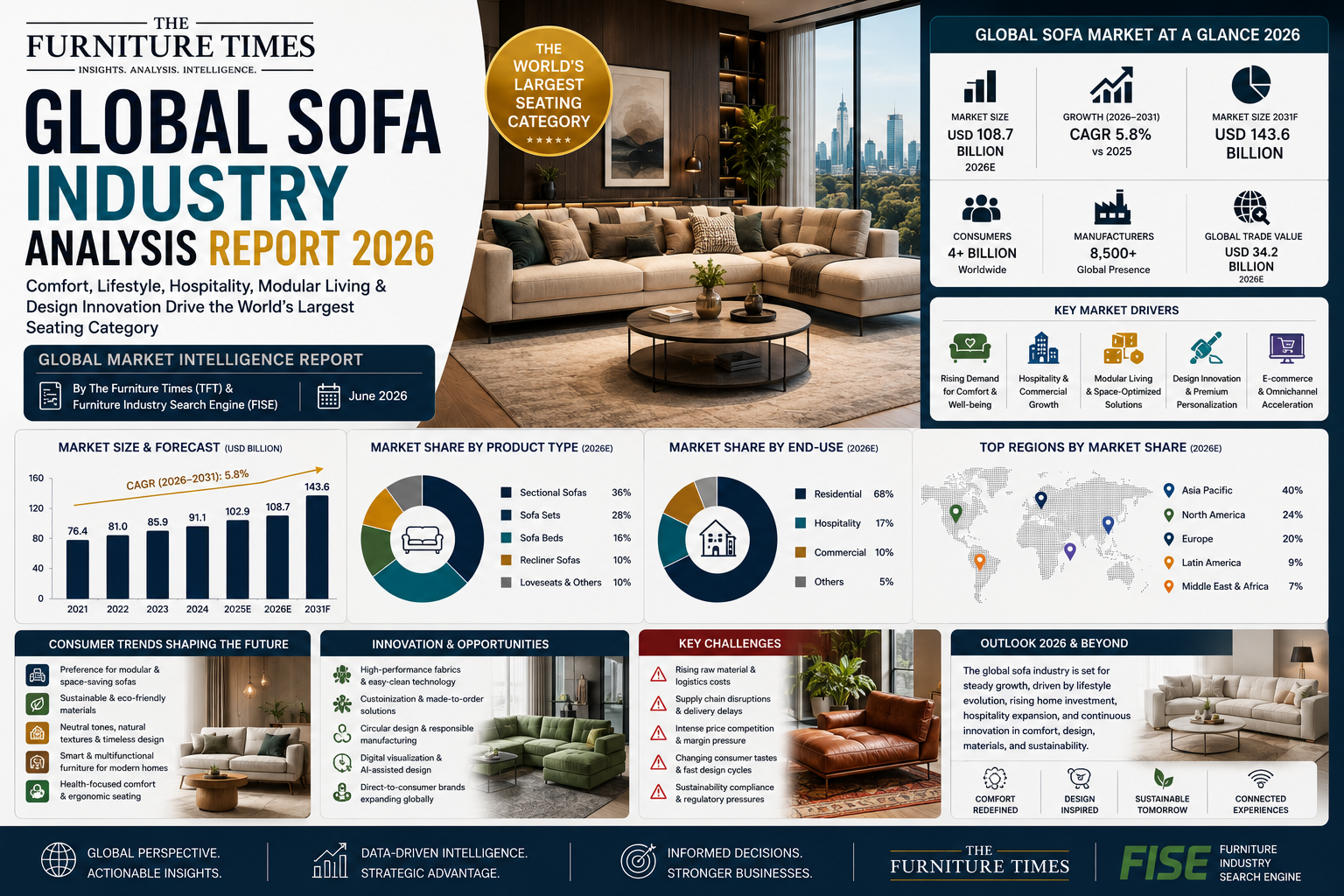
Global Sofa Industry Analysis Report 2026
Comfort, Lifestyle, Hospitality, Modular Living & Design Innovation Drive the World’s Largest Seating Category
Global Market Intelligence Report | By The Furniture Times (TFT) & Furniture Industry Search Engine (FISE) | June 2026
The global sofa industry remains one of the most influential segments within the furniture ecosystem.
A sofa is no longer simply a piece of seating furniture. It has become the centerpiece of modern living rooms, family spaces, hospitality environments, luxury residences, offices, lounges, co-working spaces, serviced apartments, and commercial interiors.
Today, the sofa market sits at the intersection of:
Furniture
Interior Design
Lifestyle
Real Estate
Hospitality
Technology
Sustainability
Consumer Psychology
As homes become multifunctional spaces for living, working, entertaining, and relaxing, the role of the sofa continues to expand.
Industry estimates place the global sofa market at approximately US$34.8 billion in 2026, with forecasts suggesting growth toward US$47.6 billion by 2035.
Executive Summary
Global Sofa Industry Health Check 2026
Consumer Demand: 8.4 / 10
Residential Demand: 8.5 / 10
Hospitality Demand: 8.2 / 10
Innovation & Design: 8.6 / 10
Sustainability Adoption: 7.4 / 10
Digital Retail Transformation: 8.1 / 10
Manufacturing Health: 7.8 / 10
Overall Industry Score: 8.1 / 10
The sofa market remains one of the healthiest and most resilient furniture categories globally.
Why Sofas Dominate the Furniture Industry
Across virtually every country, the sofa remains the single most important furniture purchase after the bed.
Consumers often upgrade sofas before replacing:
Dining furniture
Storage furniture
Accent furniture
Decorative accessories
The reasons are simple:
A sofa directly affects:
Comfort
Family interaction
Entertainment
Social gatherings
Interior appearance
Home value perception
The sofa has become the emotional center of the home.
Global Market Size & Industry Outlook
The broader furniture market continues growing steadily and is projected to surpass US$1 trillion over the next decade depending on methodology and market coverage. Seating remains one of the largest product categories globally.
Several factors are supporting sofa demand:
Urbanization
More people are moving into cities.
Housing Development
New homes create new furniture demand.
Renovation Activity
Consumers continue upgrading interiors.
Hospitality Expansion
Hotels and resorts require seating solutions.
Lifestyle Spending
Consumers increasingly invest in home comfort.
Hybrid Work
Living spaces are expected to serve multiple purposes.
Regional Analysis
Asia-Pacific: The Global Growth Engine
Asia-Pacific remains the largest furniture region globally and continues driving sofa demand.
Major sofa markets include:
China
India
Indonesia
Vietnam
Malaysia
Thailand
Philippines
Japan
South Korea
China
China remains the world’s largest furniture manufacturing ecosystem.
Demand is shifting toward:
Premium sofas
Modular seating
Smart furniture
Contemporary designs
India
India is witnessing rapid growth in:
Urban apartments
Modular furniture
Mid-market sofas
Organized retail
The expanding middle class is creating strong long-term demand.
Southeast Asia
Countries such as Malaysia, Indonesia, Vietnam, and Thailand are benefiting from:
Rising household incomes
Hospitality growth
Condominium development
Interior design awareness
Europe: Design, Sustainability & Premium Living
Europe remains one of the most sophisticated sofa markets globally.
Key markets:
Germany
Italy
France
United Kingdom
Spain
Poland
European consumers increasingly prioritize:
Sustainability
Craftsmanship
Longevity
Design quality
Demand remains strong for:
Contemporary sofas
Scandinavian styles
Modular seating
Sustainable upholstery
European consumers are increasingly willing to pay more for quality and durability.
North America: Comfort Culture Dominates
North America remains one of the largest sofa-consuming regions globally.
Key demand drivers include:
Home renovations
Large living spaces
Lifestyle upgrades
Replacement purchases
Consumers increasingly seek:
Sectional sofas
Deep-seated sofas
Recliners
Performance fabrics
Family-friendly upholstery
Comfort remains the dominant buying factor.
Middle East: Luxury & Hospitality
The Middle East continues growing as a premium furniture market.
Major demand centers include:
UAE
Saudi Arabia
Qatar
Kuwait
Bahrain
Growth is being supported by:
Luxury real estate
Hospitality projects
Tourism development
Villa construction
Consumers often favor:
Large seating configurations
Premium leather
Luxury fabrics
Customized designs
Africa: Emerging Opportunity
Africa remains one of the most underdeveloped but promising sofa markets.
Key markets include:
South Africa
Nigeria
Kenya
Ghana
Egypt
Morocco
Demand is supported by:
Housing development
Urbanization
Growing middle-class populations
Hospitality expansion
Affordability remains important, but demand continues growing steadily.
Oceania: Quality Over Quantity
Australia and New Zealand continue supporting premium sofa demand.
Consumers increasingly prioritize:
Durability
Sustainability
Modular flexibility
Outdoor compatibility
Renovation activity remains a major driver.
Materials Shaping the Industry
The choice of materials increasingly influences purchasing decisions.
Fabric Sofas
Remain the largest segment globally.
Popular options:
Polyester
Linen blends
Performance fabrics
Chenille
Bouclé
Advantages:
Comfortable
Affordable
Wide color selection
Leather Sofas
Continue dominating premium segments.
Popular categories:
Genuine leather
Top-grain leather
Full-grain leather
Advantages:
Durability
Luxury appearance
Longevity
Brown leather sofas are experiencing renewed popularity globally.
Velvet Sofas
Growing in luxury and boutique hospitality sectors.
Advantages:
Rich texture
Premium appearance
High-end positioning
Sustainable Materials
Increasingly important globally.
Examples include:
Recycled fabrics
Organic textiles
Sustainable wood frames
Eco-certified foam systems
Most Popular Sofa Styles in 2026
Consumer preferences continue evolving.
Modular Sofas
The strongest global trend.
Benefits:
Flexible layouts
Apartment-friendly
Adaptable configurations
Designers consistently identify modular sofas as one of the dominant trends for 2026.
Sectional Sofas
Especially popular in North America and larger homes.
Advantages:
Family seating
Entertainment spaces
Social interaction
Curved Sofas
Experiencing strong global growth.
Consumers increasingly prefer softer, organic shapes that create more inviting environments.
Minimalist Sofas
Popular in:
Europe
Japan
Urban apartments
Characteristics:
Clean lines
Slim profiles
Neutral colors
Luxury Statement Sofas
Growing in hospitality and luxury residential projects.
Features:
Premium upholstery
Sculptural forms
Custom finishes
Color Trends
Global demand is shifting toward:
Warm Neutrals
Sand
Beige
Camel
Taupe
Earth Tones
Olive
Clay
Terracotta
Rich Browns
Leather and fabric brown tones are making a strong comeback.
Soft Greens
Inspired by nature and wellness trends.
Hospitality Sector Impact
Hotels continue representing one of the largest growth opportunities.
Demand categories include:
Lobby sofas
Lounge seating
Guest room seating
Resort furniture
Executive lounges
Major hospitality growth regions:
UAE
Saudi Arabia
Malaysia
Thailand
Indonesia
Vietnam
Every new hotel project creates significant seating demand.
Manufacturing Trends
Global manufacturers are investing in:
Automation
Increasing productivity.
CNC Technology
Improving precision.
Digital Product Development
Accelerating customization.
Sustainable Production
Meeting environmental standards.
Faster Lead Times
Responding to consumer expectations.
The Rise of Digital Sofa Shopping
Consumers increasingly begin their purchasing journey online.
They now expect:
3D visualization
Room planners
AI recommendations
Virtual showrooms
Customer reviews
Digital discovery increasingly determines which brands consumers consider first.
Major Industry Challenges
Despite strong demand, challenges remain.
Rising Raw Material Costs
Foam, timber, and fabrics remain volatile.
Labor Shortages
Skilled upholstery labor remains difficult to replace.
Freight Costs
Global logistics continue affecting margins.
Consumer Price Sensitivity
Competition remains intense.
Product Returns
Online furniture returns remain expensive.
Manufacturers must balance affordability, quality, and profitability.
TFT & FISE Analysis
The global sofa industry is entering a new era.
Historically, sofa success depended on:
Manufacturing
Distribution
Showroom presence
Today, success increasingly depends on:
Design
Sustainability
Customization
Digital visibility
Consumer trust
The strongest brands are no longer simply selling sofas.
They are selling:
Comfort
Lifestyle
Identity
Experience
Emotional connection
The sofa is becoming a lifestyle product rather than merely a seating product.
Final Verdict
The global sofa industry remains one of the strongest sectors within the furniture economy.
Demand is growing.
Hospitality projects are expanding.
Consumers are investing more in comfort.
Modular designs are reshaping the category.
Sustainability is becoming increasingly important.
The future winners will combine:
Design + Comfort + Quality + Sustainability + Customization + Visibility
Because in modern homes, the sofa is no longer just furniture.
It is the center of how people live, relax, connect, work, and experience their spaces.
By The Furniture Times (TFT) & Furniture Industry Search Engine (FISE)
Global Market Intelligence Desk | June 2026
“TFT tells their story. FISE helps the world find them.”
