IKEA’s France Expansion Signals a Major Shift in the Future of Furniture Retail
Why Smaller Stores, Faster Access, Omnichannel Retail & Customer Convenience Are Reshaping the Furniture Industry
Global Retail Intelligence Report | By The Furniture Times | June 2026
The global furniture retail industry is undergoing one of its most significant transformations in decades.
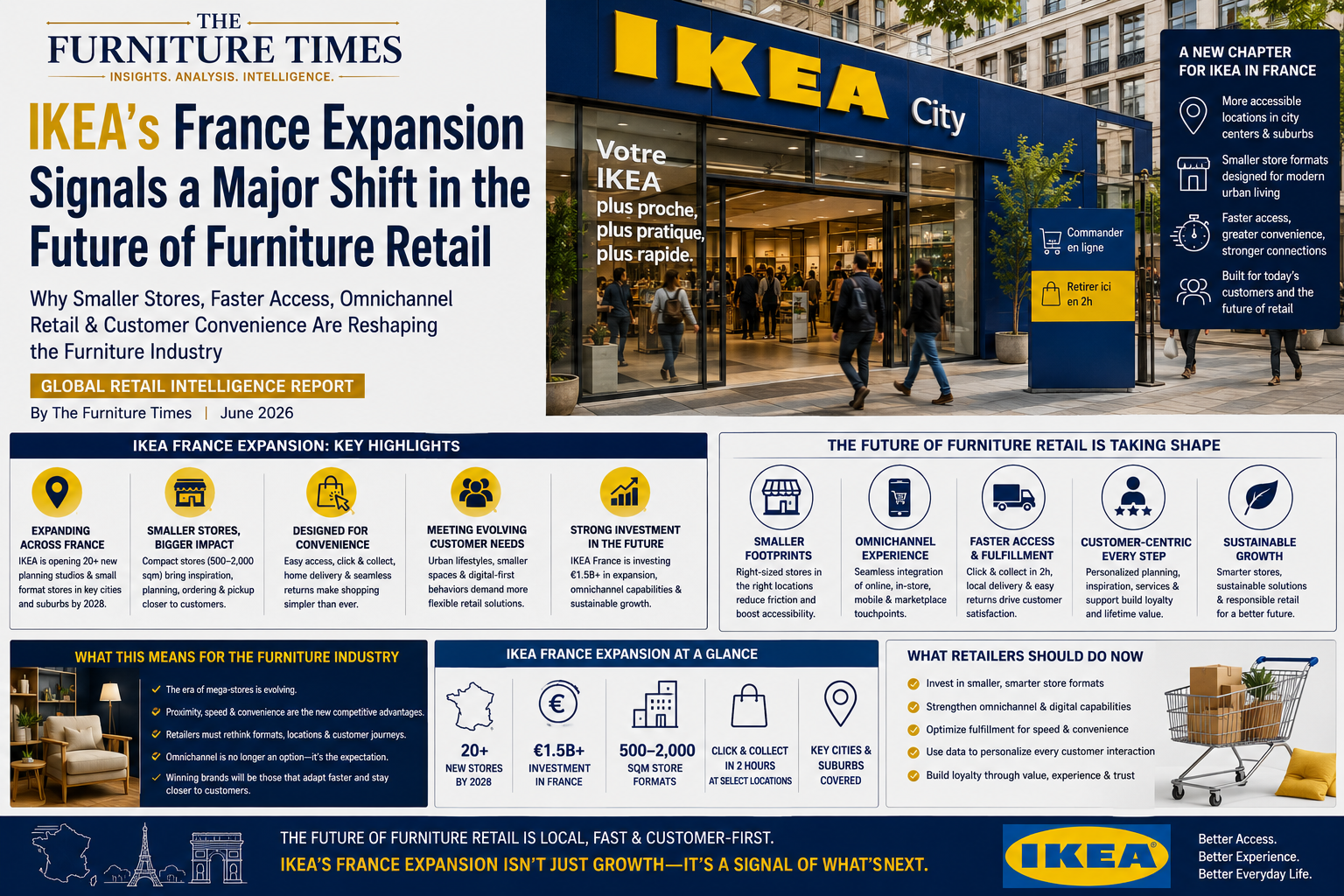
In a move that is attracting attention across the furniture ecosystem, IKEA has announced plans to significantly expand its compact-store strategy in France, aiming to bring the brand closer to customers through smaller-format locations integrated into everyday shopping destinations. The initiative includes new investments and a broader omnichannel strategy designed to improve accessibility and convenience.
For the global furniture industry, this is much more than a store expansion story.
It is a signal that the future of furniture retail is changing.
The Traditional Furniture Store Model Is Evolving
For decades, furniture retail was built around:
- massive showrooms
- destination shopping
- large warehouse formats
- suburban retail parks
Customers would often travel long distances, spend hours browsing products, and make occasional large purchases.
That model is no longer the only path to growth.
Consumer expectations have changed.
Modern consumers increasingly want:
Convenience
Speed
Accessibility
Omnichannel Experiences
Local Availability
Flexible Shopping Options
IKEA’s compact-store strategy directly responds to these changing behaviors. The new stores are designed to be much smaller than traditional IKEA locations while still offering a significant portion of the assortment and immediate product pickup.
Why France Matters
France remains one of IKEA’s most important markets globally.
The retailer is continuing investments in France while adding new funding for expansion through 2030. New compact stores are intended to reach communities that may not justify a traditional large-format IKEA store.
For furniture retailers worldwide, France becomes a testing ground for the next generation of retail formats.
The key lesson is simple:
Retail Must Move Closer To Customers
Instead of forcing customers to travel to furniture stores, furniture stores are moving closer to customers.
Compact Stores Represent a Bigger Industry Trend
The significance of compact stores extends far beyond IKEA.
Across global retail, companies are increasingly investing in:
- neighborhood stores
- city-center locations
- smaller footprints
- click-and-collect formats
- showroom concepts
- experience centers
Furniture retail is following the same direction.
Large flagship stores remain important, but smaller locations increasingly serve as:
- discovery centers
- collection points
- consultation hubs
- brand touchpoints
The future retail ecosystem may combine both large and small formats.
Omnichannel Is Becoming the New Standard
Perhaps the most important message behind IKEA’s strategy is the continued rise of omnichannel retail.
Customers no longer separate:
- online shopping
- mobile browsing
- showroom visits
- home delivery
- product pickup
They expect all channels to work together seamlessly.
IKEA’s expansion is part of a broader investment cycle focused on improving physical locations while strengthening digital capabilities.
The future furniture retailer must operate across:
Website
Mobile
Search
Social Media
Physical Stores
AI Discovery Platforms
What This Means for Furniture Retailers
Furniture retailers around the world should pay close attention.
The future customer increasingly values:
Accessibility
Customers want furniture closer to home.
Convenience
Faster purchasing and collection options matter.
Speed
Waiting weeks for simple purchases is becoming less acceptable.
Local Presence
Smaller locations can strengthen customer relationships.
Digital Integration
Physical stores must connect with online experiences.
The Impact on Furniture Manufacturers
The implications are equally important for manufacturers.
As retailers adopt more compact formats, suppliers may need to adapt by providing:
- faster replenishment
- modular product lines
- optimized packaging
- better inventory visibility
- localized fulfillment
The supply chain itself becomes part of the customer experience.
The Rise of the Visibility Economy
At The Furniture Times, we believe this development supports a broader industry shift:
The Visibility Economy
In the past:
Location = Advantage
Today:
Visibility = Advantage
Tomorrow:
Discoverability = Advantage
Customers increasingly discover brands before they visit stores.
The businesses that become:
- searchable
- discoverable
- trusted
- digitally visible
will often win before a customer even enters a showroom.
Could Smaller Stores Become the Future?
Many industry experts believe the future furniture ecosystem will combine:
Large Experience Centers
For inspiration, room settings, and product exploration.
Compact Local Stores
For convenience, collection, and accessibility.
Digital Commerce
For research, comparison, and purchasing.
AI Discovery
For answering customer questions before they even start shopping.
This hybrid model may become the dominant furniture retail format over the next decade.
What It Means for the Global Furniture Industry
IKEA’s strategy is not just about France.
It reflects a larger transformation occurring across global furniture retail.
Consumers increasingly want:
- convenience
- flexibility
- local access
- digital integration
- faster service
Furniture businesses that continue relying solely on traditional models may face increasing pressure.
Those that embrace:
Omnichannel Retail
Digital Visibility
Customer Convenience
Flexible Formats
may be better positioned for long-term growth.
The Furniture Times Industry Insight
The most important lesson from IKEA’s France expansion is not the number of stores.
It is the direction of travel.
The furniture industry is moving from:
Large Stores → Flexible Networks
Destination Shopping → Everyday Accessibility
Retail Presence → Omnichannel Presence
Physical Reach → Digital Discoverability
Final Thought
IKEA’s expansion of compact stores in France may be remembered as part of a much larger industry transformation.
The future furniture retailer may no longer be defined by:
- showroom size
- warehouse scale
- physical footprint
Instead, success may increasingly depend on:
Accessibility
Convenience
Discoverability
Omnichannel Capability
Customer Experience
The companies that understand these changes early will be better positioned to thrive in the next era of furniture retail.
Because the future of furniture retail is no longer simply about where stores are located.
It is about how easily customers can find, reach, and engage with a brand—both online and offline.
More information:
Ingka (IKEA)
www.ingka.com
Publication date: Tue 2 Jun 2026