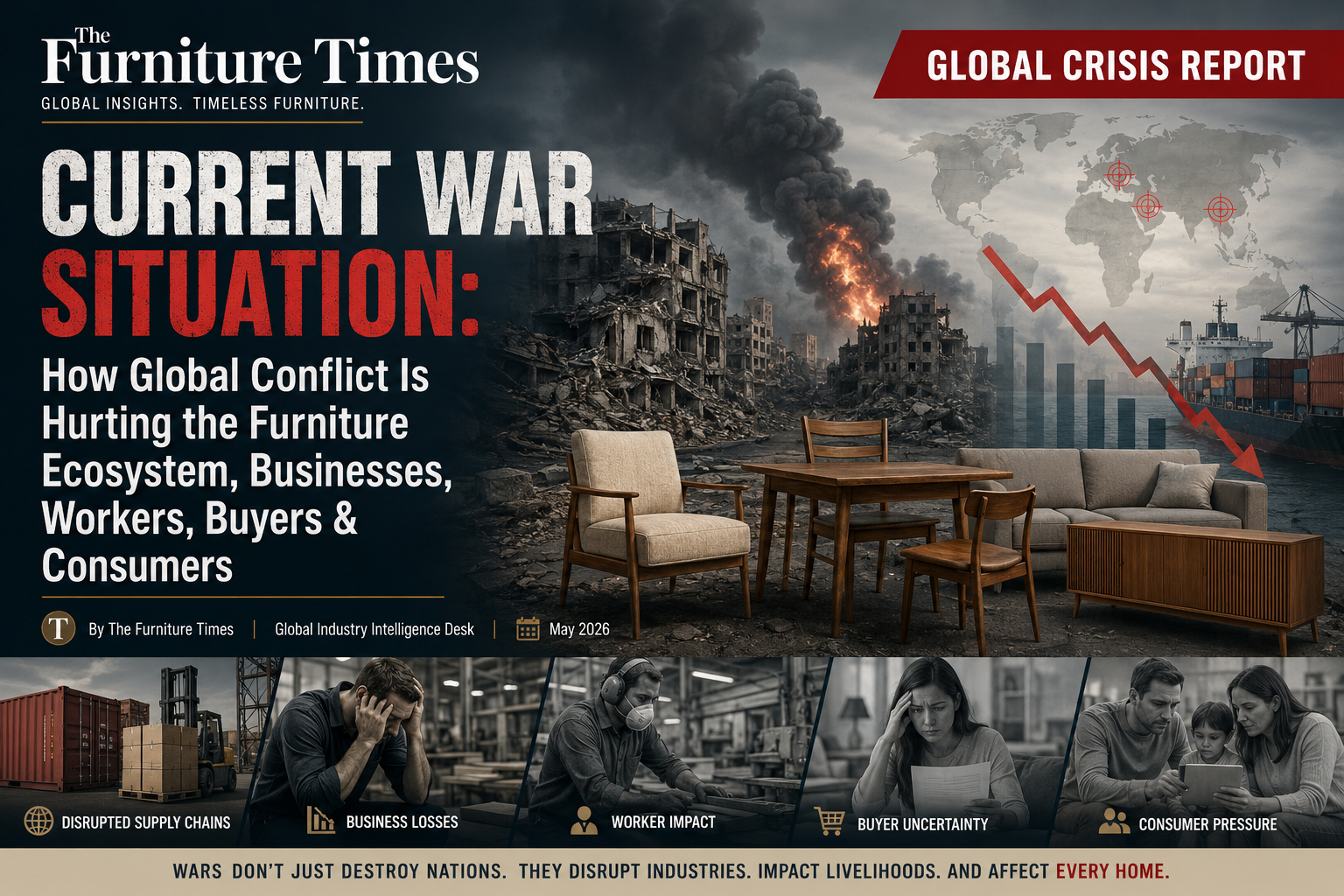
Current War Situation: How Global Conflict Is Hurting the Furniture Ecosystem, Businesses, Workers, Buyers & Consumers
Global Crisis Report | The Furniture Times
By The Furniture Times | Global Industry Intelligence Desk | May 2026
Introduction: War Is No Longer Far from the Furniture Industry
The world is facing a new era of conflict-driven uncertainty. From the Middle East and Red Sea shipping routes to Ukraine, Sudan, and wider geopolitical tension, the impact is no longer limited to governments and military strategy.
It is reaching factories, showrooms, ports, warehouses, workers’ homes, and consumers’ wallets.
The furniture industry is suffering not because demand has disappeared, but because the systems behind demand are under pressure.
The Big Picture: Conflict Is Disrupting the Entire Value Chain
The furniture ecosystem depends on global movement:
wood, metal, foam, fabrics, chemicals, leather, glass, hardware
factories, ports, containers, fuel, trucking, warehousing
buyers, sellers, retailers, installers, designers, and workers
When conflict disrupts energy, shipping, currency, imports, or trade routes, furniture businesses feel it immediately.
Maersk has warned that the Middle East conflict is disrupting major land, sea, and air corridors, with effects extending far beyond the region.
1. Shipping Disruption: The Cost of Moving Furniture Is Rising
Furniture is bulky. A sofa, dining set, wardrobe, or hotel furniture package requires space, handling, and reliable shipping.
When shipping routes become unsafe or delayed, furniture companies face:
longer delivery times
higher freight costs
delayed project handovers
more expensive inventory
customer dissatisfaction
The Red Sea crisis already showed how vulnerable furniture retail can be: UK retailer DFS blamed Red Sea disruption for delivery delays, higher shipping costs, and a profit warning in 2024.
2. Energy Volatility: Every Factory Feels the Fuel Shock
Conflict in oil-sensitive regions affects the price of fuel, logistics, electricity, and raw materials.
The Financial Times reported that oil-price volatility linked to Middle East conflict could weaken global trade growth, with Global Trade Alert estimating a potential drag on merchandise trade if volatility persists.
For furniture manufacturers, this means:
higher machine operating costs
higher foam and chemical input costs
higher trucking and container costs
higher finishing and coating costs
higher final product prices
When fuel becomes unstable, furniture becomes more expensive before it even reaches the showroom.
3. Timber & Wood Supply Pressure
Wood is one of the most important materials in furniture. Conflict, sanctions, export restrictions, and compliance rules are creating pressure across the timber supply chain.
Ukraine has extended restrictions on exports of unprocessed timber and fuelwood through 2026, reinforcing domestic processing and energy-security priorities.
At the same time, reports have highlighted continued concern around sanctioned Russian timber reaching European markets through rerouting and rebranding, showing how conflict creates both supply gaps and trust issues in timber sourcing.
For the furniture industry, this creates:
material uncertainty
compliance risk
higher sourcing costs
pressure on certified wood supply
more paperwork for exporters
4. Workers Are Suffering: The Human Side of the Crisis
Behind every piece of furniture is a worker:
carpenter
upholsterer
machine operator
polisher
packer
driver
installer
salesperson
When businesses face rising costs and falling margins, workers are often the first to suffer.
They may face:
reduced shifts
delayed wages
job insecurity
factory slowdowns
migration pressure
rising cost of living
Sudan shows how conflict can damage livelihoods broadly: Reuters reported that Sudan’s economy has been severely affected by years of internal conflict, with industrial shutdowns, agricultural collapse, displacement, and import restrictions adding more pressure.
5. SMEs and Artisans Are Hit Hardest
Large companies may survive disruption through reserves, contracts, and diversified supply chains.
Small furniture businesses often cannot.
They face:
no buffer for rising material prices
no backup suppliers
no strong export network
limited access to finance
weak digital visibility
For artisans and micro-skilled workers, one delayed order can affect household income.
War does not only disrupt global trade. It disrupts family survival inside the industry.
6. Buyers Are Delaying Decisions
Furniture buyers are becoming cautious.
Retailers, hotel developers, project contractors, and homeowners are asking:
Will prices rise again?
Will delivery be delayed?
Can this supplier still deliver?
Should we wait?
Should we reduce the order?
This creates a dangerous cycle.
Demand does not disappear, but confidence weakens. Orders slow down. Projects delay. Factories reduce production. Workers suffer.
7. Consumers Pay the Final Price
Consumers feel the impact through:
higher furniture prices
longer delivery times
fewer product choices
lower discounts
delayed home upgrades
When freight, fuel, timber, metal, foam, and currency costs rise, the final price eventually reaches the buyer.
The consumer may not see the war, but they see the price tag.
8. Africa & Vulnerable Markets Face Deeper Pressure
Conflict-driven supply disruption hits weaker economies harder.
AP reported that Sudan’s farmers are facing sharp rises in fuel and fertilizer costs linked to wider regional disruption, worsening already fragile conditions.
Reuters also reported that widening Middle East conflict has disrupted global markets, supply chains, aid routes, and energy costs, with Sub-Saharan Africa especially affected by freight and access constraints.
For furniture ecosystems in emerging markets, this means:
higher import costs
weaker currencies
expensive materials
reduced consumer spending
more difficult business survival
9. The Furniture Industry’s Hidden Weakness: No Resilience System
The deeper issue is not only war.
The deeper issue is that the furniture industry is still too fragmented.
Many companies still depend on:
one supplier
one country
one shipping route
one communication tool
one buyer group
one trade fair cycle
That is dangerous in a conflict-driven world.
TFT Deep Analysis: The Industry Is Entering the Resilience Economy
The furniture industry is moving through three phases:
Phase 1: Globalization
Source anywhere, ship anywhere.
Phase 2: Disruption
War, tariffs, energy shocks, shipping delays.
Phase 3: Resilience Economy
Diversified suppliers, regional hubs, digital discovery, verified networks, faster communication.
The winners will be companies that can adapt fast.
Strategic Recommendations
For Manufacturers
Diversify suppliers, reduce dependence on one export market, build stronger digital visibility, and prepare alternative sourcing plans.
For Retailers
Create backup supplier networks, review shipping risk, communicate clearly with customers, and avoid overdependence on single-region imports.
For Buyers
Source from multiple countries, check supplier reliability, use verified platforms, and prioritize suppliers with strong communication and delivery transparency.
For Workers & SMEs
The industry must support training, digital inclusion, and visibility for small workshops and artisans so they can access broader opportunities during crisis periods.
For TFT & FISE
This is where the ecosystem must evolve.
TFT brings intelligence, crisis reporting, and market awareness.
FISE helps buyers find alternative suppliers.
FISE Connect helps communication continue inside a structured system.
FISE.live can help suppliers build trust through live product showcases and factory visibility.
Final Thought
The current war situation is not only a geopolitical crisis.
It is a business crisis.
A supply-chain crisis.
A worker crisis.
A consumer crisis.
A visibility crisis.
The furniture industry cannot stop global conflict.
But it can build stronger systems to survive it.
The future belongs to furniture businesses that are:
visible
diversified
digitally connected
fast-moving
resilient

Related Posts
Global Furniture Industry Shows Signs of Strategic Transformation Amid Economic Uncertainty
Why Core Values Will Become the New Competitive Advantage in the Furniture Industry