
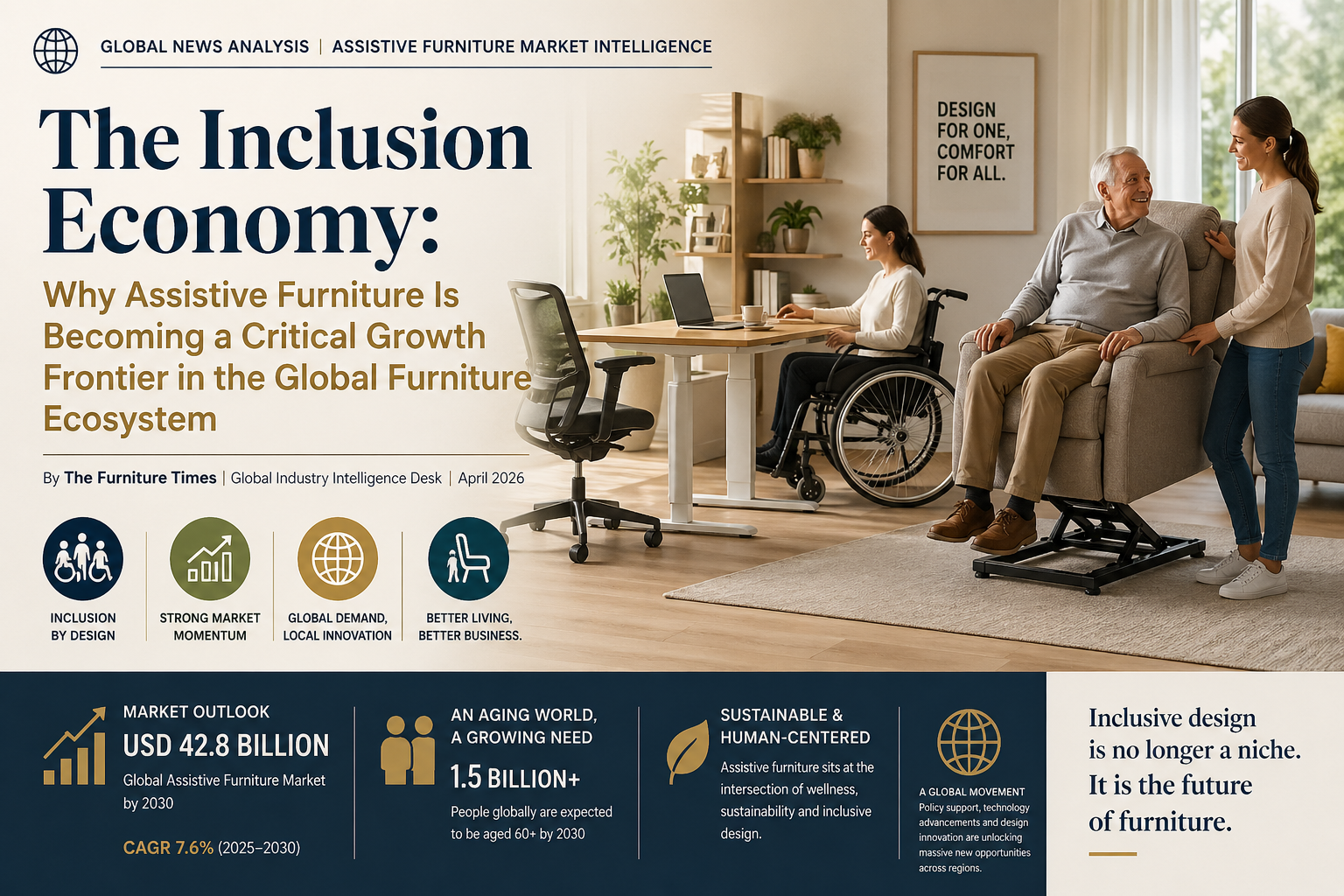
The Inclusion Economy: Why Assistive Furniture Is Becoming a Critical Growth Frontier in the Global Furniture Ecosystem
Global News Analysis | Assistive Furniture Market Intelligence
By The Furniture Times | Global Industry Intelligence Desk | April 2026
Introduction: Furniture That Enables Life
A powerful transformation is reshaping the global furniture industry:
Furniture is no longer just about comfort—it is about capability, independence, and inclusion.
The assistive furniture market—designed to support people with disabilities, aging populations, and individuals with mobility or health challenges—is emerging as one of the most socially impactful and economically significant segments in the global ecosystem.
The Big Picture: Why Assistive Furniture Is Rising
Assistive furniture sits at the intersection of:
- Healthcare
- Aging populations
- Accessibility
- Smart living
- Inclusive design
Globally, more than 2.5 billion people need at least one assistive product, and this number is expected to reach 3.5 billion by 2050 due to aging and chronic conditions
This is not a niche market.
This is a global necessity market.
What Is Assistive Furniture?
Assistive furniture is part of the broader field of assistive technology—products designed to help people perform daily activities, improve mobility, and maintain independence
Examples include:
- Adjustable beds
- Lift chairs
- Ergonomic seating
- Height-adjustable desks
- Accessible kitchen units
- Bathroom support furniture
- Mobility-support furniture
- Smart home-integrated furniture
These solutions are designed not only for people with disabilities but also for:
- Elderly individuals
- Patients recovering from injuries
- People with chronic conditions
- Inclusive public spaces
The Core Drivers of Growth
1. Aging Global Population
The world is aging rapidly.
- Longer life expectancy
- Rising elderly population
- Increased need for independent living
This creates massive demand for:
- Mobility-support furniture
- Safety-enhancing designs
- Home-care furniture solutions
2. Rise of Home Healthcare
Healthcare is shifting from hospitals to homes.
Patients now prefer:
- Recovery at home
- Assisted living environments
- Remote care setups
This is driving demand for:
- Medical-grade furniture
- Adjustable and ergonomic solutions
- Smart assistive systems
3. Disability Inclusion & Accessibility Laws
Governments and institutions are increasingly enforcing:
- Accessibility standards
- Inclusive infrastructure
- Disability-friendly environments
This impacts:
- Public buildings
- Offices
- Schools
- Hospitality spaces
4. Smart & Adaptive Technology Integration
Assistive furniture is becoming smarter:
- Motorized adjustments
- Sensor-based systems
- Voice-controlled furniture
- AI-assisted mobility
This is transforming furniture into functional technology platforms.
5. Universal Design Movement
Modern design is shifting toward:
Design for everyone—not just specific users
Features like:
- Adjustable heights
- Easy-grip materials
- Stable structures
benefit all users—not just those with disabilities.
Market Structure: A Multi-Sector Opportunity
Assistive furniture is not limited to healthcare.
It spans across:
Residential
- Elderly care
- Home rehabilitation
- Smart living environments
Healthcare
- Hospitals
- Clinics
- Rehabilitation centers
Commercial & Public Spaces
- Offices
- Airports
- Hotels
- Educational institutions
The Hidden Challenges
Despite strong demand, the assistive furniture market faces structural barriers:
1. High Cost of Specialized Products
Assistive furniture often requires:
- Engineering precision
- Advanced materials
- Customization
This increases cost and limits accessibility in some markets.
2. Limited Awareness
Many people who need assistive furniture:
- Do not know what is available
- Do not know where to find it
3. Fragmented Supplier Ecosystem
There is no unified global system to identify:
- Assistive furniture manufacturers
- Healthcare furniture suppliers
- Accessibility-focused design companies
4. Lack of Standardized Discovery
Buyers struggle to:
- Compare products
- Verify quality
- Understand features
The Real Problem: The Accessibility Search Gap
Here is the deeper issue:
The need for assistive furniture is massive—but discovery is weak.
- Families cannot easily find solutions
- Hospitals cannot compare suppliers efficiently
- Designers lack structured databases
- Suppliers struggle to reach global markets
This creates a gap between:
Need → Awareness → Access
TFT Deep Analysis: The Industry Is Entering the Inclusion Economy
Assistive furniture is evolving across three stages:
Stage 1: Medical Necessity
Basic support products for healthcare
Stage 2: Functional Design
Improved usability and comfort
Stage 3: Inclusion & Intelligence (Next Phase)
Driven by:
- Smart furniture
- AI integration
- Universal design
- Data-driven solutions
Strategic Solutions: What the Industry Must Do
1. Move from “Medical Product” to “Lifestyle Solution”
Assistive furniture should not feel clinical.
It should be:
- Aesthetic
- Comfortable
- Integrated into daily living
2. Build Category-Based Visibility
Suppliers must clearly define:
- Assistive furniture manufacturers
- Elderly care furniture providers
- Rehabilitation furniture specialists
- Accessible home furniture suppliers
3. Integrate Smart Technology
Future-ready products must include:
- Automated adjustments
- Sensor-based monitoring
- Smart home connectivity
4. Improve Affordability & Scalability
Manufacturers should explore:
- Modular designs
- Mass production
- Cost-efficient materials
5. Strengthen Global Discovery Infrastructure
This is the biggest gap.
The industry needs:
- Structured supplier databases
- Verified product listings
- Category-based search systems
- Accessibility-focused filters
Role of FISE: The Missing Infrastructure
The assistive furniture market highlights a critical gap:
There is no global search system connecting accessibility solutions with furniture discovery.
Furniture Industry Search Engine (FISE) can enable:
- Global assistive furniture listings
- Category-based discovery (healthcare, elderly, rehabilitation)
- Verified supplier profiles
- Certification and compliance filters
- AI-powered solution matching
Example Use Case
A hospital searching for:
“Assistive beds and patient mobility furniture suppliers in Southeast Asia”
Today:
- Complex sourcing
- Limited comparison
With FISE:
- Structured discovery
- Verified suppliers
- Faster procurement
Key Takeaways (April 2026)
1. Assistive Furniture Is a High-Impact Growth Segment
Driven by aging populations and healthcare shifts
2. Demand Is Massive and Growing
Billions of people need assistive solutions globally
3. Smart Technology Is Transforming the Market
Furniture is becoming adaptive and intelligent
4. Accessibility Is Becoming Mandatory
Driven by policy and social awareness
5. Discovery Is Still Weak
Search and supplier visibility remain fragmented
Conclusion: Furniture That Changes Lives
Assistive furniture is not just another category.
It is one of the most important segments shaping the future of the furniture industry.
It connects:
- Health
- Technology
- Inclusion
- Design
- Human dignity
Final Thought
The future of furniture is not just about comfort.
It is about enabling people to live better, longer, and more independently.
And the next phase will be defined by:
Search + Trust + Inclusion + Intelligence
